Sthitaprajña: Stability Beyond Fear and Desire
The Vedic Vision of One Established in Wisdom
The Bhagavad Gītā presents the sthitaprajña, one of stable wisdom, as the culmination of psychological development. This is not someone who feels nothing, but someone whose sense of self rests on ground that fear and desire cannot shake. This lesson explores what stable wisdom looks like and how it develops.
In the second chapter of the Bhagavad Gītā, Arjuna asks Krishna one of the most practical questions in spiritual literature: 'What are the characteristics of the sthitaprajña, one whose wisdom is stable? How does such a person speak? How do they sit? How do they walk?'
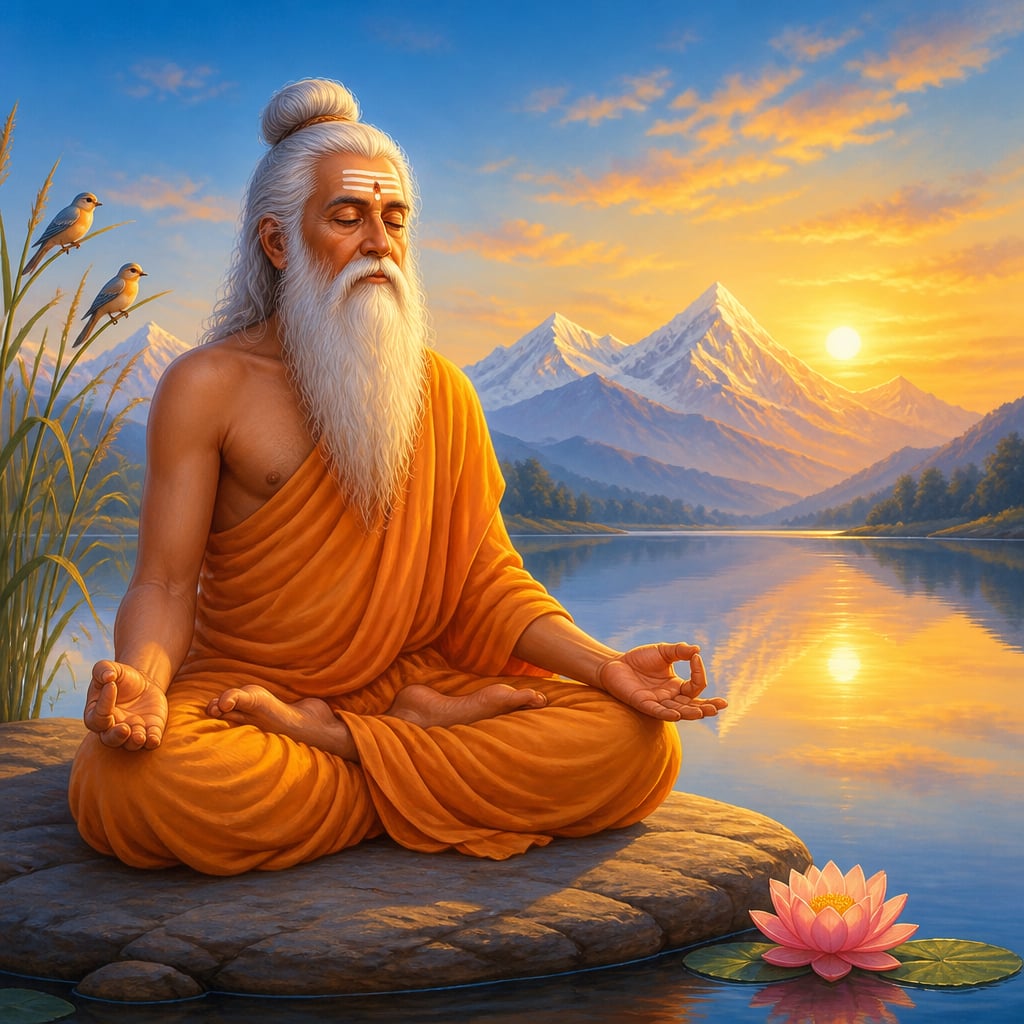
Arjuna is not asking for abstract philosophy. He is asking: What does it look like? If I encountered such a person, how would I recognize them? And implicitly: How would I become such a person?
Krishna's response describes a state that represents the culmination of everything we have explored in this chapter, not the elimination of fear and desire but their integration into something larger. The sthitaprajña still lives in a world of threats and attractions. They still have a nervous system that responds, a mind that perceives danger and opportunity. But something fundamental has shifted: their sense of who they are no longer depends on these movements.
The key term is 'prajña', wisdom or profound understanding. Not information, not even knowledge, but wisdom, the kind of understanding that changes the one who understands. 'Sthita' means established, stable, firmly placed. The sthitaprajña is not someone seeking wisdom but someone established in it. The seeking is complete; what remains is living from that completion.
The sthitaprajña represents Indian psychology's highest vision of human possibility, not superhuman capacity but fully realized human nature. It influenced all subsequent Indian thought about emotional regulation, leadership, and spiritual development. The concept offers an alternative to Western notions of mental health as mere absence of disorder, presenting instead a positive vision of what psychological flourishing can look like.
What makes their wisdom stable? The texts suggest that ordinary understanding is unstable because it depends on conditions. We feel wise when things go well, foolish when they don't. We feel secure when external circumstances support us, anxious when they threaten. Our sense of self rises and falls with fortune's waves. This is not stability but reactivity wearing wisdom's mask.
The sthitaprajña has discovered something that doesn't depend on conditions, what the tradition calls the ātman or true Self. This is not the ego-self that fear protects and desire aggrandizes. It is something prior to both, untouched by either. Finding this ground, the sthitaprajña is like a mountain: clouds come and go, storms rage and pass, but the mountain remains. Fear and desire are the weather; the Self is the mountain.
Krishna describes specific characteristics. When desires arise, the sthitaprajña 'does not become agitated.' Note the precision: it doesn't say desires don't arise; it says agitation doesn't follow. The physiological response to attraction may still occur, this is human biology, but the psychological sequel of craving, grasping, and suffering does not automatically engage. There is desire without desperation.
Similarly with fear: when danger appears, the sthitaprajña responds appropriately without being destabilized. They may act to avoid harm, wisdom is not stupidity, but they don't lose themselves in the action. The response is functional rather than frantic. There is caution without collapse.

The Gītā uses a beautiful image: 'As waters enter the ocean, which is full and ever stable, so all desires enter the one of stable mind, and that person attains peace, not one who craves for objects.' The ocean receives rivers constantly yet remains the ocean. Its fundamental nature is not changed by what flows in. The sthitaprajña receives experiences, including fear and desire, without being transformed by them. They remain who they are.
This stability is not rigidity. The ocean is not frozen; it is full and flowing. The sthitaprajña is not emotionally dead but emotionally spacious. There is room for everything without anything taking over. Joy arises and is welcomed; sorrow arises and is held. Fear signals caution; desire signals interest. All information is received; none becomes dictatorship.
How does one develop this stability? The tradition suggests it grows through the practices we have explored: awareness of what arises (the first step of saṃyama), acceptance without resistance (the second step), and direction toward wisdom rather than reaction (the third step). Over time, consistent practice establishes new patterns. What was once effort becomes nature. What was once difficult becomes spontaneous.
The texts also emphasize viveka, discrimination. The sthitaprajña has clearly seen the difference between the changing and the unchanging, between what can be taken away and what cannot. Having made this discrimination, they rest in what endures. Fear loses its power when we recognize that what we fundamentally are cannot be harmed. Desire loses its compulsion when we recognize that what we fundamentally are is already complete.

This is not a state reserved for renunciates in caves. The tradition offers the figure of King Janaka, a ruler with full worldly responsibilities who maintained perfect equanimity while engaging politics, economics, and family life. He is called 'videha', one who lives as if without body, not because he ignored physical reality but because he didn't identify himself with physical conditions. He ruled effectively precisely because his decisions were not distorted by personal fear and desire.
The sthitaprajña state might also be described as 'witness consciousness', the capacity to observe experience without being absorbed by it. When fear arises, there is the fear and there is the witnessing of the fear. When desire arises, there is the desire and there is the witnessing of the desire. The witness remains stable while the witnessed flows by. Over time, identification shifts from content to witness, from weather to sky.
Practically, this manifests in several ways. The sthitaprajña responds rather than reacts. There is a gap between stimulus and response in which choice operates. They speak appropriately to situations rather than from personal defensive or acquisitive agendas. Their relationships are freed from the distortions of needing others to fulfill lacks or protect vulnerabilities.
Importantly, the sthitaprajña is not indifferent. The Gītā explicitly rejects cold detachment. Krishna calls Arjuna to action, not to withdrawal. The difference is that action flows from wisdom rather than compulsion. The sthitaprajña may feel deeply, compassion, joy, love, even appropriate anger, but these feelings do not destabilize their fundamental equilibrium. They feel and act freely because they are not enslaved.
Is this state achievable? The tradition says yes, it is our natural state, obscured by identification with what changes. We are already the mountain; we have hypnotized ourselves into believing we are the clouds. The practice is not becoming what we are not but recognizing what we are. Fear and desire are not obstacles on this path but teachers pointing us toward the ground that neither can shake.
Case studies
MS Dhoni: 'Captain Cool' and the Psychology of Equanimity
Mahendra Singh Dhoni, perhaps India's most successful cricket captain, became legendary not just for his achievements but for his composure. In situations where millions watched and national pride hung in the balance, his heart rate reportedly barely changed. During the 2011 World Cup final, with India chasing victory in Mumbai, billions watching, and the match swinging both ways, teammates describe Dhoni as perfectly calm, making decisions with the same clarity he'd show in a practice match. When asked about his equanimity, Dhoni often responded with characteristic simplicity: 'I focus on what I can control. The result is not in my hands; my effort is.' This is practical sthitaprajña, not indifference to outcome but non-identification with it. His famous helicopter shot to win that final was not an anxious gamble but a calculated expression of skill, made possible precisely because fear wasn't distorting his judgment. Team members recall that his presence alone created calm in the dressing room. 'When Dhoni was at the crease,' said Yuvraj Singh, 'we knew we could win from any position. Not because he was superhuman, but because he didn't panic.' His equanimity was contagious, a quality the Gītā attributes to sthitaprajñas, who stabilize those around them.
Dhoni embodies the Gītā's teaching that stable wisdom performs better, not worse. His non-attachment to outcome freed his skills to function optimally. He demonstrates that sthitaprajña is not withdrawal from life but fuller engagement, action from clarity rather than from anxiety.
Dhoni's composure enabled India to win the 2011 World Cup final with his iconic six, and his calm leadership created a team environment where players performed above their individual capabilities under extreme pressure.
Composure is trainable and contagious. Dhoni's calm wasn't magic; it came from consistent practice of focusing on process over outcome, on controllables over uncontrollables. Any leader can develop similar stability through the same principles: clarity about what's in your control, acceptance of what isn't, and trust in developed skill.
In high-volatility environments like trading floors, emergency rooms, and startup boardrooms, the calmest person in the room disproportionately influences outcomes. Dhoni's equanimity was not personality but practice. Anyone can train composure by consistently redirecting attention from outcomes they cannot control to processes they can.
Under Dhoni's captaincy, India won all three major ICC trophies (2007 T20 World Cup, 2011 ODI World Cup, 2013 Champions Trophy), a feat no other captain has achieved.
King Janaka: The Videha, Stability in the Midst of Action
King Janaka of Videha appears throughout Indian literature as the exemplar of enlightenment in action. Unlike renunciate sages who achieved stability through withdrawal, Janaka maintained perfect equanimity while ruling a kingdom, managing a court full of politics, raising a daughter (Sita), and engaging the full complexity of worldly life. When the sage Yājñavalkya visited his court, Janaka welcomed him with the confidence of an equal, not from arrogance but from genuine realization. Their dialogues in the Bṛhadāraṇyaka Upaniṣad reveal a king whose understanding matched any forest-dwelling sage. The tradition calls him 'Videha', 'without body', not because he ignored physical reality but because he didn't identify with bodily conditions. He felt pleasure and pain, success and failure, but none altered his fundamental stability. A famous story illustrates this: During a philosophical discussion, news came that Mithila (his capital) was burning. Janaka responded: 'Nothing that is mine is burning.' This wasn't coldness but clarity, he would act to address the fire, but his sense of self wasn't in flames. He demonstrates that enlightenment is not about circumstances but about relationship to circumstances. The householder's path is not inferior to the renunciate's; it simply requires establishing stability while remaining fully engaged.
Janaka proves that sthitaprajña is not withdrawal-dependent. His stability came not from avoiding challenge but from resting in the Self while meeting every challenge. He is the tradition's answer to those who think wisdom requires escape from the world.
Janaka maintained a kingdom renowned for prosperity, justice, and philosophical depth. His court became the intellectual center of the Upanishadic age, proving that wisdom and worldly engagement can coexist at the highest level.
Janaka is relevant for anyone who thinks, 'I could be peaceful if I didn't have all these responsibilities.' His message is that responsibilities are not obstacles to equanimity but opportunities for it. The politician, the businessperson, the parent can all achieve stable wisdom, not despite their engagement but through it, properly understood.
The 'work-life balance' conversation often assumes that work and spiritual life are opposing forces to be balanced. Janaka's example dissolves this assumption entirely. Responsibilities are not obstacles to inner stability; they are the training ground for it. This reframe is especially liberating for parents, caregivers, and anyone who feels their duties prevent their growth.
King Janaka's court at Mithila hosted philosophical debates attended by sages from across ancient India, and the Brihadaranyaka Upanishad records his exchanges with Yajnavalkya as foundational texts on wisdom-in-action.
Reflection
- When you experience fear or intense desire, do you feel that you ARE the fear/desire, or that fear/desire is arising within something larger that is you? What is that 'larger something'?
- What is the most stable thing about you, something that remains constant despite changing circumstances, moods, and conditions? How might you rest more consciously in that stability?
- The sthitaprajña is described as satisfied 'in the Self by the Self.' What would it mean to find satisfaction that doesn't depend on external conditions? Is such satisfaction even possible, or is it an unrealistic ideal?