Ṛta: What Is Ṛta?
The Cosmic Order That Precedes Even the Gods
Discover Ṛta, the Vedic principle of cosmic order that governs everything from planetary movements to ethical conduct, a truth so fundamental that even the Devas must align with it.
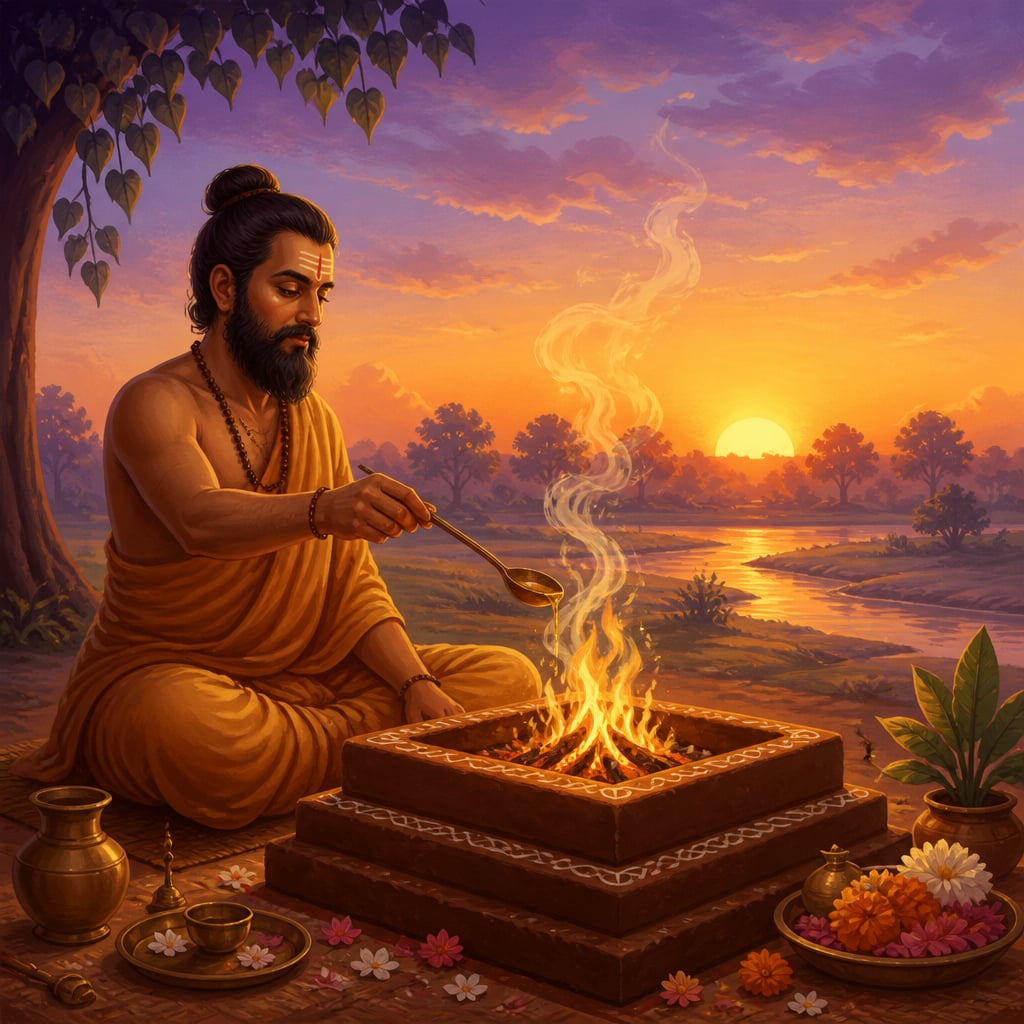
The priest stands before the sacred fire in the pre-dawn darkness. Behind him, his village along the Saraswati sleeps. He has performed this ritual for thirty years, and for thirty years the sun has never failed to appear. Not once. As the first rays break over the eastern hills, touching the river's waters with gold, he pours the offering of ghee. The fire flares. The sun rises. The cosmic dance continues.
But what makes the sun rise? Not the offering itself, the priest knows this. The yajna does not command the cosmos; it participates in something already in motion. Something older than the Devas themselves. Something the Rishis called Ṛta.
The Vedic Understanding
For the Rishis who composed the Rig Veda between 6000-4000 BCE, the universe was not chaos occasionally punctuated by order. It was order, deep, abiding, inviolable order, occasionally disturbed by chaos. This order they named Ṛta.
The word itself comes from the Sanskrit root ṛ, meaning "to move, to flow, to rise." Ṛta is that which flows properly, the natural movement of things when nothing obstructs them. The sun rises not because it chooses to, but because rising is what suns do according to Ṛta. Rivers flow to the sea. Seasons turn. Day follows night.
But Ṛta is far more than celestial mechanics. The Rishis saw the same principle governing human life. Just as the sun cannot decide to rise in the west, certain actions carry inherent consequences. Truth-telling, generosity, and righteous conduct align with Ṛta. Deception, greed, and cruelty violate it. Not because some divine judge declares it so, but because reality itself is structured this way.
What the Mantras Reveal
The Rig Veda speaks of Ṛta with remarkable consistency across its ten mandalas. Consider this verse from the first mandala:
"Ṛtasya pathā prehi", "Walk the path of Ṛta."
This deceptively simple instruction carries profound weight. The path of Ṛta is not a metaphor; it is the actual structure of reality. To walk it is to align oneself with the deepest patterns of existence. To stray from it is not merely to "sin" in the Western sense, but to place oneself at odds with how the cosmos actually works.
Another verse declares: "Ṛtena āditya tiṣṭhanti divi", "The Ādityas (solar deities) stand in heaven by Ṛta." Even the gods maintain their positions through alignment with cosmic order. They do not stand above Ṛta; they stand within it. This is a radical claim: the divine itself is subject to a principle greater than personality or will.
Varuna, the Deva most associated with Ṛta, is called its guardian (Ṛtasya gopā). He does not create Ṛta, he upholds it. He observes it. In the Vedic imagination, Varuna watches human conduct not as a moralistic judge but as a witness to whether beings align with or violate the cosmic pattern. His famous "nooses" (pāśāḥ) are not punishments imposed from outside but natural consequences that bind those who stray from Ṛta.
Traditional Wisdom
Sayanacharya, the great 14th-century commentator, interprets Ṛta primarily as ritual and cosmic order intertwined. The yajna works, in Sayana's reading, because it participates in Ṛta, the ritual mirrors cosmic patterns, and by performing it correctly, the ritualist aligns human action with universal law.
Sri Aurobindo offers a deeper, psychological reading. In The Secret of the Veda, he suggests that Ṛta represents not merely external order but the truth-consciousness that underlies reality. The Rishis, in Aurobindo's interpretation, were not simply observing nature's patterns but accessing a level of awareness where truth and existence are identical. To know Ṛta is not to have information about order but to perceive reality as order.
Both interpretations honor the text. Ṛta operates at multiple levels, cosmic, ritual, ethical, and psychological, simultaneously. The Vedic worldview does not separate these domains as modern thought tends to do.
Understanding Ṛta in its original context prevents modern misreadings. The Rishis were not creating a religion with arbitrary rules enforced by supernatural beings. They were perceiving and articulating the deep order of reality, an order that modern science continues to discover in domains from physics to biology. The Vedic dating of 6000-4000 BCE is based on astronomical references within the texts and the Saraswati's presence as a mighty river (it dried up around 1900 BCE). Western academic dating of 1500-1200 BCE relies on the now-questioned Aryan migration theory.
Living This Today
In 2017, the Nobel Prize in Physiology or Medicine was awarded to Jeffrey Hall, Michael Rosbash, and Michael Young for their discoveries of molecular mechanisms controlling circadian rhythm. Their research revealed something the Rishis would have recognized instantly: living beings have internal clocks that align with cosmic patterns. When we ignore these patterns, working night shifts, exposing ourselves to artificial light at wrong hours, eating at irregular times, we suffer consequences. Not as punishment, but as natural outcome.

The research showed that nearly every cell in our bodies contains "clock genes" that synchronize with the day-night cycle. Disrupt this alignment, and inflammation increases, cancer risk rises, cognitive function declines. The body is not being punished for breaking rules; it is simply operating against its own design. This is Ṛta in biological terms.
Consider how this extends beyond circadian rhythms. Ecologists speak of "carrying capacity", the number of organisms an environment can sustain. Exceed it, and populations collapse. Economists observe "mean reversion", the tendency of values to return to long-term averages. Psychologists document how sustainable well-being depends on aligning behavior with values. These are not separate phenomena. They are glimpses of the same underlying order the Rishis called Ṛta.
Circadian rhythm research (2017 Nobel Prize) shows that ignoring natural light-dark cycles leads to inflammation, cognitive decline, and increased disease risk. The body is not designed for 24/7 artificial environments.
Organizations that ignore natural rhythms, demanding constant productivity without rest cycles, experience burnout and declining performance. Sustainable high performance requires alignment with human biological patterns.
Ecological systems follow carrying capacity limits and seasonal patterns. Human systems that ignore these (overfishing, monoculture farming, resource extraction without regeneration) eventually collapse.
Cognitive behavioral therapy works by helping people see natural consequences of thought patterns. Insight into cause-and-effect relationships often changes behavior more effectively than willpower or external rules.
High-performing teams develop shared understanding of natural consequences rather than relying on surveillance or punishment. 'If we ship buggy code, we'll have angry customers', this is Ṛta thinking in the workplace.
Systems thinking involves tracing cause-effect loops. Seeing how actions create rippling consequences, often delayed, develops what Peter Senge calls 'systems intelligence.'
Your Path Forward
You might be wondering: if Ṛta is so fundamental, why isn't everyone aligned with it? The answer lies in the nature of awareness. Ṛta doesn't force compliance, it simply is. The sun doesn't punish us for sleeping during daylight; it simply rises. Our misalignment creates its own consequences, often delayed enough that we fail to connect cause and effect.
The invitation of this lesson is simple but demanding: begin noticing. Where in your life are you operating against natural patterns? Where are you fighting reality instead of flowing with it? These are not abstract questions. They might be as concrete as your sleep schedule or as subtle as how you respond to unwelcome truths.
In the next lesson, we'll explore how Ṛta provides an ethical framework that operates without external enforcement, ethics not as obedience but as alignment. But first, sit with this: the cosmos has an order. It was here before you arrived. It will continue after you leave. The only question is whether you'll work with it or against it.
Case studies
The Nobel Prize Discovery: Circadian Rhythms as Biological Ṛta
In 2017, Jeffrey Hall, Michael Rosbash, and Michael Young received the Nobel Prize in Physiology or Medicine for discovering molecular mechanisms controlling circadian rhythm. Their decades of research revealed that nearly every cell in our bodies contains 'clock genes' that synchronize with the 24-hour day-night cycle. When researchers disrupted these genes in fruit flies, the organisms' behavior became erratic, sleeping at wrong times, feeding irregularly, dying prematurely.
The Rishis would have recognized this immediately: life is structured around cosmic rhythms. The twelve-spoked wheel of Ṛta (dvādaśāraṃ cakram) includes not just the year's cycle but the day's cycle, embedded in the very cells of living beings. The Nobel research confirmed what Vedic culture encoded in practice, sandhyā vandana (rituals at dawn, noon, and dusk), eating by daylight, sleeping with darkness. These weren't arbitrary customs but attunement to biological Ṛta.
The research spawned an entire field of 'chronomedicine', timing medical interventions to biological rhythms. Chemotherapy administered at optimal circadian times is more effective and less toxic. Shift workers following circadian principles have fewer accidents and health problems. Major corporations are redesigning work schedules around circadian science. The Vedic intuition has become medical protocol.
Ṛta is not abstract philosophy, it is the structure of reality, discoverable by those who look carefully. Modern science and ancient wisdom converge on the same truth: alignment with natural order produces health; violation produces disorder.
Chronobiology is now influencing workplace policy, school start times, and medical treatment scheduling. Hospitals that time chemotherapy to circadian rhythms see better outcomes. Companies experimenting with chronotype-aligned work schedules report higher productivity and lower burnout.
Night shift workers have a 25-40% higher risk of cardiovascular disease and a 30% increased risk of diabetes compared to day workers, not as punishment, but as natural consequence of circadian misalignment.
Adi Shankaracharya: Perceiving the Order Behind Diversity
In the 8th century CE, Adi Shankaracharya traveled across Bharat and found a fragmented philosophical landscape. Dozens of schools, hundreds of local traditions, seemingly contradictory practices and beliefs. Where others saw only chaos and conflict, Shankara perceived underlying order. Through rigorous analysis of the Vedas, Upanishads, and Brahma Sutras, he articulated Advaita Vedanta, demonstrating that beneath apparent diversity lay a single, unified reality (Brahman). His four mathas, established at India's four corners, created an institutional structure that reflected cosmic order.
Shankara embodied the Ṛta principle at the intellectual level: just as the cosmos has hidden order beneath apparent chaos, so philosophy has unified truth beneath apparent contradiction. His method was not to impose order externally but to reveal the order already present, precisely what the Rishis did when they perceived Ṛta in nature. The twelve-year-old who debated scholars saw what others missed: the underlying pattern.
Shankara's framework unified Dharmic thought in ways that persist today. The four mathas continue as centers of learning. His commentaries remain authoritative references. More importantly, he demonstrated that perceiving Ṛta, finding the order in apparent disorder, is itself a form of wisdom that can be cultivated. The Dharmic tradition was not just preserved but integrated.
Ṛta operates at every level, cosmic, biological, social, and intellectual. Those who develop sensitivity to hidden order can navigate complexity that overwhelms others. Shankara saw unity where others saw only fragmentation, just as the Rishis saw Ṛta where others saw only random nature.
Pattern recognition across disciplines is the defining skill of the most effective systems thinkers today, from epidemiologists tracking disease spread to data scientists finding structure in noise. The ability to perceive hidden order beneath apparent chaos separates insight from mere information processing.
Shankaracharya wrote Brahma Sutra Bhashya, commentaries on 10 principal Upanishads, and the Bhagavad Gita Bhashya, totaling several hundred thousand words of philosophical analysis. His framework synthesized hundreds of seemingly contradictory Vedic statements into a coherent non-dual system.
Reflection
- Where in your life are you currently fighting against natural patterns instead of flowing with them? Consider your sleep, work rhythms, relationships, or health habits.
- The Rig Veda says even the gods operate within Ṛta. What does it mean for the divine itself to be subject to cosmic order rather than its author?
- If consequences are natural rather than imposed, is there any meaningful difference between violating Ṛta and simply making an unwise choice? What does 'moral' mean in a universe of natural consequences?