Dinacaryā: Living in Alignment With Order

Practical Methods for Daily Harmony

Discover practical methods for living in alignment with Ṛta, daily practices that make cosmic order embodied rather than merely understood.

My grandmother never read the Vedas. She never discussed philosophy. She couldn't have defined Ṛta if asked. But watching her live was watching Ṛta in motion.
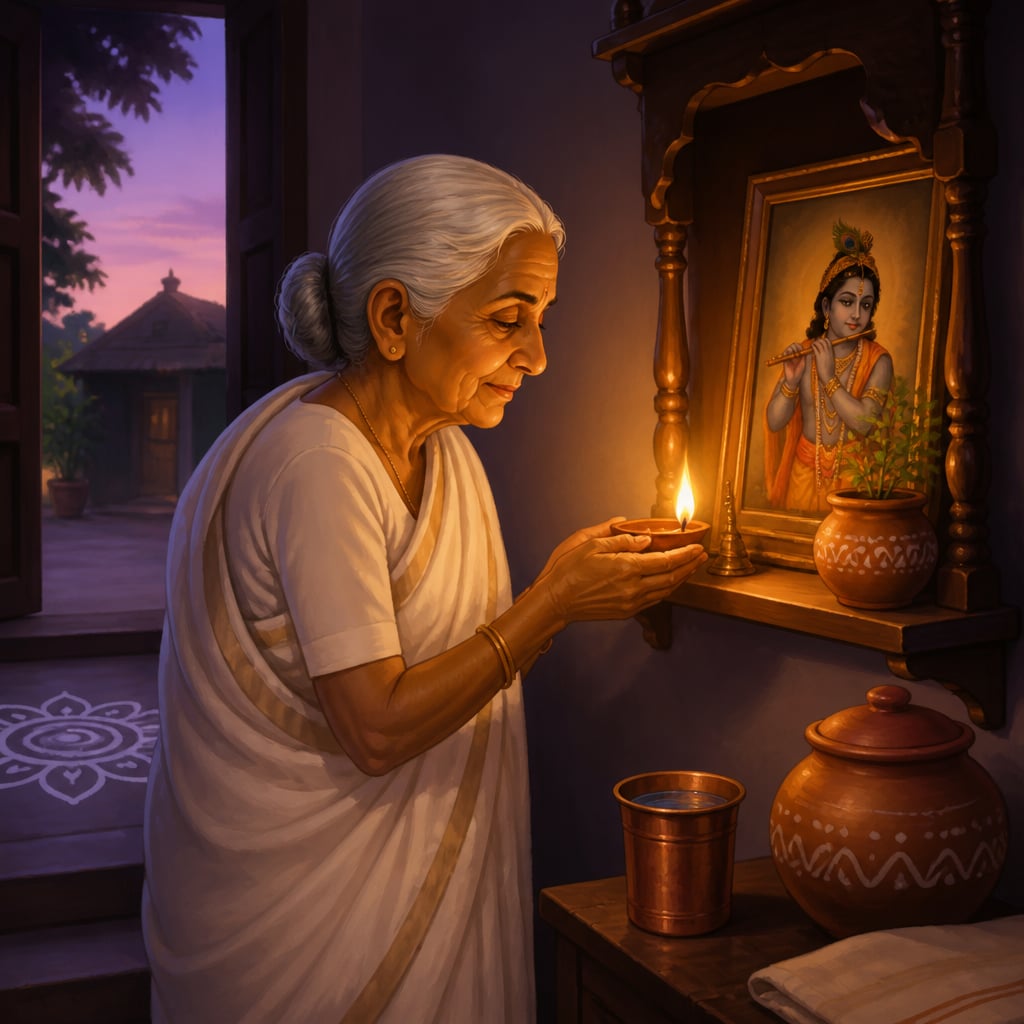
Grandmother lighting the morning diya at the threshold

She rose before dawn, while the house was still dark. Her first act was to draw water, offer prayers, and light the morning lamp. She swept the front of the house and drew a kolam, a geometric pattern in rice powder that would feed the ants and mark the day's beginning. She prepared food for the family with unhurried precision, every action deliberate but not anxious.

Her days followed patterns as reliable as the sun's movement. Morning for household duties. Afternoon for rest and reading. Evening for prayer and family. She ate simply, slept early, spoke truthfully. When problems arose, she addressed them without drama. When good fortune came, she accepted it without grasping.

She died at ninety-one, surrounded by family, having lived through wars, famines, and the upheavals of a century. Through all of it, her daily pattern held. She had aligned herself with something larger than circumstance, and that alignment carried her.

This lesson is about her secret, or rather, the secret that wasn't secret at all. Living in alignment with Ṛta is not esoteric spiritual attainment. It is practical daily structure that harmonizes individual rhythm with cosmic pattern.

The Architecture of Aligned Living

The Vedic tradition offers a clear framework for aligned living, built on three pillars:

Kāla (Time Alignment), Living in harmony with natural cycles. Rising near dawn, eating when the sun is high, sleeping with darkness. This isn't arbitrary routine but attunement to biological and cosmic rhythms. The body has clocks in nearly every cell; ignoring them creates friction.

Karma (Action Alignment), Performing right action in each moment. This means svadharma, your unique duty given your nature, situation, and relationship. The grandmother cooking breakfast was performing her karma fully; not aspiring to be elsewhere or someone else.

Saṅgha (Relationship Alignment), Maintaining right relationships with family, community, nature, and the divine. The kolam fed ants, a daily acknowledgment that we share the world. The evening prayer connected to the transcendent. The family time honored human bonds.

These three pillars, when to act, what to act, and with whom to act, create the architecture of aligned living. They are simple to understand and require a lifetime to master.

What the Mantras Reveal

The Rig Veda encodes this practical wisdom. One famous verse offers:

"Ā no bhadrāḥ kratavo yantu viśvataḥ", "Let noble thoughts come to us from all directions."

This is a prayer for openness, aligned living isn't rigid dogma but receptivity to wisdom wherever it appears. The grandmother didn't need to read philosophy because she was living it; the truth could reach her through practice itself.

Another verse declares:

"Saṃ gacchadhvaṃ saṃ vadadhvaṃ saṃ vo manāṃsi jānatām", "Come together, speak together, let your minds know together."

This emphasizes saṅgha, relationship alignment. Individual practice matters, but community amplifies it. The grandmother's patterns were held in a family context, supported by others following similar rhythms.

Traditional Wisdom

Sayanacharya interprets the daily practices of the Vedic householder as participation in cosmic yajna. Every morning offering, every shared meal, every evening lamp is a microcosm of the great sacrifice that sustains the universe. The home becomes a temple; daily routine becomes ritual.

Sri Aurobindo extends this: aligned living is not merely performing correct actions but bringing the consciousness of Ṛta into each moment. The grandmother's unhurried presence while cooking was not just behavioral habit, it was a state of awareness. She was fully there, aligned not just in action but in attention.

Modern life is characterized by chaos, fragmentation, and constant stimulation. Daily structure has collapsed; work bleeds into everything; digital devices fragment attention. The result is epidemic anxiety, burnout, and disconnection. The Vedic teaching on dinacaryā offers a corrective: rebuild structure, align with natural rhythms, embed wisdom in routine. This is practical medicine for modern disease.

The Five Practices of Daily Alignment

Based on Vedic principles and validated by modern research, here are five practices for living in alignment:

1. Sandhyā Awareness (Transition Points)

The junctions of day, dawn, noon, dusk, are natural moments for realignment. The Vedic tradition marks these with sandhyā vandana (prayers at the transitions). Modern adaptation: use these times for brief pauses. At dawn, set intention. At noon, assess: am I aligned with what matters? At dusk, reflect: what did this day teach?

2. Ritualized Morning (Kāla Foundation)

How you begin the day shapes everything that follows. Create a morning sequence that's repeatable and meaningful: movement (even five minutes), reflection (even one minute), and intention-setting. The grandmother's lamp-lighting, water-offering, and kolam-drawing were her ritualized morning. Yours will be different but serve the same function.

3. Svadharma Clarity (Karma Focus)

Know what is yours to do today. Not everything, not everyone's work, but your work. The grandmother was clear: cooking, cleaning, prayer, family. She did not try to be a philosopher or a politician. Clarity about svadharma prevents the scattered anxiety of trying to do everything.

4. Rhythmic Eating and Rest (Biological Ṛta)

Eat at consistent times, preferably aligned with daylight. Sleep at consistent times, preferably aligned with darkness. This isn't rigid scheduling but rhythmic living. The body's circadian systems reward consistency; irregular patterns create inflammation and dysfunction.

5. Evening Completion (Integration)

End the day consciously. The grandmother's evening prayer wasn't just religious obligation, it was psychological completion. Gratitude for what went well. Acknowledgment of what didn't. Release of the day before sleep. Without completion, days blur together; with it, each day becomes a unit of meaning.

Living This Today

In the villages of Okinawa, Japan, researchers investigating longevity discovered something unexpected. The elders who lived past 100 in good health didn't have special diets or exercise regimens. They had ikigai, a reason for being, and they had daily structure that embedded that purpose into routine.

Okinawan elders tending mountain vegetable plot

They rose early. They tended gardens. They gathered with moai (close-knit friend groups) daily. They ate simple meals at consistent times. They had roles in their community, making tofu, teaching children, maintaining shrines. Their days were structured but not rigid, purposeful but not anxious.

This is Ṛta lived in Japanese cultural form. The specifics differ from Vedic tradition, but the pattern is identical: time alignment, action alignment, relationship alignment. The Okinawan centenarians weren't following philosophy, like my grandmother, they were living it.

Guru Nanak working in a Punjab field

Modern research confirms the wisdom. James Clear's "Atomic Habits" framework shows that small, consistent practices compound into massive results. The key is not dramatic change but aligned repetition. A 1% improvement daily becomes 37x improvement over a year, not through heroic effort but through the mathematics of compounding.

Clear's four laws, make it obvious, make it attractive, make it easy, make it satisfying, are modern methods for what the grandmother did naturally: embed alignment in daily structure so that right action becomes default, not decision.

Research on 'keystone habits' (Charles Duhigg) shows that certain practices cascade into broader life improvement. Morning routines, exercise, and family meals are common keystones. Structure enables further alignment.

High performers across domains consistently report morning routines: meditation, exercise, reflection. Tim Ferriss's research found this the most common practice among world-class performers.

Systems theory's concept of 'attractors' suggests that stable states require structure. Daily routines create attractors toward aligned living, the system naturally returns to them when disturbed.

Research on social support shows that behavior change is dramatically more successful in community context. Alcoholics Anonymous, weight loss groups, meditation sanghas, shared practice works better.

Google's Project Aristotle found that psychological safety, the ability to speak together without fear, was the top predictor of team success. The Rig Vedic teaching in corporate research.

Network effects show that aligned communities create positive feedback loops. The Okinawan centenarians' health wasn't just individual, it was networked through moai groups that reinforced practices.

Your Path Forward

You might be thinking: my life is too chaotic for this. I have demanding jobs, family obligations, unpredictable schedules. The grandmother's pattern seems like a luxury.

But notice: the grandmother's life was not free from challenge. She lived through partition, poverty, family illness, and social upheaval. Her pattern wasn't a luxury enabled by easy circumstances, it was a stability maintained despite difficult ones. The pattern wasn't the result of peace; it was the cause of peace.

Start small. Pick one practice from the five. Maybe it's just a five-minute morning ritual: light a candle, take three breaths, state one intention. Maybe it's consistent meal timing. Maybe it's a brief evening reflection before sleep.

The mathematics of alignment are generous. Small consistent practices compound. The grandmother didn't become aligned in a dramatic spiritual breakthrough. She became aligned through decades of daily repetition, each day slightly reinforcing the pattern until it was unshakeable.

In the final lesson of this chapter, we'll explore how Ṛta remains relevant in our accelerating world, why this ancient teaching is not outdated but urgently needed. But the foundation is here: alignment is practical, daily, and cumulative. It looks like a grandmother drawing kolam in the pre-dawn darkness. It looks like you, tomorrow morning, beginning differently.

Case studies

Okinawan Ikigai and Atomic Habits: The Science of Daily Alignment

In the villages of Okinawa, Japan, researchers studying longevity found unusual concentrations of centenarians. These elders didn't follow special diets or exercise programs. They had ikigai (reason for being) and daily structure: rising early, tending gardens, gathering with moai (close-knit friend groups), eating simple meals at consistent times, maintaining community roles. Separately, author James Clear synthesized habit research into 'Atomic Habits,' showing that tiny consistent changes, 1% improvements, compound into massive transformation. Small practices, repeated daily, become automatic; automatic aligned practices create aligned lives.

The Okinawan centenarians were living Ṛta without naming it. Their time alignment (rising with sun, consistent meals), action alignment (garden tending as svadharma), and relationship alignment (moai as saṅgha) created the three-pillared structure of Vedic aligned living. James Clear's research validates the aṇukarma principle: small actions compound. The grandmother's daily kolam wasn't dramatic spiritual practice, it was atomic habit that, repeated over decades, created unshakeable alignment. Both the centenarians and the grandmother demonstrate: alignment is built incrementally, not achieved instantly.

Okinawan centenarians show dramatically lower rates of heart disease, cancer, and dementia than global averages. They report higher life satisfaction despite modest material circumstances. Their longevity correlates not with genetics (second-generation Okinawans in other countries lose the advantage) but with lifestyle, daily structure, purpose, and community. Clear's readers who implement atomic habits report transformed productivity, health, and well-being. The evidence is clear: small daily alignment compounds into life transformation.

Alignment with Ṛta doesn't require dramatic spiritual breakthrough. It requires daily structure, consistent small practices, and relational context. The mathematics of compounding favor those who start small and persist. Start where you are, with what you have, and let time do its work.

The atomic habits movement, intermittent fasting protocols, and morning routine culture all reflect this ancient insight: small daily practices compound into transformative results. Habit-tracking apps have made the principle of daily alignment accessible to millions, though the wisdom predates the technology by millennia.

A 1% daily improvement compounds to 37x improvement over a year. A 1% daily decline compounds to 0.03x. The difference between aligned and misaligned living is exponential over time.

Guru Nanak's Working Spirituality: Alignment Through Labor, Devotion, and Sharing

In 15th-century Punjab, Guru Nanak Dev Ji founded Sikhism with a revolutionary teaching: enlightenment wasn't separate from daily life. His three-fold path, Kirat karo (earn honestly), Naam japo (remember the Divine), Vand chakko (share with others), integrated spiritual practice with worldly activity. Unlike traditions that separated monks from householders, Guru Nanak insisted that the farmer, the merchant, the artisan could achieve alignment through their daily work itself. He established langars (community kitchens) where all castes ate together, action alignment, relationship alignment, time alignment, all in one practice.

Guru Nanak's teaching is Ṛta made accessible and democratic. Kirat karo is svadharma, do your work honestly, as your unique contribution. Naam japo is consciousness alignment, remember the divine pattern within daily activity. Vand chakko is saṅgha duty, share, connect, give. The langar embodies all three: food prepared through honest labor, consumed with divine awareness, shared with all regardless of status. This is dinacaryā raised to community practice, daily structure that aligns individual, community, and cosmos.

Sikhism grew into a major world religion with over 25 million adherents. The langar tradition continues today, feeding millions daily at gurdwaras worldwide, the largest free food service on the planet. Sikh communities show high levels of cohesion, service orientation, and resilience. Guru Nanak's framework proved that spirituality need not retreat from the world; it can transform the world through integrated daily practice.

Alignment with cosmic order doesn't require renunciation. It requires integrating spiritual awareness into daily work, remembrance into routine, and generosity into structure. The grandmother lighting her lamp and Guru Nanak serving langar express the same truth: Ṛta is lived in action, not escaped from.

The growing popularity of integrated spiritual practices, from kirtan circles in Brooklyn to meditation groups in Bangalore tech parks, reflects a recognition that alignment does not require withdrawal from daily life. Working professionals are increasingly seeking practices that weave contemplation into their existing routines rather than demanding separate retreat time.

Guru Nanak Dev Ji traveled over 28,000 kilometers across four major journeys (Udasis) spanning approximately 24 years (1499-1524 CE), reaching as far as Mecca, Baghdad, and Tibet. Today, over 30 million free meals are served daily at Sikh gurdwaras worldwide through the langar tradition he established.

Reflection

More in Ṛta: Order Instead of Commandments

All lessons in Ṛta: Order Instead of Commandments · Rig Vedic Philosophy course