Adhikāra: Responsibility Without Fear

Acting From Clarity, Not Anxiety

Learn how Ṛta enables responsible action from alignment and clarity rather than anxiety and fear, the difference between dharmic responsibility and paralytic worry.

The warrior stood at dawn, watching the enemy camp across the plain. Thousands of fires dotted the darkness, more men than he could count. His companions shifted nervously, checking weapons, muttering prayers. But the warrior was still.

A young soldier approached. "Commander, how can you be so calm? We might all die today."

The warrior smiled slightly. "Yes, we might. But whether I live or die today is not in my hands. What is in my hands is how I fight. If I fight well, aligned with my training and my duty, I have done what I can do. The outcome belongs to the pattern. Fear adds nothing except poor aim."
Calm warrior at dawn watching enemy fires across the plain

This is the Vedic teaching on responsibility: we are accountable for the quality of our actions, not their ultimate results. When we understand this, we can act with full engagement but without the paralysis of anxiety. Responsibility becomes clarity, not burden.

The Two Faces of Responsibility

There are two very different experiences of responsibility.

The first is responsibility as burden, a weight of anxiety about outcomes we cannot control. This is the fear that something might go wrong, that we might be blamed, that consequences might be painful. This kind of responsibility produces paralysis, perfectionism, and procrastination. It exhausts rather than empowers.

The second is responsibility as clarity, a focused engagement with what is actually within our power. This recognizes that we control the effort, the intention, the quality of our action. We do not control how the universe responds. This kind of responsibility produces calm effectiveness. It energizes rather than drains.

The Vedic tradition consistently points toward the second. We are responsible for our dharma, our right action in this moment. We are not responsible for how the cosmic web weaves our action together with millions of other threads. That responsibility belongs to Ṛta itself.

What the Mantras Reveal

The Rig Veda reveals this teaching in verses that distinguish between human effort and cosmic outcome. Consider:

"Svasti panthām anu carema", "May we walk the path of well-being."

The prayer asks for the path, not the destination. The Rishi recognizes that we walk; whether we arrive is not fully ours to determine. The request is for alignment with a good path, the quality of the journey, not guaranteed outcomes.

Another verse offers:

"Kṛṇvanto viśvam āryam", "Making the whole world noble."

This is an aspiration, a direction of effort. The Rishis did not say "We will definitely make the whole world noble" (which would be outcome-attachment) but expressed a commitment to the effort. The doing is ours; the result emerges from the pattern.

And famously, though from the Gita rather than the Rig Veda:

"Karmaṇy evādhikāras te mā phaleṣu kadācana", "Your right is to action alone, never to its fruits."

This crystallizes the Vedic teaching: we own the action, not the outcome. This is not passivity, it demands full engagement with action. But it releases us from the anxiety of outcomes we cannot control.

Traditional Wisdom

Sayanacharya interprets Vedic ritual as requiring precise execution but releasing attachment to results. The priest performs the yajna correctly; whether the gods respond favorably is not his to control. This is not indifference but focus, full attention on what can be controlled, released attention on what cannot.

Sri Aurobindo reads this even more radically. In his interpretation, the soul's purpose is right action aligned with truth, not the acquisition of specific outcomes. The fear of consequences is itself a kind of ego-grasping, an insistence that reality respond to our preferences. The Vedic sage acts, then releases. Acts, then releases. The pattern holds everything.

Why Fear Fails

Fear-based responsibility doesn't even work on its own terms. Consider what happens when we're anxious:

The warrior who fears death is the warrior who hesitates, and hesitation in battle is often fatal. The student who fears failing the exam is the student whose mind goes blank. The leader who fears making mistakes is the leader who makes the biggest mistake: inaction.

Fear is not only spiritually misguided; it is practically counterproductive. The Vedic teaching serves effectiveness as well as peace.

Modern life is saturated with outcome-anxiety. Grades, metrics, KPIs, performance reviews, we are constantly measured by results that involve factors beyond our control. This creates chronic stress, risk-aversion, and paradoxically worse outcomes. The Vedic teaching offers a corrective: distinguish your adhikāra (in effort) from your non-adhikāra (in results). Engage fully with the first; release the second. This is both ancient wisdom and cutting-edge performance psychology.

Living This Today

On January 15, 2009, Captain Chesley "Sully" Sullenberger was piloting US Airways Flight 1549 when birds struck both engines shortly after takeoff from LaGuardia Airport. He had 208 seconds to save 155 lives.

Captain Sully landing on the Hudson

In those 208 seconds, Sully did not panic. He did not freeze with anxiety about the outcome. He ran through procedures. He assessed options. He communicated calmly with air traffic control. He made the decision to land on the Hudson River. He executed the landing with precision honed through decades of training. Everyone survived.

Later, when asked how he remained so calm, Sully said: "I was simply doing my job, applying everything I had learned over 42 years of flying. I didn't have time to be afraid. I was too busy solving the problem."

This is responsibility without fear. Sully was fully responsible, he was in command, lives depended on his decisions. But his responsibility was to process and action, not to outcome. He controlled what he could control: his training, his procedures, his decisions. The outcome, survival, emerged from that process but was not the focus of his attention.

The same principle operates at SpaceX. Elon Musk and his team have watched rockets explode on the launchpad, crash into barges, disintegrate on descent. Their approach is not fear-based avoidance of failure but curiosity-driven learning from it. Each failure is data. Each explosion teaches something. The responsibility is to learn and iterate, not to guarantee success.

SpaceX engineers analyzing telemetry

When Starship SN10 exploded minutes after landing, SpaceX engineers were already analyzing telemetry. When the media called it a failure, SpaceX called it progress. The responsibility to improve was clear; the anxiety about failure was absent. This is how you land humans on Mars: not by fearing failure but by using it.

Research on 'process goals' versus 'outcome goals' consistently shows that focusing on process produces better outcomes than focusing on outcomes directly. The fixation interferes with the execution.

High-performing sports coaches teach 'controllables', focus on execution, preparation, attitude. The scoreboard takes care of itself. Bill Belichick's 'Do your job' is nishkama karma applied to football.

Complex systems produce emergent outcomes that no single agent controls. Effective action in such systems requires releasing outcome-attachment while maintaining process-discipline.

Stoic philosophy's central practice, distinguishing what's 'up to us' from what isn't, mirrors this teaching. Modern CBT uses similar distinctions to reduce anxiety and improve coping.

Amazon's 'disagree and commit' principle requires samatva: once a decision is made, engage fully regardless of whether you agreed. The outcome will reveal; your job is execution.

Agile methodology's embrace of iteration assumes outcomes will vary. The commitment is to learning and improving, not to being right the first time. Equanimity enables rapid iteration.

Your Path Forward

You might be wondering: doesn't this lead to carelessness? If I'm not anxious about outcomes, won't I stop trying?

The Vedic answer is no, and the evidence supports this. People who are released from outcome-anxiety actually perform better, not worse. They're fully present with their action rather than distracted by worry. They iterate faster because they're not afraid to fail. They take appropriate risks because the fear of looking bad doesn't paralyze them.

The key distinction is between caring about quality and fearing bad outcomes. Sully cared intensely about flying well, that's why he trained for 42 years. But he wasn't paralyzed by fear of crashing. SpaceX cares intensely about building good rockets. But they're not paralyzed by fear of explosions.

This is the practical application: engage fully with what you control (effort, preparation, intention, action) and release what you don't (how others respond, what the market does, whether luck favors you). The release isn't indifference, it's wisdom. It's recognizing where your responsibility actually lies.

In the next lesson, we'll explore the practical methods for living in alignment with Ṛta, the daily practices that make this teaching embodied rather than merely intellectual. But the foundation is here: responsibility is clarity about what you control. Everything else belongs to the pattern.

Case studies

Sully and SpaceX: Excellence Through Released Anxiety

On January 15, 2009, Captain Chesley 'Sully' Sullenberger had 208 seconds to save 155 lives after birds destroyed both engines of US Airways Flight 1549. In those seconds, he calmly assessed options, communicated with air traffic control, and executed an unprecedented water landing on the Hudson River. Everyone survived. When asked how he remained calm, Sully said he was 'simply doing his job', applying 42 years of training without time for fear. Similarly, SpaceX has watched dozens of rockets explode, on the launchpad, attempting ocean landings, during descent. Rather than paralysis, each failure generates rapid iteration. When Starship SN10 exploded after landing, engineers were already analyzing data.

Both Sully and SpaceX embody nishkama karma, full engagement with action, released attachment to outcome. Sully's adhikāra was in flying well; whether the plane survived involved factors beyond his control. His focus on process (procedures, options, execution) rather than outcome (survival) enabled peak performance. SpaceX's iterative approach treats explosions not as failures to fear but as data to learn from. Their adhikāra is in building and learning; whether each rocket succeeds involves factors they're still discovering. Fear would slow learning; releasing it accelerates progress.

Sully's landing became known as the 'Miracle on the Hudson.' His calm process-focus saved 155 lives. SpaceX went from repeated explosions to reliably landing and reusing boosters, achieving what established aerospace companies said was impossible. Both succeeded not despite releasing outcome-anxiety but because of it. The release enabled peak performance.

Fear degrades performance; released anxiety enables it. The Vedic teaching is not merely spiritual wisdom but practical effectiveness. When we focus on what we control (action quality) rather than what we don't (outcomes), we perform better. Sully and SpaceX demonstrate this in life-and-death contexts.

Sports psychology and high-performance coaching now center on process focus over outcome anxiety. Olympic athletes, surgeons, and fighter pilots all train to redirect attention from consequences to technique, producing better results precisely by releasing attachment to results.

SpaceX achieved a 90%+ landing success rate for Falcon 9 boosters by 2023 after years of explosions. Their 'rapid iteration' approach, treating failures as learning, not fear, produced results that Boeing and Lockheed Martin's fear-of-failure culture never matched.

Arjuna's Transformation: From Paralysis to Clarity

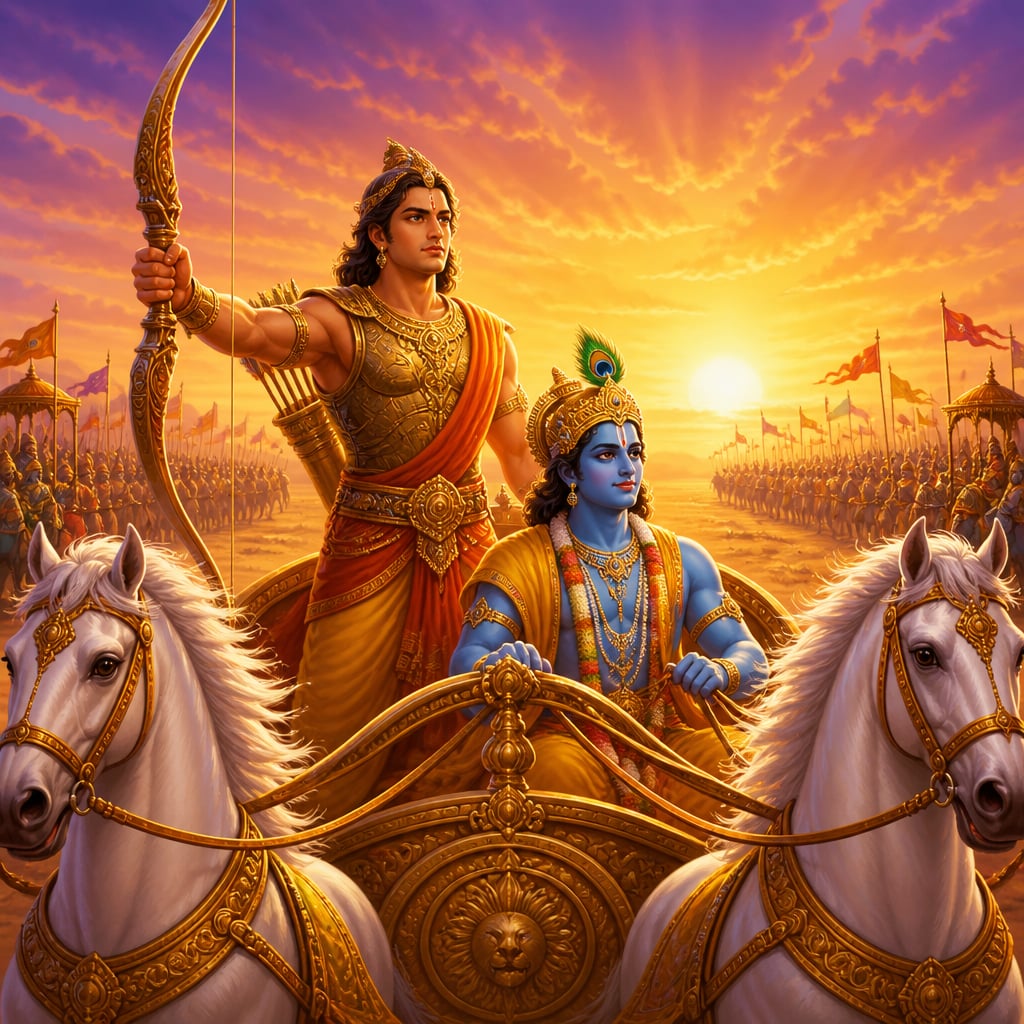
On the battlefield of Kurukshetra, the greatest warrior of his age suddenly collapsed. Arjuna, who had defeated gods and demons, dropped his bow and refused to fight. Why? He saw his teachers, uncles, and cousins in the opposing army and was overwhelmed by fear of consequences. 'What will happen if I kill them? What sin will I accumulate? What suffering will follow?' His focus on outcomes, the results of fighting, paralyzed his capacity to act. Krishna's response became the Bhagavad Gita.

Arjuna's collapse exemplifies fear-based responsibility. He was not afraid of dying, he had faced death countless times. He was afraid of consequences: killing family, accumulating karma, causing suffering. His attention was on phala (fruits), not karma (action). Krishna's teaching systematically redirected him. 'You have the right to action, not to fruits. Act without attachment to outcomes. Do your duty because it is your duty.' This was not permission to act carelessly but liberation to act clearly. Arjuna's svadharma was to fight; the consequences belonged to Ṛta.

Arjuna rose and fought, not with rage or desperation but with clarity. The Gita describes him as 'sthitaprajña', stable in wisdom. He performed his duty without attachment to winning or surviving. The war produced immense suffering (as Arjuna had feared), but his action within it was aligned with dharma. He had controlled what he could control; the pattern held the rest.

The paralysis of responsibility-as-burden (fear of outcomes) is resolved by responsibility-as-clarity (focus on right action). Arjuna's transformation shows that even overwhelming situations become navigable when we correctly understand where our adhikāra lies. We are responsible for our dharma; Ṛta is responsible for consequences.

Decision paralysis from information overload is one of the defining challenges of modern professional life. Executives, doctors, and policymakers all face the Arjuna problem: overwhelming complexity that freezes action. The resolution is the same: shift from trying to control outcomes to focusing on the quality of one's contribution.

The Bhagavad Gita contains 700 verses across 18 chapters. Krishna's discourse to Arjuna at Kurukshetra covers three primary paths: Karma Yoga (action), Jnana Yoga (knowledge), and Bhakti Yoga (devotion). The text has been translated into over 75 languages, making it one of the most widely translated philosophical works in history.

Reflection

More in Ṛta: Order Instead of Commandments

All lessons in Ṛta: Order Instead of Commandments · Rig Vedic Philosophy course