New Domains of Valor

Cyber, Space, and Electronic Warfare - The Invisible Warriors

Modern warfare has new frontiers - cyber attacks, space-based surveillance, and electronic warfare. The warriors who fight in these domains may never fire a shot but protect India just as fiercely. The invisible heroes of the digital age.

The Wars You Cannot See

Every second of every day, a war is being fought for India. No bullets are fired. No bombs explode. No soldiers fall on battlefields that cameras can capture. Yet this war is as real and as consequential as any fought in the mountains of Kargil or the deserts of Rajasthan.

This is the war in cyberspace - in the invisible realm of electrons and code. It is the war in orbit - where satellites watch and listen. It is the war across the electromagnetic spectrum - where radar waves are jammed and communications disrupted.

The warriors of these domains wear no medals that the public sees. Their victories are classified, their sacrifices unknown. But they are as much Param Veers as any soldier who charged a machine gun.

The Cyber Domain

India faces millions of cyber attacks every year. State-sponsored hackers from China, Pakistan, and other adversaries constantly probe Indian systems - military networks, government databases, critical infrastructure, financial systems. They seek to steal secrets, disrupt operations, and prepare for future conflicts.

Defending against these attacks is the Defence Cyber Agency (DCA), established in 2018. Working alongside CERT-In (Computer Emergency Response Team) and NTRO (National Technical Research Organisation), the DCA stands as India's first line of defense in cyberspace.
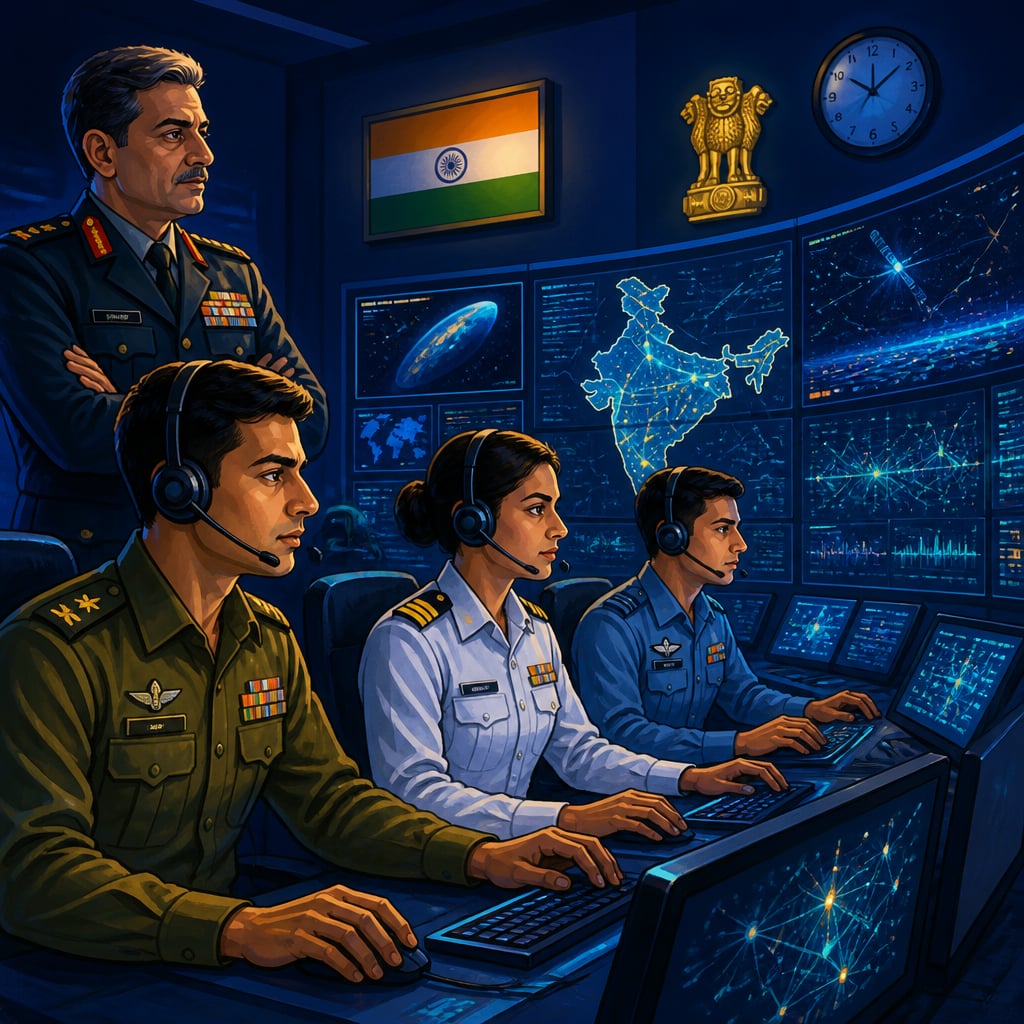
Defence Cyber Agency tri-service operations floor at night

The Invisible Battlefield

Consider what a successful cyber attack could achieve:

Cyber warriors prevent these scenarios every day. They patch vulnerabilities before hackers can exploit them. They track intrusion attempts and neutralize threats. They develop offensive capabilities to deter adversaries who know that attacks on India will be answered.

The Human Element

Cyber warfare is fought by highly skilled engineers and analysts. They work in secure facilities, staring at screens, tracking patterns that reveal enemy activity. Their work requires a unique combination of technical expertise, analytical thinking, and the ability to operate under constant pressure.

These warriors will never be photographed charging enemy positions. Their names will never appear in newspapers. But when they identify and neutralize a threat to India's critical infrastructure, they have defended the nation as surely as any soldier on the border.

The Space Domain

Space is the new high ground. Whoever controls space can see the battlefield, communicate across continents, guide weapons with precision, and deny these capabilities to adversaries. India, recognizing this reality, established the Defence Space Agency (DSA) in 2019.

Eyes in the Sky

India's military satellites provide crucial capabilities:

Surveillance: Satellites like the RISAT series use radar to see through clouds and darkness, tracking enemy movements. The Cartosat series provides high-resolution optical imagery. Together, they ensure India is never surprised by enemy buildups.

Communication: GSAT satellites provide secure military communications, allowing commanders to coordinate forces across thousands of kilometers. During the Galwan crisis, these satellites enabled real-time coordination of India's massive LAC deployment.

Navigation: India's NavIC system provides GPS-like navigation independent of American GPS - crucial for guiding missiles and troops in areas where GPS might be jammed or denied.

The Anti-Satellite Test

Mission Shakti anti-satellite missile lifting off from Abdul Kalam Island

On March 27, 2019, India conducted Mission Shakti - an anti-satellite (ASAT) missile test. A modified ballistic missile, launched from Abdul Kalam Island, destroyed a defunct Indian satellite at an altitude of 300 kilometers.

With this test, India joined an elite club of four nations (US, Russia, China, India) with demonstrated ASAT capability. The message was clear: any attempt to blind India by destroying its satellites would be met with retaliation in kind.

The scientists and engineers who made Mission Shakti possible are warriors as much as any soldier. They gave India the power to defend its space assets - a power without which modern warfare is impossible.

Protecting India's Orbital Assets

India's satellites face constant threats:

The Defence Space Agency works to protect these assets. They monitor the space environment for threats. They develop hardened satellites that can survive attack. They ensure India has backup systems if primary satellites are lost.

The Electronic Warfare Domain

Before the first bullet is fired in any modern war, the battle for the electromagnetic spectrum begins. Radars search for targets. Jammers try to blind those radars. Communications carry orders. Electronic warfare systems try to intercept and disrupt those communications.

The Invisible Sword and Shield

Electronic warfare has three components:

Electronic Attack: Jamming enemy radars and communications, spoofing GPS signals, using cyber weapons to disable electronic systems.

Electronic Protection: Hardening friendly systems against jamming, using frequency-hopping radios that evade interception, employing stealth technologies.

Electronic Support: Intercepting enemy communications and radar emissions, locating enemy units by their electronic signatures, gathering intelligence.

Indian EW Capabilities

India has developed sophisticated electronic warfare capabilities:

SAMYUKTA: An integrated electronic warfare system that can detect, locate, and jam enemy radars and communications across a wide frequency range.

Naval electronic warfare operator at a SIVA console aboard a frigate

SIVA: A naval electronic warfare suite that protects Indian warships from radar-guided missiles.

SPECTRA: Advanced electronic warfare pods for fighter aircraft, enabling them to jam enemy radars and missiles.

The Kargil Lesson

During the Kargil War, Pakistan's Stinger missiles posed a deadly threat to IAF aircraft. Electronic warfare systems helped by jamming the missiles' guidance systems and warning pilots of incoming threats. The EW operators who made this possible saved pilots' lives - though their contribution was invisible to the public.

The Defence Cyber Agency

Established in 2018 and headquartered in New Delhi, the Defence Cyber Agency is a tri-service command reporting to the Chiefs of Staff Committee. Its mandate:

The DCA operates in the shadows. Its operations are classified. But every day, its personnel defend India against cyber threats that most citizens will never know about.

The Defence Space Agency

The Defence Space Agency, established in 2019 and also headquartered in Delhi, manages India's military space assets. Its responsibilities include:

The DSA represents India's recognition that space is now a warfighting domain - and that India must be prepared to fight and win in that domain.

The Warriors of the New Domains

Who are the warriors of cyber, space, and electronic warfare?

They are engineers and scientists who chose to serve their country. They are military officers who specialized in technical fields. They are analysts who spend their days decoding enemy activity. They are the developers who write code that defends India's networks.

They work in air-conditioned facilities, not on frozen mountaintops. Their weapons are keyboards and antennas, not rifles and grenades. But their contribution to national security is no less vital.

The Unsung Heroes

Consider:

These warriors save lives. They prevent attacks. They protect the nation. Yet their names will never appear on any war memorial. Their victories will never be celebrated in films.

The Future of Invisible War

The new domains are only becoming more important. Future conflicts will be decided as much in cyberspace and orbit as on land, sea, and air.

Artificial Intelligence: AI will enable faster analysis of threats and automated responses to cyber attacks.

Quantum Computing: Quantum systems may break current encryption while quantum communication provides unbreakable security.

Space-Based Weapons: Directed energy weapons and kinetic interceptors in orbit may become reality.

Autonomous Systems: Drones and robots controlled through cyber and space networks will dominate future battlefields.

India is preparing for this future. DRDO develops new technologies. The armed forces train for hybrid warfare. Academic institutions feed talent into the defense pipeline.

The Dharmic Duty of Invisible Warriors

In the Mahabharata, Arjuna's charioteer was Krishna - the most powerful being on the battlefield who never lifted a weapon. The invisible warriors of cyber, space, and electronic warfare are like modern-day charioteers. They enable the warriors to fight. They protect the nation without seeking glory.

Their dharma is service without recognition. Their reward is the knowledge that they defend 1.4 billion people who will never know their names.

Conclusion: The Future Param Veers

The Param Veers of the future may never fire a shot. They may defeat enemies without leaving their desks. They may save thousands of lives through code written in silent rooms.

But they will be warriors nonetheless. They will face enemies - enemies of ones and zeros, of radar beams and satellite imagery. They will fight for India - in domains their grandparents could never have imagined.

The battlefields change. The weapons evolve. But the courage, the dedication, and the willingness to serve remain the same.

The invisible warriors of cyber, space, and electronic warfare are the Param Veers of the digital age. They deserve our gratitude - even if we never know their names.

Key figures

Defence Cyber Agency (DCA)

Defence Space Agency (DSA)

Mission Shakti

Case studies

The Invisible Defense

A state-sponsored hacker group attempts to penetrate Indian military networks during a border crisis. If successful, they could steal operational plans, disable communications, or plant malware for later activation. How do cyber warriors respond?

Victory in cyber warfare is invisible - successful defense means nothing happens. The public never knows about attacks that were prevented. This requires warriors who find satisfaction in anonymous service.

Every major corporation now faces daily cyberattacks that the public never hears about. Cybersecurity teams defend against millions of intrusion attempts annually, and their success is measured by the absence of breaches. This 'invisible defense' model applies to public health surveillance, financial fraud prevention, and environmental monitoring systems.

Deterrence Through Capability

An adversary considers destroying India's military satellites to blind its forces before an attack. What stops them?

Sometimes the best victory is the war that never happens. Building capabilities that deter adversaries is as important as winning battles. The scientists who built India's ASAT prevented wars.

Nuclear deterrence has prevented great power conflict for over 75 years. Similarly, companies invest in patent portfolios not to litigate but to deter competitors from copying their innovations. The principle holds across domains: capabilities you never use can be your most valuable assets if they prevent conflicts that would be far more costly.

Historical context

The Rise of Multi-Domain Warfare

Reflection

More in Wings & Waves - Modern Era

All lessons in Wings & Waves - Modern Era ยท Param Veer: Guardians of the Heights (1984-Present) course