IPKF - The Forgotten War

Major Ramaswamy Parameshwaran - The Only IPKF PVC

Major Parameshwaran is the sole PVC recipient from Operation Pawan - India's peacekeeping mission in Sri Lanka (1987-1990). Ambushed by LTTE militants, he charged into them, snatched a rifle from the militant who shot him, and killed him. The IPKF mission cost India over 1,200 soldiers - a forgotten sacrifice.

The Forgotten War

Between 1987 and 1990, over 100,000 Indian soldiers fought in a war that most Indians have forgotten. Not on their own soil, not against Pakistan or China, but in the jungles and villages of northern Sri Lanka. They fought against the Liberation Tigers of Tamil Eelam (LTTE) - an organization that had mastered guerrilla warfare and would later become the world's most sophisticated terrorist group.

This was Operation Pawan - India's peacekeeping mission in Sri Lanka. It was meant to be a simple intervention to enforce peace. It became India's Vietnam - a brutal, grinding conflict that claimed over 1,200 Indian lives and wounded more than 3,000.

From this forgotten war emerged one hero who received India's highest wartime gallantry award - Major Ramaswamy Parameshwaran of 8 Mahar Regiment.
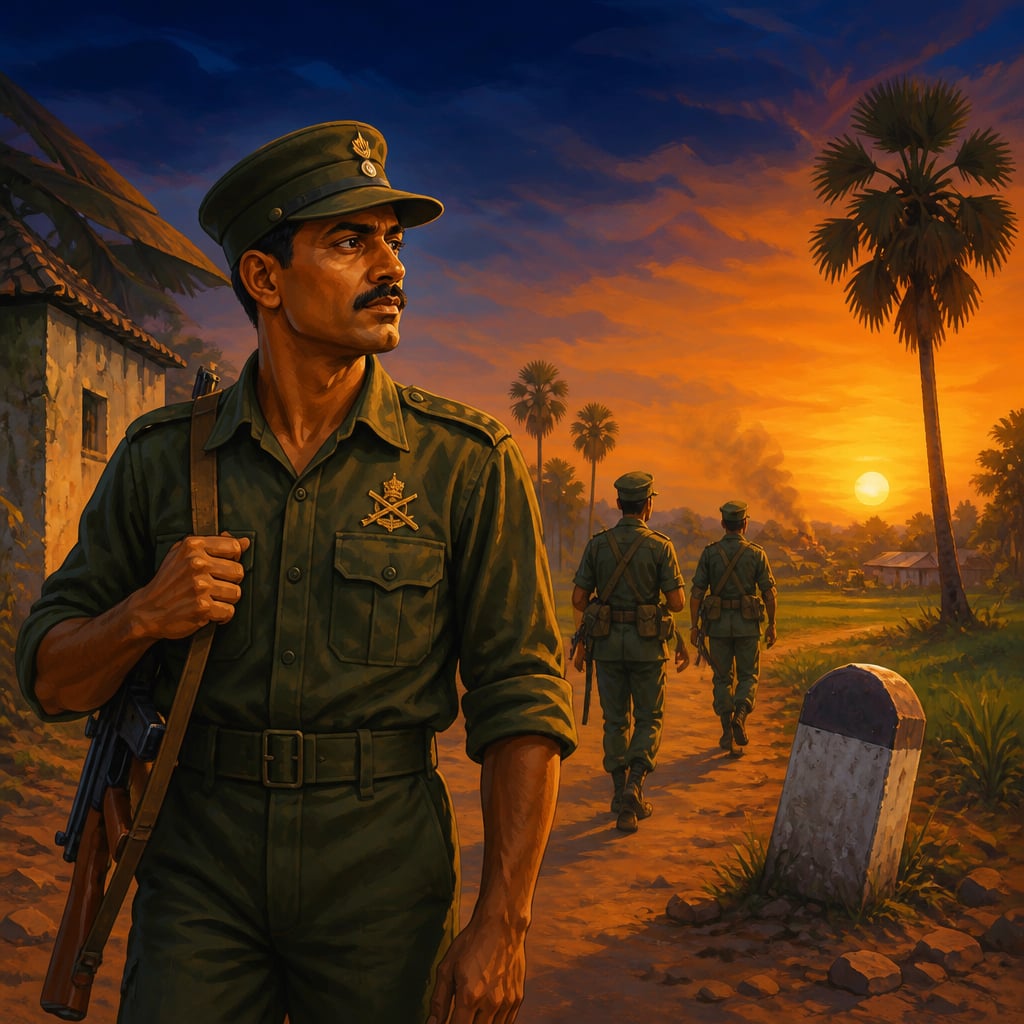
Major Parameshwaran on patrol in a Jaffna village lane at dusk

The Road to Sri Lanka

By 1987, Sri Lanka was in chaos. The civil war between the Sinhalese government and Tamil separatists had created a humanitarian crisis, with thousands of refugees fleeing to Tamil Nadu. India initially supported the Tamil cause but grew alarmed at the LTTE's ruthless methods and its destabilizing effect on the region.

The Indo-Sri Lanka Accord of July 1987 was meant to end the conflict. India would send a peacekeeping force to disarm the militants and ensure a peaceful transition. The LTTE initially agreed to surrender weapons.

But peace was not what the LTTE wanted. Within weeks, they had resumed fighting - this time against the Indian Peace Keeping Force. The IPKF found itself in an impossible situation: fighting a guerrilla war in unfamiliar terrain, against an enemy that looked like the population they were meant to protect, bound by rules of engagement designed for peacekeeping rather than combat.

Major Ramaswamy Parameshwaran

Major Ramaswamy Parameshwaran - "Parry Sahib" to his men - was born on September 13, 1946, in Bangalore. He was commissioned into the Mahar Regiment in 1972 after graduating from the Officers Training Academy (OTA), Chennai.

The Mahar Regiment has a storied history. Raised in 1941, it draws soldiers from the Mahar community of Maharashtra - a community that had fought for the Maratha Empire and had a warrior tradition dating back centuries. Dr. B.R. Ambedkar himself had advocated for their inclusion in the Army.

Major Parameshwaran embodied the regiment's spirit. He was known for three things: his tactical brilliance, his care for his men, and his absolute fearlessness in combat. When 8 Mahar was deployed to Sri Lanka in 1987, Parry Sahib was handpicked to lead operations in the most dangerous sector - Jaffna.

The Night of November 25, 1987

By late November 1987, the IPKF was deep in the Jaffna operations. The LTTE had retreated to the villages around Jaffna city, using the civilian population as shields and launching ambushes from seemingly peaceful homes and farms.

On the evening of November 25, Major Parameshwaran led his column on a search operation near Uduvil village in the Jaffna peninsula. The mission was routine - or as routine as anything could be in LTTE territory. They were searching for weapons caches and militants hiding among civilians.

As the column began its return journey after dark, it happened.

LTTE militants had been waiting in ambush. Positioned in houses along the narrow road, they opened fire with automatic weapons. The column was caught in a kill zone - fire coming from multiple directions in the darkness.

Many officers would have taken cover, called for reinforcements, tried to extract their men from the ambush. Major Parameshwaran did something else entirely.

The Charge

Major Parameshwaran counter-charging an LTTE ambush at night

With remarkable tactical instinct, Parry Sahib realized that the only way to save his men was to break the ambush from the inside. Instead of retreating, he ordered his men to provide covering fire while he moved around the enemy position.

In the darkness, under fire, he circled to the rear of the militant position. And then he charged.

Alone, he attacked the LTTE militants from behind. In the confusion of close combat, he engaged the enemy in hand-to-hand fighting. The militants, who had expected to slaughter a pinned-down column, found themselves fighting for their lives against a single furious officer.

During the fight, one militant managed to shoot Major Parameshwaran in the chest at point-blank range. It was a wound that should have killed him instantly, that should have ended the fight.

It didn't.

Major Parameshwaran, even as the bullet tore through his chest, grabbed the rifle from the militant who had shot him. He turned the weapon on his killer and shot him dead.

The other militants, stunned by this display of superhuman will, broke and fled. Five of them lay dead.

Only then did Major Parameshwaran collapse.

The Last Orders

Even mortally wounded, Parry Sahib refused to stop being an officer. As his men rushed to him, he continued giving orders. He ensured the wounded were being evacuated. He confirmed the perimeter was secure. He asked about the status of his soldiers.

His men tried to save him, but the wound was too severe. He had known it from the moment the bullet hit. He had simply refused to let that stop him from doing his duty.

Major Ramaswamy Parameshwaran died on November 25, 1987. He was 41 years old.

The Only IPKF PVC

Major Parameshwaran was awarded the Param Vir Chakra posthumously - the only recipient from Operation Pawan, and the only Mahar Regiment soldier ever to receive India's highest wartime gallantry award.

His citation speaks of "most conspicuous bravery and leadership of an exceptionally high order in the face of the enemy." But citations cannot capture what happened that night in Uduvil - a single man charging into an ambush, taking a bullet to the chest, killing his killer with the man's own weapon, and still giving orders as he died.

He was also the first graduate of OTA Chennai to receive the PVC, bringing honor to the institution that trained him.

The Forgotten Sacrifice

Operation Pawan ended in 1990 when India withdrew its forces. By then, 1,200 Indian soldiers had died and over 3,000 had been wounded. It was a bitter experience - fighting a war that India did not choose, against an enemy that had once been supported by India, with unclear objectives and restrictive rules of engagement.

The IPKF veterans came home to silence. There were no parades, no national celebrations. Many suffered from PTSD and other trauma. The war itself was politically controversial, and successive governments preferred to forget it.

But the soldiers remembered. The regiments remembered. And in the halls of 8 Mahar Regiment, the story of Parry Sahib - who charged alone into an ambush, who killed his killer with the man's own rifle, who gave orders until his last breath - is told to every new generation of Mahar soldiers.

The LTTE's End

History would prove the IPKF's sacrifice was not in vain. The LTTE, which had humiliated India and killed so many Indian soldiers, eventually assassinated former Prime Minister Rajiv Gandhi in 1991 - a fatal mistake that turned Indian opinion decisively against them.

In 2009, the Sri Lankan Army - trained and supported by India - finally defeated the LTTE. Velupillai Prabhakaran, the LTTE chief who had ordered so many attacks on Indian soldiers, was killed. The organization that had terrorized South Asia for decades was destroyed.

The IPKF veterans watched with mixed emotions. Their sacrifice had been vindicated, but the vindication had come twenty years too late, and through others' hands.

The Legacy

Major Ramaswamy Parameshwaran's sacrifice teaches us several lessons:

Courage in the darkness: When the ambush hit, Parry Sahib had every reason to take cover and wait for reinforcements. Instead, he charged alone into enemy fire. True courage is not the absence of fear - it is acting despite fear, when your men's lives depend on it.

Fighting to the last: Shot in the chest, he should have died. Instead, he killed his killer. The human will, when driven by duty, can achieve the impossible.

Duty beyond death: Even mortally wounded, he continued giving orders. An officer's responsibility to his men does not end with his own injuries.

The forgotten heroes: Over 1,200 Indian soldiers died in Sri Lanka. Most of their names are unknown to the general public. We owe them remembrance.

Mahar Regiment commemoration at the regimental centre in Sagar

At the Mahar Regimental Centre in Sagar, Madhya Pradesh, Major Parameshwaran's sacrifice is commemorated every year on November 25. Soldiers gather to remember Parry Sahib - the officer who charged alone, who killed his killer, who died giving orders.

The IPKF war may be forgotten by the nation. But the warriors who fought it, and the one who received India's highest honor, deserve to be remembered.

Key figures

Major Ramaswamy Parameshwaran

8 Mahar Regiment

The Mahar Regiment

Case studies

The Counter-Ambush Decision

Your patrol is caught in an ambush. Fire is coming from multiple directions. The textbook says to take cover, return fire, and call for reinforcements. But your men are in a kill zone, and every second means more casualties. What do you do?

Sometimes the standard solution is the wrong solution. Leaders must assess each situation independently and have the courage to act differently when the situation demands it.

In crisis management, the standard playbook fails more often than leaders admit. The 2008 financial crisis, COVID-19 pandemic response, and major cybersecurity breaches all required leaders to abandon textbook approaches and improvise. Situational awareness and the courage to deviate from protocol when circumstances demand it separate effective leaders from procedural ones.

Fighting Beyond the Fatal Wound

You are shot in the chest at point-blank range. The wound is fatal. Your attacker is right in front of you. Most people would collapse. What kept Major Parameshwaran fighting?

The body follows the mind. Years of training and mental conditioning can enable actions that seem physically impossible. True warriors prepare their minds as much as their bodies.

Ultra-marathon runners, combat athletes, and extreme endurance competitors demonstrate that the body's perceived limits are far below its actual limits. Sports science research shows that mental training and visualization can extend physical performance by 15-20% beyond what athletes believe possible.

Historical context

Operation Pawan - India's Sri Lanka Intervention

Reflection

More in Wings & Waves - Modern Era

All lessons in Wings & Waves - Modern Era ยท Param Veer: Guardians of the Heights (1984-Present) course