Naval Evolution
From INS Viraat to INS Vikrant - India's Naval Journey
The Indian Navy's journey from the aging INS Viraat to the indigenously-built INS Vikrant. The submarine service, the Sea Harrier era, and the modern blue-water navy. Heroes who guard India's maritime interests in the Indian Ocean and beyond.
Guardians of the Blue Frontier
India has 7,517 kilometers of coastline. Two million square kilometers of Exclusive Economic Zone. Some of the world's busiest shipping lanes pass through the Indian Ocean - lanes that carry 80% of the world's seaborne oil trade. The Indian Navy guards this vast domain, projecting power from the Strait of Hormuz to the Strait of Malacca.
This is the story of how India's Navy evolved from a small coastal force to a true blue-water navy - a force capable of operating anywhere in the world's oceans. It is a story of ships, submarines, and aircraft, but more importantly, of the sailors who made it possible.
The Aircraft Carrier Journey
India's journey with aircraft carriers began in 1961, when INS Vikrant - India's first carrier - was commissioned. A British-built ship, originally HMS Hercules, Vikrant served through the 1971 war, where its aircraft helped enforce the blockade of East Pakistan that led to Bangladesh's liberation.
But carriers age. By the 1980s, Vikrant was showing her years. India needed a replacement.
INS Viraat - The Last of the Line
In 1987, India commissioned INS Viraat - formerly HMS Hermes, which had served as the flagship of the British task force during the Falklands War just five years earlier. Viraat gave India a modern carrier capability, equipped with Sea Harrier jump jets that could take off from her ski-jump deck.
For 30 years, Viraat was the pride of the Indian Navy. She participated in every major naval exercise, showed the flag in ports around the Indian Ocean, and trained a generation of naval aviators. Her Sea Harriers - though small and limited compared to conventional carrier aircraft - gave India a unique capability that few navies possessed.
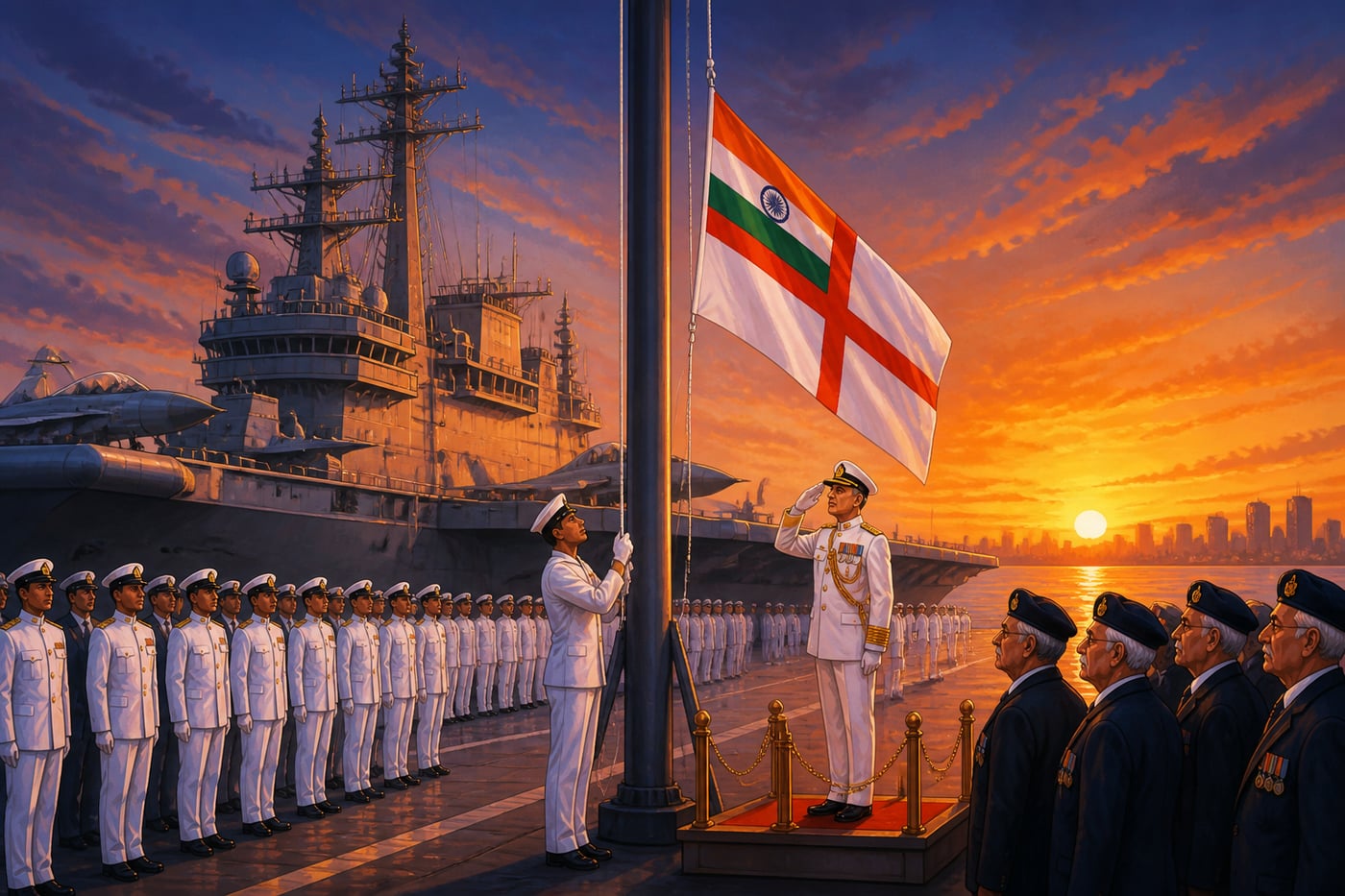
Viraat was decommissioned in 2017, having served longer than any aircraft carrier in history - 57 years between the Royal Navy and Indian Navy. She had earned her rest.
INS Vikramaditya - The Russian Giant
As Viraat aged, India looked for a successor. The solution came from an unlikely source: Russia's mothballed aircraft carrier Admiral Gorshkov. Purchased in 2004, the ship underwent a decade-long refurbishment that tested India's patience and budget.
Finally, in 2013, INS Vikramaditya was commissioned. At 45,000 tons, she was twice the size of Viraat. She carried MiG-29K fighters - true supersonic combat aircraft that gave India capabilities the Sea Harriers could never match. With her came a new era of Indian naval aviation.
INS Vikrant - Made in India
But India's greatest naval achievement was yet to come. On September 2, 2022, Prime Minister Modi commissioned INS Vikrant - India's first indigenous aircraft carrier, built entirely at Cochin Shipyard.
Vikrant represents 76% indigenous content - Indian steel, Indian weapons, Indian systems. She took 17 years to build, from keel laying to commissioning, but her completion made India one of only five nations capable of designing and building aircraft carriers.
At 45,000 tons and 262 meters long, Vikrant carries MiG-29K fighters, Kamov helicopters, and advanced sensors. She is the symbol of India's naval ambitions - and the promise of more to come.

The Silent Service - Indian Submarines
Beneath the waves, Indian submarines maintain their eternal vigil. The submarine service is called the "Silent Service" for good reason - submarines operate in secrecy, and their actions rarely make headlines. But their role in India's defense is crucial.
The Diesel-Electric Fleet
India's submarine force began with Soviet Foxtrot-class boats in the 1960s. These were followed by German HDW submarines (the Shishumar class) and Russian Kilo-class boats (the Sindhughosh class). These diesel-electric submarines are silent, deadly, and perfect for operations in the Indian Ocean's relatively shallow waters.
In 2017, India commissioned INS Kalvari - the first of six Scorpene-class submarines built at Mazagon Dock in Mumbai with French technology transfer. These boats represent the cutting edge of conventional submarine technology, with air-independent propulsion that allows them to remain submerged for weeks.
The Nuclear Deterrent
India's nuclear submarine program - the Advanced Technology Vessel (ATV) project - began in the 1980s. Its goal: to give India a submarine-launched nuclear deterrent, completing the nuclear triad.

INS Arihant, commissioned in 2016, was the first indigenously built nuclear-powered submarine. Armed with K-15 ballistic missiles, Arihant gave India the ability to launch nuclear weapons from beneath the ocean - the most survivable leg of the nuclear triad.
Arihant was followed by INS Arighat and more boats under construction. The nuclear submarine program, though shrouded in secrecy, represents one of India's greatest technological achievements.
INS Chakra - The Leased Hunters
To gain experience with nuclear submarines while Arihant was being built, India leased Akula-class nuclear attack submarines from Russia. INS Chakra (first leased 1988-1991, again 2012-2021) gave Indian submariners experience operating nuclear boats, preparing them for the indigenous SSBN and SSN programs.
Heroes of the Deep
Submariners rarely receive public recognition, but their courage is no less than any surface sailor's.
INS Sindhurakshak Tragedy
On August 14, 2013, explosions ripped through INS Sindhurakshak, a Kilo-class submarine docked at Mumbai. Eighteen sailors died in the inferno. The tragedy reminded the nation of the dangers submariners face even in port - surrounded by torpedoes, missiles, and high-pressure systems.
The sailors who died on Sindhurakshak were honored, but the best memorial to them has been the continued commitment to submarine safety and the submarine service itself.
The Patrol Rhythm
Every day, Indian submarines are on patrol. In the Arabian Sea, they watch the approaches from Pakistan. In the Bay of Bengal, they monitor Chinese movements. Their deterrent patrols, lasting months at a time, remain classified. But every day, submariners leave their families knowing they may not surface for weeks or months.
Naval Aviation - Wings Over the Ocean
Naval aviation is the Indian Navy's long-range striking arm. From carriers and shore bases, naval aircraft patrol the vast expanse of the Indian Ocean.
The Sea Harrier Era
The Sea Harrier was the backbone of Indian carrier aviation from 1983 to 2016. These remarkable aircraft could take off vertically, hover, and land on small decks. Indian Sea Harrier pilots became among the most skilled in the world, operating these demanding aircraft from Viraat's deck.
The Sea Harriers saw action during the Sri Lanka intervention in 1987, providing air cover for Indian forces. They participated in every major naval exercise for three decades.
MiG-29K - The New Era
The MiG-29K replaced the Sea Harrier as India's carrier fighter. Operating from Vikramaditya and Vikrant, these supersonic fighters give India true air superiority capability at sea. Their pilots undergo some of the most demanding training in the world - carrier landings are among the most difficult and dangerous operations in aviation.
Maritime Patrol and Reconnaissance
The P-8I Poseidon, procured from the United States, revolutionized India's maritime surveillance. These aircraft can monitor vast ocean areas, detect submarines, and strike surface ships. They have been crucial in tracking Chinese submarine movements in the Indian Ocean.
The Blue-Water Vision
India's naval strategy has evolved from coastal defense to blue-water capability. The vision: to be the dominant power in the Indian Ocean while maintaining the ability to project power beyond.
SAGAR - Security and Growth for All
India's maritime doctrine, encapsulated in the SAGAR (Security and Growth for All in the Region) vision, sees the Indian Navy as a provider of security across the Indian Ocean. From anti-piracy patrols off Somalia to humanitarian assistance in the Maldives, the Navy projects both hard power and soft power.
Infrastructure for Tomorrow
India is building the infrastructure for a great navy:
- INS Kadamba at Karwar - Asia's largest naval base
- Expanded dockyards at Mumbai, Vishakhapatnam, and Kochi
- Forward operating bases in the Andaman and Nicobar Islands
These investments ensure that India's Navy can sustain operations across the Indian Ocean for decades to come.
The Future Fleet
The Indian Navy's modernization continues:
Aircraft Carriers: After Vikrant, India plans to build an even larger carrier, possibly with electromagnetic catapults to launch heavier aircraft.
Destroyers and Frigates: The Visakhapatnam-class destroyers and Nilgiri-class frigates represent indigenous shipbuilding at its finest.
Submarines: Six more Scorpene-class submarines, additional nuclear submarines, and eventually indigenous nuclear attack submarines (SSNs) are planned.
Naval Aviation: The possibility of carrier-based fighter jets - possibly the Rafale-M - and additional maritime patrol aircraft.
The Sailors' Sacrifice
Behind every ship, submarine, and aircraft is a sailor who chose to serve at sea. Naval life is demanding:
- Months away from family
- Dangerous operations in peace and war
- The isolation of the ocean
- The constant vigilance required
From the captain of Vikrant to the newest recruit on a patrol boat, each sailor contributes to India's maritime security. Their sacrifices, mostly unseen, deserve recognition.
Legacy and Remembrance
The Indian Navy honors its heritage:
Navy Day (December 4) commemorates Operation Trident in 1971, when Indian missile boats attacked Karachi. It is a day to remember all naval heroes.
Submarine Day (December 8) marks the commissioning of INS Kalvari, India's first submarine, in 1967. It honors the silent service.
The National War Memorial in Delhi includes the names of all naval personnel who gave their lives for India.
Conclusion: Rulers of the Indian Ocean
From a small coastal force in 1947, the Indian Navy has become the dominant power in the Indian Ocean. With aircraft carriers, nuclear submarines, and advanced surface combatants, it can project power across the region.
But technology alone does not make a navy great. The officers and sailors who serve, who spend months at sea, who maintain constant vigilance in peace and war - they are the true strength of the Indian Navy.
As India rises, its Navy rises with it. The blue frontier is secure. The Param Veers of the ocean stand ready.
Key figures
INS Vikrant (R11)
INS Arihant (S2)
INS Viraat (R22)
Case studies
Building Indigenous Capability
India could have bought aircraft carriers from abroad - it would have been faster and possibly cheaper. Instead, India chose to build Vikrant indigenously, accepting 17 years of delays and cost overruns. Was this the right choice?
Short-term convenience often comes at the cost of long-term capability. True independence requires building your own capabilities, even if it takes longer and costs more initially.
India's push for indigenous semiconductor manufacturing through the India Semiconductor Mission follows the same logic. Buying chips is faster, but building the capability to design and fabricate them ensures long-term strategic independence. The same applies to any nation or company investing in core capability over outsourced convenience.
The Silent Service's Sacrifice
Submariners spend months underwater, away from families, in cramped conditions, performing missions that are never publicized. Their sacrifices go largely unrecognized. How do we honor those who serve in silence?
Not all heroism is visible. Some of the most important contributions to national security are made by those who can never be acknowledged. Their reward is the knowledge that they protect millions.
Intelligence analysts, infrastructure maintenance crews, and IT security professionals all work in roles where success means nothing visible happens. Their work only becomes apparent when it fails. Building organizational cultures that recognize and reward invisible contributions is one of modern management's persistent challenges.
Historical context
The Rise of India's Blue-Water Navy
Reflection
- Why is it strategically important for India to have the ability to build aircraft carriers domestically, rather than simply buying them from other countries?
- The submarine service operates in secrecy, and its sacrifices are rarely acknowledged. How should society recognize contributions that must remain classified?
- China's navy is expanding rapidly into the Indian Ocean. How should India respond to maintain its position as the dominant Indian Ocean power?