The Lion of Naushera

Brigadier Mohammad Usman - He Chose India

Brigadier Mohammad Usman was offered the position of Pakistan Army Chief at partition - he refused, saying 'My duty and my loyalty are to India.' At Naushera, he held the town against overwhelming Pakistani forces, earning a Rs 50,000 bounty on his head. When a shell finally found him, Prime Minister Nehru attended his funeral. He remains the highest-ranking Indian officer killed in the Kashmir War - a Muslim who chose India out of conviction and sealed that choice with his blood.

The Choice

In the chaos of partition, when millions were choosing sides based on religion, when families were torn apart and communities shattered, one man made a choice that would define his legacy and India's identity.

Brigadier Mohammad Usman was a senior Muslim officer in the British Indian Army. When partition came in August 1947, everyone assumed he would go to Pakistan. His community was predominantly Muslim. Pakistan's new army desperately needed experienced officers. Mohammad Ali Jinnah and Prime Minister Liaquat Ali Khan personally contacted him, offering rapid promotion and eventually the position of Pakistan Army Chief.
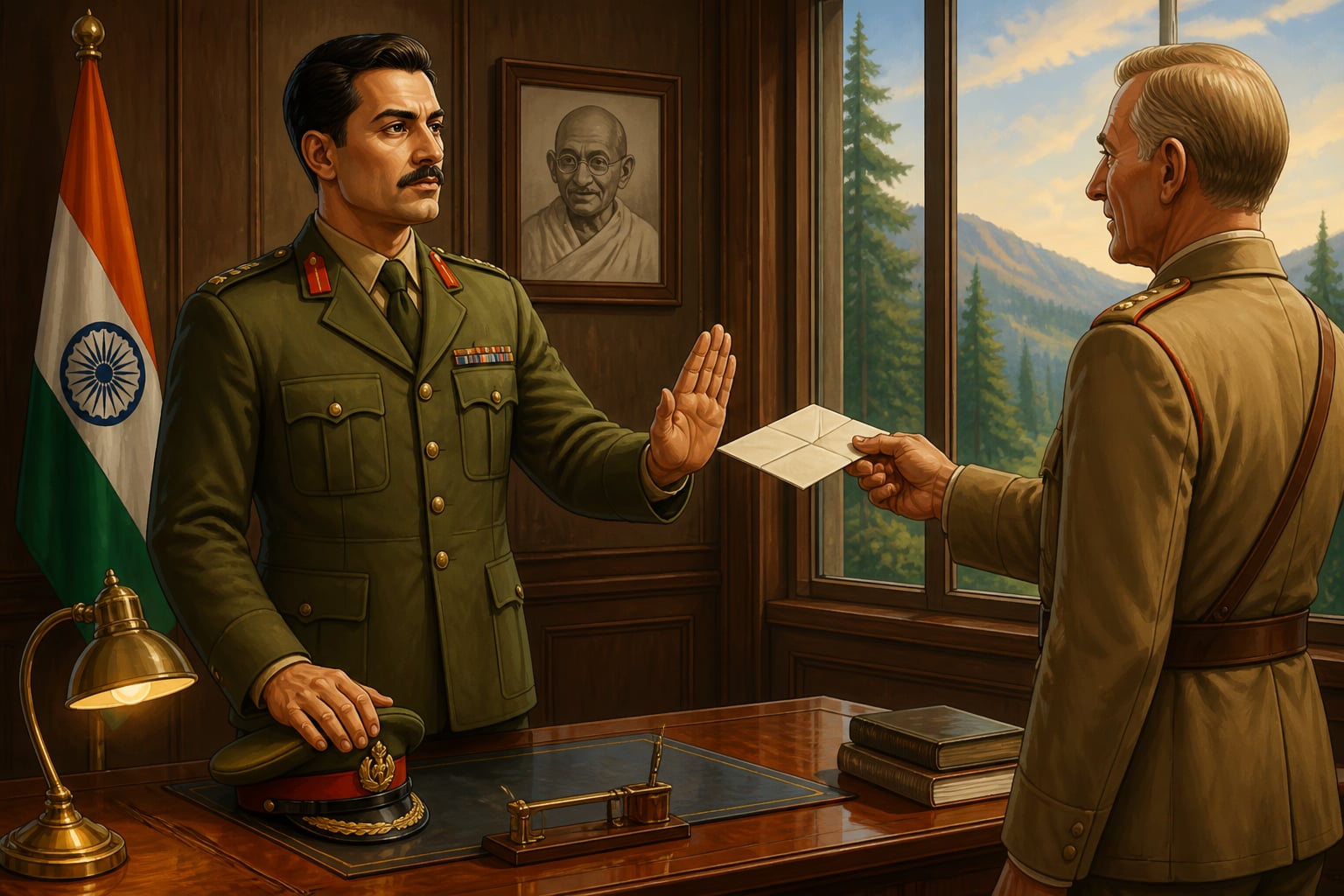
Brigadier Usman declining the Pakistan Army Chief offer in 1947

Usman refused.

"My duty and my loyalty are to India," he declared.

This was not a casual statement. It was a commitment that would cost him his life within a year.

The Making of a Soldier

Mohammad Usman was born on July 15, 1912, in Bibipur, Azamgarh district of Uttar Pradesh. He came from a family with a tradition of military service, and from an early age showed the qualities that would make him a leader.

He was commissioned into the British Indian Army and served with distinction, eventually reaching the rank of Brigadier - a remarkable achievement for an Indian officer in the colonial era. By 1947, he was one of the most experienced and respected officers in the army.

His reputation was built not just on tactical skill but on his character. He was known for leading from the front, for sharing hardships with his men, and for a personal integrity that never wavered. These qualities would be tested in the mountains of Kashmir.

The War Comes

When Pakistani-backed tribal raiders invaded Kashmir in October 1947, the new Indian nation faced its first military crisis. The Indian Army scrambled to deploy units to the threatened region.

Brigadier Usman, then commanding the 77th Parachute Brigade, was sent to take command of the 50th Parachute Brigade deployed at Jhangar in December 1947. The situation was desperate - Pakistani forces had achieved significant gains and were pushing toward Jammu.

On December 25, 1947, Christmas Day, Pakistani forces captured Jhangar from the overwhelmed defenders. The loss was a serious blow - Jhangar controlled key routes in the region. The enemy was at the gates of Naushera.

The Defense of Naushera

Naushera was vital. If it fell, the route to Jammu would be open, and the entire defensive line in the sector would collapse. Brigadier Usman was given the task of holding it - and of recapturing Jhangar.

What followed was one of the most brilliant defensive actions of the Kashmir War. In January and February 1948, Pakistani forces launched repeated attacks on Naushera with overwhelming numbers. Each time, Usman's paratroopers threw them back.

The disparity in casualties was remarkable. Indian forces inflicted approximately 2,000 casualties on the attackers (about 1,000 killed, 1,000 wounded) while suffering only 33 dead and 102 wounded themselves. This wasn't luck - it was the result of exceptional leadership and tactical skill.

The defense of Naushera earned Usman his nickname: "Naushera ka Sher" - the Lion of Naushera.

Brigadier Mohammad Usman commanding the defence of Naushera from a forward bunker.

The Bounty

Pakistan was not pleased with the Lion of Naushera. A Muslim officer who had refused to join their army was now killing their soldiers in large numbers. His effectiveness made him a priority target.

A bounty of Rs 50,000 was placed on Usman's head - an astronomical sum in 1948, equivalent to several years' salary for most workers. The message was clear: kill this man, and you will be rewarded handsomely.

Usman was aware of the bounty. It did not change how he operated. He continued to lead from the front, to visit forward positions, to share risks with his men. The Lion did not hide.

Leading from the Front

What made Usman exceptional was his style of command. He was not a headquarters general who directed battles from a safe distance. He was constantly at the front, personally assessing situations, motivating his men, and making real-time decisions.

His soldiers loved him for this. They knew that whatever dangers they faced, their brigadier faced them too. This shared risk created a bond that translated into exceptional fighting spirit. Men fight harder for leaders who share their sacrifices.

But leading from the front comes with risks. Every visit to a forward position, every inspection of defenses, every meeting with subordinate commanders exposed Usman to enemy fire. The law of averages works against those who tempt it repeatedly.

July 3, 1948

By summer 1948, Indian forces had recaptured Jhangar and stabilized the front. But fighting continued, and Pakistani forces had not given up on breaking through.

On July 3, 1948, Brigadier Usman was at a forward position near Jhangar when enemy artillery opened fire. A 25-pounder shell - a heavy artillery round - found its target.

Usman was mortally wounded. As he lay dying, his thoughts were not of himself but of his mission. His last words were recorded:

"I am dying but let not the territory we were fighting for fall to the enemy."

He was twelve days short of his 36th birthday.

The Funeral

The news of Brigadier Usman's death sent shockwaves through India. This was not just another casualty - this was the highest-ranking officer killed in the war, a man who had become a symbol of India's defense.

Nehru and cabinet at Brigadier Usman's funeral at Okhla cemetery

Prime Minister Jawaharlal Nehru and his cabinet colleagues attended the funeral - an extraordinary honor for any military officer, unprecedented for a brigadier. Usman was given a state funeral befitting a martyr.

He was buried at the Okhla cemetery near Jamia Millia Islamia in New Delhi, where his grave remains a place of pilgrimage for those who honor his memory.

The Maha Vir Chakra

Brigadier Mohammad Usman was posthumously awarded the Maha Vir Chakra (MVC) - India's second-highest gallantry decoration. The citation recognized his exceptional leadership in the defense of Naushera and Jhangar, his tactical brilliance, and his personal courage.

The MVC was appropriate recognition, but many believed Usman deserved the Param Vir Chakra itself. The distinction between the two awards can seem arbitrary when the sacrifice is complete - Usman gave everything, regardless of which medal commemorates it.

What He Represented

Brigadier Usman's significance transcends his military achievements. He was a Muslim who chose India at a time when religion was the primary basis for partition. He was not coerced or bribed - he made a free choice based on his own values.

His choice, and his sacrifice, embodied the ideal of secular India. The new nation was not meant to be a Hindu state that merely tolerated minorities - it was meant to be a country where all citizens, regardless of religion, could belong fully and give fully.

Usman proved this ideal with his blood. When Pakistan placed a bounty on his head for being a Muslim fighting against Muslims, his response was to fight harder. His identity was Indian first, and that identity asked no questions about religion.

The Might-Have-Been

Historians have speculated about what might have been. Had Usman survived, he would likely have risen to the highest ranks of the Indian Army. Many believe he would have become India's first Muslim Chief of Army Staff.

But perhaps his death served a higher purpose than his survival might have. A living general can be forgotten. A martyr who dies declaring loyalty to India at age 35, twelve days before his birthday, buried with honors by the Prime Minister - that becomes a symbol that transcends any career.

Every time Pakistan raises the issue of Muslim loyalty in India, the answer is: Brigadier Mohammad Usman.

The Legacy

Multiple memorials honor Usman's sacrifice:

Usman Chowk in Jamia Nagar, Delhi, named after him.

Brigadier Usman Road in New Delhi.

The Usman Memorial at Naushera itself, where he earned his legend.

But his greatest memorial is the idea he represented: that India belongs to all who love it, regardless of what god they pray to. That loyalty to the nation is not determined by birth but by choice. That a Muslim can die defending India and be honored as one of its greatest heroes.

The Lesson of the Lion

Brigadier Usman's story challenges simple narratives about partition, about religion, and about loyalty. He was not the only Muslim to stay with India - thousands did. But he was the most prominent, the most visible, and ultimately the most sacrificial.

His refusal of the Pakistan Army Chief position when he could have had it shows that his choice was not opportunistic. He chose India when Pakistan was offering him more. He chose India because he believed in it.

And then he proved that belief in the most final way possible.

A Nation's Gratitude

When Nehru stood at Usman's grave, he was not just mourning a general. He was acknowledging a debt that India could never fully repay. Usman had validated India's founding vision - that this was a nation for all, that religious identity did not determine national belonging.

The Lion of Naushera sleeps now in Delhi, near the university where Muslim students study in the country he died defending. His grave is marked, his story taught, his sacrifice remembered.

"My duty and my loyalty are to India."

These words, spoken in 1947, sealed with blood in 1948, echo through the decades. They are the answer to anyone who questions whether Muslims belong in India.

They belong. Brigadier Mohammad Usman proved it.

Historical context

The First Kashmir War - October 1947 to January 1949

Reflection

More in The First War - Kashmir 1947-48

All lessons in The First War - Kashmir 1947-48 ยท Param Veer: Forging the Nation (1947-1971) course