The Battle of Badgam

Major Somnath Sharma - India's First PVC

Major Somnath Sharma led 4 Kumaon Regiment at Badgam airfield when 700+ raiders attacked. His last radio message - 'I shall not withdraw an inch but will fight to the last man and the last round' - became the defining words of Indian military valor. He became independent India's first Param Vir Chakra recipient.

The First Among Heroes

November 3, 1947. Just 79 days after India's independence.

At Badgam airfield, seven kilometers from Srinagar, a young Major with his left arm in a plaster cast watched the morning mist lift from the Kashmir Valley. Major Somnath Sharma of the 4th Battalion, Kumaon Regiment, commanded a company of approximately 100 men. His task: protect the airfield that was India's lifeline to Kashmir.

What he didn't know was that over 700 tribal raiders, armed with modern weapons and burning with the fury of jihad, were converging on his position from three directions. Before the day ended, Somnath Sharma would write the first chapter in the legend of the Param Vir Chakra - with his own blood.

The Road to Badgam

The Raiders Strike

On October 22, 1947, thousands of Pashtun tribal warriors from Pakistan's North-West Frontier Province invaded Kashmir. They called it ghazwa - holy war. Armed with rifles, machine guns, and mortars supplied by Pakistan, they swept through the valley with terrifying speed.

By October 24, they had reached Baramulla, just 50 kilometers from Srinagar. There, they stopped - not to regroup, but to loot, rape, and murder. The St. Joseph's Convent, a missionary hospital, became a scene of horror. Nuns were violated. Patients were killed in their beds. The raiders' bloodlust temporarily slowed their advance.

This brief pause gave India a crucial window.

The Airlift

On October 27, 1947, Maharaja Hari Singh signed the Instrument of Accession, formally joining Kashmir to India. Within hours, the Indian Air Force began the most audacious military airlift the subcontinent had ever seen.
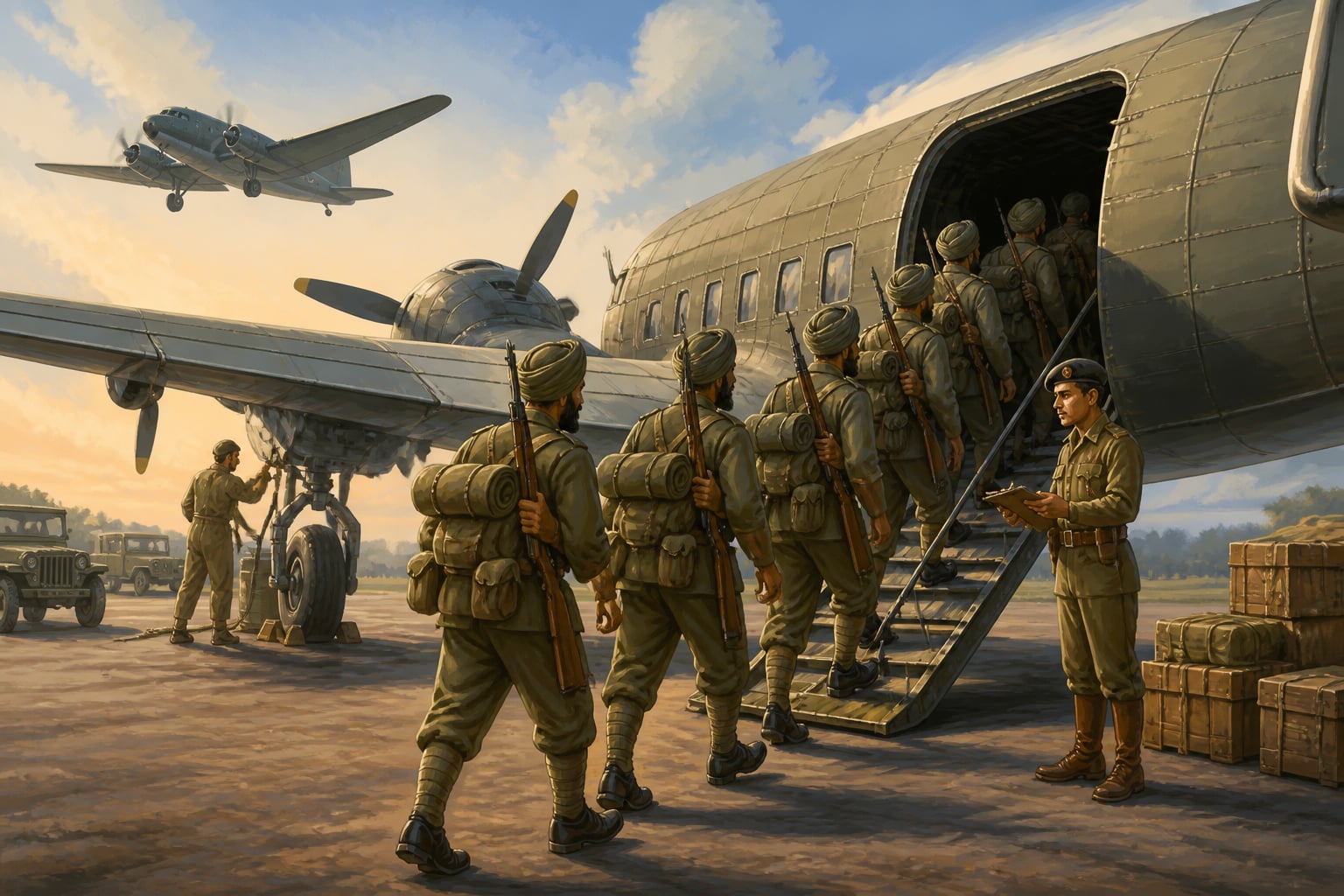
Stripped Dakota airlift of 1 Sikh Regiment to Srinagar in October 1947

Dakota aircraft, stripped of seats, carried soldiers of 1 Sikh Regiment directly into Srinagar airfield. Landing on an undefended runway with enemy forces nearby, these soldiers immediately took up positions and halted the raiders at the outskirts of the city.

But Srinagar was not safe. The airfield remained vulnerable. If the raiders captured it, no more reinforcements could land. Kashmir would fall.

A Wounded Officer Volunteers

Major Somnath Sharma had recently fractured his left wrist during a hockey match. His arm was in a plaster cast. By all military norms, he should have been in a hospital, not a combat zone.

But when orders came for his company to fly to Kashmir, Sharma refused to stay behind.

"I will not let my boys go into battle without me."

His commanding officer relented. On November 1, 1947, Major Sharma and D Company of 4 Kumaon landed at Srinagar airfield.

Major Somnath Sharma in a field tent with his plaster cast and Bhagavad Gita before flying to Kashmir.

The Man Behind the Legend

Born to Serve

Somnath Sharma was born on January 31, 1923, in Dadh, Kangra district (now in Himachal Pradesh), into a distinguished military family. His father, Major General Amar Nath Sharma, had served with distinction in the British Indian Army. His brother, General V.N. Sharma, would later become Chief of Army Staff.

Military service was in his blood.

Detail Information
Born January 31, 1923
Birthplace Dadh, Kangra, Himachal Pradesh
Father Major General Amar Nath Sharma
Brother General V.N. Sharma (later COAS)
Commission February 22, 1942
Regiment 4th Battalion, Kumaon Regiment
Rank at death Major
Age at death 24 years

World War II Service

Sharna received his commission on February 22, 1942, joining the 8th Battalion, 19th Hyderabad Regiment. During World War II, he served in the Arakan campaign in Burma - some of the most brutal jungle fighting of the war.

In Burma, he learned the art of small-unit tactics, defensive warfare, and leadership under fire. These lessons would prove decisive at Badgam.

Character and Faith

Those who knew Somnath Sharma described him as deeply religious but never preachy, strict but fair, demanding but caring. He led from the front, sharing every hardship with his men.

He always carried a small copy of the Bhagavad Gita in his chest pocket - the same book that would help identify his body after the battle.

November 3, 1947: The Last Day

The Morning Patrol

At dawn on November 3, Major Sharma's D Company was ordered to patrol the area around Badgam, a village near the airfield. Intelligence suggested enemy presence, but the exact strength was unknown.

Sharna deployed his men in a defensive perimeter. Despite his fractured arm, he personally directed the placement of each position. He could not throw grenades or fire a rifle effectively, but he could think, he could lead, and he could inspire.

The Enemy Appears

Around 10:30 AM, the first raiders were spotted. What had seemed like a routine patrol suddenly transformed into a desperate defensive battle.

The enemy force was massive - estimates range from 500 to over 700 fighters. They attacked from three directions simultaneously, trying to overwhelm the small Indian force through sheer numbers.

D Company was outnumbered at least 7:1.

The Fight Begins

Major Sharma immediately recognized the danger. If his company was overrun, the airfield would fall. If the airfield fell, Srinagar would follow. If Srinagar fell, Kashmir would be lost.

He radioed his assessment to Brigade Headquarters:

"We are surrounded. Enemy strength is at least 500. Request reinforcements immediately."

But reinforcements would take time - time that had to be bought with blood.

Leadership Under Fire

What happened next would define Indian military valor for generations.

Major Sharma moved constantly along his defensive line, directing fire, repositioning men, encouraging the wavering, steadying the frightened. His fractured arm made every movement painful, but he ignored the pain.

When the mortar team ran low on ammunition, Sharma personally helped carry shells to their position. When a light machine gun jammed at a critical moment, he stood exposed to enemy fire, helping clear the stoppage.

His men watched their commander - wounded, exposed, calm - and found their own courage.

The Raiders Press In

By early afternoon, the situation had become desperate. Casualties mounted. Ammunition dwindled. The raiders, sensing victory, pressed their attack with renewed fury.

The enemy was now less than 50 yards from Indian positions.

The Last Message

At approximately 2:30 PM, Major Somnath Sharma picked up his radio handset. What he said next would be engraved in the memory of the Indian Army forever:

"The enemies are only 50 yards from us. We are heavily outnumbered. We are under devastating fire. I shall not withdraw an inch but will fight to the last man and the last round."

As he spoke the final words, a mortar shell landed nearby. The transmission ended with the crash of the explosion.

Major Somnath Sharma was dead at 24 years of age.

The Aftermath

D Company Holds

Sharna's death did not break his company - it galvanized them. Inspired by their commander's sacrifice, the surviving soldiers fought on with desperate fury.

By evening, when reinforcements finally arrived, D Company had held. The airfield remained in Indian hands.

The Butcher's Bill

Side Casualties
Indian Army 21 killed, 26 wounded
Raiders ~200 killed, many more wounded

The raiders had expected to sweep aside a small patrol and capture the airfield by noon. Instead, they had been stopped cold by a company that refused to retreat. The heavy casualties broke their momentum. They never recovered the initiative.

Finding the Body

Recovery of Major Somnath Sharma's body with his Bhagavad Gita

Three days after the battle, Indian forces recovered Major Sharma's body. It was badly disfigured by the mortar blast - unrecognizable.

He was identified by two items:

  1. The leather holster of his pistol
  2. A few blood-stained pages of the Bhagavad Gita in his chest pocket

The book that had guided his life was with him at his death.

The Recognition

India's First PVC

When the Param Vir Chakra was instituted on January 26, 1950, the selection committee reviewed the gallantry of the Kashmir War. The choice for the first recipient was unanimous.

Major Somnath Sharma's citation reads:

"Major Somnath Sharma displayed the most conspicuous gallantry, outstanding leadership, and devotion to duty. His last message - 'The enemy is less than 50 yards from us. We are heavily outnumbered. I shall not withdraw an inch but will fight to the last man and the last round' - will serve as an inspiration to all ranks and remain an everlasting symbol of the patriotism and heroism of our armed forces."

A Family Connection

In a remarkable twist of fate, Major Somnath Sharma was the brother-in-law of Savitri Khanolkar's daughter - making him a relative of the woman who designed the very medal he received.

She had created a symbol of supreme sacrifice. She saw it first awarded to family.

The Legacy

The Kumaon Regiment's Pride

The 4th Battalion, Kumaon Regiment, preserves Major Sharma's memory with reverence:

Physical Memorials

The First of Twenty-One

Every Param Vir Chakra recipient who came after Somnath Sharma walks in his footsteps. He set the standard - not just of courage, but of a specific kind of courage:

What Badgam Saved

The Immediate Impact

The raiders' failure at Badgam had immediate consequences:

  1. The airfield remained open - More Indian troops could land
  2. Raider momentum was broken - They never recovered their early speed
  3. Time was bought - Days that allowed India to reinforce Srinagar
  4. Morale shifted - Indian troops saw that the raiders could be stopped

The Strategic Significance

If Badgam had fallen on November 3, 1947:

One company. One morning. One Major with a broken arm who refused to withdraw.

The history of a subcontinent pivoted on his decision.

The Lesson of Badgam

What Made Him Do It?

Why did Somnath Sharma choose to fight when retreat was possible? Why did he stand when running would have saved his life?

The answer lies in the book he carried - the Bhagavad Gita. In Chapter 2, Lord Krishna tells Arjuna:

स्वधर्मे निधनं श्रेयः परधर्मो भयावहः

"Death in one's own dharma is better; the dharma of another is fraught with danger."

Somnath Sharma was a soldier. His dharma was to protect. On November 3, 1947, his dharma demanded that he stand between the enemy and the airfield - between chaos and civilization, between raiders and refugees, between death and hope.

He fulfilled his dharma. The Bhagavad Gita he carried promised him that such fulfillment leads to the highest liberation.

The Message That Lives

"I shall not withdraw an inch but will fight to the last man and the last round."

These words are not just history. They are a living code.

Whenever an Indian soldier faces overwhelming odds, whenever retreat seems sensible but duty demands otherwise, whenever the easy path conflicts with the right path - those words whisper across the decades.

I shall not withdraw an inch.

Somnath Sharma's body lies in the earth. His spirit stands forever at Badgam.

Historical context

First Kashmir War (October 1947 - January 1949)

India was barely two months old as an independent nation when the Kashmir War began. The military was still organized along British lines, awards and honors had not yet been instituted, and the country was reeling from Partition violence. The stand at Badgam proved that the new Indian Army could fight and win.

Living traditions

Major Somnath Sharma's story is taught in Indian schools as part of the curriculum on national heroes. The Indian Army's Kumaon Regiment considers him their greatest hero. His final radio message - 'I shall not withdraw an inch' - has become a catchphrase for steadfastness in Indian military culture. Every November 3, the Kumaon Regiment commemorates his sacrifice with special ceremonies.

Reflection

More in The First War - Kashmir 1947-48

All lessons in The First War - Kashmir 1947-48 · Param Veer: Forging the Nation (1947-1971) course