Vairajanma: The Spiral of Suspicion
When Trust Becomes Fear and Fear Becomes Fate
The seeds of doubt planted by Damanaka take root and grow into consuming fear. Pingalaka and Sanjivaka begin watching each other with suspicious eyes, each interpreting innocent actions as proof of hostile intent. Their defensive behaviors trigger more suspicion, creating a deadly spiral that neither can escape. As the tragedy approaches its climax, both friends prepare for a confrontation neither truly wants.
The Changed Gaze
It began with the eyes.
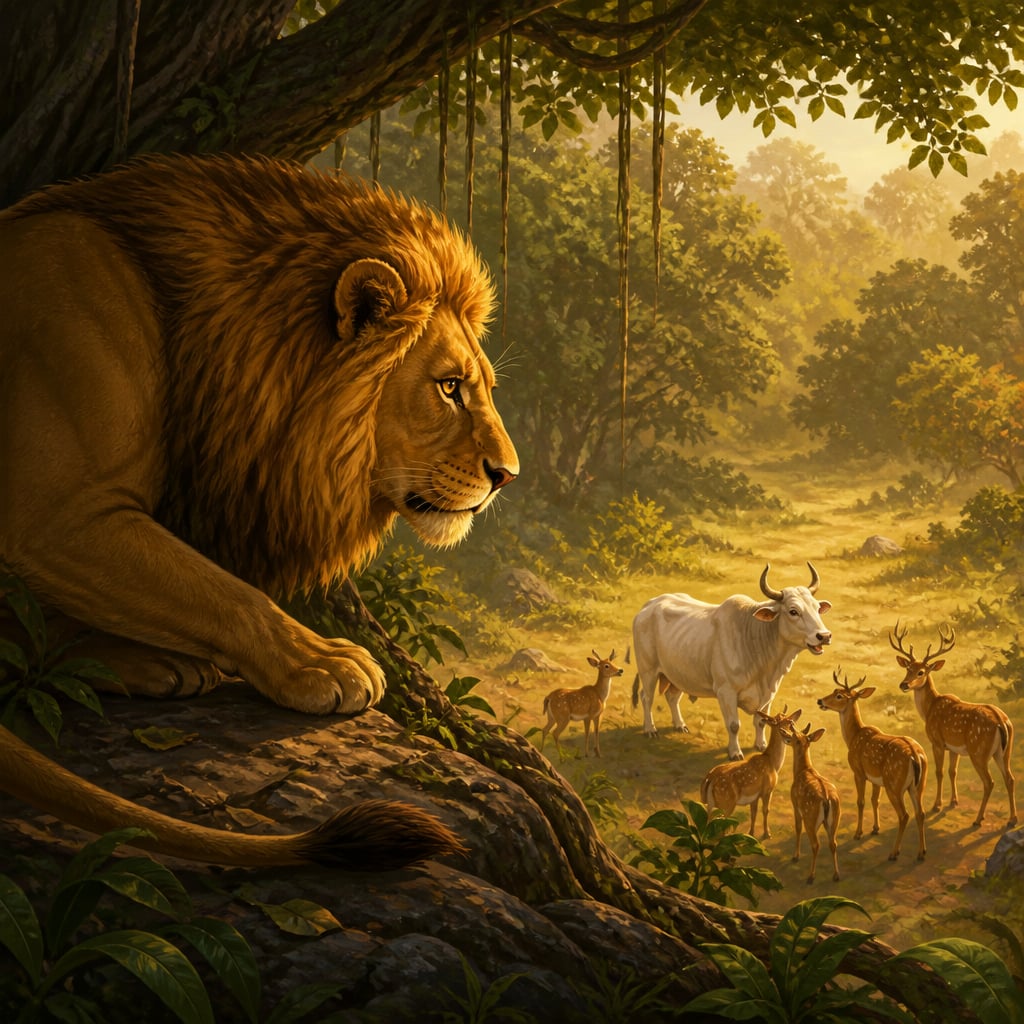
Pingalaka found himself watching Sanjivaka differently now. Where before he had looked at his friend with warmth and admiration, now his gaze carried questions. When Sanjivaka spoke to other animals, Pingalaka noticed. When the forest creatures seemed to defer to the bull's wisdom, Pingalaka counted each instance.
Is he building alliances? the lion wondered. Is he winning my subjects' loyalty for his own purposes?
These thoughts felt foreign, unwelcome - like insects crawling beneath his fur. But once begun, they would not stop.
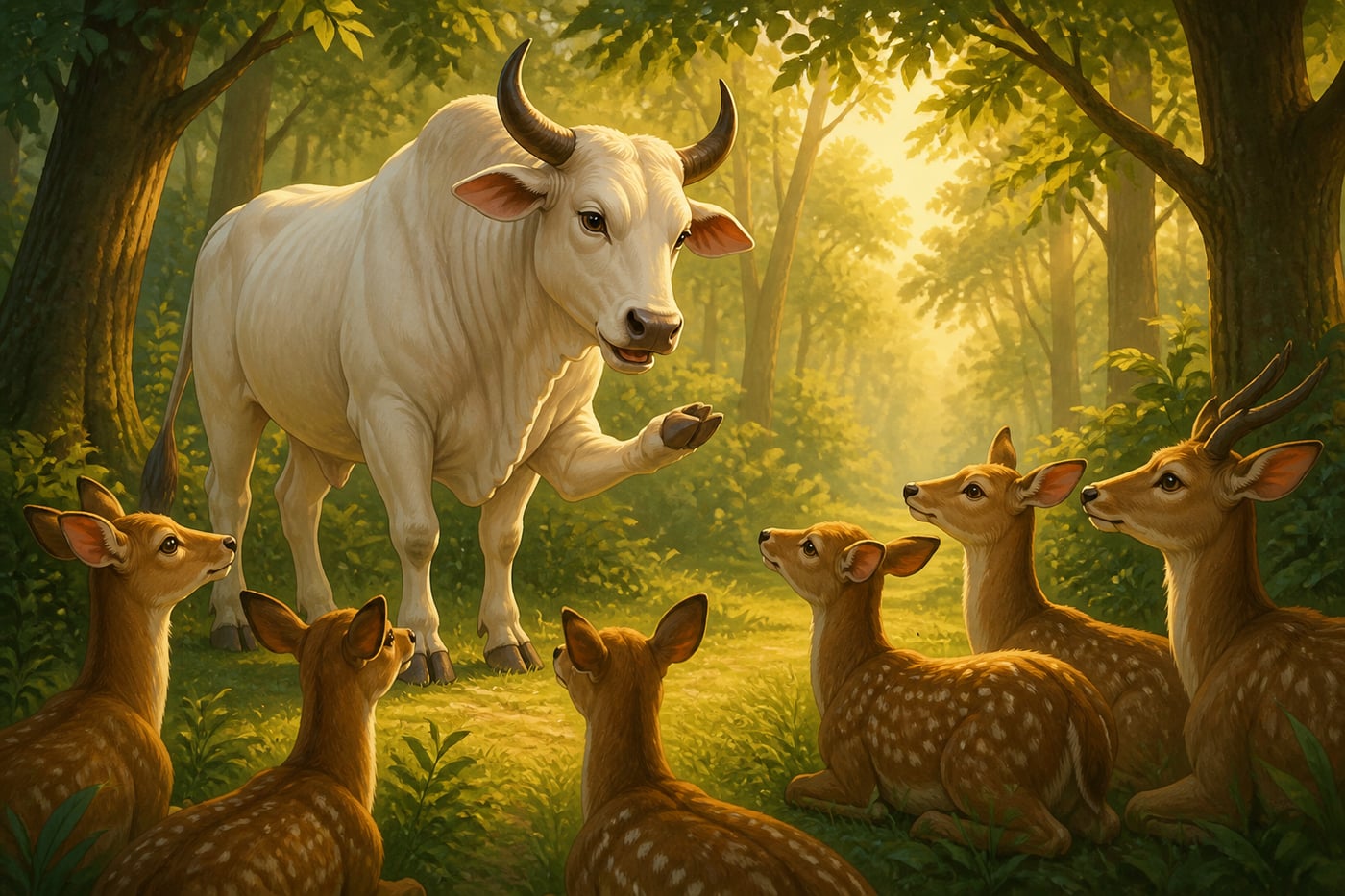
One afternoon, Pingalaka observed Sanjivaka in deep conversation with a group of deer. The bull was explaining something, gesturing with his great head, and the deer listened with obvious respect. When they departed, they bowed to Sanjivaka as if to a lord.
They never bow to me like that, Pingalaka thought, and the bitterness of the observation surprised him.
The Misread Moment
That evening, when Sanjivaka approached for their usual conversation, the lion was distant and preoccupied.
"Is something troubling you, my friend?" Sanjivaka asked, sensing the change.
"Nothing," Pingalaka replied, but his voice was curt. "What were you discussing with the deer today?"
Sanjivaka looked puzzled. "The deer? They asked about the medicinal plants in the eastern meadow. One of their fawns is ill. Why do you ask?"
"They seemed very attentive to your words. Very... respectful."
Now Sanjivaka understood - or thought he did. The lion's tone carried an edge he had never heard before. Was this the calculation Damanaka had warned him about? Was Pingalaka growing suspicious of him?
"I merely shared what I knew," the bull said carefully. "I meant no overstepping."
"Overstepping?" The lion's eyes narrowed. "An interesting choice of words. Do you feel you might be overstepping in some way?"
A chill ran through Sanjivaka. The lion's golden eyes held something new - a hardness, a probing quality. Was he imagining it? Or was this the predator's gaze that Damanaka had described?
"I... no, of course not. I misspoke."
But the damage was done. Each had seen something troubling in the other, and each had withdrawn a little further into doubt.
The Self-Fulfilling Prophecy
The cruelest aspect of Damanaka's scheme was how it made his false accusations come true.
Before his whisperings, Pingalaka had no reason to fear Sanjivaka, and Sanjivaka had no reason to fear Pingalaka. Their friendship was genuine, their trust complete. But now, because each believed the other might be dangerous, both began acting in ways that seemed to confirm those fears.
Sanjivaka's new caution made him appear secretive - as if he had something to hide. His watchfulness seemed like the vigilance of a plotter awaiting his moment.
Pingalaka's scrutiny made him appear predatory - as if he were stalking prey. His questions seemed like the probing of a hunter assessing his target.
Neither was plotting against the other. Both were simply trying to protect themselves from a threat they believed existed. But their protective behaviors looked exactly like the threatening behaviors Damanaka had described.
This is the nature of suspicion: it creates what it fears.
The Widening Chasm
The friends who once were inseparable now could barely stand to be in each other's presence.
Pingalaka noticed that Sanjivaka no longer came to the royal court each morning. The bull who had once greeted the dawn beside his friend now grazed alone in distant meadows, returning only when the forest grew dark.
He is avoiding me, the lion thought. Why would an innocent creature avoid his friend? Unless he has something to fear... or something to hide.
Sanjivaka, for his part, had made a conscious decision to keep his distance. The lion's eyes had become too sharp, too questioning. Being near Pingalaka felt like being near a predator who was deciding when to strike.
Better to stay away, the bull reasoned. If I am not present, I cannot be accused of plotting. If I am not close, I cannot be attacked without warning.
But his absence only confirmed Pingalaka's suspicions. And Sanjivaka's distant wariness only made the lion more certain that something was wrong.
Preparation for the Worst
As the days passed, both friends began making preparations - not for reconciliation, but for conflict.
Pingalaka started positioning himself strategically within the forest. He identified escape routes, defensive positions, points where an attack might come. When he rested, he kept his back to solid rock. When he moved, his eyes swept constantly for threats.
If Sanjivaka has truly turned against me, he reasoned, I must be ready. A king who is caught unprepared is no king at all.
Sanjivaka, too, changed his habits. He no longer grazed in open meadows where he would be vulnerable. He stayed near the forest's edge, where he might flee if necessary. He slept lightly, waking at every sound.
If Pingalaka decides to attack, he thought, I must be able to run. I am no fighter. My only defense is distance.
And so both friends, who had once sought each other's company above all else, now organized their lives around avoiding each other - and being ready for violence should avoidance fail.
The Spiral Tightens
What neither Pingalaka nor Sanjivaka realized was that their preparations for conflict made conflict more likely.
When Sanjivaka saw the lion positioning himself strategically, he interpreted it as hunting behavior - a predator preparing to strike. His fear intensified.
When Pingalaka saw the bull staying near the forest's edge, he interpreted it as preparation for escape - or for bringing in outside forces. His suspicion deepened.
Each defensive action looked offensive to the other. Each protective measure looked threatening. They were caught in a spiral where every attempt to feel safer made the other feel less safe - which prompted more defensive actions, which looked more threatening, on and on.
And through it all, neither spoke to the other. Neither said: "I fear something has come between us. Can we talk?" Neither admitted: "I am frightened and I need to understand what is happening."
Pride. Fear. The terrible momentum of suspicion. All these kept them silent when words might still have saved them.
The Final Warnings
Damanaka delivered his final manipulations with the skill of a master.
To Pingalaka, he said: "Great King, I have learned that Sanjivaka plans to challenge you openly before the entire court. He intends to declare that a grass-eater has no need to fear a lion - that your rule is a sham. He will challenge you, and if you do not act decisively, your authority will crumble."
To Sanjivaka, he said: "Noble bull, the King has decided. Tomorrow, when you come to court, he will attack you. He has told the other carnivores to be ready. Your only chance is to strike first - to show that you are not helpless prey. If you appear weak, you die. If you show strength, perhaps you survive."
Both Pingalaka and Sanjivaka received these 'warnings' with terrible certainty. Each believed that the confrontation they had feared was now inevitable. Each believed that survival depended on being the one to act first.
Damanaka watched them prepare, watched them arm themselves with fear and suspicion, and smiled the cold smile of a creature who has achieved everything he desired.
The Night Before
The night before the confrontation, neither Pingalaka nor Sanjivaka slept.
The lion lay beneath his banyan tree, memories playing through his mind. He remembered the day he had first met Sanjivaka - how the bull's intelligence and gentleness had amazed him. He remembered their conversations, their laughter, the feeling of finally having a true friend.
How did it come to this? he wondered. Were those memories false? Was I deceived from the beginning?

Across the forest, Sanjivaka stood in the moonlight, remembering the same moments. The lion's loneliness that had mirrored his own. The joy of companionship after years of servitude. The unprecedented sensation of being valued not for his strength but for his mind.
Was it all a hunter's game? he wondered. Was I being fattened for the kill?
Neither could quite believe that the other had always been an enemy. But neither could ignore the mounting evidence - the changed behavior, the suspicious meetings, the warnings from Damanaka.
Tomorrow, each thought, everything ends one way or another.
And in the shadows, Damanaka waited for the sunrise that would bring the destruction of a friendship - and, he hoped, the restoration of his own power.
The Weight of Atisandeha
The Panchatantra names this state 'atisandeha' - excessive suspicion. It is not mere doubt, which might be reasonable. It is doubt that has grown beyond all proportion, doubt that has consumed everything else.
Atisandeha is a kind of madness. It makes us interpret every action as confirmation of our fears. It makes us see enemies where there are friends, threats where there is love. Under its influence, we cannot perceive clearly - we can only see through the dark glass of our suspicion.
Pingalaka and Sanjivaka have reached this state. They can no longer remember clearly what they once meant to each other. They can no longer imagine innocent explanations for each other's behavior. They are trapped in a prison of perception where every door leads only to more fear.
Vishnu Sharma shows us this state not to celebrate it but to warn against it. Atisandeha is the final stage before tragedy. Once suspicion reaches this level, only extraordinary intervention can prevent disaster. And in Pingalaka and Sanjivaka's case, no such intervention is coming.
The story teaches one of the Panchatantra's most painful truths: trust, once damaged, is almost impossible to repair. The manipulator's power lies in understanding this fragility. Damanaka did not need to destroy friendship directly - he merely needed to introduce uncertainty. The friends themselves did the rest, each misinterpreting the other, each confirming the other's fears.
Reflection
- Have you ever found yourself watching a friend with suspicion, interpreting their normal behaviors as signs of something sinister? Looking back, were your suspicions justified, or had something - perhaps someone - planted doubt in your mind that colored how you saw everything?
- Pingalaka and Sanjivaka each sensed that something had changed but neither addressed it directly. What would it have taken for one of them to say: 'Something feels different between us - can we talk about it?' What prevents such honest conversations in your own relationships?
- The story shows how suspicion becomes self-fulfilling - fearing hostility, we act in ways that create hostility. This pattern appears in relationships, politics, and international conflicts. Can you think of examples where believing something strongly enough made it come true? Is there a way to break out of such cycles?