Mitranasha: The Final Break
The Tragic End of a Beautiful Friendship
The sun rises on the day of tragedy. Pingalaka and Sanjivaka face each other - not as friends but as enemies they have been made to believe they are. In the fatal confrontation that follows, the lion kills the bull he once called brother. Too late, the truth emerges. The forest mourns, Damanaka claims his hollow victory, and Pingalaka must live with the knowledge that he destroyed the only true friendship he ever had.
The Dawn of Tragedy
The sun rose red that morning, as if the sky itself knew what was to come.
Pingalaka had not slept. He stood beneath the banyan tree, his golden mane disheveled, his eyes red with exhaustion and something darker. All night he had wrestled with his thoughts, trying to find another explanation, another path. But Damanaka's words kept returning: 'He will challenge you. If you do not act decisively, your authority will crumble.'
Across the forest, Sanjivaka too had kept vigil through the night. The gentle bull who had once known only peace now stood tensed for conflict, his great horns lowered. Damanaka's warning echoed in his mind: 'Your only chance is to strike first. If you appear weak, you die.'
Both friends had arrived at the same terrible conclusion: there was no avoiding what must come. Both believed the other would attack. Both believed survival demanded acting first.
And so, as the morning light spread through the forest, they moved toward each other - not with joy, as they once had, but with dread.
The Confrontation
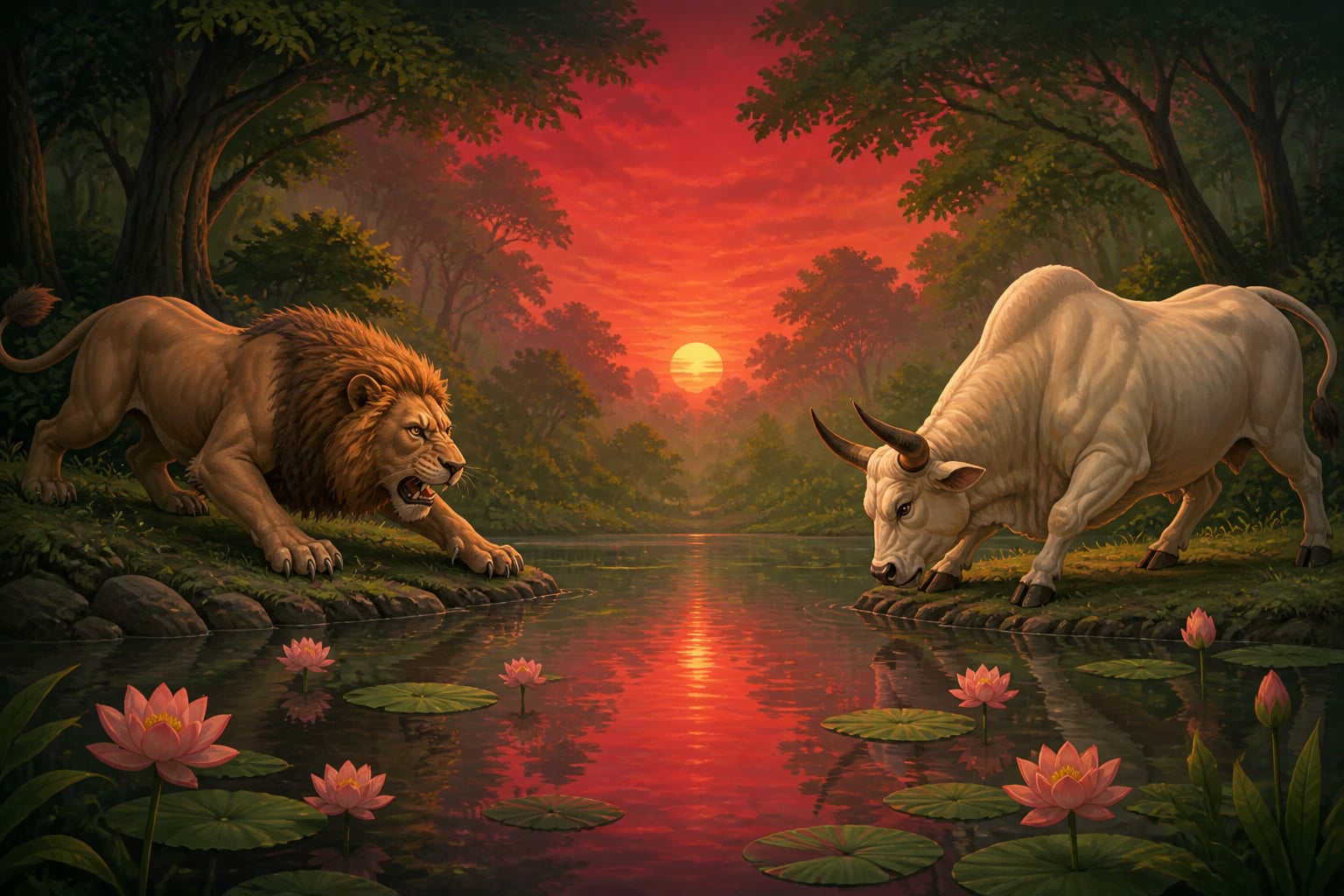
They met in the clearing by the lotus pond - the same spot where they had once spent golden hours in conversation. Now it would witness their destruction.
Pingalaka saw Sanjivaka approaching with his head lowered, horns forward. He comes ready for battle, the lion thought. Damanaka was right. He means to fight.
Sanjivaka saw Pingalaka crouched, muscles coiled, claws extended. He is preparing to spring, the bull thought. Damanaka was right. He means to kill.
Both stood frozen for a moment, each waiting for the other to make the first move. The forest fell silent, as if holding its breath.
"So it has come to this," Pingalaka said, his voice heavy with grief and anger. "My trusted friend, who I welcomed into my kingdom, who shared my deepest thoughts - you would betray me?"
Sanjivaka's eyes widened. "Betray you? I have done nothing but offer you friendship! It is you who plans treachery - you who would kill the friend who trusted you!"
"Do not insult me with denials," Pingalaka growled. "I know of your meetings with the elephants, your whispering to the forest creatures. You have been building power behind my back."
"And I know of your meetings with the carnivores," Sanjivaka shot back, fear making his voice sharp. "Planning how to dispose of the bull who became inconvenient. Just as my old master abandoned me when I was stuck in the mud."
The Moment of No Return
They circled each other, predator and prey, once friends, now convinced they were enemies.
"I did not want this," Pingalaka said, and there was genuine pain in his voice. "You were... you are... I thought we were..."
For one moment, the spell nearly broke. Sanjivaka saw the grief in the lion's eyes - the same grief he himself felt. A different word, a gesture of openness, might have changed everything.
But fear had gone too deep. When Sanjivaka saw the lion hesitate, he thought: This is a predator's trick. He is trying to make me drop my guard before he strikes.
And when Pingalaka saw the bull's horns still lowered, he thought: He refuses to stand down. He is committed to this challenge.
"Then so be it," Pingalaka said, and the last thread of hope snapped.
The lion sprang.
The Fall of Sanjivaka
The fight was brief and terrible.
Sanjivaka was strong - stronger than any bull Pingalaka had ever faced. His horns were formidable, his courage unshakeable. But he was not a fighter by nature. He was a philosopher, a counselor, a gentle soul forced into violence by circumstances he did not create.
Pingalaka was a killer by blood and training. His ancestors had hunted creatures like Sanjivaka for thousands of generations. Despite his friendship, despite his civilized mind, his body knew exactly what to do.
The bull fought bravely, wounding the lion with his horns. But in the end, nature prevailed. Pingalaka's claws found their mark. Sanjivaka fell.
As the great bull lay dying, the red haze of combat faded from Pingalaka's eyes. He looked down at his friend - his true friend, the only creature who had ever understood him - and saw what he had done.

"Pingalaka..." Sanjivaka whispered, blood staining his white coat. "Why? I never... I never meant you harm..."
"The conspiracy," Pingalaka said, his voice hollow. "The meetings with the elephants... the challenge to my authority..."
"I spoke to no elephants about you. I planned no challenge." Sanjivaka's gentle eyes, even now, held only sadness - not accusation. "Who told you these things?"
And in that moment, the terrible truth began to dawn.
The Truth Revealed
Damanaka chose this moment to appear, his face arranged in an expression of grief that did not reach his yellow eyes.
"Great King," he said, "the traitor is defeated. Your authority is secure."
Pingalaka stared at the jackal. Something in his voice... something in the timing of his appearance...
"Damanaka," the lion said slowly, "it was you who told me Sanjivaka was plotting against me. It was you who warned me of his conspiracy."
"I only shared what I observed, O King. A loyal servant's duty."
"And did you also share your observations with Sanjivaka?" Pingalaka's voice grew dangerous. "Did you perhaps warn him that I planned to attack?"
For just an instant, something flickered in Damanaka's eyes - triumph, quickly suppressed. But Pingalaka saw it.
"You did," the lion said, horror dawning. "You told each of us that the other was planning attack. You made us believe we had no choice but to fight."
"King, I assure you-"
"SILENCE!"
The roar shook the forest. Birds fled from the trees. Animals throughout the kingdom froze in terror.
Pingalaka looked down at Sanjivaka's still form, then back at Damanaka. The full weight of what he had done crashed upon him like a mountain.
"I killed my friend," he whispered. "My only true friend. Because I believed a jackal's lies."
The Hollow Victory
Damanaka fled. Even he could see that remaining meant death. He had achieved what he wanted - the friendship was destroyed, Sanjivaka was gone - but the victory tasted of ashes.
Pingalaka did not pursue. He had no rage left for the jackal. All his grief was spent on the gentle creature cooling at his feet.
The forest gathered in silent mourning. Animals who had loved Sanjivaka's wisdom, who had benefited from his kindness, came to pay their respects. They saw their king crouched beside the bull's body, not as a ruler, but as a shattered friend.
"I cannot undo this," Pingalaka said to no one, to everyone. "I cannot bring him back. The jackal's lies are exposed, but what good does that do now? Sanjivaka is dead. Dead by my own claws."
Karataka, who had watched everything unfold, spoke at last: "I tried to warn Damanaka that this was wrong. I argued against his plan. But I did not stop him. I did not warn you or Sanjivaka. I am complicit in this tragedy."
Pingalaka looked at him without anger. "You were not the architect. But you watched the building burn and did nothing." He turned away. "We are all guilty here. All except Sanjivaka, who was only ever guilty of offering friendship to those who did not deserve it."
The Forest Mourns

They buried Sanjivaka in the meadow he had loved, where the grass was sweet and the river sang nearby. Animals of every kind came to mark his passing - predators and prey standing together in grief, united as they had been when the bull lived among them.
Pingalaka spoke the funeral words, though his voice broke repeatedly:
"Here lies Sanjivaka, who was called 'Life-Giver.' He came to this forest abandoned and alone, and he gave it something it had never known - the example of true friendship between those the world says should be enemies. He taught me that connection matters more than power, that wisdom is worth more than strength, that a king is nothing without those who love him truly.
"I killed him. I, who should have protected him, who owed him everything - I killed him because I believed lies over truth, because I let suspicion poison what was pure, because my pride would not let me simply ask: 'Friend, what is happening between us?'
"May the world remember him. May the world learn from my failure."
The Lesson of Mitrabhedha
And so ends the first book of the Panchatantra: Mitrabhedha, the Severing of Friends.
Vishnu Sharma placed this tragedy at the beginning of his great work for a reason. Before we can learn to make friends wisely, we must understand how easily friendship can be destroyed. Before we can protect what we value, we must see the forces that threaten it.
The story of Pingalaka and Sanjivaka teaches bitter lessons:
That jealousy is a poison that destroys not just its target but its host. Damanaka achieved his goal, but his victory was hollow - he regained power only to flee for his life.
That trust, once broken, is nearly impossible to restore. Even if Pingalaka had discovered the truth before the fight, could he have erased the weeks of suspicion? Could Sanjivaka have forgotten his fear?
That words can be more deadly than claws. Damanaka killed Sanjivaka as surely as if he had struck the blow himself - but he used only whispers.
And most importantly: that the failure to communicate - the pride that prevents us from simply asking 'what is wrong?' - can destroy everything we hold dear.
The Final Wisdom
Pingalaka ruled the forest for many years after, but he was never the same. The joy that Sanjivaka had brought him never returned. He had learned too late what true friendship meant - and the knowledge of what he had destroyed haunted him always.
The ancient sage who composed these tales wanted us to feel this loss. He wanted the story to hurt, because pain teaches what pleasure cannot. When we remember Sanjivaka's gentle eyes as he died, when we feel Pingalaka's shattering realization, we are more likely to ask ourselves: Am I being manipulated? Am I trusting the wrong voices? Am I protecting my friendships, or letting them be poisoned?
As the Panchatantra teaches: 'Mitra' - a true friend - is the greatest treasure. Easier to find gold in the ocean than to find a heart that beats in harmony with yours. When you have such a friend, guard that friendship with your life. Question those who would speak against it. And never, never let silence and suspicion grow where honest words could heal.
For once friendship is broken, no power on earth can restore what is lost.
Reflection
- Pingalaka discovered the truth only after it was too late to change anything. Have you ever discovered something important about a situation only after you could no longer act on that knowledge? How did that experience change how you approach decisions now?
- Sanjivaka died without accusation, asking only 'Why?' rather than cursing his killer. What does his final response reveal about his character? Could you imagine responding with such grace if betrayed by someone you trusted completely?
- The Panchatantra opens with this tragedy - the destruction of friendship - rather than with a happier tale. Why do you think Vishnu Sharma chose to begin with pain rather than joy? What does it suggest about how wisdom is transmitted?