Kutayukti: The Jackal's Cunning Plan

How Jealousy Breeds Schemes Against the Innocent

As Pingalaka and Sanjivaka's friendship deepens, the jackal minister Damanaka watches with bitter jealousy. Once the King's trusted advisor, he now finds himself ignored and irrelevant. In conversations with his cautious companion Karataka, Damanaka reveals his plan to destroy what he cannot share - using not claws or teeth, but the far more dangerous weapons of whispered lies and manufactured suspicion.

The Forgotten Minister

In the golden days that followed their first meeting, Pingalaka and Sanjivaka became inseparable. They would walk together through the forest glades, discussing everything from the nature of kingship to the mysteries of the stars. They debated philosophy, shared secrets, and laughed at each other's stories. The entire forest noticed the change in their king - where once he had been melancholy and withdrawn, now he radiated contentment.

But one creature watched these scenes with eyes that grew darker by the day.

Damanaka the jackal had served Pingalaka for many years. He had been the King's closest advisor, the one who whispered counsel into the royal ear, the one who knew the King's mind better than any other. He had grown accustomed to influence, to being sought out for his opinions, to the small gestures of respect that came with proximity to power.

Now, all of that had evaporated like morning dew.
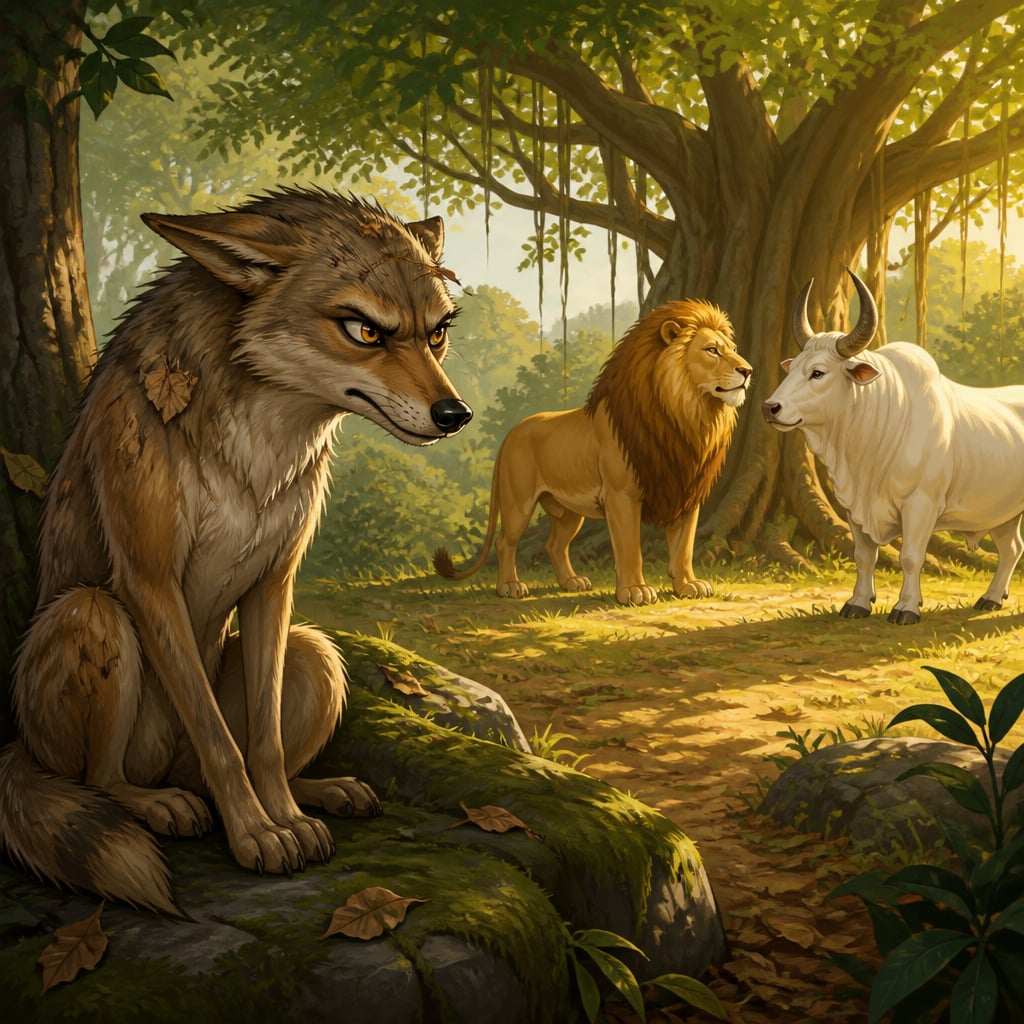
Damanaka the jackal sitting alone on a mossy stone watching the lion and bull converse in the distance

Damanaka and Karataka conversing about the king's new friend

"Look at them," Damanaka muttered to his companion Karataka, as they watched the lion and bull conversing by the great banyan tree. "Day after day, hour after hour, they talk and talk. Does the King even remember we exist?"

Karataka, ever the voice of moderation, counseled patience. "Perhaps it is good that the King is happy, friend. His contentment brings peace to the entire forest. Our positions are secure enough."

"Secure?" Damanaka's voice dripped with contempt. "We are nothing now. Less than nothing. A grass-eating bull has more influence with our king than we do. Is this the reward for years of faithful service?"

The Poison of Envy

As days turned to weeks, Damanaka's resentment deepened into something far more dangerous. He stopped attending court, knowing that his presence would go unnoticed anyway. Instead, he spent his time brooding in the shadows, watching the friendship he despised, nursing his grievances until they festered into hatred.

The forest flourished under Pingalaka's new disposition. With the King no longer hunting, the herbivores lived without fear. Even the carnivores found enough food, as if the land itself responded to the harmony between its most unlikely residents. Animals spoke of a new age of peace, of a king transformed by the power of friendship.

To Damanaka, every word of praise was salt in an open wound.

"They call it peace," he snarled one evening. "I call it unnatural. A lion who doesn't hunt? A king who takes counsel from a bull? This is not harmony - it is corruption. The natural order has been overturned, and everyone celebrates as if this were a blessing."

Karataka shifted uncomfortably. "The King seems happier than he has ever been. Surely that counts for something?"

"Happiness built on delusion will not last," Damanaka replied, his eyes gleaming with sudden intensity. "And when it crumbles - as it must - someone will need to be there to pick up the pieces. Someone who understands how a kingdom should truly be run."

The Seed of a Scheme

Damanaka lying awake at night weaving his scheme

That night, Damanaka lay awake, his mind working like a skilled weaver at a loom. He understood something that his simpler companion did not: power is not destroyed by direct confrontation. It is undermined from within, weakened by doubt, and toppled by suspicion.

"The bond between Pingalaka and Sanjivaka seems unbreakable," he mused. "But every bond has its weak points. Every trust can be eroded. What I cannot destroy with force, I shall dissolve with words."

He thought about what he knew of both creatures. Pingalaka, for all his power, was proud and easily wounded in his dignity. He feared nothing that he could see - but the unseen, the mysterious, that could trouble even a lion's heart. Had he not been frightened by Sanjivaka's bellowing before he knew its source?

And Sanjivaka - the gentle philosopher, the bull who had known abandonment and betrayal. Surely somewhere in that large heart there lurked the fear of being abandoned again, of being seen as a threat rather than a friend.

"Yes," Damanaka whispered to himself. "The lion fears treachery, and the bull fears the lion's nature. These fears sleep now, lulled by affection. But I can wake them. I can make each see the other not as friend but as enemy."

The Art of Kutayukti

The next morning, Damanaka sought out Karataka with a new energy in his step. "I have found the way," he announced. "The way to restore our rightful positions."

Karataka looked alarmed. "What are you planning, Damanaka? I warn you, meddling with the King's affairs is dangerous."

"Dangerous for the foolish, perhaps," Damanaka replied smoothly. "But I am no fool. I understand the art of kutayukti - the cunning stratagem. I will not attack our enemies directly. I will simply... illuminate certain truths that both parties have been too blind to see."

"What truths?"

"That a lion and a bull are natural enemies. That friendship between predator and prey is an aberration that nature itself cannot tolerate. That Sanjivaka, for all his gentle philosophy, is still a creature that the lion's ancestors hunted. And that Pingalaka, for all his current gentleness, is still a killer by nature."

Karataka shook his head. "But they know all this. They have overcome their natures through the power of their bond."

"They think they have overcome their natures," Damanaka corrected. "But nature sleeps - it never dies. And when doubt enters the heart, when suspicion clouds the mind, nature awakens with a vengeance."

The Jackal's Resolution

Karataka made one last attempt to dissuade his friend. "Consider what you are doing, Damanaka. You plan to destroy a beautiful friendship that harms no one - that, in fact, has brought peace to the entire forest. And for what? To regain influence that we may not even deserve?"

For a moment, something flickered in Damanaka's eyes - perhaps a shadow of doubt, perhaps a memory of better impulses. But then it was gone, replaced by cold determination.

"The ancient texts say: 'Where there is no respect, there is no wealth; where there is no wealth, there is no power; and where there is no power, there is only extinction.' I have lost respect in this court. If I do not act, I will lose everything else as well."

"But at what cost to others?"

"That is not my concern," Damanaka replied. "In the great game of power, there are winners and losers. I have been losing for too long. Now it is my turn to win."

He turned toward the palace, his decision made. Behind him, Karataka watched with troubled eyes, knowing that he was witnessing the birth of a tragedy but powerless to prevent it.

The First Move

Damanaka's plan was elegant in its simplicity. He would not lie - not directly. Lies could be discovered and disproven. Instead, he would tell truths - but truths carefully selected and cunningly framed to create a picture far from reality.

He would approach Pingalaka first. The lion was proud and protective of his authority. Damanaka would plant the suggestion that Sanjivaka, with his knowledge of human ways and his silver tongue, was slowly usurping the King's power. That the other animals now looked to the bull for guidance rather than their rightful ruler.

Then he would go to Sanjivaka. The bull had survived betrayal once before - abandoned by the merchant who should have protected him. Damanaka would whisper that the lion's nature could never truly change. That one day, in a moment of hunger or anger, Pingalaka would remember what he was and what Sanjivaka was. That the bull was living on borrowed time.

"I will speak to each in private," Damanaka planned. "I will express concern, not accusation. I will appear to be warning them, protecting them. And each will begin to watch the other with new eyes - suspicious eyes. And from suspicion, fear will grow. And from fear, enmity. And from enmity... destruction."

He smiled - a cold, calculating smile that held no joy. The architect of ruin had completed his blueprints. Now it was time to begin construction.

The Wisdom of the Ancients

The tale of Damanaka's scheming comes from the heart of the Panchatantra's first book, Mitrabhedha - the Severing of Friends. The ancient sage Vishnu Sharma placed this story at the very beginning of his collection because he understood a profound truth: the greatest threats to our happiness often come not from external enemies but from those who envy our joy.

Damanaka represents a universal type - the person who cannot bear to see others happy when their own ambitions are unfulfilled. Rather than examining his own heart, rather than finding contentment in what he has, he chooses to destroy what others have built. His cunning makes him dangerous, but it is his envy that makes him destructive.

The story warns us that jealousy is not merely unpleasant - it is genuinely dangerous, both to its target and to the one who harbors it. Damanaka's scheme will bring grief to Pingalaka and death to Sanjivaka, but it will also corrupt Damanaka's own soul. The jackal who plots the destruction of friendship has already destroyed his own capacity for it.

As the ancient saying goes: "Envy is the ulcer of the soul - it consumes the envious long before it touches the envied."

Reflection

More in Vichcheda: When Friendships Break

All lessons in Vichcheda: When Friendships Break ยท Panchatantra: Mitrabhedha course