Yuddhaprarambha: Starting the War
The first battles
The owls launch devastating night attacks against the sleeping crows, exploiting their ability to see in darkness. As crow casualties mount and panic spreads, King Megavarna faces an impossible choice: continue fighting a war they cannot win, or find another way.
Night Falls on the Banyan
For generations, the hatred between crows and owls had simmered like coals beneath ash, hot but hidden, dangerous but dormant. Occasional skirmishes broke out when the two clans crossed paths, but no full war had erupted.
Until now.
King Arimardana of the owls had grown tired of the old stalemate. "Why do we content ourselves with random attacks?" he demanded of his council. "Why do we not crush these crows once and for all? Our ancestors swore vengeance, let us deliver it!"
His war minister, a great horned owl named Kruravaktra, "the fierce-faced one", stepped forward. "My king, the time is perfect. The crow population has grown complacent. They roost together in that great banyan, believing themselves safe in numbers. But numbers mean nothing in the dark."
"And in darkness," smiled Arimardana, "we are supreme."
The First Strike
It came without warning on a moonless night.
The crows of Mahilaropya slept peacefully in their banyan, thousands of black forms huddled on branches, heads tucked beneath wings. Sentries dozed at their posts, for who attacks in total darkness?
Owls do.
They came in waves, silent as death itself. Their great wings made no sound as they swooped through the branches. Their eyes, adapted for hunting in blackest night, saw every sleeping crow as clearly as if it were noon.
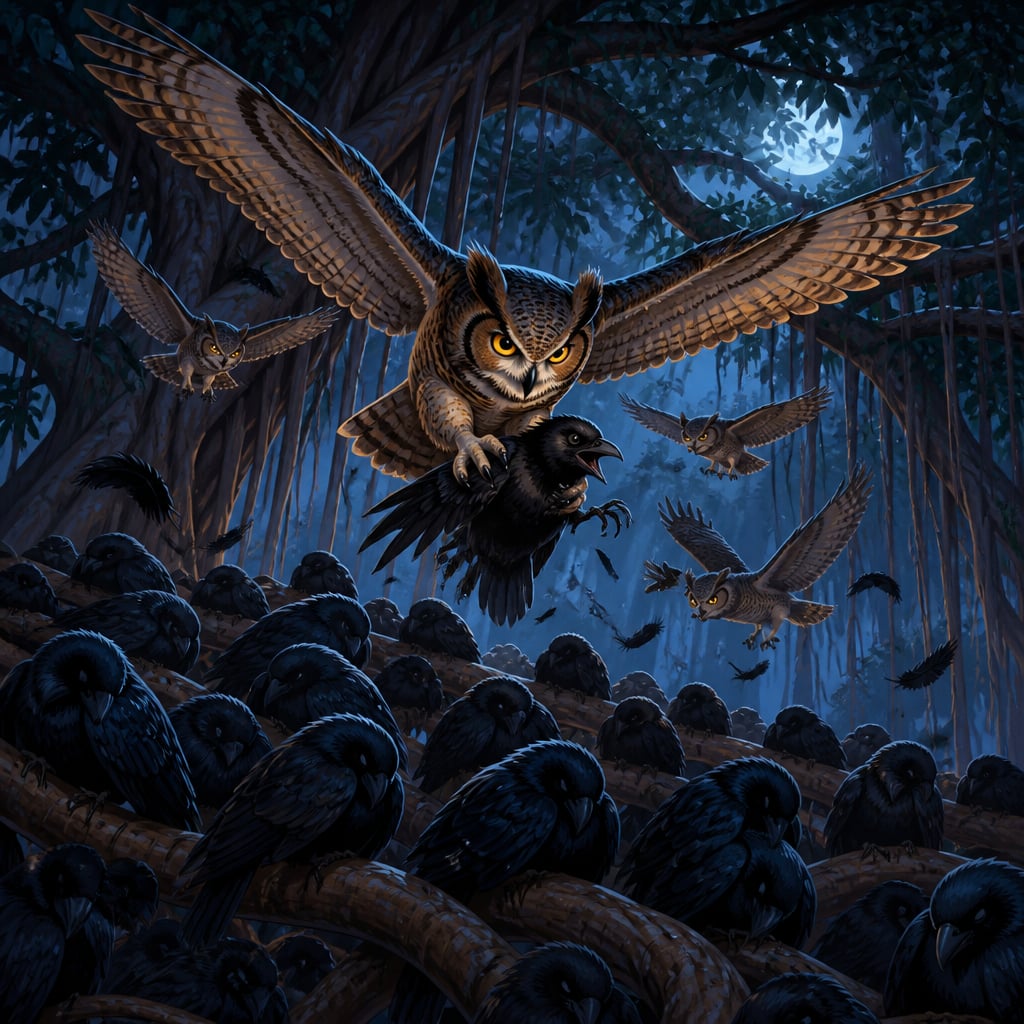
The first crow died without waking, talons through his neck before he could cry out. The second managed a single startled caw before an owl's beak silenced him forever. By the time the alarm spread through the roost, dozens were already dead.
Panic erupted. Crows flew blindly in every direction, crashing into branches, into each other, into the waiting talons of owls they could not see. The darkness that had always meant safety now meant death.
"Flee! Flee!" screamed the survivors, but where could they flee to? They could not see their attackers. They could not see the branches. They could not see anything at all.
King Megavarna, jolted awake by the chaos, tried to rally his people. "Form up! Fight back!" But his commands were useless. How could his warriors fight what they could not see?
The owls methodically worked their way through the banyan, killing at will. Only when the first gray light of dawn touched the eastern sky did they retreat, hooting in triumph as they winged back toward Gridhrakuta.
They left behind a scene of carnage. Hundreds of crows lay dead among the branches. Hundreds more were wounded. The survivors huddled in shocked silence, unable to comprehend what had happened.
The Nights That Followed
The attack was not an isolated incident. It was the first battle in a systematic campaign of terror.
Night after night, the owls returned. Sometimes they struck the main roost; sometimes they found smaller groups of crows sheltering elsewhere. Always they came in darkness, when their eyes gave them absolute advantage.
The crows tried everything. They posted more sentries, but sentries who cannot see cannot warn. They spread out to different trees, but the owls simply hunted them one group at a time. They tried staying awake all night, but exhausted birds cannot fly, cannot forage, cannot survive.
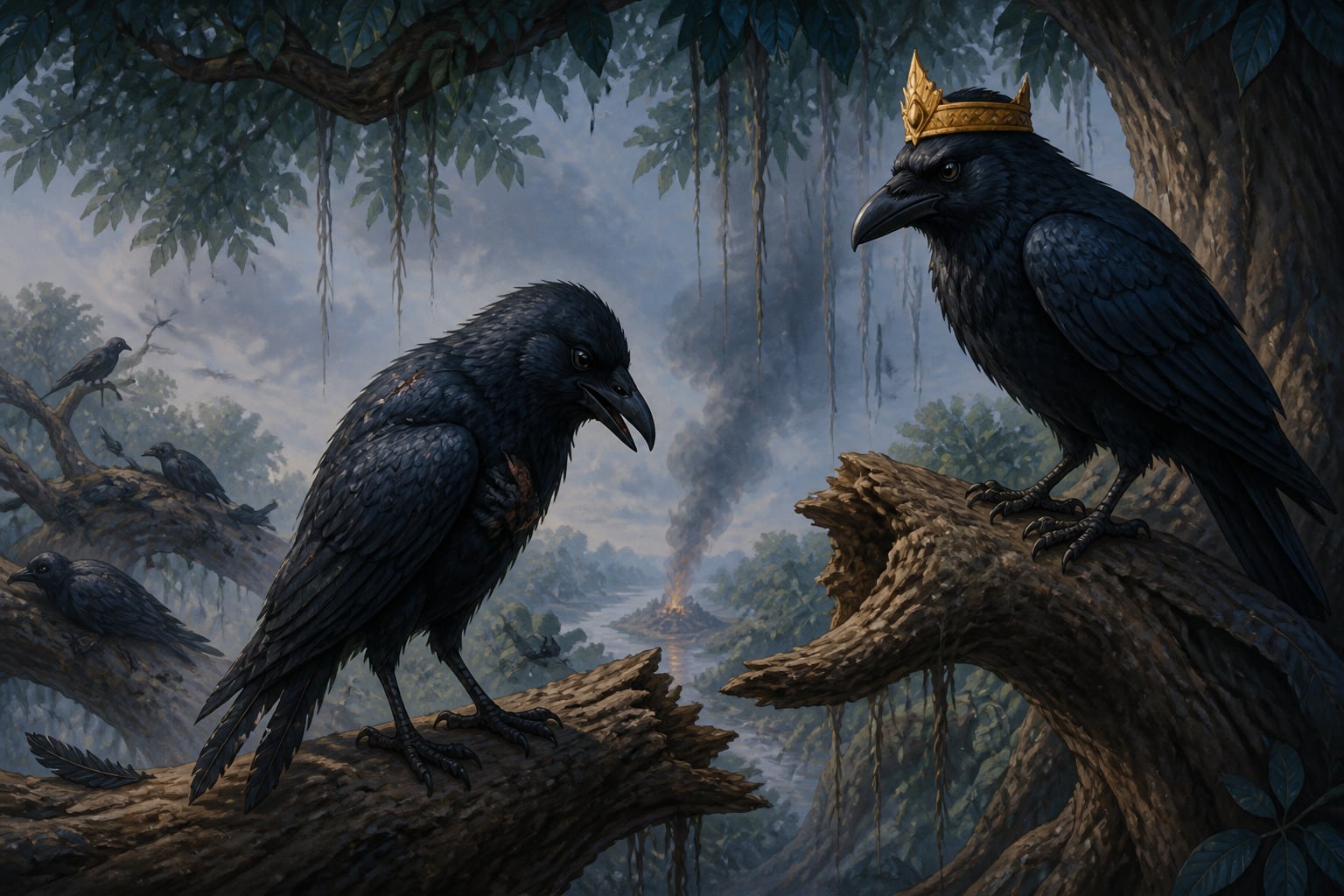
"We are being slaughtered," reported General Meghaksha, the crow army's commander, his voice heavy with despair. "Each night we lose dozens. Our people are terrified to sleep. The young and old are dying from exhaustion. At this rate, there will be no crow nation left within a season."
King Megavarna listened in grim silence. The reports grew worse each day. Entire family groups wiped out. Nesting sites abandoned. Crows fleeing the forest entirely, preferring exile to nightly terror.
"Can we not attack them during the day?" asked a young warrior. "When we can see and they cannot?"
"We have tried," replied Meghaksha. "But the owls roost deep in the caves of Gridhrakuta. The passages are narrow, dark, and easily defended. Any crow who enters is blind and vulnerable. We lose more birds trying to attack than we do defending."
"Then what can we do?"
No one had an answer.
A King's Despair
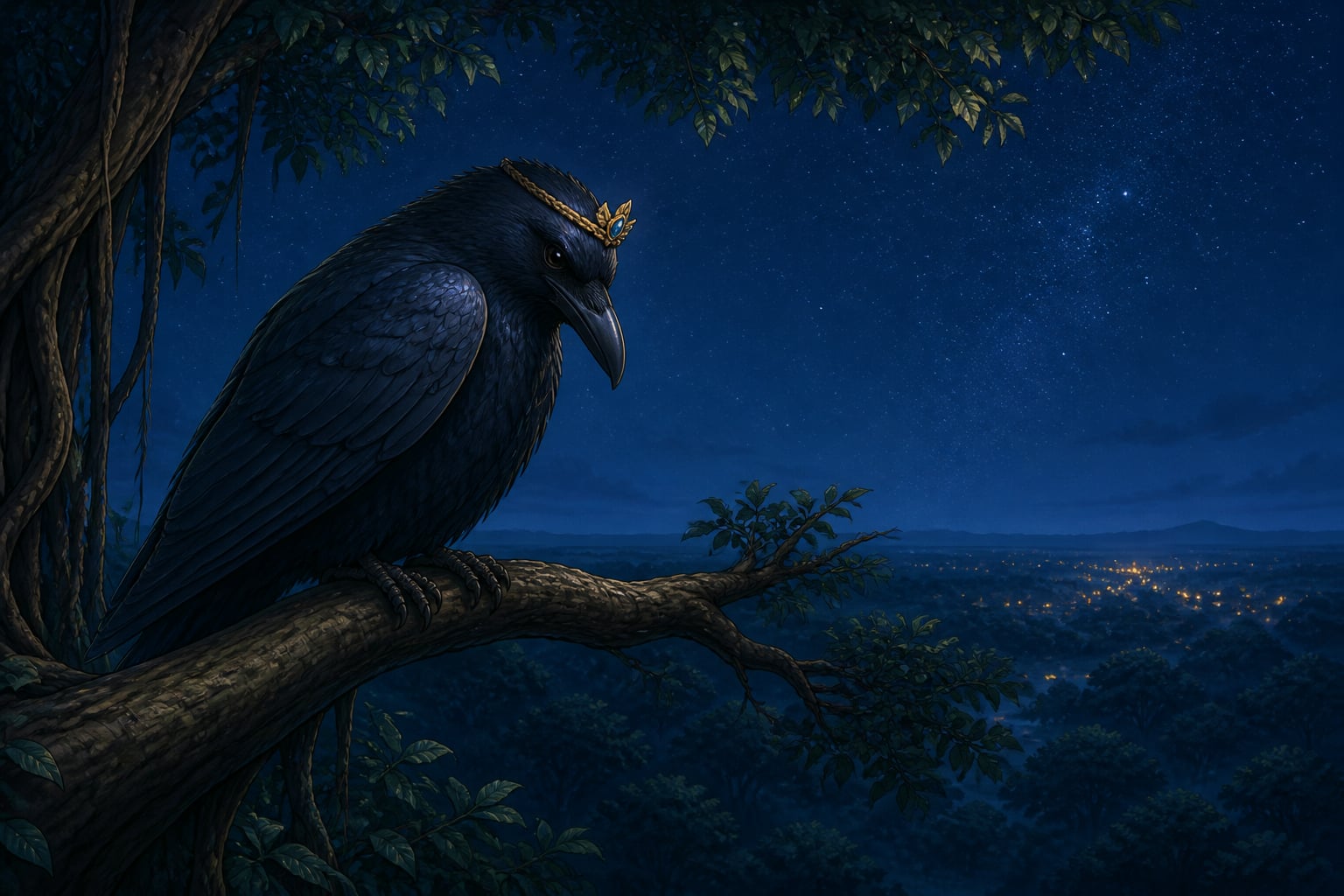
That night, King Megavarna sat alone on the highest branch of the banyan, watching the darkness gather. Somewhere out there, owl eyes were watching back, waiting for full night to begin another attack.
"I have failed my people," he whispered to himself. "I inherited this war, but I cannot fight it. Every strategy I try, every defense I mount, none of it matters against enemies who own the night."
He thought of his father, and his father's father, all the way back to the days after the great assembly. Each had fought this war. Each had believed they might end it. None had succeeded.
"Perhaps," Megavarna thought, "some wars cannot be won through battle. Perhaps there is another way."
But what other way? The owls wanted no peace. They wanted vengeance for an insult so ancient that no one living remembered the exact words. They would not stop until every crow was dead, or until they were stopped by means other than conventional warfare.
"I need counsel," the king decided. "Not from warriors, who think only of fighting. Not from diplomats, who believe every enemy can be reasoned with. I need the wisdom of those who have studied strategy in all its forms, including forms that others might consider... unconventional."
He summoned his five ministers to meet at dawn, if any of them survived the night.
The Turning Point
That night's attack was the worst yet. The owls seemed to know the crows were breaking. They pressed their advantage ruthlessly, striking from multiple directions, driving the crows from branch to branch until exhaustion made them easy prey.
But dawn came, as it always does. And when the surviving crows gathered in the morning light, something had changed.
"We cannot continue like this," King Megavarna announced to the assembled remnants of his court. "Direct combat against the owls is suicide. Our strength means nothing against their night vision. Our numbers mean nothing when we cannot coordinate in darkness."
He paused, looking at the haggard faces around him.
"Therefore, I am calling a council of ministers. Not to plan our next battle, but to find a way to end this war entirely. I want every option considered. Every strategy examined. Every possibility explored, no matter how unusual or how distasteful."
He spread his wings.
"We will not win this war by fighting it. We will win it by thinking it. And I need the wisest minds in our kingdom to show me how."
The five ministers, each famous for a different approach to problems, exchanged glances. They had never been called to council together. Each represented a different school of thought, often contradicting the others. That the king wanted all five suggested the situation was truly desperate.
Or perhaps, just perhaps, the king had a plan that required all of their wisdom combined.
Reflection
- Think of a time when you were in a competition or conflict where the other side had an advantage you couldn't match, whether in skills, resources, or circumstances. How did you handle it? Did you try to compete directly, or did you find another approach?
- King Megavarna admits his conventional approaches have failed and seeks new solutions. How hard is it to admit that what you've been doing isn't working? What makes people continue failed strategies instead of trying something new?
- The owls exploit their natural advantage ruthlessly, giving the crows no quarter. Is this wise strategy or dangerous overconfidence? When an enemy is defeated, is it better to destroy them completely or leave them a way out? What are the risks of each approach?