Shatrubhava: The Birth of Enmity
How conflicts begin
In the age when birds chose their king, an ancient insult sparked eternal war between crows and owls. This lesson reveals how a single moment of mockery created hatred that would burn across generations, and teaches us how conflicts truly begin.
The Third Tantra Begins
In the great forest of Mahilaropya, where we have learned of friendships broken and wisdom won, there stands a mountain called Gridhrakuta, the Vulture's Peak. Upon its rocky slopes, in caves and crevices carved by ancient winds, dwelt the nation of owls, ruled by their fierce king Arimardana, whose name means "Crusher of Enemies."
Not far away, in the spreading branches of an enormous banyan tree, lived the nation of crows, led by their wise king Megavarna, the "Cloud-Colored One." For as long as any creature could remember, crows and owls had been enemies. They fought without mercy, without negotiation, without any hope of peace.
But why? What had begun this endless war?
The answer lies in events that happened long, long ago, in the age when all birds were one kingdom, and when they gathered to choose their first king.
The Assembly of Birds
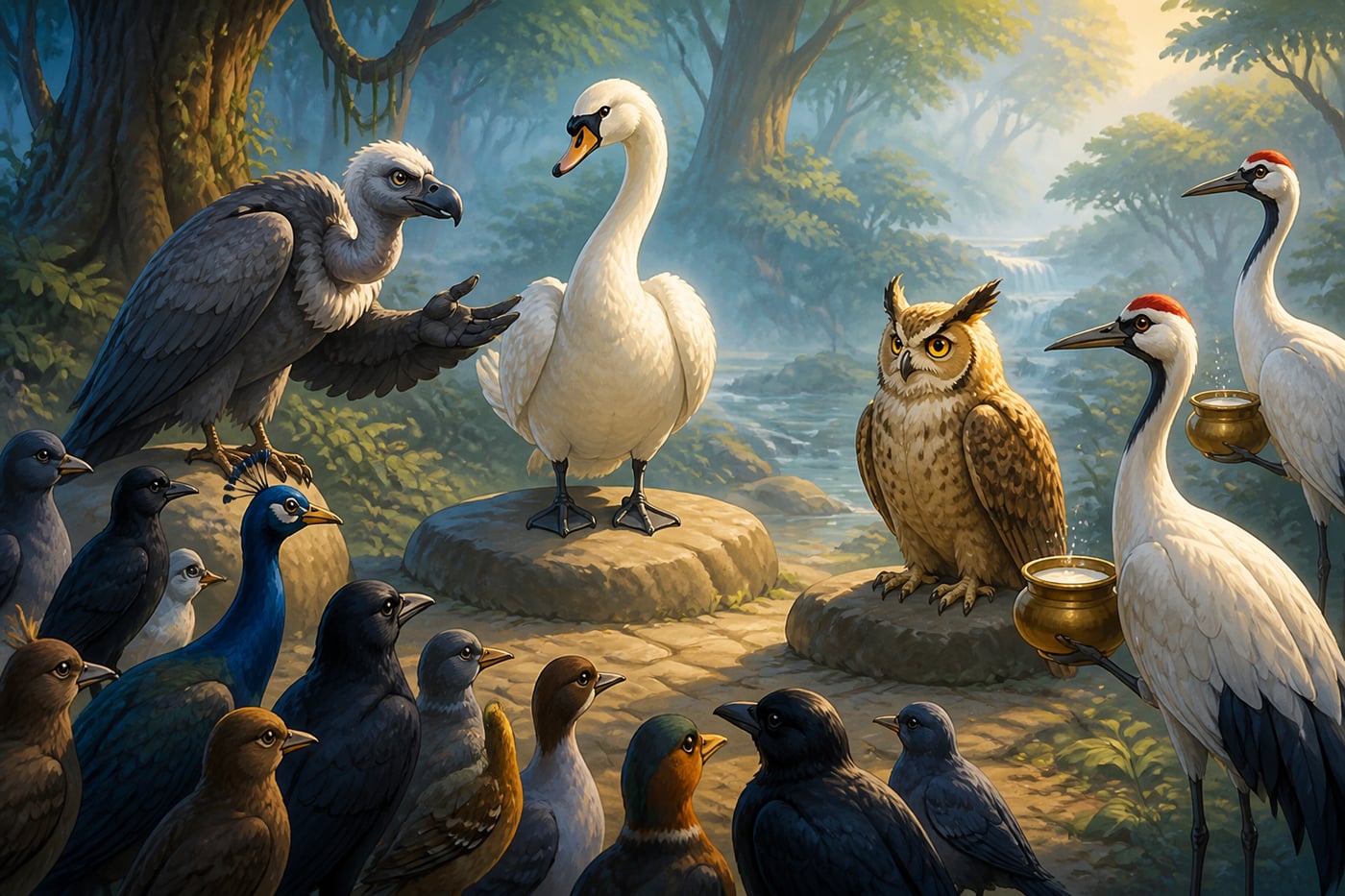
In the beginning of the world, the birds had no ruler. They lived freely but without order, and when disputes arose, there was no one to settle them. Finally, the wisest among them called for a great assembly.
"We must choose a king," declared the ancient swan. "Look at how other creatures live. The lions rule the beasts. The serpents have their kings. Even the fish in the sea follow their leaders. Only we birds fly without direction, squabble without resolution, and suffer without protection."
The birds agreed. From every corner of the sky they came, eagles and sparrows, peacocks and pigeons, vultures and hummingbirds. They gathered on a vast plain, their numbers darkening the earth like a living carpet of feathers.
"Who shall be our king?" asked the swan. "Speak, and let us decide."
Many names were proposed. The eagle, for his strength. The peacock, for his beauty. The parrot, for his cleverness with words. But one by one, each candidate was found wanting. The eagle was too cruel. The peacock was too vain. The parrot could only repeat what others said.
Then an old vulture spoke. "What of the owl? He sees in darkness when all others are blind. He is wise and patient. He strikes without warning. Surely such qualities make a worthy king."
A murmur of approval ran through the assembly. The owl, yes, the owl might serve well. None could deny his hunting prowess or his mysterious wisdom. Preparations began at once for the coronation.
Servants brought sacred water from holy rivers. A throne was constructed of woven branches. Priests began chanting the mantras of royal consecration. The owl sat before them, silent and dignified, waiting to receive the crown.
And then a crow landed.
The Crow's Mockery
He was just an ordinary crow, black-feathered, sharp-eyed, and possessed of a tongue as cutting as his beak. He had arrived late to the assembly and knew nothing of the deliberations. But when he saw the owl sitting upon the makeshift throne, with holy water being prepared and priests chanting, he burst into harsh, mocking laughter.
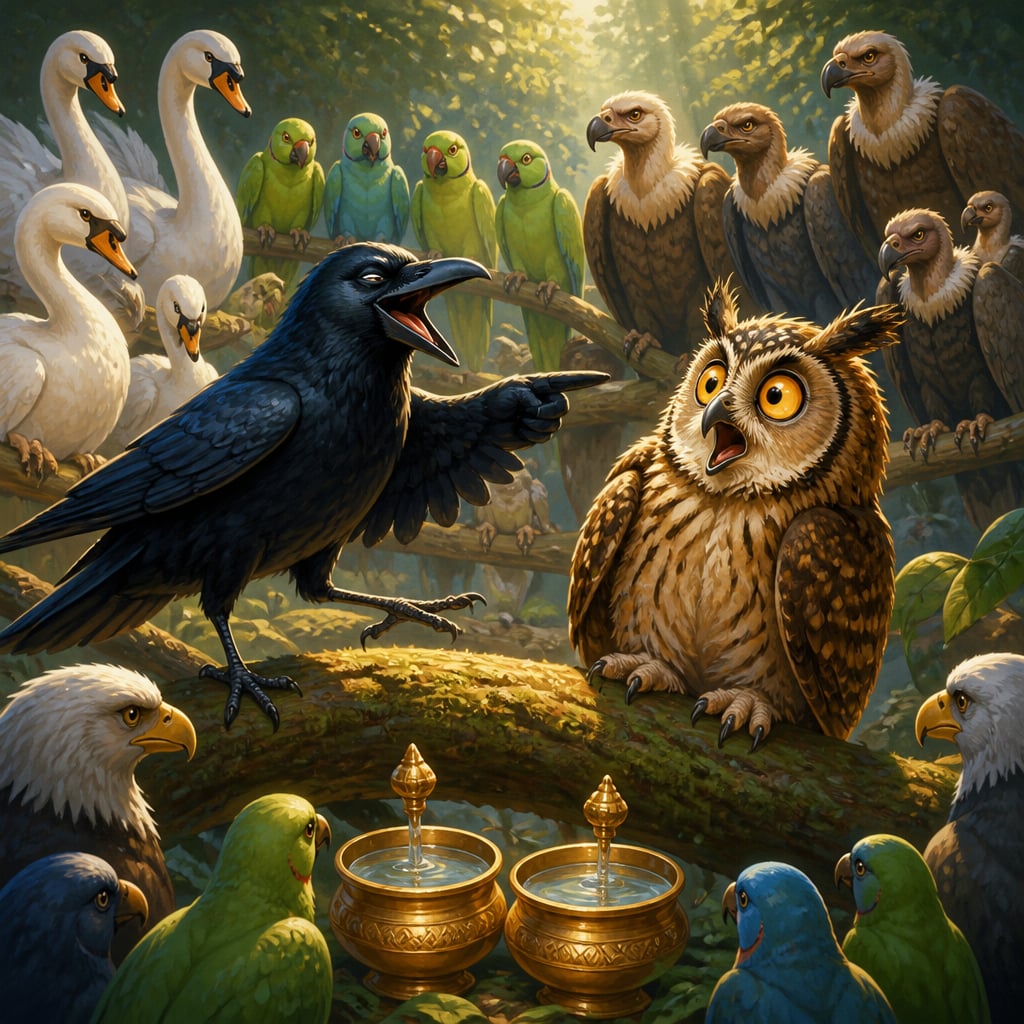
"What is this absurdity?" he cawed. "You mean to crown this creature king? Look at him! Those bulging eyes that see nothing by day! That flat face like a curse pressed into feathers! You would make this ugly, night-skulking, rat-eating thing the ruler of all birds?"
The assembly fell silent. The owl's eyes, those large, golden eyes that had seemed so wise moments before, now appeared strange and unsettling.
"Consider what you are doing!" continued the crow, warming to his theme. "By day, when most of us are active, the owl is blind and helpless. He cannot lead us in daylight, cannot judge our disputes under the sun, cannot even find his way from one branch to another! Will you choose a king who must hide from the very light of day?"
He strutted before the assembly, his voice dripping with contempt.
"And look at his face! Among all birds, is there any more ill-omened? When humans see an owl, they consider it a sign of death and disaster. Will we choose a king whose very appearance brings bad luck? We have the golden eagle, the magnificent peacock, the clever parrot, and you would pass over all of these for this... this demon-faced creature of the darkness?"
The crow laughed again, and this time, some of the other birds laughed with him. The mood of the assembly shifted. The owl's supporters began to look uncertain. The priests stopped their chanting. The sacred water sat unused.
"I propose we abandon this farce," declared the crow. "Let us choose no king at all rather than crown this grotesque mockery of a bird."
The Wound That Never Healed
The assembly dissolved in confusion. Some birds agreed with the crow; others defended the owl; most simply flew away, tired of the endless debate. No king was chosen that day, nor for many days after.
But the owl did not forget.
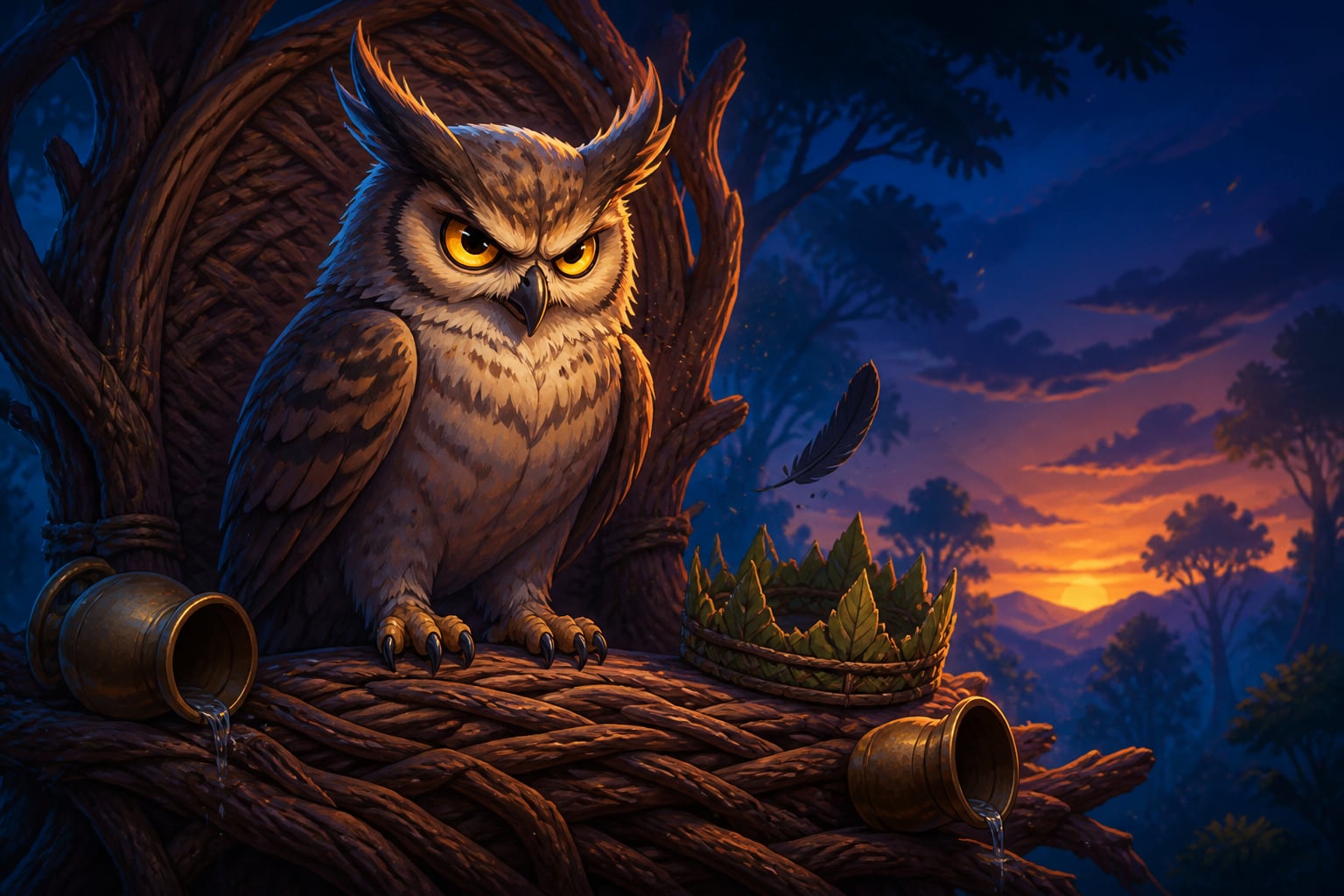
He sat on his throne of branches long after everyone had left, the sacred water drying in its vessels, the priests departed, the crown unclaimed. In the silence of that empty plain, hatred was born in his heart, a hatred as cold and patient as the owl himself.
"The crow has humiliated me before all birds," he spoke into the darkness. "He has stolen my crown with his mockery. He has made me a laughingstock for all eternity. This insult I will never forgive. This wrong I will never forget."
He spread his great wings and flew into the night.
"From this day forward," he swore, "crows and owls are enemies. No crow shall ever be safe from owl-kind. We shall hunt them, harass them, kill them wherever we find them. What the crow began with words, we shall finish with blood. And this war shall not end until the last crow or the last owl lies dead."
And so it was. The owl who would have been king returned to his people and told them of the crow's insult. He commanded them to attack crows without mercy. His children were raised on hatred, and their children after them. Generation after generation, the war continued.
The crow who had spoken so mockingly that day, he too returned to his people, bewildered by the violence that followed. "I only spoke the truth," he said. "I only said what everyone was thinking."
But truth spoken cruelly is its own kind of lie. And words, once released, cannot be recalled.
The Lesson of Origins
This is how the great war between crows and owls began, not with armies or territory or resources, but with an insult. A single moment of public humiliation, a few sentences of mockery, and two species were locked in eternal conflict.
"Remember this," say the wise, "when you are tempted to mock another in public. The owl may have been an unworthy king, but the crow's words created a worthy enemy. What might have been settled in a moment of kindness was instead sealed in generations of blood."
In the forest of Mahilaropya, in the shadow of Vulture's Peak, the war continues still. King Megavarna of the crows and King Arimardana of the owls prepare their forces. Neither remembers the original insult, but both have inherited its hatred.
The story of their war, and the wisdom it teaches about conflict, strategy, and the price of victory, begins now.
Reflection
- Think of a time when someone's words hurt you deeply, not because they were false, but because of how they were delivered. How did that experience affect your relationship with that person? What would have been different if they had said the same thing more kindly?
- The crow believed he was speaking the truth about the owl's unsuitability as king. Was he wrong to speak up? Is there a way he could have expressed his concerns without creating a permanent enemy? When does honest criticism become harmful mockery?
- The owl's descendants hate crows for something that happened generations ago. Is it ever right to inherit hatred? Are there situations where remembering historical wrongs is important, or should we always try to start fresh? How do we balance learning from history with not being trapped by it?