Mantrana: Strategic Council
Seeking wise counsel in crisis
King Megavarna summons his five ministers, each representing a different strategic approach. As they debate peace, war, retreat, and alliance, the wisest among them, old Sthirajivin, proposes a plan so unconventional that it shocks even the desperate king.
The Council Convenes
In the gray light of dawn, five crows gathered on a secluded branch far from the main roost. They were the king's ministers, each famous throughout the crow nation for a particular kind of wisdom.
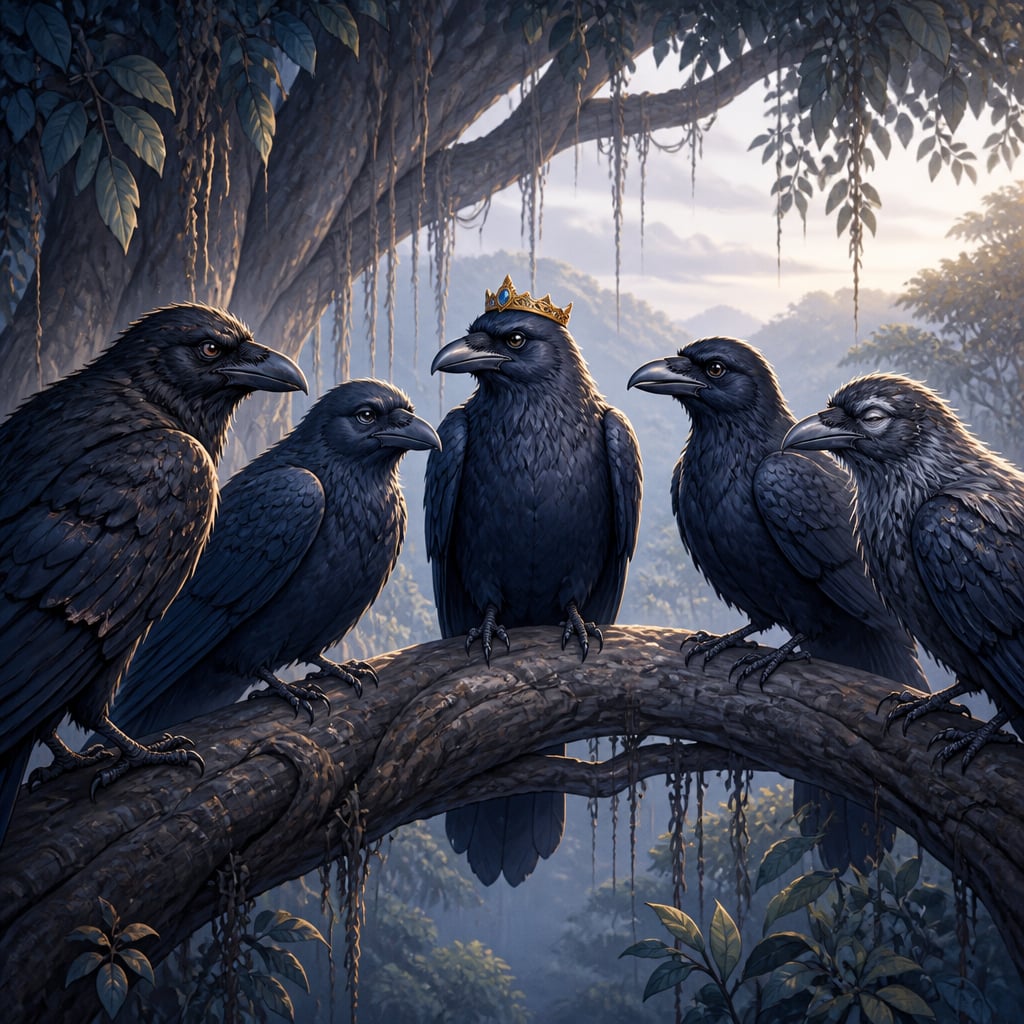
King Megavarna had chosen his council carefully. He did not want agreement; he wanted options. He did not want comfort; he wanted truth. And so he had summoned five minds that rarely agreed on anything.
"My ministers," the king began, "you know our situation. The owls have advantages we cannot match. Our people die each night. Conventional warfare is failing. I have called you here not to repeat strategies that have failed, but to find a path forward, whatever that path may be."
He looked at each of them in turn.
"Speak freely. Hide nothing. The survival of our people depends on the wisdom you share today."
The Five Opinions
The first minister was Uddhvamsin, known as "the Destroyer." He was old but fierce, a veteran of many battles against the owls.
"We must fight!" he declared. "I know we are losing, but surrender is not an option. The owls will never accept peace, they want our extinction. Our only choice is to fight harder, smarter, with every crow who can fly. Better to die fighting than to be slaughtered in our sleep."
"And how do you propose we fight harder?" asked the second minister, Sandhiman, called "the Peacemaker." His voice was gentle, almost sorrowful. "We have tried fighting. We have tried defending. We have tried everything warriors can try. Our people are exhausted, terrified, dying. Perhaps... perhaps the time has come to seek peace."
"Peace?" Uddhvamsin's feathers rose in outrage. "With owls? They will never, "
"They might," Sandhiman interrupted. "If we offer them something they value. Territory, perhaps. Tribute. Public apology for the ancient insult. I know it wounds our pride, but pride is a poor shroud for the dead."
The third minister, Anuvartita, was called "the Follower." He was known for building alliances and finding common ground.
"Neither war nor peace alone will save us," he said thoughtfully. "What we need are allies. Surely other birds suffer from owl aggression? The doves, the sparrows, the small birds who fear the night hunters, perhaps we could unite them against our common enemy. Together, we might have strength we lack alone."
"And if no allies will join us?" asked the fourth minister, Prajnapti, "the Wise One," who was famous for his caution.
"Then perhaps we should retreat," he said slowly. "Leave this forest entirely. Find a new home where owls do not hunt. The world is vast, surely there are places beyond the reach of owl hatred. Better to live elsewhere than to die here."
"Abandon our ancestral home?" King Megavarna's voice was pained. "Our families have nested in this banyan for generations."
"Dead crows need no nests, my king."
Silence fell over the council. Four strategies had been proposed: war, peace, alliance, retreat. Each had merit. Each had flaws. The king looked toward the fifth minister, who had not yet spoken.
The Fifth Minister Speaks
Sthirajivin was the oldest of them all. His name meant "long-lived one," and indeed he had survived more seasons than any crow in living memory. His feathers were gray with age, his eyes clouded, his movements slow. But his mind remained sharp as a talon.
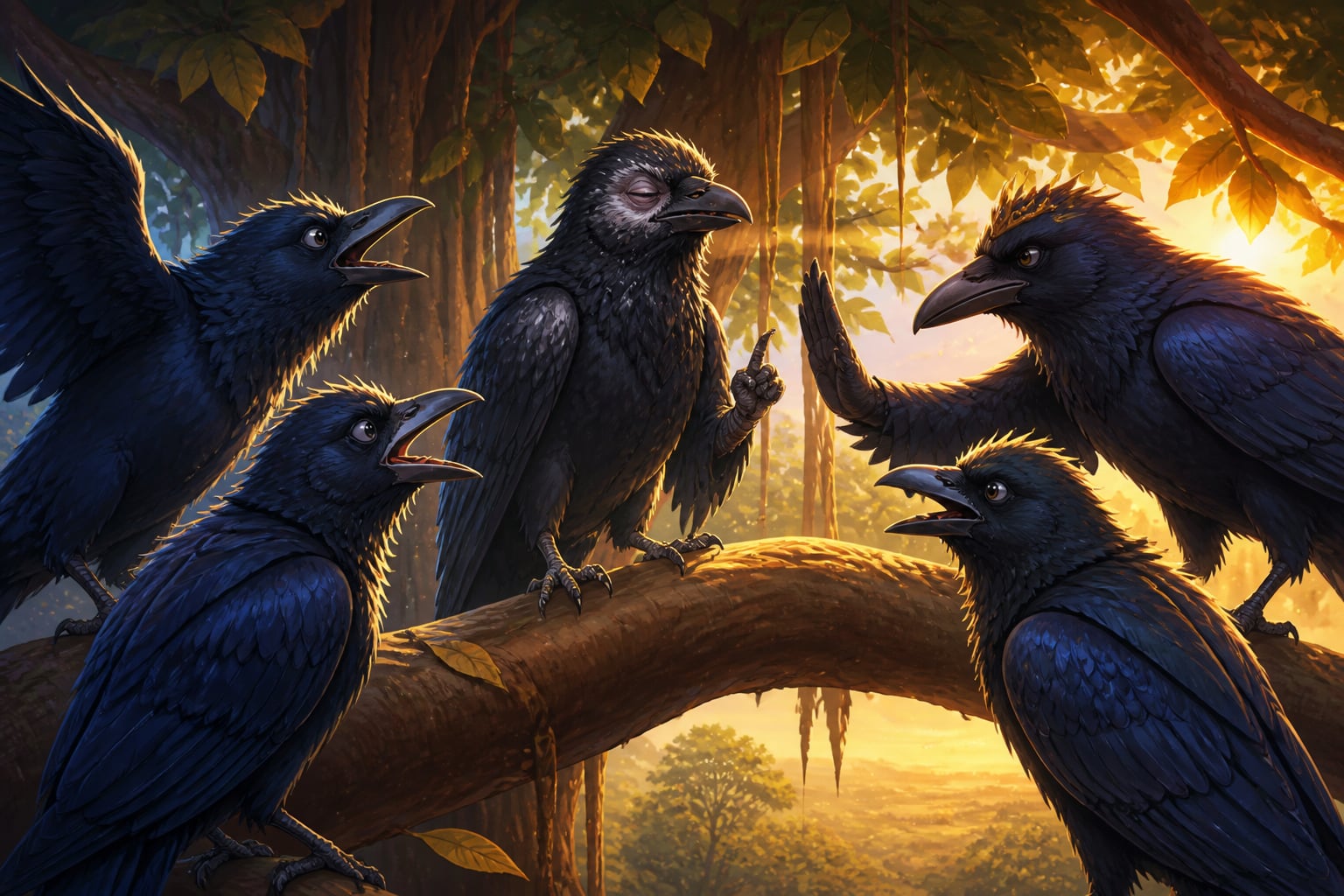
"The young ministers speak of fighting, fleeing, negotiating, allying," he said, his voice soft but carrying. "These are the four traditional responses to conflict. But there is a fifth way, one that the ancient texts describe but that few have the courage to attempt."
The other ministers exchanged glances. What fifth way?
"The owls have one critical weakness," Sthirajivin continued. "They are overconfident. They believe their night advantage makes them invincible. They believe we have no secrets, no plans, no capacity for deception. They underestimate us because they have beaten us so easily."
"How does their overconfidence help us?" asked the king.
"Because overconfident enemies can be manipulated. They accept what they expect to see. They trust information that confirms their superiority. They welcome what appears to strengthen them." The old crow's clouded eyes seemed to gleam. "My king, what if we gave the owls exactly what they want, a traitor?"
"A traitor?"
"A crow who appears to have betrayed his people. Who offers to serve the owl king. Who brings information, guidance, access. The owls would welcome such a gift. They would never suspect that the 'traitor' was actually a spy, feeding them false information, learning their secrets, waiting for the perfect moment to strike."
The council erupted in protest.
"Deception is dishonorable!" cried Uddhvamsin.
"It would never work!" objected Sandhiman.
"Who would volunteer for such a mission?" demanded Anuvartita.
"The risks are incalculable!" warned Prajnapti.
But King Megavarna raised a wing for silence. His eyes were fixed on the old minister.
"Continue, Sthirajivin. Tell me more of this plan."
The Strategy Revealed
"The plan requires sacrifice," said Sthirajivin. "The volunteer must be willing to be hated by his own people, for the deception to work, even most crows must believe him a genuine traitor. He must live among enemies who would kill him instantly if they suspected. He must endure exile, loneliness, and constant danger."
"What volunteer would accept such terms?"
"One who loves his people more than his reputation. One who is willing to be remembered as a traitor so that his nation might survive." Sthirajivin paused. "Such crows are rare. But they exist."
"And if this spy succeeds in infiltrating the owl court, what then?"
"Then he learns everything. Where they sleep, how they organize their attacks, what they fear. He builds trust over time, becoming valued, even essential. And when the moment is right, when we know enough to strike at their heart, he acts."
"How?"
Sthirajivin smiled grimly. "The owls roost in caves during the day. Dry caves filled with dry wood and dry feathers. If someone were to introduce fire into those caves at midday, when the owls are blind and sleeping..."
The council fell silent as the implications sank in.
"You speak of burning them alive," said Sandhiman, his voice barely a whisper.
"I speak of survival," replied Sthirajivin. "They have shown us no mercy. They attack our sleeping children. They slaughter our elderly. They have made it clear they will not stop until every crow is dead. I propose we end them first, not through battle, which we cannot win, but through infiltration and fire."
"It is... extreme," said the king slowly.
"So is extinction."
The King's Decision
King Megavarna sat in silent thought for a long time. Around him, his ministers waited. The sun rose higher, warming their feathers, another day of temporary safety before the terror of night returned.
Finally, the king spoke.
"Uddhvamsin counsels war, but we have tried war and failed. Sandhiman counsels peace, but the owls have refused all overtures. Anuvartita counsels alliance, but we have no allies willing to die for us. Prajnapti counsels retreat, but where can we go that owl hatred will not follow?"
He turned to the fifth minister.
"Sthirajivin alone offers a path to victory rather than mere survival. His plan is dangerous. It requires deception, patience, and an iron will. It asks one of us to sacrifice everything, honor, home, the love of his people, for a chance to save us all."
The king's voice hardened.
"I accept this counsel. We will find our volunteer. We will execute this strategy. And either we will end this war forever, or we will die trying. But we will not simply wait to be hunted to extinction."
He looked at his ministers.
"Now, who among you knows a crow brave enough, clever enough, and dedicated enough to become the greatest traitor our people have ever known?"
Sthirajivin smiled.
"My king... I believe I know just the crow."
Reflection
- Think of a time when you had to make an important decision and sought advice from others. Did you seek people who agreed with you, or people who challenged your thinking? What did you learn from that experience?
- Each minister offered a different strategy: fight, negotiate, ally, retreat, or deceive. If you were King Megavarna, which would you have chosen? Why? What does your choice reveal about your own values and assumptions?
- Sthirajivin's plan involves deception, presenting a false traitor to trick the enemy. Is deception in warfare ever justified? What about in other areas of life? Where do we draw the line between clever strategy and unethical manipulation?