Dyuta: The Gambler's End

Sahadeva kills Shakuni

For thirteen years, Sahadeva has carried a vow: to kill Shakuni, the uncle whose loaded dice destroyed his family's honor and kingdom. Now, on the final day of war, with Shalya fallen and the Kaurava army crumbling, the youngest Pandava finally faces the master gambler. But Shakuni has one more game to play, and this time, the stakes are his own life.

The Architect of Ruin

Every tragedy needs its architect.

The Mahabharata war that consumed millions of lives, that turned brothers against brothers and sons against fathers, that drowned Kurukshetra in blood for eighteen days, all of it could be traced back to one man and one game.

Shakuni, the King of Gandhara, the master of dice, the uncle who loved his nephew Duryodhana more than he loved dharma.

Now, with Shalya dead and the Kaurava army in its death throes, Shakuni still fought on. His chariot wove through the chaos of the final day, his banner, a gambling die, still flying above the carnage. He was old, he was not particularly skilled in combat, but he was still dangerous.

Because Shakuni never played fair.

The Vow Remembered

Across the battlefield, Sahadeva saw that banner and felt something cold and hard settle in his chest.

Thirteen years.

For thirteen years, he had carried the memory of that day in the Sabha, the dice game where his eldest brother had lost everything. The kingdom. The brothers. Draupadi herself. Each roll of the dice had been another wound, and Sahadeva had known, even then, that the dice were not honest.

"I vow to kill Shakuni," he had said on that terrible day, even as they dragged Draupadi by her hair into the assembly. "For what he has done today, I will take his life."

He had been the youngest then, barely more than a boy. Now he was a warrior blooded by eighteen days of slaughter, and his target was finally within reach.

The Hunt

Sahadeva guided his chariot toward Shakuni's banner. Around him, the remnants of the Kaurava army were disintegrating. With Shalya dead, there was no command structure left. Warriors fought in isolated pockets, each man for himself.

But Shakuni was not fleeing.
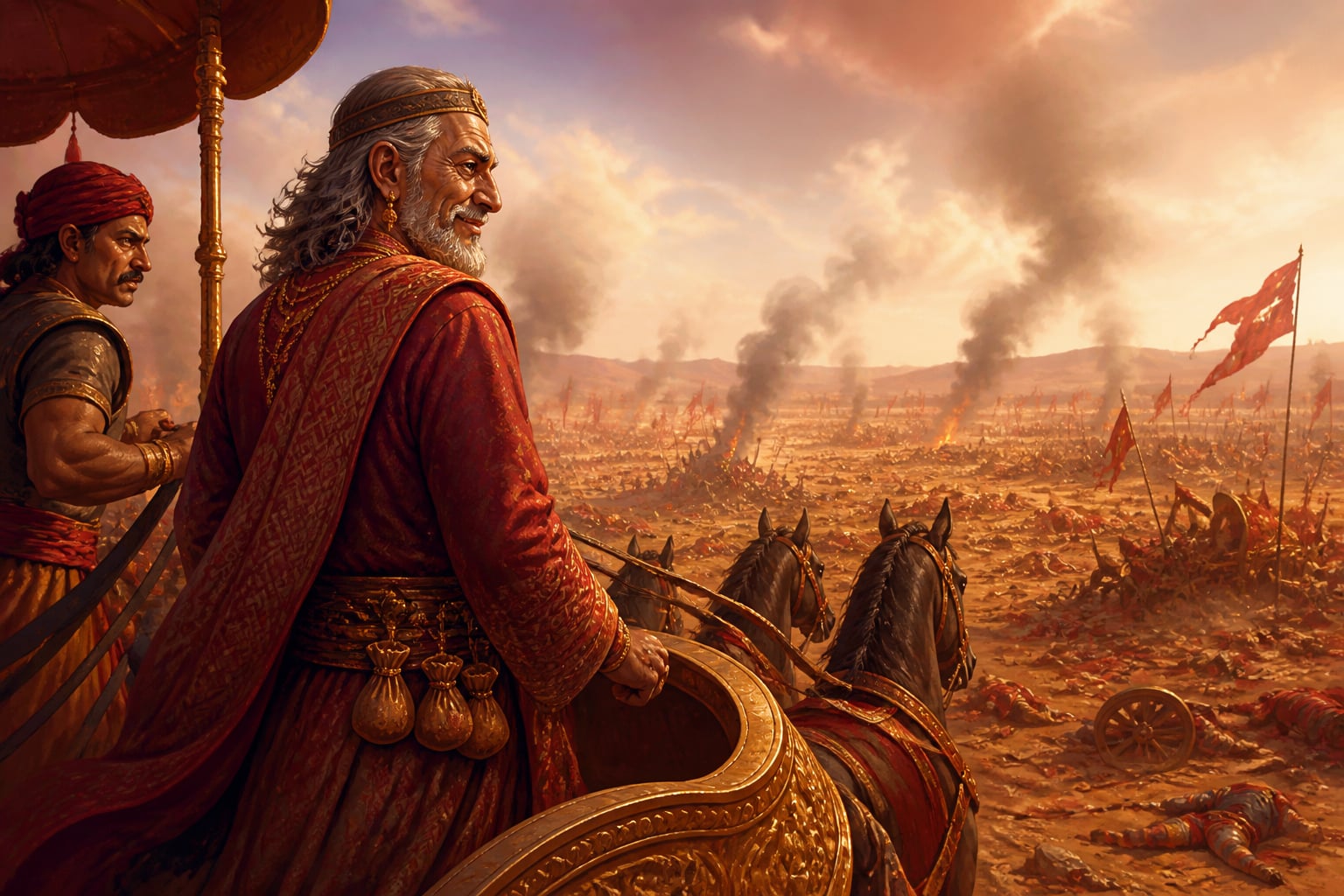
Shakuni watches the dying Kaurava ranks from a rise

The old gambler had stopped his chariot on a small rise, watching the battlefield with calculating eyes. He saw Sahadeva approaching, saw the determination in the young Pandava's face, and smiled.

One last game, Shakuni thought. Let us see how this one plays out.

The Gambler's History

Shakuni was not born evil.

He came from Gandhara, a kingdom far to the northwest, wealthy from trade routes, cultured, sophisticated. His sister Gandhari had been married to Dhritarashtra, the blind prince of Hastinapura, in a political alliance. But the marriage had come with humiliation: Gandhari, learning she would wed a blind man, had blindfolded herself forever.

What happened next was disputed. Some said Bhishma had imprisoned Shakuni's father and brothers, feeding them so little that only one could survive. The dying king had given his bones to Shakuni, bones that were fashioned into dice that would always fall as their user wished.

Other versions told simpler stories: a cunning man who saw his nephew Duryodhana's weakness and exploited it, feeding the prince's jealousy until it became poison.

Whatever the truth, the result was the same: Shakuni had dedicated his life to destroying the Kuru dynasty from within.

"I will make them tear each other apart," he had reportedly vowed. "Cousin against cousin. Brother against brother. Until nothing remains."

He had succeeded beyond his darkest dreams.

Face to Face

Sahadeva's chariot stopped thirty paces from Shakuni's.

For a long moment, the two men simply looked at each other. The young warrior, barely past thirty, his face still capable of showing emotion. The old schemer, his face a mask that had hidden his thoughts for decades.

"So," Shakuni said, "the youngest Pandava comes himself. I had thought Bhima would claim my life, he seems to enjoy killing uncles."

"Bhima has other work," Sahadeva replied. "You are mine."

"Yours?" Shakuni laughed, a thin, reedy sound. "I remember you from the Sabha. You were the one who wept. Such a tender heart for a Kshatriya."

"I remember the Sabha too." Sahadeva's voice was steady. "I remember Draupadi dragged before the court. I remember you laughing as my brothers lost everything. I remember the dice that never fell wrong."

"The dice fell as they fell."

"The dice fell as you made them fall." Sahadeva raised his sword. "Today, uncle, you face a game where the outcome cannot be fixed."

The Battle

Shakuni was not a great warrior, everyone knew this. He had survived the war by cunning, by staying behind stronger fighters, by knowing when to retreat. His skills lay in manipulation, not combat.

But he was not helpless.

As Sahadeva charged, Shakuni's chariot began to move, not toward the Pandava, but in a complex pattern designed to keep distance between them. His charioteer was skilled, his horses fresh, and Shakuni himself hurled throwing weapons with surprising accuracy.

A dart struck Sahadeva's shield. Another grazed his arm.

He is trying to tire me out, Sahadeva realized. To make me chase until I am exhausted, then escape in the confusion.

But Sahadeva was the son of the Ashwini Kumaras, the divine twins who represented skill, speed, and cleverness. He was not merely a warrior; he was the most intelligent of the Pandavas, a master of astrology and medicine. He could see patterns too.

He stopped chasing.

Instead, he positioned his chariot at an angle, predicting where Shakuni's evasive pattern would bring him. When the gambling king's chariot curved around for another pass, Sahadeva was waiting.

Sahadeva cuts the traces of Shakuni's chariot horses

His sword cut the traces of Shakuni's horses.

The chariot lurched, stopped, and for the first time in decades, Shakuni found himself unable to run.

The Reckoning

Shakuni drew his own sword, an ornate weapon, more ceremonial than practical. His hands were steady, but his eyes showed the first flicker of genuine fear.

"You cannot kill me," he said. "I am your uncle, Gandhari's brother. Would you add kinslaying to your crimes?"

"Kinslaying?" Sahadeva's laugh was bitter. "You destroyed our family with weighted dice. You turned brother against brother. You are responsible for every death on this field, including your own hundred nephews. Do not speak to me of kinslaying."

"I did what was necessary."

"Necessary?" Sahadeva advanced, sword raised. "Necessary for what? Your sister married our grandfather's heir. She was Queen of Hastinapura. What more did you want?"

For a moment, something genuine flickered across Shakuni's face, old pain, old rage.

"They humiliated her. They made her marry a blind man without telling her. They used Gandhara like a pawn in their games." His voice shook. "I wanted them to suffer as we suffered. As she suffered."

"And now?" Sahadeva gestured at the battlefield around them, the corpses, the broken chariots, the crows already gathering. "Are you satisfied?"

Shakuni looked at the devastation. For one moment, his mask slipped entirely. There was no triumph in his eyes. Only exhaustion. Only an old man who had gotten exactly what he wanted and found it tasted like ash.

"No," he whispered. "No, I am not satisfied. I thought I would feel... something. Instead I feel nothing. Only tired."

"Then let me give you rest."

The End of Games

Shakuni raised his sword in a final, futile defense. He was not a warrior, had never been a warrior, and Sahadeva's blade was faster, surer, driven by thirteen years of waiting.

The strike was clean. The master gambler fell.

Sahadeva swings his straight sword mid-strike at Shakuni amid a corpse-strewn battlefield, the fallen golden dice pouch at the old gambler's belt as the killing blow lands.

Sahadeva stood over the body, breathing hard. Around him, the battle continued, the sounds of dying men, the clash of weapons, the screams of horses, but for this moment, there was only silence in his heart.

It is done. The man who destroyed us is dead.

He waited for satisfaction. For the sense of closure that thirteen years of hatred should have earned.

It did not come.

The Hollow Victory

Instead, Sahadeva felt only weariness. Shakuni lay at his feet, an old man with blood soaking into his fine robes. His sword had fallen from his hand, the ornate weapon looking absurd, like a child's toy.

He was not a demon. He was just a man. An angry, broken man who let his grief become poison.

Sahadeva thought of his own mother, Madri, who had died when he was a baby. He thought of his uncle Shalya, just killed by Yudhishthira. He thought of all the uncles, by blood or marriage, who had been swept away by this war.

"You won nothing," he said to Shakuni's corpse. "Your revenge destroyed you along with everyone else. I hope it was worth it."

The corpse, of course, said nothing.

The Final Princes

With Shakuni dead, the last organized resistance collapsed.

The remaining sons of Dhritarashtra, those few that Bhima had not yet found, fell one by one as the afternoon wore on. Uluka, Shakuni's own son, died trying to avenge his father. Sushasana fell to Bhima's mace. The Kaurava generals who had survived the previous seventeen days met their ends in the chaos.

By late afternoon, of the eleven akshauhinis that had marched under Duryodhana's banner, only scattered survivors remained. The Kaurava army had ceased to exist as a fighting force.

But one man remained.

The Search for Duryodhana

Duryodhana was not among the dead.

The Pandavas searched the battlefield as the sun began its descent. They found bodies beyond counting, friends, enemies, strangers, but not the Kaurava king.

"Where is he?" Bhima growled. "Where is the snake who started all this?"

"He has fled," Arjuna said. "Perhaps to the north, toward, "

"No." Nakula pointed toward a distant lake, its waters glinting in the evening light. "Look there. Those are his guards, what remains of them."

A handful of Kaurava soldiers had formed a perimeter around the lake's edge. They were wounded, exhausted, clearly preparing to die, but they would not move.

"He is in the lake," Yudhishthira said quietly. "Hiding beneath the waters. Using some maya to breathe, perhaps. Waiting for night, when he can slip away."

"Then we go to him," Bhima said, his mace already rising.

"Not yet." Krishna's voice was calm. "Let him hide a while longer. Let him feel what it is to be hunted. Let him know that there is nowhere left to run."

The Pandavas made camp within sight of the lake. The sun set on the eighteenth day, the last sunset the world would see as it had been. Tomorrow would bring a new order, built on the bones of the old.

But first, they had to dig Duryodhana out of his hiding place.

And finish what the dice game had started.

Living traditions

In modern Indian discourse, 'Shakuni' has become shorthand for a scheming manipulator, someone who works behind the scenes to set others against each other while keeping their own hands clean. The term is used in politics, business, and social commentary to describe people who benefit from conflict they've secretly engineered. Understanding Shakuni's character helps people recognize similar patterns in contemporary life.

Reflection

More in Shalya Parva

All lessons in Shalya Parva · The Mahabharata course