Antim Divas: The Final Dawn
Day eighteen, Shalya commands
With Karna fallen and the Kaurava army shattered, the eighteenth and final dawn of Kurukshetra breaks over a battlefield of ghosts. Duryodhana turns to his last commander, Shalya, the King of Madra, a reluctant warrior fighting against his own nephews. As the sun rises on the war's final day, both armies know that by sunset, the world will have changed forever.
The Silence After Thunder
The seventeenth night was the longest of the war.
Karna was dead. The son of the Sun, the greatest warrior Duryodhana had ever known, lay somewhere on that blood-soaked field, his golden armor, once divine, then surrendered to Indra, now dull with dust and death. The man who had promised victory, who had sworn to kill Arjuna or die trying, had fulfilled only the second half of his vow.
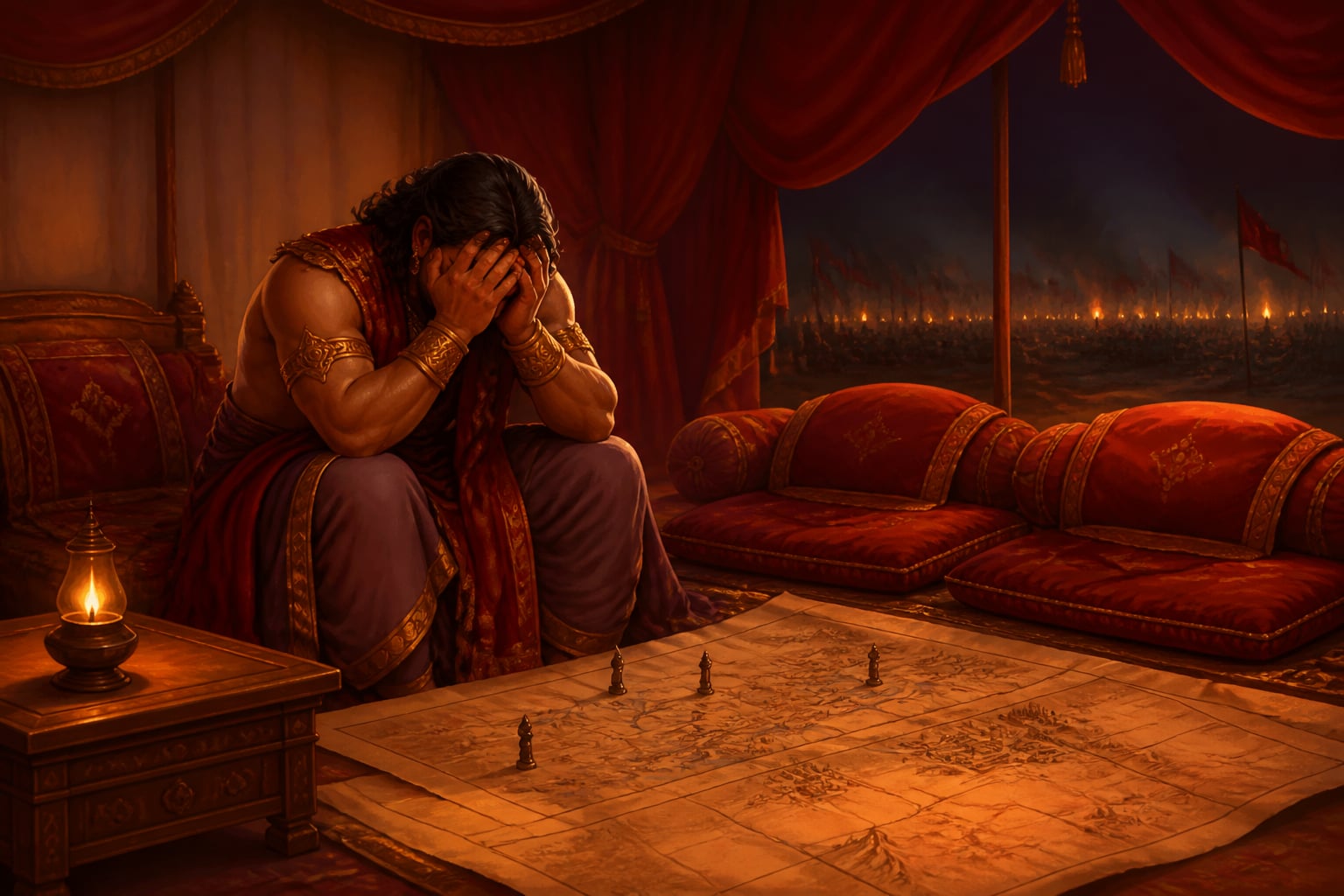
In his tent, Duryodhana sat alone. Around him, the sounds of a dying army filtered through the canvas, the groans of the wounded, the weeping of those who had lost brothers, the hollow silence of men who knew tomorrow would bring more death.
Three commanders. Three failures.
Bhishma had fallen on the tenth day, brought low by Shikhandi's presence and Arjuna's arrows. Drona had been murdered on the fifteenth, killed while meditating after hearing the lie about his son's death. And now Karna, proud, loyal, cursed Karna, had died with his chariot wheel stuck in the mud and Parashurama's curse stealing his knowledge at the crucial moment.
"Is there no one left who can stand against them?"
The question was not meant for an answer. But an answer came.
The Last Commander
Kripacharya entered the tent, followed by Ashwatthama and the few surviving generals. Their faces bore the hollow look of men who had seen too much death.
"Your Majesty," Kripa began, "the army needs a commander. Without leadership, the men will scatter by morning."
"Who is left?" Duryodhana's voice was bitter. "I have spent my greatest warriors like coins at a gambling table. Bhishma, Drona, Karna, all gone. Who remains that the Pandavas have not already broken?"
"There is one," Ashwatthama said quietly. "The King of Madra."
Shalya.
Duryodhana looked up. Of course. The uncle of Nakula and Sahadeva, one of the finest warriors in the world, a king whose chariot-driving skills rivaled Krishna's own. He had served as Karna's charioteer for two days, his tongue as sharp as any weapon, his "honest" assessments designed to demoralize rather than inform.
But Shalya had never wanted to fight for the Kauravas.
A Reluctant Warrior
The story was well known. When war became inevitable, Shalya had marched from Madra with a massive army, intending to fight for his nephews, the Pandavas. Nakula and Sahadeva were his sister Madri's sons, his own blood.
But Duryodhana had been clever. He had arranged for lavish hospitality along Shalya's route, magnificent camps, fine food, beautiful attendants, all appearing to be gifts from Yudhishthira. When Shalya, grateful for the hospitality, offered a boon to his apparent host, Duryodhana revealed himself.
"You have accepted my hospitality. You have offered me a boon. I ask only this: fight for me."
Bound by his word, Shalya had no choice. He had marched to war against his own nephews, his heart with the Pandavas but his sword in Kaurava hands. It was a trick worthy of Shakuni, and it had worked.
Now, on the final day, that same reluctant warrior was the only hope Duryodhana had left.
The Appointment
Shalya was summoned. He entered the command tent with the bearing of a king, tall, silver-haired, his face weathered by decades of rule and war. Unlike the other commanders, there was no eagerness in his eyes. Only duty, heavy as iron.
"You wish me to command," he said. It was not a question.
"I need you to command," Duryodhana replied. "You are the finest warrior we have left. Your skill with weapons is legendary. Even Krishna respects your abilities."
"Krishna." Shalya's laugh was hollow. "Yes, I am sure he does. As he respected Bhishma, and Drona, and Karna, all of whom now feed the crows of Kurukshetra."
"Will you refuse?"
A long silence. Then:
"I am bound by my word to fight for you. I have kept that word through seventeen days of slaughter. I will keep it one day more."
"Then you accept?"
"I accept command of what remains of your army." Shalya's eyes met Duryodhana's. "But I make you no promises of victory. I go to fight, perhaps to die, against my own sister's children. Do not ask me to pretend joy at this duty."
Counting the Cost
As dawn approached, Shalya surveyed what remained of the once-mighty Kaurava host.
The numbers were devastating:
| Force | Started | Remaining |
|---|---|---|
| Akshauhinis | 11 | ~1.5 |
| Major Warriors | 15+ | 5 |
| Commanders | 4 | 0 (until Shalya) |
Of the great warriors who had marched to Kurukshetra, only a handful remained:
- Shalya himself, now commander
- Shakuni, the architect of the dice game
- Kripacharya, the immortal teacher
- Ashwatthama, burning for revenge
- Duryodhana, the king who had started it all
The hundred Kaurava brothers who had once seemed invincible? Bhima had killed ninety-nine of them with his own hands. Only Duryodhana remained.
One day, Shalya thought. One day to end eighteen days of madness.
The Final Dawn
The sun rose red over Kurukshetra, the color of blood, the color of endings.

Shalya mounted his chariot, the white horses stamping impatiently. Around him, the Kaurava army formed up for what everyone knew would be the last time. The men moved with the mechanical precision of those who have stopped hoping and simply endure.
Across the field, the Pandava forces gathered. Their losses had been terrible too, Abhimanyu, Ghatotkacha, the sons of Draupadi, but their core remained intact. The five brothers still lived. Krishna still guided them. And they had the momentum of victory after victory.
Yudhishthira stood in his chariot, watching his uncle take the field against him. The irony was not lost on him. Shalya had taught him and his brothers as children, had bounced them on his knee, had blessed them at their weddings. Now they would try to kill each other.
"Mama," Nakula whispered, the word for maternal uncle. "He fights against us still."
"He fights because he must," Yudhishthira replied. "As we all do."
Shalya's Address

Before the battle began, Shalya rode before his troops. His voice, trained to command armies, carried across the silent field.
"Warriors of Hastinapura. I will not lie to you as others have. Our situation is desperate. We have lost our greatest champions. The enemy is strong, and victory is uncertain."
The soldiers stirred. This was not the rousing speech they had expected.
"But this I promise: today, there will be no half-measures. No strategies, no tricks, no waiting for advantage. Today, we fight with everything we have, and we leave nothing behind."
He raised his spear, the weapon he wielded as well as any man alive.
"If we are to fall, let us fall as warriors. If this is our end, let it be an ending worthy of song. And if the gods favor us, if somehow we prevail, then let it be said that the Kaurava army died and was reborn on the same day."
A roar went up from the ranks. It was not hope exactly, it was something fiercer. The battle cry of men who have accepted death and find, in that acceptance, a terrible freedom.
The Battle Begins
The conches sounded. The drums thundered. And for the final time, the armies of Kurukshetra charged toward each other.
Shalya fought like a man possessed. His spear was everywhere at once, striking, blocking, throwing, catching. Warriors who approached him fell like wheat before the scythe. For a few hours, it seemed as if the Kaurava army had found its champion at last.
But across the field, the Pandavas were equally relentless. Bhima carved through the Kaurava ranks, still hunting for any sons of Dhritarashtra he might have missed. Arjuna and Krishna moved like a single entity, the Gandiva bow singing death with every pull. Nakula and Sahadeva fought side by side, deliberately avoiding the sector where their uncle commanded.
And Yudhishthira, the king who rarely led charges, watched Shalya's movements with careful eyes. He knew what was coming. He had known since the war began.
Today, I must kill my mother's brother.
The dharma of war demanded it. The man who had taught him the spear, who had blessed his marriage, who shared his blood, that man was the enemy commander now. And enemy commanders had to die.
The sun climbed higher. The death toll mounted. And somewhere in the chaos, Yudhishthira began making his way toward Shalya's banner.
The final day had begun. By its end, one side would cease to exist.
Living traditions
Shalya's story resonates in modern discussions about institutional loyalty versus personal ethics. His predicament, bound by word to serve a cause he doesn't believe in, mirrors dilemmas faced by employees, soldiers, and citizens who must reconcile personal values with institutional obligations. In management literature, 'Shalya's dilemma' sometimes refers to the challenge of serving honorably in organizations whose goals one doesn't share.
- Shalya Tal (Shalya's Lake): A sacred tank near Kurukshetra associated with King Shalya. Local tradition holds that Shalya performed rituals here before the final day's battle.
- Brahma Sarovar: The largest sacred tank in Kurukshetra, where post-war rites were performed for all fallen warriors including the Kaurava commanders.
- Sthaneshwar Mahadev Temple: One of the oldest temples in Kurukshetra, where warriors from both sides reportedly prayed before battle. The temple predates the war and is mentioned in various Mahabharata traditions.
Reflection
- Shalya fights for the Kauravas because he gave his word, even though his heart is with the Pandavas. Is this admirable integrity or moral cowardice? Should he have broken his promise to fight for the side he believed was right?
- Duryodhana tricked Shalya into fighting for him using hospitality and a carelessly given boon. In what ways do we see similar manipulation today, people binding others through gifts, favors, or obligations?
- Yudhishthira must kill his maternal uncle, a man who blessed him as a child and taught him skills as a youth. The war demands this. How do we reconcile personal relationships with systemic conflicts that force us onto opposite sides?