Adhogati: The Fall of Duryodhana

Bhima shatters Duryodhana's thighs

The blow falls, not to the chest, not to the head, but to Duryodhana's thighs. In an instant, the war is over and Bhima's thirteen-year vow is fulfilled. But Balarama's rage at the foul, and Duryodhana's final defiant words from the ground, transform victory into something far more complicated. The Pandavas have won the war, but as they stand over their fallen cousin, they realize that winning and triumph are not the same thing.

The Blow

The sound was like nothing else on Kurukshetra had produced.

It was not the clash of metal on metal. It was not the twang of bowstrings or the thunder of chariots. It was the sound of a mace striking flesh, of bones shattering, of a man's legs being destroyed in a single, devastating impact.

Duryodhana did not scream.

He fell.

One moment he was standing, mace raised for what would have been the killing blow against Bhima. The next, he was on the ground, his legs bent at impossible angles, his face white with shock and the beginning of unimaginable pain.

Bhima stood over him, chest heaving, his mace dripping with, No. Not blood. Not yet. This wound would not bleed much. It would simply end everything Duryodhana had been.

"I kept my vow," Bhima said. His voice was hoarse. "I said I would break your thighs for what you did to Draupadi. It is done."

Balarama's Fury

For a moment, there was only silence. The torches flickered. The survivors of both armies stared, unable to process what they had witnessed.

Then Balarama moved.

The elder brother of Krishna, the master who had trained both warriors, strode into the circle with fury written across his face. His plough-weapon was already in his hands.

"ADHARMA!" His voice was a thunderclap. "This is adharma! A blow below the waist, forbidden! Forbidden by every law of combat, every tradition I taught you!"

He turned on Bhima, and for a moment, it seemed as if he might kill the Pandava where he stood.
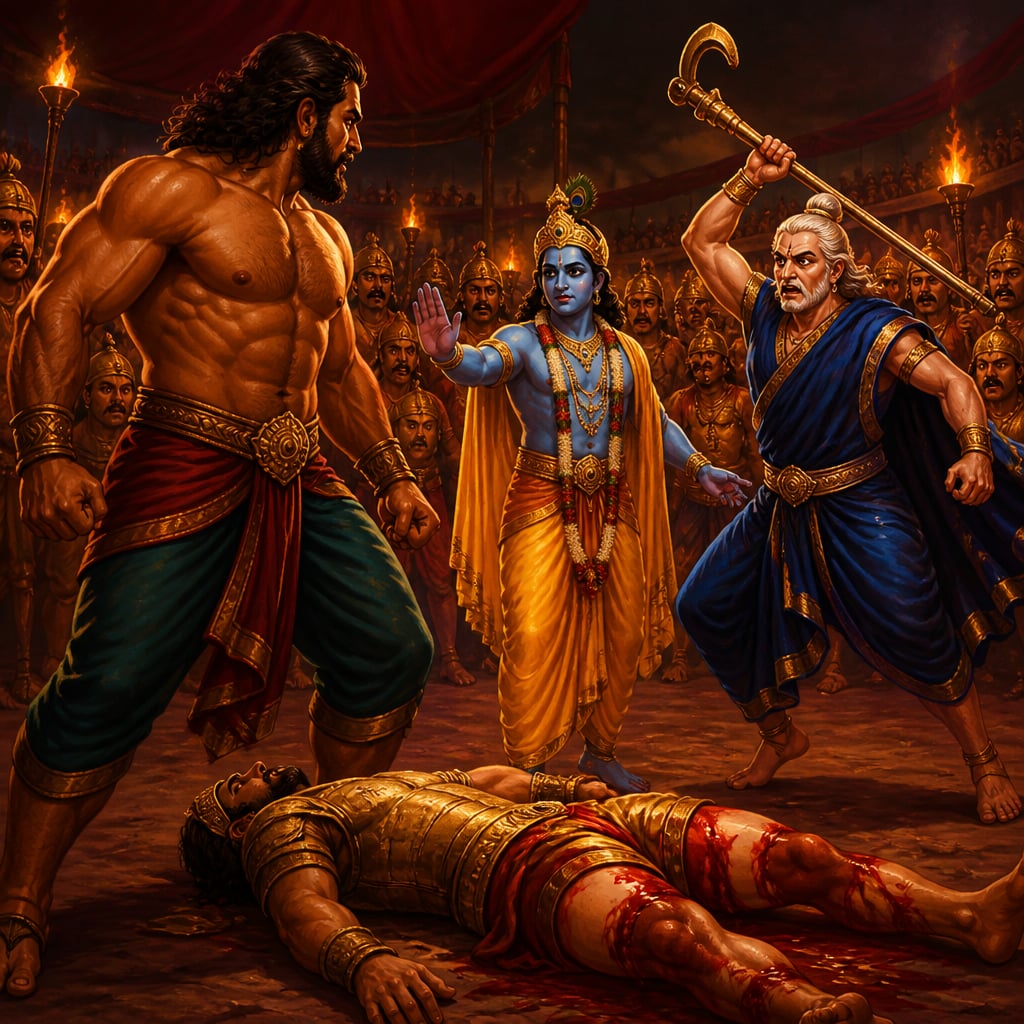
Balarama, face contorted in fury, raises his great plough weapon high in the torchlit duelling circle as Krishna steps calmly between his brother and Bhima beyond Duryodhana's fallen body, the surrounding warriors frozen in shocked silence.

"I will slay this rule-breaker myself. I will, "

"Brother." Krishna's voice was calm, almost gentle. "Peace."

"Peace?" Balarama whirled on him. "You speak of peace? You signaled him! I saw it, your hand on your thigh. You told him to strike there. You orchestrated this... this violation!"

"I reminded him of a vow he made," Krishna said. "A vow made before any rules of this combat were established. Which oath takes precedence, brother? The ancient one, or the recent one?"

"The rules of gadā-yuddha are eternal!"

"So is the dharma of keeping one's word."

The Argument

The two brothers faced each other, Balarama trembling with rage, Krishna serene and immovable. Around them, the warriors watched, uncertain whose side to take.

"You have corrupted everything," Balarama said. "Throughout this war, you have bent every rule, broken every tradition. Bhishma killed through deception. Drona murdered through lies. Karna slain when his chariot was stuck. And now this, the final proof that dharma means nothing to you."

"Dharma means everything to me," Krishna replied. "But dharma is not a set of rules to be followed blindly. It is the pursuit of righteousness in a world that is never simple."

"Righteousness? You call this righteous?"

"I call it necessary." Krishna's eyes were ancient, sad. "Duryodhana was not going to surrender. He would have killed Bhima, killed all my kinsmen, and the war would have continued until everyone was dead. Sometimes, brother, the choice is not between right and wrong, but between lesser evils."

"Then evil wins either way."

"Perhaps. But this evil ends the war. The other evil would have continued it forever."

Balarama stared at his brother for a long moment. Then, without another word, he turned and walked away into the darkness.

He would not return to Dwaraka with Krishna. He would not celebrate the Pandava victory. His last act in the war was to reject everything it had become.

Duryodhana's Words

Duryodhana laughs defiantly from the ground at Yudhishthira

On the ground, broken beyond any hope of recovery, Duryodhana began to laugh.

It was not the laughter of madness, though some who heard it thought so. It was the laughter of a man who had seen through to the truth of things and found it absurd.

"You think you have won," he said, his voice carrying despite the pain. "You think this is victory."

Yudhishthira stepped forward. "The war is over, cousin. You are defeated."

"Defeated?" Duryodhana's laugh was bitter. "Look at what you have won, Dharmaraja. Look at the cost of your kingdom."

He raised himself on his arms, only his arms worked now, would ever work again, and gestured at the darkness beyond the torchlight.

"Eighteen days. Millions dead. Your son Abhimanyu, dead. Ghatotkacha, dead. Draupadi's five children, they will be dead by morning, though you don't know it yet. Drona, Bhishma, Karna, dead. My hundred brothers, dead."

"And for what? So you can sit on a throne of corpses and call yourself king?"

The Moral Victory

The words hung in the air, poisonous and true.

Bhima moved to silence him, but Yudhishthira raised a hand. Let him speak. Let them hear what they had won.

"I lived as a king," Duryodhana continued. His voice was weakening, but his spirit burned as fierce as ever. "I enjoyed every pleasure that wealth and power could provide. I never begged, never compromised, never bent my knee to anyone."

He looked directly at Yudhishthira.

"Can you say the same? You, who gambled away your kingdom, your brothers, your wife? You, who spent thirteen years as a servant, hiding in disguise? You, who let others do your killing while you wrung your hands about dharma?"

"I followed the path of righteousness," Yudhishthira said. But his voice lacked conviction.

"Did you? Then why did your brother strike below the waist? Why did you tell lies to kill Drona? Why did you let Krishna manipulate every battle to your advantage?" Duryodhana's smile was ghastly. "The path of righteousness... you abandoned it long ago. The difference between us is that I admit what I am. You pretend to be something better while doing exactly the same things."

The Final Declaration

The pain was becoming unbearable now, Duryodhana's face had gone gray, his breath coming in gasps, but he was not finished.

"When I die," he said, "I will go to heaven. The scriptures are clear: a Kshatriya who dies in battle, facing his enemies, earns Swarga. That cannot be taken from me."

He let himself fall back to the ground, staring up at the stars.

"And you? You will live with what you have done. You will rule a kingdom of ghosts. Every night, you will see the faces of those you killed, those you lied to, those you betrayed in the name of dharma."

"I have lost the war. But I have not lost myself. Can you say the same, Yudhishthira? Can any of you say the same?"

Silence. No one had an answer.

The End of the War

The Pandavas stand as hollow victors around the fallen Duryodhana

The Pandavas stood over their fallen cousin, and none of them felt like victors.

Arjuna thought of Karna, his brother, killed while defenseless. Of Drona, his teacher, murdered through deception. Of Bhishma, his grandfather, brought down by using Shikhandi as a shield.

Bhima looked at his mace, still in his hands, and felt only emptiness. Thirteen years he had waited for this moment. Now it had come, and it tasted like ashes.

Yudhishthira heard Duryodhana's words echoing in his mind. A throne of corpses. Pretending to be something better. Were they true? Had he sacrificed his dharma to win a war for dharma?

Krishna alone seemed unmoved. But those who knew him well could see something in his eyes, not regret, exactly, but acknowledgment. The price had been paid. Whether it was worth paying... that question would haunt them all.

The Morning After

Duryodhana did not die that night.

His body, incredibly, continued to live, though his legs were ruined, his kingdom lost, his allies dead. He lay on the battlefield through the dark hours, waiting for either death or dawn.

Neither came quickly enough.

The Pandavas withdrew to make camp. There were rituals to perform, wounds to tend, survivors to account for. The war was over, but its aftermath was just beginning.

And somewhere in the darkness, three survivors of the Kaurava side, Ashwatthama, Kripacharya, and Kritavarma, came upon their fallen king.

What they found, and what Ashwatthama did next, would transform the Pandavas' victory into horror. But that is a story for another day.

For now, there was only this: Duryodhana on the ground, broken but defiant. The Pandavas standing over him, victorious but hollow. And the knowledge that in this war, no one had truly won.

The Kurukshetra war was over.

The Mahabharata's tragedy was just beginning.

The Cost

In eighteen days, the war had consumed:

Losses Number
Akshauhinis destroyed All 18
Kaurava brothers killed 100 of 100
Pandava sons killed Abhimanyu + Draupadi's 5 sons
Great warriors fallen Bhishma, Drona, Karna, Shalya, Shakuni, and countless others
Total casualties Millions

All for a kingdom that was now a graveyard.

All for dharma that had been bent beyond recognition.

All for a victory that felt like defeat.

The sun would rise on a new world, but it would illuminate only what had been lost, not what had been gained.

Living traditions

The end of the mace duel remains one of the most debated moments in Indian cultural discourse. Was Bhima justified in breaking the rules to fulfill his vow? Was Krishna right to signal him? Different political and philosophical movements have used this scene to argue for different views of ethics, consequentialist positions citing Krishna, deontological positions citing Balarama. The scene is regularly invoked in debates about whether the ends justify the means, making ancient ethics relevant to contemporary dilemmas.

Reflection

More in Shalya Parva

All lessons in Shalya Parva · The Mahabharata course