Relevance in 2026 and Beyond

Aging, letting go, closure

What can a three-thousand-year-old story about aging kings and forest fires teach us about modern life? The Ashramavasika Parva confronts experiences every human will face: aging parents, family wounds that won't heal, grief that seems impossible to process, and our own mortality. In this concluding lesson, we explore how the parva's ancient wisdom applies to contemporary challenges, from eldercare crises to death denial, from workplace succession to finding closure with those we've lost.

The Eternal Relevance of Aging

The Ashramavasika Parva was composed millennia ago, but its central concerns are timeless. Every generation must navigate:

These aren't ancient problems, they're human problems. The specifics change (we don't retire to forests or die in wildfires), but the underlying dynamics remain remarkably consistent across cultures and centuries.

The Eldercare Crisis

Dhritarashtra's situation mirrors what millions of families face today: an aging parent living in a household where they are cared for materially but suffer emotionally.

Dhritarashtra's Experience Modern Parallel
Dependent on nephews he had wronged Elderly parent dependent on children with unresolved resentment
Tolerated but not truly welcomed Parent in child's home feeling like a burden
Memories of better days Dementia patients caught between past and present
Bhima's verbal cruelty Adult children's impatience and unkindness

The modern eldercare crisis isn't just about nursing homes and medical costs, it's about the emotional reality of multi-generational households where old wounds remain unhealed. Many families provide excellent physical care while creating environments of emotional suffering.

Dhritarashtra's choice to leave, to choose dignity over comfort, suggests that sometimes the kindest thing we can do for aging parents is to help them find environments where they feel honored, not just housed.
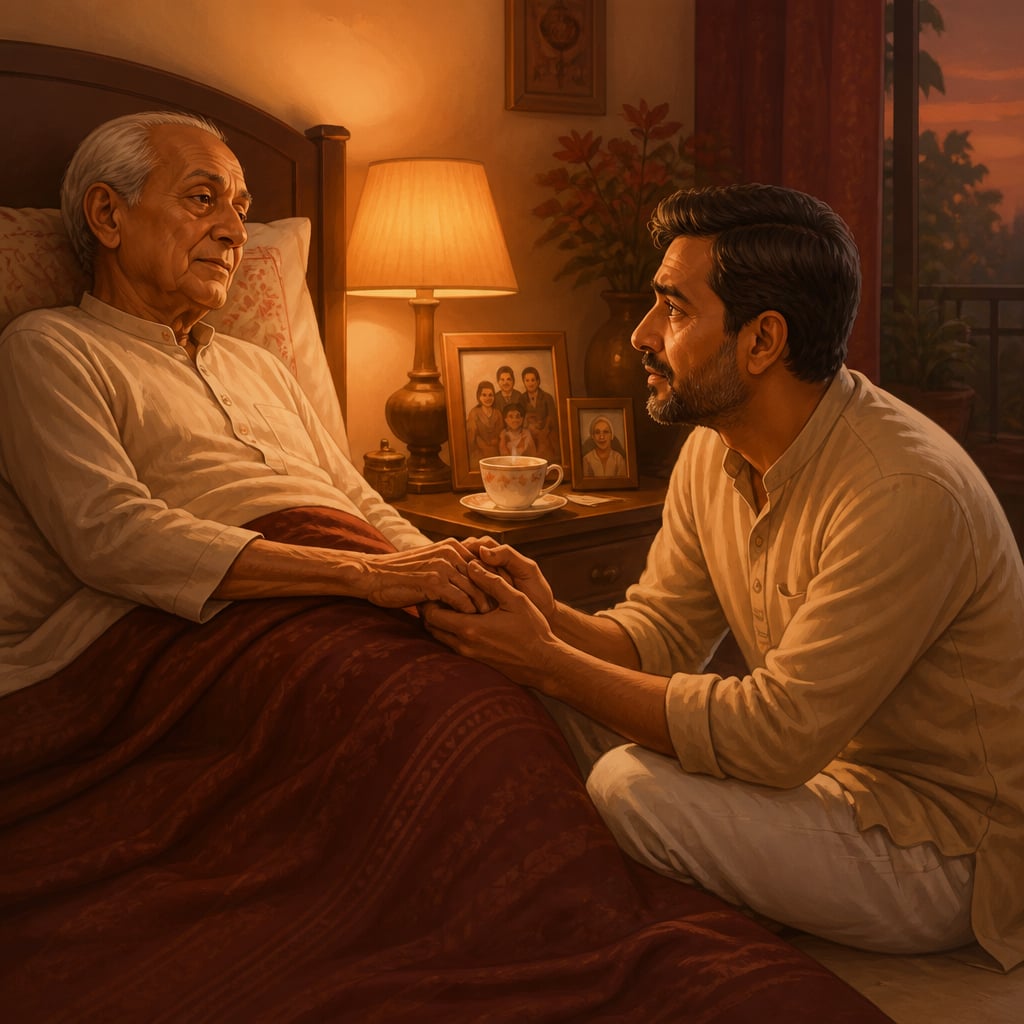
A middle-aged Indian adult sits beside an aged parent's bed in a quiet modern Indian home at evening, holding the parent's frail hand.

When to Let Go of Power

The parva raises a question relevant to every leader, parent, and professional: When is it time to step back?

Dhritarashtra clung to his position long past the point of benefit, first to the throne (enabling his sons' crimes), then to the palace (enduring daily humiliation). His late-life decision to leave for the forest was wise but overdue.

Modern applications:

The parva doesn't say "step back early", it says "step back consciously." The vanaprastha ideal isn't about abandoning responsibility prematurely but about recognizing when your chapter has ended and a new one must begin.

Unforgivable Wounds

Bhima's treatment of Dhritarashtra raises uncomfortable questions about forgiveness. The Kauravas had genuinely wronged the Pandavas, attempted murder, humiliation, exile. Bhima's anger was justified. And yet his refusal to release that anger poisoned everyone around him.

The modern tension:

The parva offers no easy resolution. Dhritarashtra left without receiving Bhima's forgiveness. Gandhari never said she forgave the Pandavas for killing her sons. Yet both found peace anyway, suggesting that healing may not require forgiveness from others, only release within ourselves.

Application: If you carry resentment toward someone who genuinely wronged you, the question isn't "Should I forgive them?" but "Am I willing to let this define the rest of my life?" You can acknowledge that wrong was done without being imprisoned by it forever.

Processing Impossible Grief

The vision of the dead addresses a universal human need: closure. Dhritarashtra needed to hear his sons say they didn't blame him. Kunti needed Karna's forgiveness. The living needed to know the dead were at peace.

Modern grief often lacks this closure:

We cannot summon the dead as Vyasa did, but we can create equivalents:

The parva suggests that the content of such communication matters less than the act itself. What the living needed most was to speak, and to believe they were heard.

Death Denial vs. Death Preparation

Contemporary culture largely avoids thinking about death. We use euphemisms ("passed away," "lost"), hide dying people in hospitals, and treat death as a medical failure rather than a natural conclusion.

The Ashramavasika Parva presents a radically different approach:

Modern applications:

Death Denial Death Preparation
Avoid thinking about mortality Reflect on death regularly
Fight aging at all costs Accept physical decline gracefully
Die in hospitals, surrounded by machines Plan for death at home, peacefully
Leave no instructions Create advance directives
Never discuss death with loved ones Have honest end-of-life conversations

The elders' peaceful death in the forest fire was possible because they had spent years preparing. They knew they were ready. Most of us, if fire came tomorrow, would not be ready, not because we're young, but because we haven't done the work.

The Witness's Burden

Sanjaya's survival carries its own lesson. He was commanded to live when those he served chose death. His purpose was to remember and transmit, to ensure the story survived even when the protagonists did not.

Modern witnesses:

Sanjaya's solution, eventual retreat to the mountains, suggests that witnessing trauma requires processing. He didn't return to ordinary life as if nothing had happened. He took time, perhaps the rest of his life, to integrate what he had seen.

An elderly vanaprastha sage walks a forest path at dawn

The Ashrama System: Ancient Wisdom for Modern Transitions

The four-stage ashrama system provides a framework for life transitions that modern culture lacks:

  1. Brahmacharya (student) - Learning, preparing
  2. Grihastha (householder) - Working, raising family, building
  3. Vanaprastha (forest-dweller) - Withdrawing, mentoring, preparing for death
  4. Sannyasa (renunciant) - Complete release from worldly ties

Modern life often has no equivalent of vanaprastha. We work until we can't, then suddenly find ourselves "retired" with no framework for what that means. The result: depression, purposelessness, and frantic attempts to remain relevant.

The parva suggests that the transition from active life to preparation for death should be:

What Would Vanaprastha Look Like Today?

We're not going to retire to forests. But the principles of vanaprastha can be adapted:

Reduced consumption - Downsizing possessions, simplifying life Mentorship focus - Shifting from doing to teaching Spiritual practice - Making time for reflection, meditation, prayer Relationship healing - Resolving what can be resolved before death Death preparation - Creating wills, advance directives, having conversations

Some modern communities are experimenting with contemporary versions:

Applying Ashramavasika Wisdom: A Personal Inventory

The parva invites us to examine our own lives through its themes:

On aging and dependency:

On letting go:

On unhealed wounds:

On grief:

On death:

The Parva's Lasting Message

The Ashramavasika Parva ends with fire, but its message is not about destruction. It's about transformation. The elders entered the flames having completed their work:

This is what the parva offers: not a prescription for dying in forest fires, but a vision of what completed life looks like. It's a life where:

The elders came to the forest to die. They died well. The parva asks us: When your time comes, will you be ready?

A Final Reflection

The Ashramavasika Parva is not comfortable reading. It confronts us with aging, conflict, grief, and death, the very topics we most want to avoid. But in confronting them, it offers wisdom that denial cannot provide.

Dhritarashtra found peace by leaving behind everything he had clung to. Gandhari found closure by touching her sons' faces one last time. Kunti found release through service and forgiveness. Vidura found transcendence through conscious departure.

These are not ancient stories about ancient people. They are mirrors reflecting our own futures, futures where we too will age, grieve, and eventually die. The question is whether we will prepare as the elders did, or be surprised by what was always coming.

The parva's title, Ashramavasika, means "dwelling in the hermitage." But the real dwelling is internal. We can carry the hermitage within us, a space of preparation, acceptance, and peace, regardless of where our bodies reside.

This is the relevance of the Ashramavasika Parva in 2026 and beyond: not as a guide to forest living, but as a guide to living fully until the very end, and then dying well.

More in Ashramavasika Parva

All lessons in Ashramavasika Parva · The Mahabharata course