Divya Drishti: Vision of the Dead
Vyasa summons fallen warriors
On the banks of the Ganga, Vyasa performs the impossible, summoning all who died in the great war. From the sacred waters emerge thousands of radiant figures: Duryodhana walks beside Abhimanyu, Bhishma alongside Drona, Karna near the sons he never acknowledged. For one miraculous night, the boundaries between worlds dissolve, old enemies meet as equals, and the living finally learn the fate of those they mourned. At dawn, they must say goodbye forever.
The Summoning
As the last light faded from the sky, Vyasa stood at the edge of the Ganga, his arms raised toward the darkening heavens. He spoke words of power, mantras so ancient that even the Vedas had forgotten them, syllables that predated language itself.
The river began to glow.
First, a faint luminescence beneath the surface, like moonlight trapped in water. Then brighter, as if the riverbed itself had caught fire. The witnesses, Pandavas and citizens, elders and soldiers, widows and orphans, held their breath.
"They are coming," Vyasa said softly. "Do not be afraid. They mean you no harm. They are as eager to see you as you are to see them."
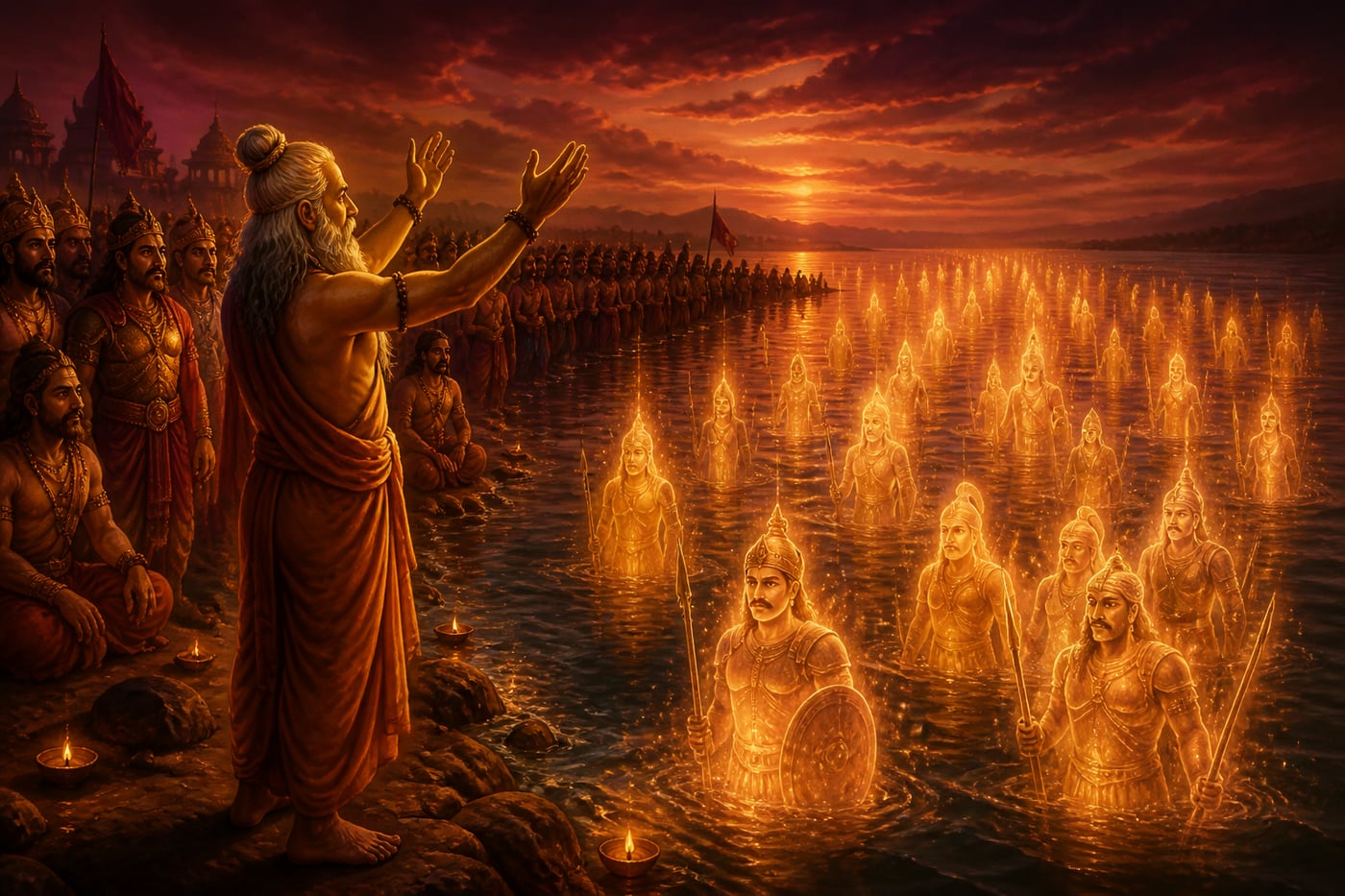
And from the shining waters, figures began to rise.
The Dead Emerge
First came the great warriors, those whose names would be remembered for millennia. Bhishma, his white hair flowing, his body whole and unmarked by the hundred arrows that had pinned him to his deathbed. Drona, his acharya's dignity restored, the Brahmastra that killed him forgiven. Karna, radiant with the inner light that his armor had once provided externally.
Then the hundred sons of Dhritarashtra, walking in order of their birth. Duryodhana led them, his bearing regal, his expression, for the first time anyone could remember, at peace. Behind him came Duhshasana, and behind Duhshasana the other ninety-eight, a procession that seemed endless.
The Pandava dead followed. Abhimanyu, young and beautiful, the terror of the Chakravyuha erased from his face. Ghatotkacha, Bhima's beloved son by the rakshasi Hidimba. The five Upapandavas, Draupadi's sons, murdered in their sleep but here restored to vibrant life.
| The Great Warriors | The Hundred Sons | The Pandava Dead |
|---|---|---|
| Bhishma | Duryodhana | Abhimanyu |
| Drona | Duhshasana | Ghatotkacha |
| Karna | 98 others | Five Upapandavas |
| Shalya, Bhurishravas | Iravan, Subhadra's brother |
And still they came, soldiers by the thousand, elephants and horses, kings and common warriors, all rising from the Ganga in endless streams of light.
The Living Meet the Dead

Dhritarashtra stood frozen as his sons approached. He could not see them, but he could feel their presence, a hundred familiar energies gathering around him like warmth.
"Father," Duryodhana's voice came, gentle as Dhritarashtra had never heard it in life. "Do not weep for us. We are well. We fought as warriors should, and we died as warriors must. There is no shame in our ending."
"But I failed you," Dhritarashtra whispered. "I let you march to your destruction. I should have stopped you."
"You could not have stopped me," Duryodhana replied. "No one could. My path was my own choosing. But know this: I do not blame you. I never did."
One by one, the hundred brothers touched their father's feet. Dhritarashtra felt each touch, recognized each son by the pressure of their hands, the rhythm of their movement. For the first time since the war ended, he smiled.
Gandhari's Hundred
Gandhari too was surrounded by her sons. She who had bound her eyes to share her husband's blindness now wished desperately that she could remove the cloth, just once, to see her children restored.
"Mother," Duhshasana said, "you were the best of mothers. Whatever crimes we committed, they were not your teaching. You gave us dharma; we chose adharma. The fault was ours alone."
"I would have given anything to save you," Gandhari said. "I cursed Krishna himself for your deaths."
"We know," Duryodhana replied. "And that curse will bear fruit in time. But do not carry anger into your remaining years. You have suffered enough. Let the curse be the last of your rage; let what remains be peace."
Gandhari reached out, her hands finding the faces of her sons one after another. Each face felt exactly as she remembered, the shape of Duryodhana's jaw, the curve of Duhshasana's cheek, the distinct features of each of the hundred. She memorized them anew, knowing this would be the last time.
Arjuna and Abhimanyu
Arjuna stood before his son, unable to speak. Abhimanyu had been sixteen when he entered the Chakravyuha, the military formation that only seven warriors in history had known how to penetrate. He had learned the entry but not the exit, and that partial knowledge had cost him his life.
"Father," Abhimanyu said, "you taught me everything I needed to know. The Chakravyuha's exit was not your failure, it was fate. The gods required my death that day, and no teaching could have prevented it."
"I should have been there," Arjuna said. "I was diverted. If I had been on the field, "
"Then someone else would have died to divert you elsewhere. My death was woven into the fabric of the war. Accept it as I have accepted it."
"Are you... happy?" Arjuna asked, the question sounding absurd even as he spoke it.
"I am at peace," Abhimanyu replied. "I died fighting as a Kshatriya should. I am honored in the realms where warriors dwell. What more could a son of Arjuna ask?"
Draupadi's Sons
The five Upapandavas gathered around Draupadi. They had been her only biological children, one son from each of her five husbands, and they had been murdered in their sleep by Ashwatthama's night raid.
"You never had the chance to prove yourselves in battle," Draupadi said, tears streaming. "You were killed before your lives truly began."
"We died in our fathers' camp," her eldest son replied, "surrounded by their tents, defended until we could not be defended anymore. That is honor enough. And here, in the realms where we dwell, we have proven ourselves many times over. Do not grieve for lives we never lived; rejoice in the lives we live now."
Draupadi embraced each of her sons in turn. They felt solid and warm, as real as they had ever been. But she could sense the dawn approaching, feel the limited time pressing down on every moment.
"I will see you again," she said. "When my time comes."
"Yes," they assured her. "We will be waiting."
Kunti and Karna
Kunti had held back, watching the reunions from a distance. But there was one face she sought in the crowd of the dead, one figure she needed to see more than any other.
Karna found her before she found him.
"Mother," he said simply.
The word broke her. She collapsed, and he caught her, holding her as she wept.
"I abandoned you," she sobbed. "I let you float down the river in a basket. I never claimed you. I let you die fighting your own brothers."
"I know," Karna said. "I knew before the war. You came to me, remember? You asked me to join my brothers. I refused."
"Why? Why did you refuse?"
"Because Duryodhana loved me when I had no one else. He raised me up when the world called me a suta-putra, a charioteer's son. How could I betray him for a mother who had already betrayed me?"
The words should have been bitter, but they were not. Karna spoke with the calm of one who has processed his grievances and moved beyond them.
"I do not blame you," he continued. "You were young, unmarried, frightened. The world would have destroyed you if you had kept me. Your choice was impossible, and you made the best decision you could. I understand now. I forgive you."
"I never forgave myself," Kunti whispered.
"Then forgive yourself now," Karna said. "I give you permission. Let it go."

Enemies at Peace
Across the riverbank, scenes played out that would have seemed impossible during the war. Bhishma spoke with the Pandavas who had been forced to fight their grandfather. Drona blessed Dhrishtadyumna, the prince who had been born specifically to kill him. Duryodhana and Yudhishthira stood face to face, not as enemies but as cousins, the enmity of lifetimes dissolved.
"I hated you," Duryodhana admitted. "I hated everything about you, your virtue, your patience, your claim to the throne. That hatred consumed my life."
"And I never understood you," Yudhishthira replied. "I saw your actions but not your wounds. I fought you without ever truly knowing you."
"Perhaps that is the nature of war," Duryodhana said. "We fight reflections of ourselves, projections of our own fears. The enemy is always more complex than we imagine."
They did not embrace, that would have been too much, but they parted with something approaching respect.
The Message from Beyond
As the night wore on, patterns emerged in the conversations between living and dead. Again and again, the dead offered the same message:
- We are at peace. The realms we inhabit are not places of punishment but of rest.
- We do not blame you. Whatever happened in the war happened because it had to happen.
- Let go of your grief. We are not served by your suffering.
- Live your remaining days well. That is the best memorial you can offer us.
Bhishma, speaking to the entire assembly, summarized what the dead wanted the living to understand:
"We fought because we believed we had to. Some of us were right; some were wrong. But here, in the realms beyond death, such distinctions fade. What matters now is that you who remain do not repeat our mistakes. Learn from our war. Build a peace that lasts. And when your time comes, join us without regret."
Dawn Approaches
The eastern sky began to lighten. The dead grew fainter, their forms becoming translucent.
"We must go," Karna said to Kunti. "The worlds cannot remain connected for long."
"I am not ready," Kunti said.
"You are never ready. But death comes anyway, and so does parting. Remember what I told you. Forgive yourself. Live the remainder of your days in peace. And when you come to where I am, we will have eternity to speak."
All across the riverbank, the same farewells were playing out. The dead embraced the living one last time. Tears flowed, but they were tears of release, not just of loss.
As the first ray of sunlight touched the Ganga's surface, the luminescence faded. The figures dissolved like morning mist, sinking back into the waters that had birthed them.
Within moments, the river was just a river again, dark, silent, empty of everything but water and the memory of miracles.
After the Vision
The living stood in stunned silence as the sun rose. No one moved. No one spoke. What was there to say after such an experience?
Finally, Vyasa broke the silence.
"You have seen them. You have heard them. You know now that death is not the end, and that those you love are not lost forever. Take this knowledge with you. Let it change how you live."
Dhritarashtra spoke, his voice stronger than it had been in years.
"I am ready now. I have seen my sons. I know they are at peace. Whatever time remains to me, I will spend preparing to join them. The war is truly over."
Around him, others nodded. The vision had accomplished what no amount of counseling or ritual could have done: it had provided proof. The dead were not suffering in some terrible realm. They were not angry at those who survived. They had moved on, and they wanted the living to move on too.
The Pandavas and their retinue began the long journey back to Hastinapura, changed forever by what they had witnessed. Behind them, the elders returned to their hermitage, their preparations for death now infused with hope rather than mere resignation.
But fire was coming. A fire that would complete what the vision had begun, releasing the elders from their bodies and sending them to join the dead they had just seen.
Living traditions
The vision of the dead resonates with contemporary discussions about grief, closure, and the relationship between the living and deceased. Modern grief counseling sometimes uses techniques like 'empty chair' dialogues or letter-writing to facilitate communication with the dead, psychological versions of what Vyasa's supernatural intervention provided. The episode suggests that grief is not about 'moving on' from the dead but about transforming the relationship, from present, conflicted reality to peaceful, resolved memory.
- Shraddha and Tarpana: Annual rituals where descendants offer water (tarpana) and food (pinda) to ancestors, believing that the offerings reach the deceased and sustain them in the afterlife. The vision in the Mahabharata confirms what these rituals assume, that the dead can receive offerings and communicate across the divide between worlds.
- Gaya (Vishnu Gaya): The most sacred site for performing shraddha rituals. Hindus believe that offerings made here reach ancestors directly and grant them moksha. The Mahabharata's vision of the dead emerging from water connects to the belief that sacred waters provide passage between worlds.
- Varanasi Ghats: The series of steps leading to the Ganga in Varanasi, where cremation ghats like Manikarnika handle Hindu funeral rites. The belief that death in Varanasi grants moksha connects to the Mahabharata's vision of death as transition rather than ending.
Reflection
- If you could speak with one deceased person for one night, who would it be and what would you need to say or hear?
- The dead appeared without enmity, former enemies standing together peacefully. If death dissolves hatred, why do we hold onto it so tightly in life? What would it take to release your grievances before death forces you to?
- Karna forgave Kunti for abandoning him at birth. What enabled him to forgive such a profound betrayal? Could you forgive a parent who abandoned you, or have you?