Ashrama: Life in the Forest
Elders live as ascetics
Deep in the Himalayan forests, the elders establish their hermitage. Dhritarashtra exchanges royal silks for bark garments, Gandhari tends the sacred fire, and Kunti performs the domestic duties she had abandoned as a queen. But the greatest transformation belongs to Vidura, who, having guided his brother to spiritual safety, prepares for his own departure from the world through yogic dissolution.
The Hermitage Takes Shape
The forests near the banks of the Ganga, in the foothills of the Himalayas, had hosted hermitages for centuries. Here, where the river still ran cold from its mountain source, Dhritarashtra and his companions established their final home.
The transformation was complete. The blind king who had once worn silks and sat upon jeweled thrones now wrapped himself in garments of bark and grass. Gandhari, who had commanded a thousand servants, now gathered firewood and drew water from the stream. Kunti, mother of kings, cooked simple meals of roots and forest fruits.
And yet, within weeks, a strange thing happened: they began to feel at peace.
"I spent eighty years as a king," Dhritarashtra told Vidura, "and I never knew a moment without anxiety. Now I own nothing, rule no one, and my mind is finally quiet."
The Rhythm of Renunciation
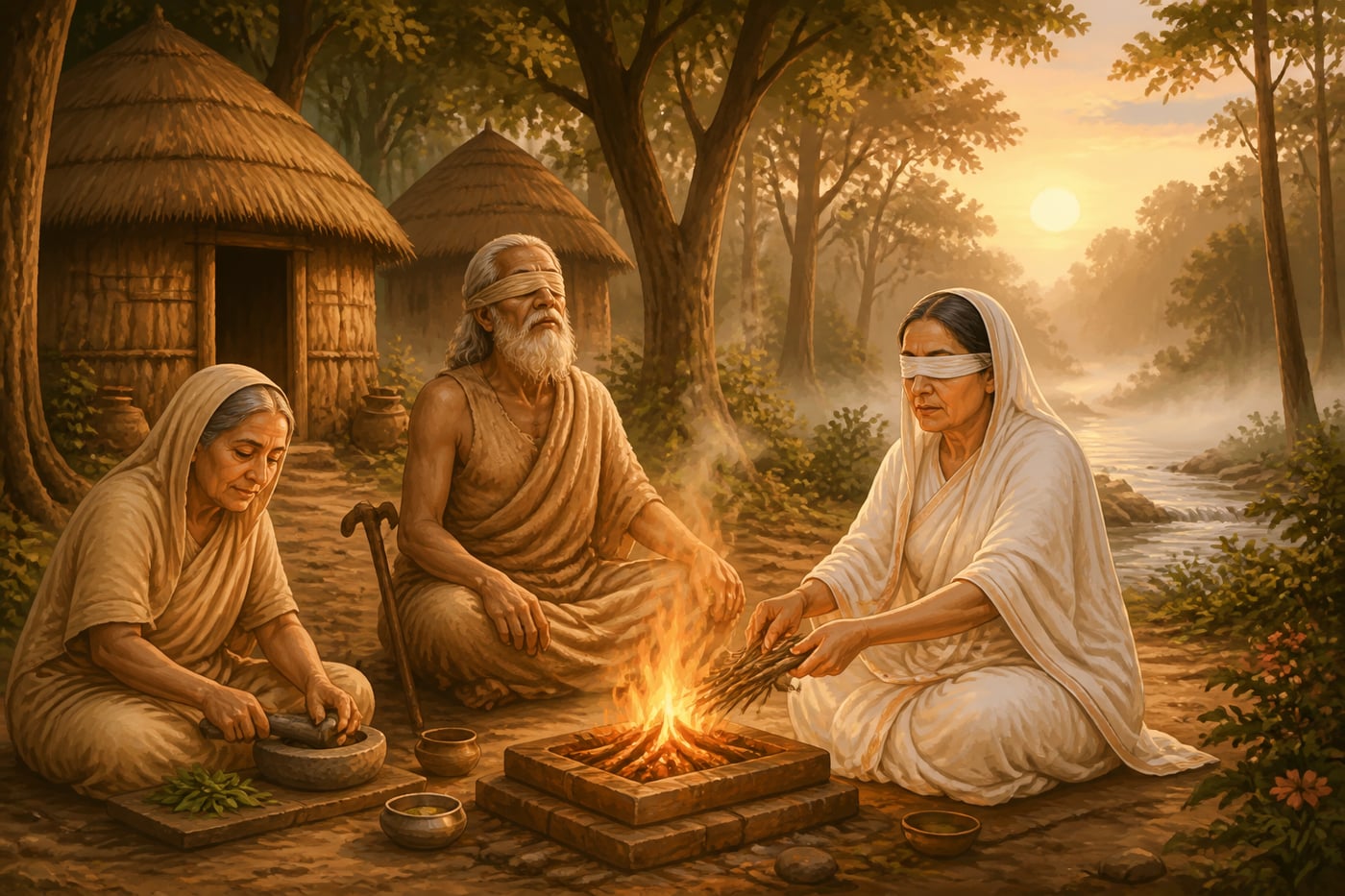
The hermitage followed the ancient patterns established by generations of forest-dwellers. Each day began before dawn with ablutions in the cold river, followed by meditation as the sun rose. The morning was for ritual, tending the sacred fire, offering prayers, chanting the Vedic hymns that Dhritarashtra had learned as a child but rarely practiced as a king.
| Time of Day | Practice | Purpose |
|---|---|---|
| Pre-dawn | River ablutions | Purification |
| Sunrise | Sandhya vandana | Greeting the sun |
| Morning | Agnihotra | Fire offerings |
| Midday | Scriptural study | Knowledge |
| Afternoon | Light work | Forest maintenance |
| Sunset | Sandhya vandana | Evening prayers |
| Night | Meditation | Preparation for sleep |
Food was simple, whatever the forest provided. No meat, no spices, no indulgence. The body, which had been pampered for decades, learned to live with less. And as it learned, the mind grew clearer.
This is what we were meant for, Gandhari realized one morning. Not thrones and armies, but this, simplicity, prayer, preparation for what comes next.
Vidura's Final Teaching
Vidura had come to the forest knowing he would not return to the world of men. At his age, with his work complete, only one task remained: to achieve conscious departure from the body.
He began spending longer periods in meditation, withdrawing from conversation, eating less and less. Dhritarashtra noticed but said nothing; he understood what his brother was doing.
"You taught me dharma all my life," Dhritarashtra said one evening, "and I ignored you at every turn. I enabled my sons' crimes. I watched injustice and called it love. Why did you stay with me?"
Vidura's answer was gentle: "Because dharma is not only about correcting others. It is also about presence. I could not make you hear me, but I could stay. Sometimes staying is the teaching."
"And now you are leaving."
"Yes. My body has served its purpose. I have guided you to this place where you can complete your journey without me. What remains for me to do?"
The Yogic Departure
The sages of the forest had taught Vidura the techniques of conscious death, how to withdraw the life force from the body systematically, releasing each element back to its source. This was not suicide but transcendence, the final application of a lifetime's spiritual practice.
One morning, Vidura walked deep into the forest alone. He sat beneath a great tree, assumed the meditative posture, and began the process of departure.
First, he withdrew consciousness from his limbs. His body became still as stone.
Then he withdrew from his senses. The sounds of the forest faded; the light dimmed.
Finally, he gathered all his vital energy at the crown of his head and, with a single act of will, released it upward.
The body remained seated, but Vidura was gone.
Sanjaya found him hours later, seated in perfect meditation, no longer breathing. The expression on his face was one of complete peace, the peace of one who had completed every duty, resolved every debt, and departed exactly as he intended.

Dhritarashtra's Grief and Understanding
When Dhritarashtra learned of his brother's death, he did not weep. Instead, he sat in silence for a long time, his blind eyes turned toward where the sun would be.
"He was the best of us," Dhritarashtra finally said. "Born of a servant woman, denied the throne that should have been his, and yet he became the most dharmic person I have ever known. While I failed at everything that mattered, he succeeded at the only thing that does."
"What is that?" Gandhari asked.
"Dying well. Leaving consciously. Not clinging to a body that has served its purpose." Dhritarashtra paused. "He has shown me what I must do when my time comes."
They performed the funeral rites for Vidura simply, as befitted a forest-dweller. No grand processions, no royal honors. Just fire, prayers, and the return of a body to the elements from which it was made.
Sanjaya Remains
Of the original group, only Sanjaya remained as attendant to the blind king. The charioteer who had once witnessed the entire war through divine sight now served in the most humble capacity, helping Dhritarashtra navigate the forest paths, ensuring he did not stumble over roots or rocks.
"You could return to Hastinapura," Dhritarashtra told him. "Yudhishthira would honor you. You have served enough."
"Where would I go?" Sanjaya replied. "I have seen too much death to find comfort among the living. Here, at least, I can be useful. And perhaps I too will learn how to leave as Vidura did."
The relationship between master and servant had transformed into something else, two old men keeping each other company in the twilight of their lives, neither with anywhere else to be.
Kunti's Silent Penance
Kunti spoke little in the hermitage. While Dhritarashtra and Gandhari processed their grief through conversation and ritual, she worked, gathering, cooking, cleaning, as if labor alone could quiet the voices in her head.
Her sons did not know why she had really come. They thought it was duty, or perhaps excessive kindness to the bereaved. Only she knew the truth: that she was here because of Karna.

Every morning, she would walk to the river and offer water to the sun, the same sun who had fathered the son she abandoned. Every evening, she would sit apart from the others and silently recite the names of her children: Yudhishthira, Bhima, Arjuna, Nakula, Sahadeva... and Karna.
Six sons. Five who knew her as mother. One who died never having called her that.
"The forest is my punishment and my purification," she told herself. "I will serve these grieving parents as penance for what I did to my firstborn. Perhaps, in some life, he will forgive me."
The Peace of Simplicity
Months passed. The elders grew thinner but stronger in spirit. The artificial concerns of palace life, politics, succession, wealth, reputation, fell away like dead leaves. What remained was elemental: breath, prayer, the rhythm of days, the slow preparation for death.
Dhritarashtra found that his blindness, which had been a curse in the palace, was almost an advantage in the forest. Unable to see, he was not distracted by sights. His meditation grew deep. His memory of the Vedas, suppressed for decades by kingly duties, returned with startling clarity.
"I am finally becoming what I should have been from the start," he told Gandhari. "Not a king, but a seeker. Not a ruler, but a student of dharma."
"It is never too late," she replied, "to become who you were meant to be."
The Approaching End
In Hastinapura, time passed differently. The Pandavas ruled, the kingdom prospered, and gradually the memory of the elders' departure faded into the background of daily life. But it never fully disappeared.
Yudhishthira, in particular, was haunted by guilt. He had not stopped Bhima's cruelty. He had not found a way to make the palace safe for his uncle. He had watched his mother walk into the forest without truly understanding why.
I must visit them, he decided. I must see that they are well. Perhaps I can bring them home.
But the forest journey would wait. Affairs of state demanded attention. Months turned to years. And in the hermitage, the elders continued their preparations, knowing that the next visit from their family might well be the last.
What none of them knew, not Yudhishthira in his palace, not Dhritarashtra in his hermitage, was that fire was coming. A fire that would end everything, close every account, and finally release the old ones from their long, patient wait.
Living traditions
The ashram tradition depicted in this parva has influenced modern wellness and spiritual retreat culture globally. Western concepts of 'ashram stays,' 'yoga retreats,' and 'detox from technology' echo Dhritarashtra's discovery that simplicity enables spiritual clarity. The fundamental insight, that reducing external complexity can reveal internal truth, remains as relevant today as it was in the forest where the blind king finally found peace.
- Ashram Life in Modern India: Thousands of ashrams throughout India continue the tradition of forest hermitages, offering retreats for spiritual seekers. While most modern ashrams have electricity and plumbing, they preserve the core elements: simple living, regular spiritual practice, communal support for seekers, and guidance from experienced teachers.
- Rishikesh Ashrams: The 'Yoga Capital of the World' hosts hundreds of ashrams in the Himalayan foothills, near where Dhritarashtra's hermitage would have been located. The area preserves the tradition of forest retreat while being accessible to modern seekers.
- Tapovan (Near Gangotri): A high-altitude meadow traditionally used by advanced practitioners for intense tapas (austerity). The name means 'forest of tapas.' While not directly connected to the Mahabharata narrative, it represents the continuation of the same tradition of forest practice that the elders followed.
Reflection
- Vidura chose the time and manner of his death through yogic practice. What do you think about the idea of conscious, chosen death? Is there value in preparing for death throughout life rather than waiting for it to happen?
- Dhritarashtra said he 'never knew a moment without anxiety' as king but found peace in the forest. What in your life creates constant anxiety, and what would it take to release it, even partially?
- Kunti performed the same daily tasks in the forest that servants had done for her in the palace, gathering, cooking, cleaning. How did the meaning of this labor change when she did it herself, and with a different intention?