Somnath: Temple of the Moon God
Where Chandra was healed of his curse
Discover the first jyotirlinga at Somnath, Gujarat, where the moon god Chandra prayed to be relieved of Daksha's curse. Learn why the moon waxes and wanes, the temple's location at the confluence of three rivers, and its status as the most revered of all jyotirlingas.
The First Light: Where the Moon Found Redemption
On the western coast of Gujarat, where the Arabian Sea crashes against ancient shores, stands the temple that begins every pilgrim's journey through the twelve jyotirlingas. Somnath, literally "Lord of the Moon", marks the spot where the celestial god of night found relief from a curse that had robbed him of his radiance.
The Dwadasha Jyotirlinga Stotra begins with these words:
सौराष्ट्रे सोमनाथं च Saurāṣṭre Somanāthaṃ ca "In Saurashtra, Somnath..."
This positioning is no accident. Somnath is Pratham Jyotirlinga, the first of the twelve, the beginning of the sacred geography of Shiva's infinite light.
The Curse That Dimmed the Moon
To understand why Shiva manifested here, we must travel back to a cosmic drama involving love, jealousy, and the wrath of a powerful father-in-law.
Chandra, the moon god, had married all twenty-seven Nakshatras, the star goddesses who are daughters of Prajapati Daksha. Each nakshatra represented a lunar mansion, and Chandra was to spend one night with each wife as he traveled through the heavens. The arrangement should have been perfect: twenty-seven nights, twenty-seven wives, an eternal celestial rhythm.
But Chandra fell deeply in love with one wife above all others: Rohini, the beautiful red star. He began neglecting his other wives, spending all his time with Rohini alone. The twenty-six ignored wives complained bitterly to their father.
Daksha warned Chandra repeatedly. The moon god promised to reform but always returned to Rohini. Finally, Daksha's patience broke. He pronounced a terrible curse:
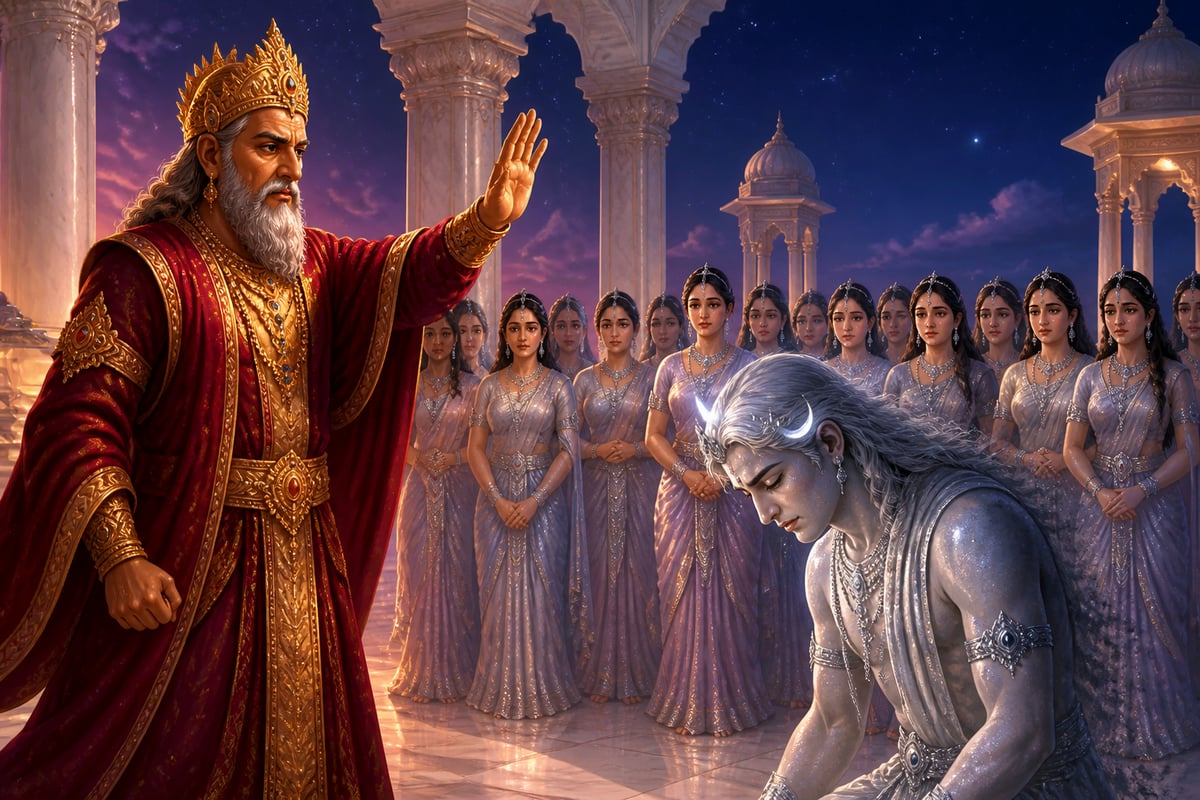
"You who have forsaken your duties for passion, may you waste away! May your light diminish day by day until you vanish completely!"
The curse took immediate effect. The brilliant moon began to fade. Night by night, Chandra's luminous body grew dimmer. The world was plunged into darkness. Crops failed without moonlight to guide the seasons. Tides became erratic. The medicinal herbs that drew power from moon-rays lost their potency.
The Penance at Prabhas
Desperate, Chandra sought advice from Brahma, who revealed that only Shiva could counter such a powerful curse. The creator directed Chandra to the western coast of Saurashtra, to a sacred spot called Prabhasa, "the place of emergence", where three rivers converged before meeting the sea.
Here, at the Triveni Sangam of the Hiran, Kapila, and Saraswati rivers, Chandra established a linga and began a penance that would last for six months, from the full moon to the new moon and back again, matching the very rhythm of his fading and returning light.

Chandra performed the Pashupata Vrata, the most austere form of Shiva worship. He bathed the linga with sacred waters, offered bilva leaves, and chanted the Mahamrityunjaya Mantra, the great death-conquering hymn, continuously.
Shiva's Merciful Intervention
Moved by Chandra's devotion, Shiva appeared before the wasting moon god. But even Mahadeva could not simply erase the curse of Daksha, a curse spoken in righteous anger has its own power. What Shiva could do was modify it.
"Your light will wax and wane," Shiva declared. "For fifteen days you will fade; for fifteen days you will grow bright again. This cycle will continue eternally. But you will never completely vanish. And this place where you found redemption, here I will remain as Somnath, the Lord of Soma, the Lord of the Moon."

Shiva then placed Chandra upon his own head, where the crescent moon remains to this day, a permanent reminder of divine compassion. This is why Shiva is called Chandrashekara, "the one who wears the moon as a crown."
The Temple at the Edge of the World
Somnath's location is geographically extraordinary. According to ancient texts, it marks the point where the Indian subcontinent ends and the western ocean begins. A pillar near the temple famously declares:
"The first point of land in the direction of the South Pole, with no land between here and Antarctica."
This wasn't just poetic license. Ancient Indian astronomers understood that the Somnath coast faces directly south across the Arabian Sea, with no landmass interrupting the ocean until Antarctica. The temple thus stands at a liminal point, the edge of the known world, where land meets the infinite sea, where the finite touches the eternal.
The three rivers that converge here, Hiran (golden), Kapila (tawny, named after Sage Kapila), and the underground Saraswati, create a powerful Triveni Sangam. Bathing at this confluence before darshan is considered essential for pilgrims, just as at Prayagraj.
Architecture of the Present Temple
The current Somnath temple, completed in 1951, represents the Chalukya style of architecture, also known as Kailash Mahameru Prasad style. Its distinctive features include:
- Shikhara (spire): Soars 50 meters high, visible from far out at sea
- Garbhagriha (sanctum): Houses the original swayambhu linga
- Sabha Mandapa: Assembly hall with intricate stone carvings
- Nritya Mandapa: Dance hall for ritual performances
- Arrow Pillar (Ban Stambh): Points toward the South Pole
The linga itself is believed to be the original, a swayambhu manifestation that emerged naturally, not installed by human hands. It sits in the garbhagriha at a slight angle, representing Shiva's eternal, self-manifested presence.
The Shiva Tattva: Waxing and Waning
Somnath teaches a profound philosophical truth through the moon's story: everything in manifestation is subject to cycles of growth and decline, but the essential self remains unchanged.
Chandra's light waxes and wanes, but the moon itself, the physical body, remains constant. The change is apparent, not real. Similarly, our fortunes rise and fall, our bodies age, our circumstances shift endlessly. But the consciousness that witnesses all this change? That remains unaffected.
This is the teaching of Somnath:
- Soma represents the mind (manas), which waxes and wanes with emotions, thoughts, and experiences
- Nath represents the Lord, the unchanging witness consciousness (sakshi)
- Somnath together means: the Lord who remains constant while the mind goes through its cycles
The curse was not removed, it was transformed. Suffering was not eliminated, it was given meaning. This is Shiva's way: not to protect us from life's cycles, but to reveal that our true nature is beyond them.
Why Somnath Comes First
The Dwadasha Jyotirlinga Stotra could have listed the twelve sacred sites in any order. Why does Somnath begin the count?
Several traditions offer explanations:
- Chronological: This was the first place Shiva manifested as a jyotirlinga
- Astronomical: The moon governs time-keeping; starting with Somnath honors this primacy
- Geographical: West to east follows the sun's apparent path; pilgrimage begins at the western edge
- Symbolic: The moon represents the mind; spiritual journey begins with mastering the mind
Whatever the reason, pilgrims who complete the full Dwadasha Jyotirlinga yatra traditionally begin here, at the shore of the Arabian Sea, where the moon found peace and Shiva took up permanent residence.
The Eternal Return
Somnath's story doesn't end with Chandra's redemption. The temple would be destroyed and rebuilt multiple times over two millennia, a subject we'll explore in the next lesson. But through every destruction, something remarkable happened: the devotion of pilgrims ensured the temple rose again.
Like Chandra's light, Somnath waxed and waned. Like Chandra's light, it always returned. This is perhaps the deepest teaching of the first jyotirlinga: what is destroyed in form can never be destroyed in essence. The linga that Shiva promised to inhabit eternally cannot be unmade by human violence.
As the evening aarti begins and thousands of lamps illuminate the temple against the darkening sea, pilgrims witness what Chandra witnessed millennia ago: the eternal light of Shiva, unwavering even as the moon above begins another cycle of its endless waxing and waning.
Key figures
Chandra
The moon god who received Shiva's blessing at Somnath
Daksha
Prajapati (lord of creation) and father-in-law of Chandra
Rohini
The fourth nakshatra and Chandra's favorite wife
Historical context
Mythological origins; historical temple from c. 1st century CE
Living traditions
Somnath remains one of India's most visited pilgrimage sites, with over 5 million pilgrims annually. The Somnath Trust, established after independence, manages the temple and has developed the surrounding area for pilgrims. The temple's reconstruction by Sardar Patel became a symbol of national renewal and cultural continuity.
- Triveni Snan: Ritual bathing at the confluence of Hiran, Kapila, and Saraswati rivers before temple darshan. Pilgrims immerse themselves at this sangam just as Chandra bathed before beginning his penance.
- Somvari Vrat: Monday fasting observed by devotees of Somnath. Since Soma (moon) governs Monday, this day is especially powerful for worship at this jyotirlinga.
- Evening Sound and Light Show: A daily multimedia presentation narrating the history of Somnath from Chandra's curse through centuries of destruction and rebuilding.
- Somnath Jyotirlinga Temple: The main temple housing the first jyotirlinga. The current structure was rebuilt in 1951 in Chalukya style. The garbhagriha contains the ancient swayambhu linga.
- Bhalka Tirtha: The site where Lord Krishna was struck by a hunter's arrow and departed from his earthly form. A temple marks this sacred spot.
- Triveni Sangam: The confluence of Hiran, Kapila, and the underground Saraswati rivers. Pilgrims bathe here before temple darshan.
- Nageshwar Jyotirlinga
Reflection
- Have you experienced a 'curse' in your life, a difficulty or setback, that you later came to see as transformed rather than removed? How did that transformation occur?
- The moon's physical body remains constant while its light appears to change. What in your own experience remains constant while your circumstances, moods, and thoughts continuously change?
- Daksha's curse was righteous, Chandra had genuinely wronged his other wives. Yet the curse caused suffering to the entire world, not just Chandra. How do we balance justice with its unintended consequences?