Dhvamsa Punarnirmana: Destruction and Resurrection
The temple that was rebuilt 17 times
Explore Somnath's tumultuous history of destruction and rebuilding. Learn about Mahmud of Ghazni's raid in 1026 CE, the colonial debates over its reconstruction, and Sardar Patel's role in rebuilding the temple after Independence.
The Undying Flame: Somnath's History of Destruction and Renewal
No temple in India, perhaps no temple in the world, embodies the principle of resilience as powerfully as Somnath. Destroyed repeatedly over two millennia, it has risen again each time, a testament to the principle that what is sacred cannot be unmade by human violence.
This is the story of those destructions and resurrections, a history that shaped not just a temple, but the very idea of cultural continuity.
The Early Temples: Before the Storm
According to tradition, the first temple at Somnath dates to the beginning of time itself, built by Soma (the moon god) in gold after receiving Shiva's blessing. This was followed by temples built by Ravana in silver, Krishna in wood, and finally King Bhimadeva I of the Chalukya dynasty in stone.
Historically, we can trace documented temple structures from the early centuries of the Common Era:
| Period | Temple/Event | Builder/Context |
|---|---|---|
| c. 1st century CE | First historical structure | Unknown; possibly Kshatrapa rulers |
| 649 CE | Stone temple | Maitraka King Vallabhideva |
| 725 CE | Arab raid | Junayad's generals attack |
| 815 CE | Rebuilt | Gurjara-Pratihara patronage |
| 1026 CE | Mahmud's raid | The most famous destruction |
| 1169 CE | Rebuilt | Kumarapala of Chaulukya dynasty |
By the time of the medieval period, Somnath had become one of the wealthiest and most renowned temples in the entire world.
The Raid of 1026 CE: Mahmud of Ghazni
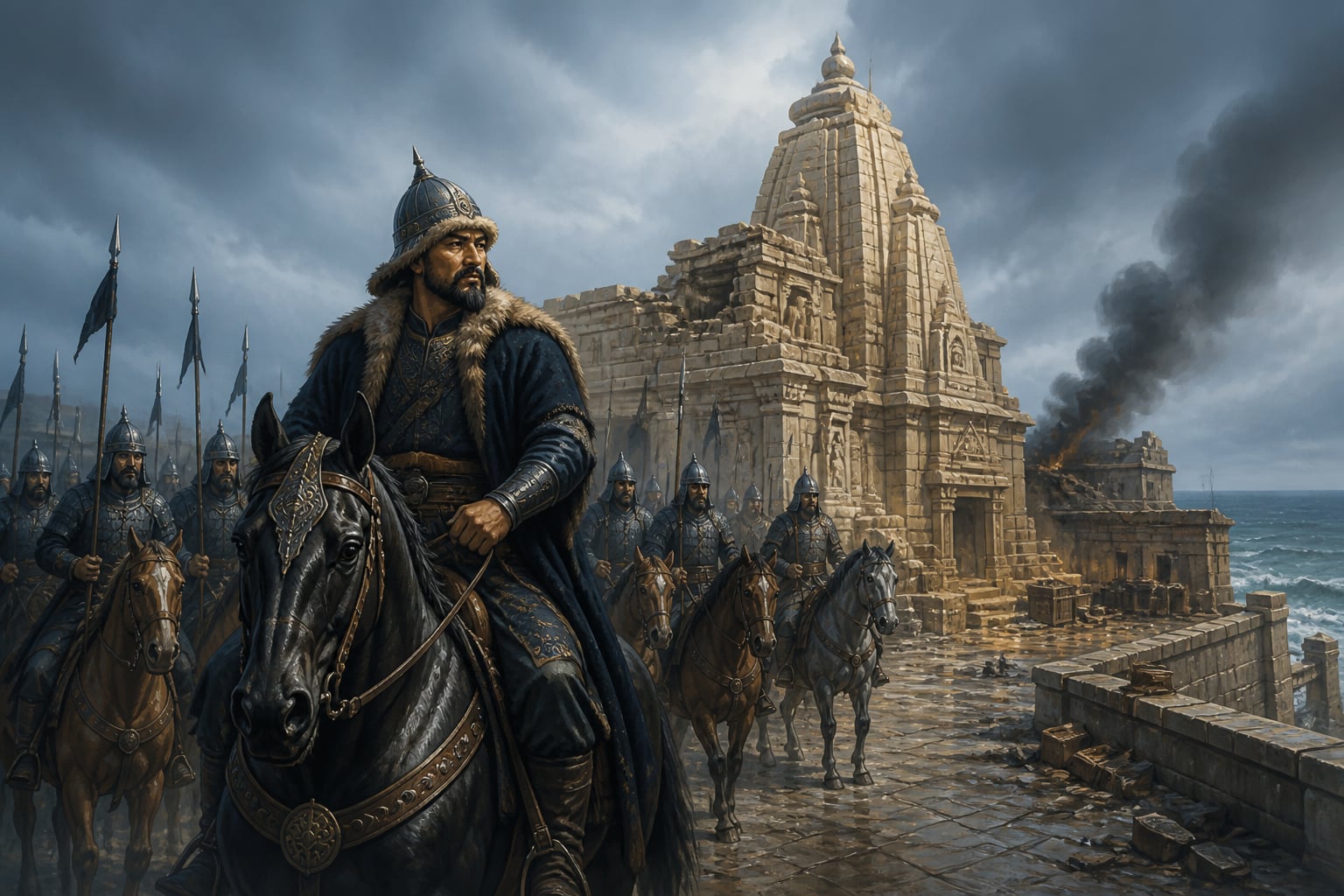
The event that would echo through history for a millennium occurred in the winter of 1026 CE. Mahmud of Ghazni, the powerful sultan based in what is now Afghanistan, led his army across the Thar Desert to attack Somnath.
Mahmud was a complex figure, a patron of poets and scholars who commissioned the great Persian poet Firdausi to write the Shahnameh, yet also a ruthless military commander who conducted seventeen campaigns into India. His motives for attacking Somnath were multiple:
- Economic: Somnath's legendary treasury attracted raiders
- Political: Demonstrating power over Indian kingdoms
- Ideological: Religious zeal against idol worship
- Strategic: Establishing dominance in Gujarat
The accounts of what happened vary between sources. Persian chronicles describe fierce resistance from the temple's defenders. Al-Biruni, the great Central Asian scholar who accompanied Mahmud's court, wrote with evident distaste about the destruction. Hindu sources describe the devotion of those who died defending the temple.
What is certain: the temple was destroyed, its treasury looted, and the idol damaged. Mahmud returned to Ghazni with enormous wealth. The event became legendary on both sides, celebrated in Persian poetry as a triumph, mourned in Indian memory as a tragedy.
The Pattern of Resilience: Rebuilding After Each Destruction
What happened after 1026 CE is as significant as the raid itself: the temple was rebuilt.
King Bhimadeva I of the Chaulukya dynasty ordered reconstruction almost immediately. Within decades, a grand new temple stood at Prabhasa. This pattern would repeat multiple times:
| Destruction | Rebuilt By | Notes |
|---|---|---|
| 1026 (Mahmud) | Bhimadeva I | Stone temple restored |
| 1297 (Delhi Sultanate) | Local devotees | Smaller structure |
| 1395 (Muzaffar Shah) | Regional rulers | Temple restored |
| 1451 (Mahmud Begada) | Devotees | Linga worship continued |
| 1701 (Aurangzeb) | Marathas | Final pre-modern temple |
Each time, the story was the same: destruction by invading forces, followed by reconstruction by devoted communities. The linga itself, whether the original swayambhu or successors, remained the focus of worship throughout.
Al-Biruni's Testimony: A Scholar's Account

Abu Rayhan al-Biruni (973-1048 CE), one of the greatest scholars of the medieval Islamic world, provides invaluable testimony about Somnath. Unlike propagandistic accounts, al-Biruni wrote with scholarly objectivity.
In his masterwork Kitab al-Hind (Book of India), he described:
"Somnath is situated on the coast... The temple received continuous endowments from the revenues of 10,000 villages. A thousand Brahmins performed daily worship, while 350 musicians and dancers maintained continuous service."
Al-Biruni did not celebrate the temple's destruction. He documented it as a scholar recording historical events, with evident respect for the civilization he was studying. His account confirms both Somnath's extraordinary wealth and the cultural loss its destruction represented.
The Colonial Controversy: The Somnath Gates
Somnath entered a new chapter of controversy during British colonial rule through the strange affair of the "Somnath Gates."
In 1842, the British Governor-General Lord Ellenborough announced that he was returning the gates of Somnath, supposedly taken by Mahmud to Ghazni, to India. His proclamation was extraordinarily theatrical:
"The insult of 800 years is at last avenged!"
There were immediate problems:
- Authenticity: The gates were almost certainly not from Somnath
- Timing: Britain was engaged in the disastrous First Afghan War
- Politics: Ellenborough was attempting to generate pro-British Hindu sentiment
- Reception: Indian leaders were largely unimpressed; the gates ended up in storage at Agra Fort
The episode revealed how Somnath had become a political symbol, manipulated by colonial powers for their own purposes. It also sparked early debates about temple reconstruction that would continue for over a century.
Sardar Patel's Vision: The Modern Temple
The most recent, and perhaps final, chapter of Somnath's resurrection came immediately after Indian independence.
Sardar Vallabhbhai Patel, India's first Deputy Prime Minister, was deeply moved by Somnath's condition. During a visit to Junagadh in 1947 to integrate the princely state into India, he visited the temple ruins and made a vow:
"I have decided that Somnath should be reconstructed. It is my dream that this temple of Somnath should be reconstructed and that this dream should be realized during my own lifetime."

Patel's approach was significant:
- Personal commitment: He drove the project despite his demanding official duties
- Financial independence: Refused government funds, insisting on public donations
- Cultural continuity: Framed reconstruction as restoring India's civilizational heritage
- Secular spirit: Invited all Indians, regardless of religion, to contribute
The foundation stone was laid in November 1947, just months after independence, with President Rajendra Prasad presiding. Tragically, Patel died in December 1950, before the temple's completion. The temple was inaugurated in May 1951 by President Prasad.
The Architectural Achievement: The 1951 Temple
The current Somnath temple represents a remarkable architectural achievement. Designed by the temple architect Prabhashankar Sompura, it deliberately chose the Chalukya style (also called Kailash Mahameru Prasad) to echo the great medieval temple.
Key features:
- Height: 50 meters (155 feet) to the shikhara's peak
- Material: Sandstone from the Junagadh region
- Style: Nagara architecture with Solanki-period influences
- Integration: The original swayambhu linga was preserved and installed in the new garbhagriha
The design avoided simply replicating an earlier temple. Instead, it synthesized traditional elements into a fresh expression, appropriate for a temple that has always been rebuilt, never merely restored.
The Debate: History and Memory
Somnath continues to generate scholarly debate. Some historians emphasize that medieval temple destructions had complex motivations, political and economic as much as religious. Others point to the persistent Hindu memory of these events as evidence of their deep cultural impact.
What seems clear is that Somnath functions on multiple levels:
- As tirtha: A sacred site where Shiva remains eternally present
- As symbol: Of Hindu resilience and cultural continuity
- As history: A case study in medieval conflicts and their legacy
- As living temple: A vibrant pilgrimage center serving millions annually
These dimensions coexist, sometimes in tension, but together they constitute what Somnath means today.
The Shiva Tattva: The Indestructible Self
Somnath's repeated destructions and resurrections teach a profound philosophical truth that echoes the Bhagavad Gita:
नैनं छिन्दन्ति शस्त्राणि नैनं दहति पावकः nainaṃ chindanti śastrāṇi nainaṃ dahati pāvakaḥ "Weapons cannot cut it, fire cannot burn it."
The atman, the eternal self, cannot be destroyed by physical forces. Similarly, the sacred reality that Somnath represents transcends its physical manifestations. Invaders could break stones and loot treasuries, but they could not destroy what Somnath actually is: a point of connection between human devotion and divine presence.
This is why the temple always rose again. The physical structure is important, but it is not the temple's essence. As long as devotees remember and return, as long as pujas are performed and mantras chanted, Somnath exists, whether in gold, silver, wood, stone, or in the hearts of pilgrims.
Somnath Today: The Eternal Return
Today's Somnath is more than a temple, it's a pilgrimage complex managed by the Somnath Trust. The site includes:
- The main temple: Housing the jyotirlinga
- Somnath Museum: Displaying archaeological finds from the site
- The Arrow Pillar: With its famous inscription
- Sound and Light Show: Narrating the temple's history
- Ahilyabai Temple: The earlier small temple maintained by Ahilyabai Holkar
Over five million pilgrims visit annually. On Mahashivaratri, the crowds swell to hundreds of thousands, all coming to receive darshan of the jyotirlinga that human violence has never succeeded in destroying.
The evening aarti at Somnath, performed as the sun sets over the Arabian Sea, continues a tradition thousands of years old. The flames rise, the bells ring, and the priests chant the same mantras that have echoed here through destructions and resurrections, invasions and liberations, across the vast sweep of Indian history.
Like Chandra's light, waxing and waning but never vanishing, Somnath endures.
Key figures
Mahmud of Ghazni
Ghaznavid Sultan who led the 1026 CE raid on Somnath
Al-Biruni
Central Asian scholar who documented Somnath in his masterwork on India
Sardar Vallabhbhai Patel
India's first Deputy Prime Minister who championed Somnath's reconstruction
Historical context
Medieval to Modern Period (1026 CE - 1951 CE)
Living traditions
Somnath's reconstruction has become a model for temple restoration projects across India. The Somnath Trust, established after Patel's initiative, manages not just the temple but extensive charitable and educational activities. The temple's resilient history is frequently invoked in discussions of cultural preservation and continuity.
- Sound and Light Show: A daily audiovisual presentation on the temple grounds narrating Somnath's history from Chandra's curse through the medieval destructions to modern reconstruction.
- Samudra Darshan: Viewing the Arabian Sea from the temple complex, often combined with sunset watching as the temple faces the western ocean.
- Somnath Museum: Houses archaeological artifacts, old photographs, and remnants from various periods of Somnath's history. Includes fragments from earlier temples and historical documentation.
- Ahilyabai Temple: The smaller temple built by Queen Ahilyabai Holkar in 1783 when the main temple lay in ruins. Maintained continuous worship at the site for over 150 years.
- Sardar Patel Memorial: Memorial honoring the leader who championed the temple's reconstruction. Includes photographs and documentation from the rebuilding period.
Reflection
- What in your life has been 'destroyed' and rebuilt, perhaps multiple times? A relationship, a career, a belief, a sense of self? What enabled the rebuilding?
- The devotees of Somnath kept rebuilding for nearly two thousand years. What sustains such persistence across generations? What do we owe to those who will come after us?
- Can physical destruction ever truly destroy something sacred? What is the relationship between a sacred site's physical form and its spiritual significance?