Pitru Karma: Ancestral Rites at Trimbak

Narayan-Nagbali and Kalsarpa Shanti rituals

Understand why Trimbakeshwar is considered a powerful center for ancestral rites. Learn about the Narayan-Nagbali ritual to free souls from curses, Kalsarpa Shanti for astrological remedies, and the symbolic meaning of the water-eroded linga.

Honoring the Ancestors: Trimbakeshwar as India's Sacred Site for Pitru Karma

Beyond its significance as a jyotirlinga, Trimbakeshwar holds another distinction: it is considered one of the most powerful sites in India for pitru karma, rituals honoring and liberating deceased ancestors. Each year, thousands come here not only for darshan but to perform ceremonies that address unfinished business with those who came before them.

This lesson explores why Trimbakeshwar has this special association and what the rituals performed here teach us about the Hindu understanding of our relationship with the dead.

The Concept of Pitru Rina: The Debt to Ancestors

In Hindu dharma, we are born with three primary debts (rina):

Debt To Whom How Repaid
Deva Rina The gods Through worship and yajna
Rishi Rina The sages Through study and teaching
Pitru Rina The ancestors Through shraddha and producing offspring

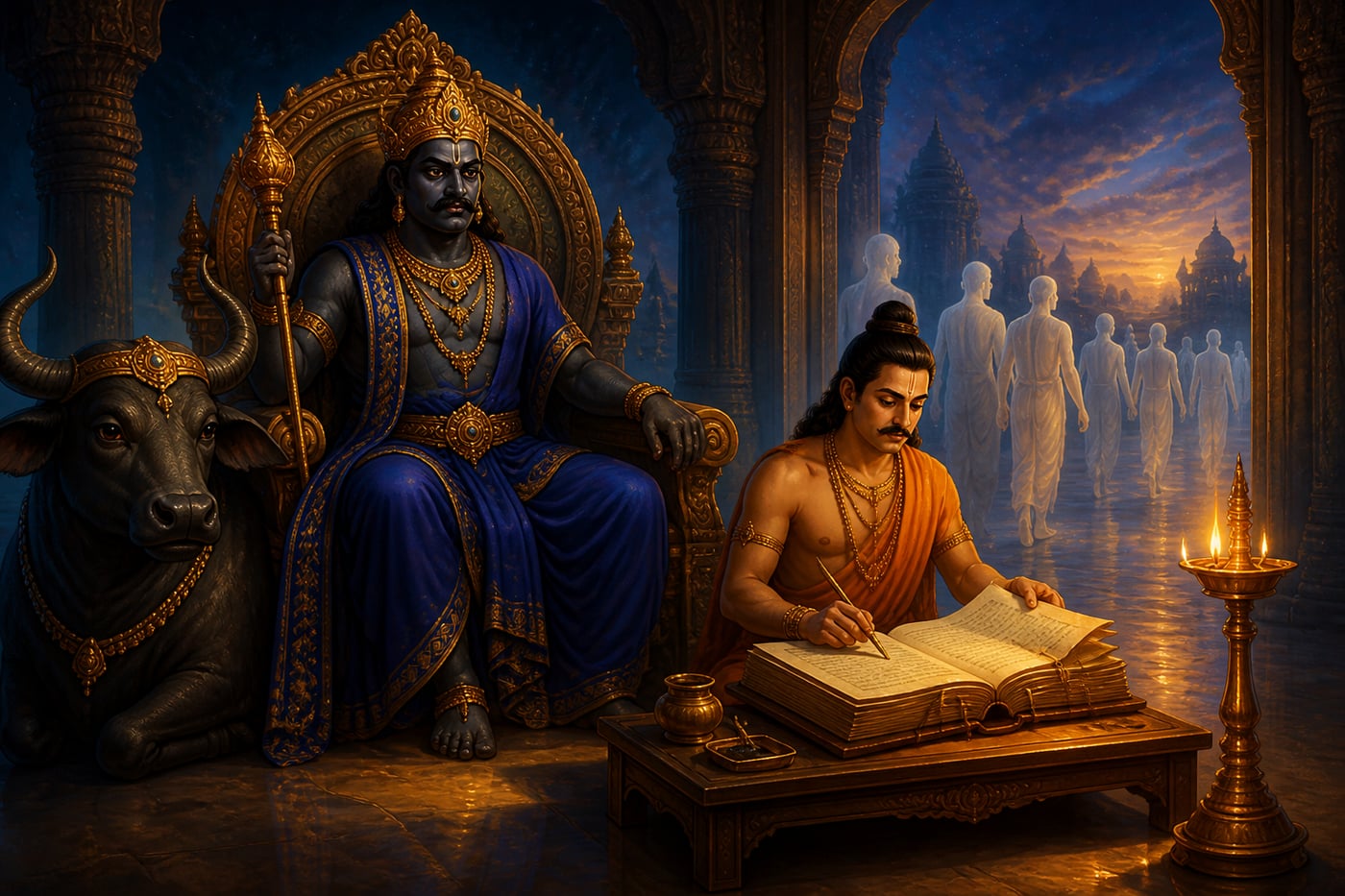
Yama and Chitragupta with karma ledger in Pitru Loka

Of these three, Pitru Rina (the debt to ancestors) is perhaps the most intimate. We exist because they existed. Our physical bodies carry their genetic inheritance. Their choices shaped the circumstances into which we were born. Recognizing this debt, Hindu tradition developed elaborate ceremonies to honor the dead, ensure their peaceful transition, and maintain the connection between the living and their ancestors.

But what happens when that connection is troubled? When ancestors died under inauspicious circumstances, or when their rites were not properly performed, or when they or their descendants were under curses? This is where Trimbakeshwar's special role emerges.

Why Trimbakeshwar for Pitru Karma?

Several factors make Trimbakeshwar uniquely powerful for ancestral rites:

1. The Godavari Connection

The Godavari, originating here, is one of India's most sacred rivers for the disposal of ashes and the performance of shraddha. The belief that this river emerged from Shiva's locks specifically to purify sin makes it extraordinarily powerful for ancestral liberation. What pollutes, including ancestral curses or incomplete rites, can be cleansed here at the river's source.

2. Gautama's Redemption

The mythology of Trimbakeshwar centers on purification from false accusation. Sage Gautama was blamed for a sin he did not commit, yet he still performed penance. This establishes Trimbakeshwar as a place where even unjust burdens can be resolved, including ancestral burdens we did not personally create.

3. The Trimurti Linga

The three-faced linga representing Brahma, Vishnu, and Shiva encompasses all phases of existence: creation, preservation, and dissolution. For souls stuck in transitional states, between death and full liberation, this comprehensive divine presence offers complete resolution.

4. Textual Authority

Various Puranas specifically recommend Trimbakeshwar for pitru karma, particularly the Padma Purana and Skanda Purana, which describe the efficacy of rites performed here.

The Narayan-Nagbali Ritual

The most elaborate and powerful ancestral rite performed at Trimbakeshwar is Narayan-Nagbali, actually two rituals combined, traditionally performed together over three days.

Narayan Bali: Liberating Stuck Souls

The Narayan Bali portion addresses souls who died under inauspicious circumstances:

Such souls, according to tradition, may not transition smoothly to Pitru Loka (the realm of ancestors). They may remain as pretas, restless spirits, causing disturbance to themselves and their descendants. Symptoms might include:

The Narayan Bali ritual invokes Lord Vishnu (Narayan) to guide these souls to peaceful transition. The ritual includes:

  1. Sankalpa: Declaration of intention and identification of the ancestor
  2. Pinda Daan: Offering of rice balls representing the ancestor's subtle body
  3. Narayan Puja: Worship of Vishnu as the liberator
  4. Brahmin Bhoj: Feeding of Brahmins as representatives of the ancestors
  5. Tarpana: Water offerings to complete the liberation

Nagbali: Addressing Serpent-Related Karma

The Nagbali portion addresses specific karmic issues related to serpents (nagas):

In Hindu cosmology, nagas are powerful beings who can bless or curse. Harming them, even unintentionally, can create karmic consequences. Nagbali propitiates these beings and resolves the negative karma.

The combined Narayan-Nagbali is typically performed over three days, requiring specific materials, the guidance of trained priests, and significant expense. It is not undertaken lightly but as a serious spiritual intervention for persistent ancestral issues.

Trimbakeshwar priest performing Narayan Nagbali ritual fire with patron family seated across

Kalsarpa Shanti Puja

Another major ritual performed at Trimbakeshwar is Kalsarpa Shanti, a remedy for an astrological condition called Kalsarpa Dosha (or Yoga).

What is Kalsarpa Dosha?

In Vedic astrology, Rahu and Ketu are the lunar nodes, mathematical points where the moon's orbit intersects the ecliptic. They are depicted mythologically as a serpent, with Rahu as the head and Ketu as the tail.

Kalsarpa Dosha occurs when all seven planets (Sun, Moon, Mars, Mercury, Jupiter, Venus, Saturn) fall on one side of the Rahu-Ketu axis, essentially "trapped" between the serpent's head and tail.

Those with this configuration are believed to experience:

The Kalsarpa Shanti Ritual

Performed at Trimbakeshwar because of its association with the Trimurti and Shiva's power over serpents, Kalsarpa Shanti includes:

  1. Abhishekam: Bathing the linga with various sacred substances
  2. Naga Puja: Worship of the serpent deities
  3. Rudrabhishekam: Special worship of Shiva
  4. Homa: Fire ritual invoking planetary deities
  5. Sarpa Sukta: Chanting of Vedic hymns to serpents

The ritual typically takes 3-4 hours and is performed by designated temple priests. Many people travel specifically to Trimbakeshwar for this puja, making it a significant source of the temple's activity.

The Pitru Paksha Connection

Family performing pinda daan at Kushavarta during Pitru Paksha

During Pitru Paksha, the fortnight specifically dedicated to ancestor worship (usually in September-October), Trimbakeshwar sees dramatically increased activity. This period, falling in the lunar month of Bhadrapada, is considered the most powerful time for pitru karma.

During Pitru Paksha:

At Trimbakeshwar, tens of thousands perform tarpana and pinda daan during this period, turning the temple complex and the Kushavarta Kund into a concentrated center of ancestral remembrance.

Tripindi Shraddha: The Three-Generation Rite

For those who have not performed annual shraddha for their ancestors, Trimbakeshwar offers Tripindi Shraddha, a comprehensive ceremony that covers three generations of ancestors in a single ritual.

This is particularly important for:

The Tripindi Shraddha "catches up" on missed obligations, ensuring that ancestors across three generations receive the rites that support their peaceful existence in Pitru Loka.

The Shiva Tattva: Death and Continuity

Why is a Shiva temple the primary site for ancestral rites? The connection goes deep:

Shiva as Mahakala (Lord of Time) presides over death and what lies beyond it. He is present at the moment of death, and those who die remembering him are said to achieve liberation. His presence at Trimbakeshwar provides spiritual power for rites that deal with death and its aftermath.

The Trimurti teaching of Trimbakeshwar is especially relevant here. The ancestors have passed through dissolution (Shiva's function) and now exist in a different form of being. The ritual process involves all three phases:

The water-eroded linga teaches impermanence, the physical form dissolves, but what it represents endures. This is precisely the teaching relevant to death: the body dissolves, but the soul's journey continues. Rituals at Trimbakeshwar support that continuing journey.

Understanding Pitru Karma Today

How should modern Hindus understand these rituals? Several perspectives coexist:

Traditional View: The rituals literally liberate ancestral souls, resolve karmic issues, and maintain essential relationships across the boundary of death.

Psychological View: The rituals provide closure, honor family memory, and help the living process grief and guilt. Whether or not they affect the dead, they undeniably affect the living.

Philosophical View: The rituals express the Hindu understanding that individual existence is embedded in larger networks, family, lineage, cosmos. We are not isolated individuals but nodes in a web of relationship that transcends death.

Dharmic View: Regardless of metaphysics, performing pitru karma fulfills our debt to those who gave us life. It is simply the right thing to do, an expression of gratitude that requires no further justification.

These views are not mutually exclusive. A single person might hold all of them simultaneously, performing the rituals with sincerity while remaining uncertain about their exact mechanism.

The Continuing Conversation with the Dead

Trimbakeshwar's role as a center for pitru karma reminds us of something often forgotten in modern life: our relationship with the dead does not end at death. The Hindu tradition maintains that the living and the ancestors exist in ongoing relationship, they can help us; we can help them; the connection endures.

In the temple's precincts, where thousands come each year to perform rites for their departed, this understanding becomes palpable. The priests chant; the offerings are made; the water is poured. And something, whether we understand it as literal soul liberation, psychological healing, or dharmic duty fulfilled, is accomplished.

The three-faced linga presides over it all: creator, preserver, dissolver, the complete cycle that encompasses both the living and the dead, held together in Shiva's eternal, water-bathed presence.

Key figures

Yama

The god of death and dharma; ruler of Pitru Loka (the realm of ancestors)

Chitragupta

The divine accountant who maintains records of all beings' karmas

The Ancestral Deities

The collective presence of all ancestors who receive worship in pitru karma

Historical context

Continuous tradition from Puranic period to present

Living traditions

Trimbakeshwar remains India's primary center for specialized pitru karma rituals. The Narayan-Nagbali and Kalsarpa Shanti attract visitors from across India and the global diaspora. The temple economy significantly depends on these ritual services, supporting a community of specialized priests and associated services.

Reflection

More in Nadi Sangama: Where Rivers Meet Shiva

All lessons in Nadi Sangama: Where Rivers Meet Shiva ยท The Twelve Jyotirlingas course