Swayambhu: The Self-Manifested Lingas
What Makes Jyotirlingas Categorically Different
India has millions of Shiva temples, but only twelve Jyotirlingas. The difference lies in a single concept: swayambhu, self-manifested, emerging without human intervention. Discover the theology that makes these lingas 'born from themselves,' why this matters for pilgrimage, and what it teaches about the relationship between the sacred and the made.
The Crucial Distinction
India has over 30,000 Shiva temples. In almost every village, you'll find a Shiva linga receiving daily worship. Some are ancient; some are newly installed. Some are in magnificent stone temples; some sit under trees.
Yet when devotees speak of the Jyotirlingas, their voice changes. These aren't simply old temples or famous sites. They're considered categorically different, a different class of sacred entirely.
The distinction lies in a single Sanskrit word: swayambhu.
Swayambhu vs. Manushya: The Two Types of Lingas
Traditional classification divides lingas into categories:
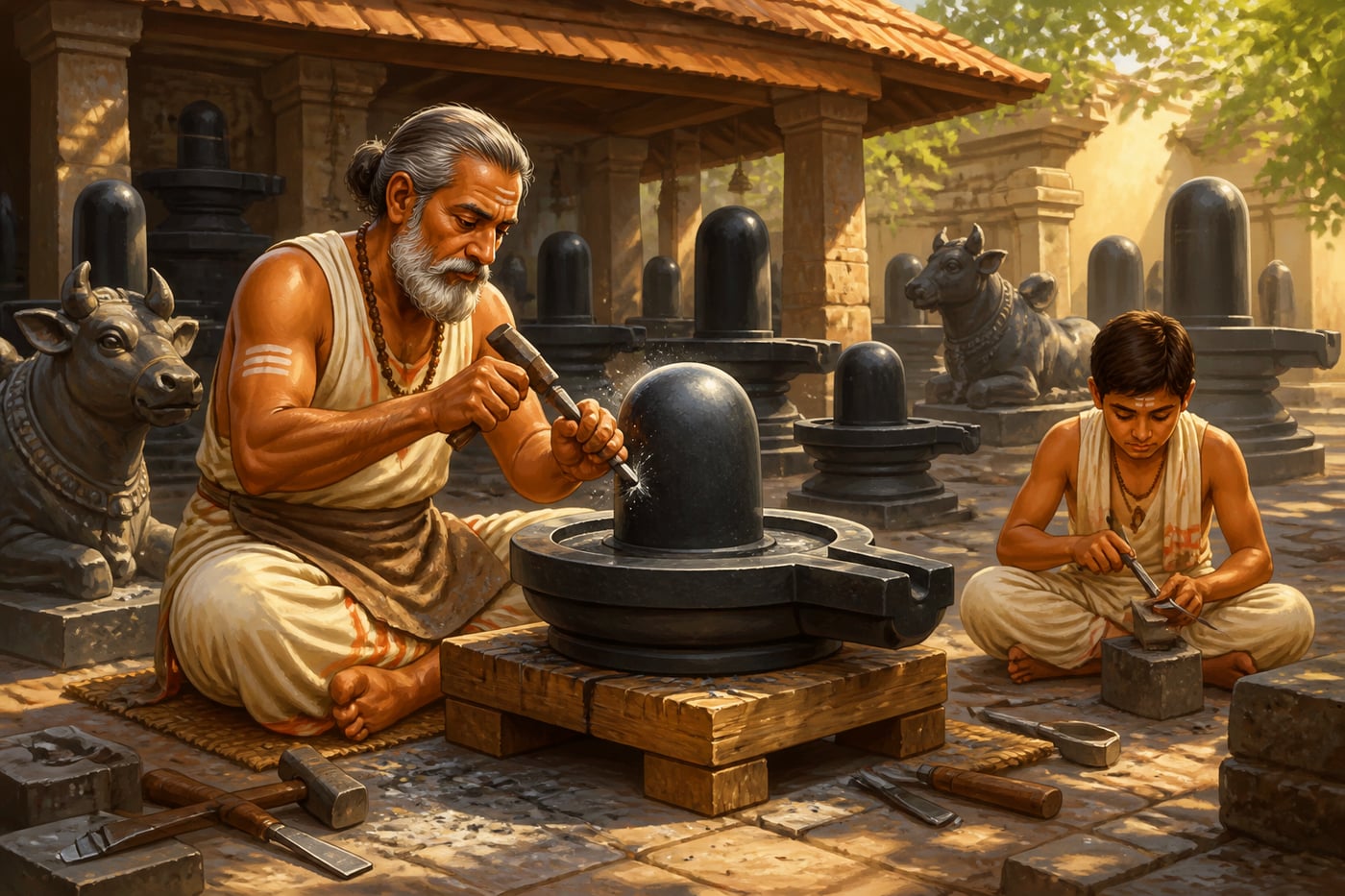
Manushya Lingas (मानुष्य लिङ्ग), "Human lingas." These are carved by sculptors, installed by priests through prana-pratishtha rituals, and consecrated according to Agamic procedures. The overwhelming majority of Shiva temples contain manushya lingas. They are holy, but they are made.
Swayambhu Lingas (स्वयम्भू लिङ्ग), "Self-born lingas." These are not carved or installed. They emerged from the earth, appeared in caves, or manifested through divine intervention. No human hand shaped them. They simply are.
The Jyotirlingas are the supreme examples of swayambhu lingas. They are manifestations of the infinite pillar of light that appeared between Brahma and Vishnu, not representations of it, but actual points where that cosmic light touched earth.
What "Self-Born" Really Means
When we say a linga is swayambhu, we're making a theological claim: the sacred does not require human permission to exist.
A manushya linga becomes sacred through human ritual. Priests perform prana-pratishtha, "establishment of life-breath", invoking divine presence into the carved stone. The linga is stone until the ritual; afterward, it is Shiva.
A swayambhu linga reverses this. It is already Shiva, has always been Shiva, before any human recognized it. The sacred manifested independently. Humans merely discovered what was already there.
This is not a minor theological point. It speaks to the fundamental question: Does the sacred need us?
The swayambhu teaching answers: No. The sacred exists independently. Our temples don't create holiness; they respond to holiness that was there before us.
The Geological Reality
Skeptics might ask: Aren't the "self-manifested" lingas simply natural rock formations that humans interpreted as sacred?
Yes. And this doesn't diminish their significance, it illuminates it.
At Kedarnath, the linga is a natural conical rock formation. At Amarnath (not one of the twelve, but a famous swayambhu), the linga is an ice stalagmite that forms and dissolves annually. At several Jyotirlingas, the original linga is a natural rock, while the temple was built around it centuries later.

The tradition looks at these geological features and says: This is not an accident. This is Shiva showing himself without waiting for human intervention.
Nature and the sacred are not opposed in this worldview. Natural formations can be divine manifestations. The earth itself becomes a text that Shiva writes.
Why Swayambhu Status Matters
The swayambhu distinction creates real differences in worship:
Pilgrimage Priority: Swayambhu sites are considered more spiritually potent than installed sites. A pilgrim who visits Kashi Vishwanath receives blessings unavailable at even the most magnificent new temple with its manushya linga.
Ritual Differences: At swayambhu sites, certain purificatory rituals that are essential for manushya lingas are unnecessary, the linga needs no human ritual to be holy. This affects abhisheka (bathing) practices and some temple procedures.
Indestructibility: A manushya linga can be desecrated or destroyed; its sacredness depends on maintained ritual. A swayambhu linga, being inherently sacred, cannot truly be destroyed. When Somnath was demolished repeatedly, the sacred remained, because the site itself, not any particular stone, was swayambhu. New temples could be built because the swayambhu power of the location persisted.
Darshan Quality: Traditional teaching holds that darshan (sacred seeing) at a swayambhu site offers direct contact with Shiva's cosmic form, not merely contact with a consecrated image. The veil between devotee and deity is thinner.
The Inner Swayambhu
Here the teaching takes an inward turn.
If swayambhu means "self-born", existing without external cause, then the ultimate swayambhu is consciousness itself.
Your awareness didn't begin when you were born. The body was born; the awareness that witnesses the body was there before and continues after. Awareness is swayambhu, it doesn't depend on anything for its existence. It simply is.
The external Jyotirlingas point to this inner jyotirlinga. When you stand before Kedarnath or Kashi Vishwanath and feel awe, you're recognizing something: the infinite light "out there" is the same infinite light "in here."
This is why the Shiva Purana, after describing the sixty-four external jyotirlingas, speaks of the antara-jyotirlinga, the inner pillar of light that can be accessed through meditation. External pilgrimage leads to internal pilgrimage. The twelve sites are training wheels for recognizing the swayambhu that you are.
Jyotirlinga as Teaching Device
Consider the pedagogical genius of the swayambhu concept:
Problem: How do you teach that the sacred is everywhere and always accessible?
Solution: You establish certain sites as supremely sacred precisely because they weren't made sacred by humans. Then you teach that what's true at these special sites is actually true everywhere, we just don't notice.
The Jyotirlinga tradition doesn't say other sites are worthless. It says these twelve are windows, places where the ever-present light is more visible, where the eternal breaks through more clearly.
Once a devotee experiences the sacred at Rameshwaram or Kedarnath, they carry that experience home. They begin seeing their local temple differently. Eventually, they begin seeing everything differently.
The swayambhu sites are not destinations. They're training sites for recognizing swayambhu everywhere.
The Complementary Relationship
Manushya and swayambhu lingas are not competitors. They form a complete system:
Swayambhu lingas teach that the sacred exists independently of human effort. They humble us, we did not create this; we can only recognize it.
Manushya lingas teach that humans can invite the sacred into form through proper action. They empower us, through right ritual, we can make our environments holy.
Both are needed. Without swayambhu lingas, we might think we control the sacred. Without manushya lingas, we might think the sacred is inaccessible except at rare special sites.
Together, they teach: the sacred is always present (swayambhu), and we can learn to see it anywhere (manushya ritual as training).
The Test of a Swayambhu
How does tradition determine if a linga is swayambhu?
The criteria are not scientific but traditional:
Origin in legend: Is there a Puranic story describing its manifestation without human agency?
Geological distinctiveness: Does the linga have unusual features suggesting natural rather than carved origin?
Ancient worship: Has the site been worshipped beyond historical memory, suggesting recognition of pre-existing sanctity?
Reported miracles: Has the site been associated with extraordinary events suggesting divine presence?
Textual recognition: Is the site listed in authoritative texts (like the Dwadasha Stotra) as a jyotirlinga?
These criteria are not "proof" in a modern scientific sense. They're markers that the tradition uses to identify sites where the sacred appears to have manifested without human invitation.
Chapter Conclusion: The Foundation
We have now completed Chapter 1: the origin of the Jyotirlingas.
We began with the cosmic contest, Brahma and Vishnu arguing over supremacy, Shiva appearing as the infinite pillar of light that neither could measure. We learned about the sixty-four original sites and why twelve became canonical. We memorized the stotra that has guided pilgrims for a thousand years. And we've understood what makes these twelve categorically different from the millions of other Shiva temples.
The foundation is laid:
- The Jyotirlingas are not merely old or famous temples
- They are points where the infinite broke through into the finite
- They are swayambhu, self-manifested, not created by human ritual
- They exist to teach us that the sacred is always present, always independent, always waiting to be recognized
In the chapters ahead, we will visit each of the twelve sites in detail, their legends, their history, their distinctive practices, and the wisdom each offers.
But remember as we journey: each external Jyotirlinga points to the internal one. The pillar of light that neither Brahma flying up nor Vishnu diving down could measure? It's the same light of consciousness that illuminates these very words as you read them.
The swayambhu is not only out there in Gujarat or Varanasi or the Himalayas.
It is here. It is you.
Key figures
Shiva as the Self-Existent
Shiva in his aspect as the uncaused cause; the self-born deity who exists prior to all creation and manifestation
The Inner Controller
The divine presence within all beings; the witness consciousness that dwells in every heart
The First Seer
The unknown devotees who first recognized the swayambhu lingas and began worship at these sites, often in prehistoric times
Historical context
The swayambhu concept is present in the earliest Shaiva texts (Linga Purana, Shiva Purana, c. 300-1000 CE); worship at swayambhu sites predates these texts by centuries or millennia
The swayambhu teaching emerged from a culture that recognized the sacred in nature, mountains, rivers, trees, and rock formations. When Puranic Hinduism systematized these beliefs, it created categories (swayambhu vs. manushya) that honored both inherited nature-worship and emerging temple culture. The Jyotirlingas became the supreme examples of natural sacred sites within an increasingly temple-centered tradition.
Understanding swayambhu teaches modern practitioners that the sacred isn't only what religions create, it also includes what religions discover. This has implications for ecology (land can be inherently sacred), interfaith dialogue (different traditions may recognize the same natural sanctity), and personal practice (the inner jyotirlinga doesn't require institutional mediation). The swayambhu teaching keeps the tradition humble before a sacred that exceeds human categories.
Living traditions
The swayambhu concept influences modern Hindu ecology and land-use debates. When a natural formation is considered swayambhu, it becomes spiritually protected, development that would harm it faces religious opposition. This has affected dam projects, mining proposals, and urban expansion near sacred sites. The teaching that the land itself can be inherently holy, without human consecration, provides theological foundation for environmental protection.
- Swayambhu Linga Darshan Etiquette: At swayambhu sites, traditional practice includes specific behaviors: circumambulation (pradakshina) is done with special reverence knowing the linga existed before any temple; offerings are made directly to the original rock where visible; some pilgrims touch their foreheads to the ground before the original formation rather than approaching the decorated shrine.
- Antara-Jyotirlinga Meditation: A contemplative practice of visualizing the infinite pillar of light extending from the base of the spine (mūlādhāra) through the crown (sahasrāra) and beyond, connecting the individual to the cosmic jyotirlinga. Often practiced before or after physical pilgrimage, or as a daily practice for those who cannot travel.
- Kedarnath Temple: Perhaps the most dramatically swayambhu of all Jyotirlingas, the linga here is a natural triangular rock formation in the Himalayan heights. The temple was built around the formation; the rock itself predates any human intervention. The challenging pilgrimage (14 km trek at high altitude) reinforces the sense of approaching something primal.
- Other Swayambhu Sites (Non-Jyotirlinga): Many non-Jyotirlinga Shiva temples also claim swayambhu status based on natural rock formations or legendary spontaneous appearances. Examples include Achaleshwar Mahadev (Rajasthan), Kapaleeshwarar (Chennai), and numerous local swayambhu sites. Visiting these helps understand the spectrum of swayambhu claims.
Reflection
- Is there something in your life that feels 'swayambhu', not something you created or chose, but something that was always there waiting to be recognized? How might you honor it differently?
- If the sacred exists independently of human recognition, as swayambhu teaching suggests, what is the purpose of temples, rituals, and pilgrimage? Are they discovery or creation?
- The same tradition that teaches some sites are inherently sacred (swayambhu) also teaches that humans can create sacred spaces (manushya). Is this a contradiction, or does it reveal something about the relationship between the eternal and the temporal?