Brahmanda Spardha: The Cosmic Contest

When Brahma and Vishnu Argued Over Supremacy

Discover the cosmic origin story of the Jyotirlingas - how Lord Shiva appeared as an infinite pillar of light to settle the greatest divine debate. Learn about Brahma's fateful lie, the curse that followed, and why this moment became the foundation for twelve of Hinduism's most sacred sites.

The Argument That Shook the Cosmos

In the beginning, before the twelve sacred temples, before the pilgrims and the priests, there was an argument.

Not between humans, but between gods. Not over territory or treasure, but over the most fundamental question: Who is supreme?

Brahma, the creator of worlds, sat upon his lotus throne. Four heads gazed in all directions, each reciting the Vedas, each convinced of his own primacy. "I create," he declared. "From me spring all beings, all worlds, all possibilities. Without creation, what would exist to preserve or destroy?"

Vishnu, reclining on the cosmic serpent Ananta in the ocean of milk, smiled with the patience of one who sustains all things. "You create, yes," he replied, "but I preserve. What good is creation that does not endure? The worlds you make would collapse in moments without my sustaining grace."

Back and forth they argued, each marshaling cosmic evidence. Brahma pointed to the infinite forms emerging from his meditation. Vishnu showed the countless beings sheltered in his protection. Neither would yield. Neither could.
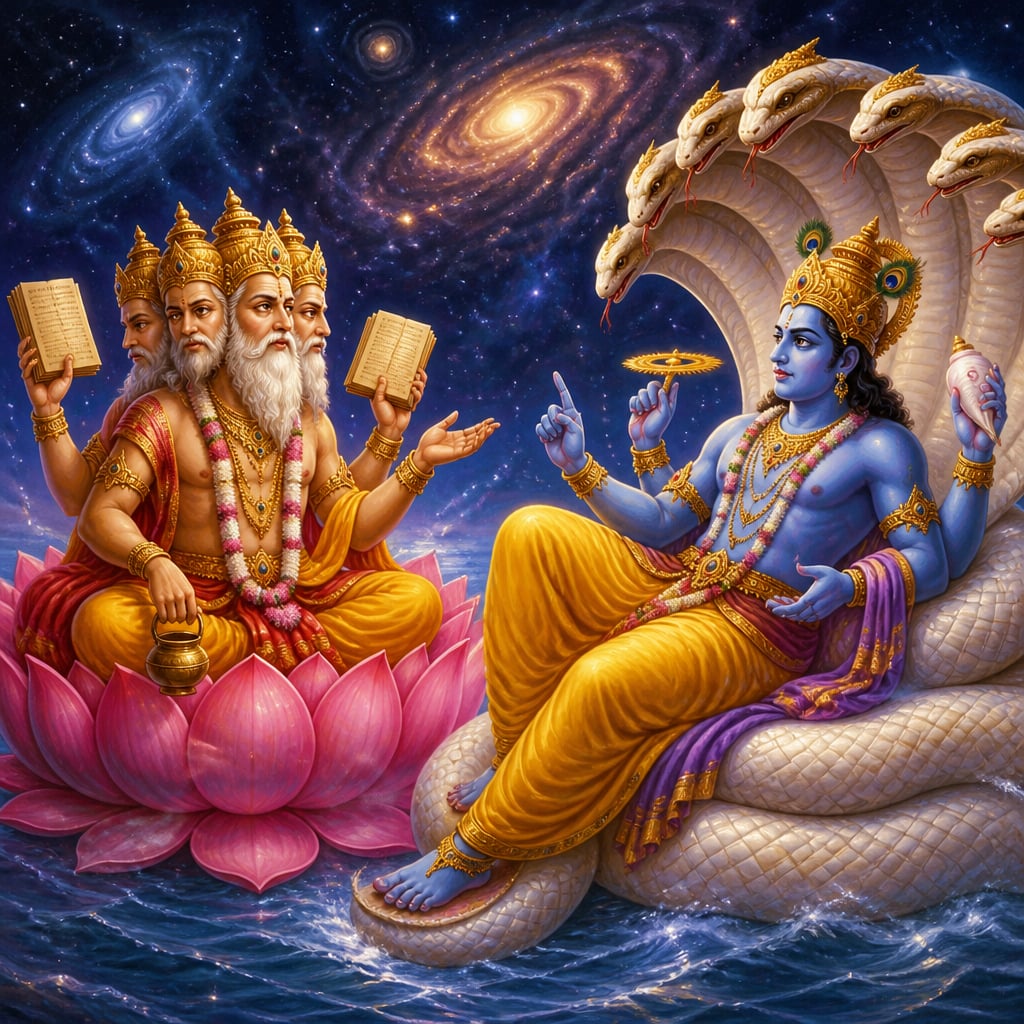
Brahma and Vishnu arguing over supremacy

The debate grew heated. Divine voices thundered across dimensions. The very fabric of existence trembled under the weight of their conflict.

The Pillar of Light

Then, without warning, everything changed.

Between the arguing gods appeared a column of fire, a pillar of blazing light that seemed to have no beginning and no end. It pierced through all worlds, from the lowest depths to the highest heavens, and kept going. Its radiance was so intense that even the gods had to shield their eyes.

"What is this?" Brahma asked, his four heads turning in confusion.

"I do not know," Vishnu admitted, "but we must find out."

They agreed to a contest: Brahma would fly upward to find the top of this infinite pillar, while Vishnu would dive downward to find its base. Whoever found the end first would be declared supreme.

Jyoti, light. Linga, symbol, sign. This Jyotirlinga, this pillar of infinite light, would settle their dispute.

Or so they thought.

The Journey Without End

Vishnu transformed into his Varaha avatar, the great boar, and plunged downward. Through world after world he dove, through dimensions of increasing darkness, through layers of creation that seemed endless. For a thousand years he traveled down, then a thousand more. The pillar continued without a base.

Finally, exhausted and humbled, Vishnu returned. "I could not find its bottom," he admitted honestly. "This light is infinite. Whatever this is, it is beyond my comprehension."

Brahma, meanwhile, had flown upward in his swan form. Higher and higher he soared, through celestial realms and beyond them, through spaces where even gods rarely ventured. Like Vishnu, he found no end to the pillar.

But Brahma was not willing to admit defeat.

The Fateful Lie

Brahma in swan form encountering the Ketaki blossom

As Brahma flew ever higher, he encountered a Ketaki flower, the fragrant screwpine blossom, drifting downward through the cosmos. "Where do you come from?" he asked.

"I was placed at the top of this pillar," the flower replied. "I have been falling for ages."

Brahma saw his opportunity. "Will you witness for me," he asked, "that I reached the top?"

The Ketaki, perhaps foolishly, agreed.

Brahma returned to where Vishnu waited. "I have found the summit," he announced proudly. "This flower is my witness. I have won, I am supreme."

The Revelation

At that moment, the pillar of fire transformed.

Shiva emerging from the pillar to curse Brahma

From within the infinite light emerged Shiva, Mahadeva, the Great God, in all his terrifying and beautiful magnificence. His appearance revealed the truth: the endless pillar of light was Shiva himself, formless and infinite, beyond the comprehension of even the highest gods.

"Vishnu," Shiva spoke, his voice like cosmic thunder softened with compassion, "you have been truthful. You acknowledged the limits of your knowledge. This humility reflects true wisdom."

He turned to Brahma, and his gaze became terrible. "Brahma, you have lied. To claim victory through falsehood diminishes not your rival, but yourself. For this deception, you shall receive no worship on earth. Though you are the creator, no temples shall be built in your honor."

To the Ketaki flower: "And you, who bore false witness, your fragrance shall never grace my worship. You shall remain excluded from all Shiva rituals forever."

The Curse and Its Meaning

Brahma's curse explains one of Hinduism's enduring mysteries: while Vishnu has countless temples and Shiva's temples number in the millions, Brahma, the creator, has only a handful of temples in all of India, the most famous being at Pushkar in Rajasthan.

The Ketaki flower (Pandanus), despite its sweet fragrance, is never offered in Shiva worship. Walk into any Shiva temple in India and you will find bilva leaves, dhatura, milk, honey, but never the Ketaki flower.

These are not mere stories. They are explanations encoded in narrative. They tell us why things are the way they are.

But more importantly, they tell us something deeper about the nature of truth itself.

The Shiva Tattva: What the Jyotirlinga Teaches

Why did Shiva appear as a pillar without beginning or end?

Because consciousness itself has no beginning or end. The light that Brahma and Vishnu could not measure is the light of awareness, the witness behind all experience, the presence that exists before creation and after dissolution.

The Jyotirlinga is not simply a symbol of Shiva. It is a symbol of the infinite nature of consciousness, that which cannot be bounded by even the greatest powers of creation and preservation.

Vishnu's honest admission of his limits represents viveka, discrimination, the wisdom to know what we know and what we don't. Brahma's lie represents the ego's desperate need to seem supreme, even at the cost of truth.

Every Jyotirlinga temple that exists today is a reminder of this cosmic moment. When you stand before the linga at Somnath or Kedarnath, at Kashi or Rameshwaram, you stand before a fragment of that infinite pillar of light, a doorway to the formless through form.

The Birth of Sacred Geography

The Puranas tell us that where this infinite pillar touched the earth, it left marks, sacred points where the boundary between the finite and infinite became thin. These became the Jyotirlingas, the "lingas of light."

Originally, there were sixty-four such sites. Over time, twelve emerged as the most spiritually powerful, the most accessible, or the most associated with particular legends. These twelve became the Dwadasha Jyotirlinga, the twelve pillar-sites that form Hinduism's most sacred Shaiva pilgrimage circuit.

But that is a story for our next lesson. For now, sit with this image: an infinite pillar of light, too vast for even gods to measure, appearing in the midst of divine conflict to reveal a truth beyond argument.

The supreme is not won through debate or claimed through deception. It simply is, infinite, luminous, and ever-present.

This is the teaching that twelve temples across India are built to remember.

Key figures

Shiva

The supreme consciousness; the destroyer and transformer in the Trimurti; Lord of the Jyotirlingas

Brahma

The creator deity in the Trimurti; four-headed god who recites the Vedas; father of all beings

Vishnu

The preserver deity in the Trimurti; sustainer of all creation; the one who maintains cosmic order

Historical context

Puranic Period (c. 300-1000 CE for textual composition; mythological timeframe is cosmic/atemporal)

The Lingodbhava story emerged during a period of intense theological development when Shaivism was establishing itself as a major devotional tradition. The Gupta and post-Gupta periods saw the composition of the major Puranas, including the Shiva Purana and Linga Purana which contain our earliest textual versions of this story. Temple architecture increasingly depicted this narrative, particularly in South India where Pallava and Chalukya kings patronized Shaiva temples.

Understanding the Lingodbhava as theological literature, not mere mythology, explains why it became the foundational narrative for Jyotirlinga worship. The story establishes that Jyotirlingas are not arbitrary sacred sites but points where infinite consciousness (represented by the unmeasurable pillar) touches finite reality. This makes pilgrimage to Jyotirlingas a philosophical act, not merely a religious duty.

Living traditions

The Lingodbhava story is depicted in sculptures at hundreds of South Indian temples and remains the theological foundation for Shaiva philosophy. The concept of Shiva as formless consciousness (nirguna Brahman) accessible through form (saguna Brahman) continues to influence Indian philosophy and meditation traditions. Mahashivaratri draws over 10 million pilgrims to Jyotirlinga sites annually.

Reflection

More in Jyoti Stambha: The Infinite Pillar of Light

All lessons in Jyoti Stambha: The Infinite Pillar of Light ยท The Twelve Jyotirlingas course