Dwadasha Stotra: The Sacred Hymn-Map

Twelve Lines That Shaped a Pilgrimage Tradition

The Dwadasha Jyotirlinga Stotra is more than a prayer, it is a geographical index encoded in verse. Learn the complete Sanskrit hymn attributed to Adi Shankaracharya, understand what each verse reveals about its corresponding temple, and discover how twelve lines of poetry became the definitive map for millions of pilgrims.

A Map You Can Memorize

In an age before GPS, printed maps, or even widespread literacy, how did pilgrims navigate to temples scattered across a subcontinent?
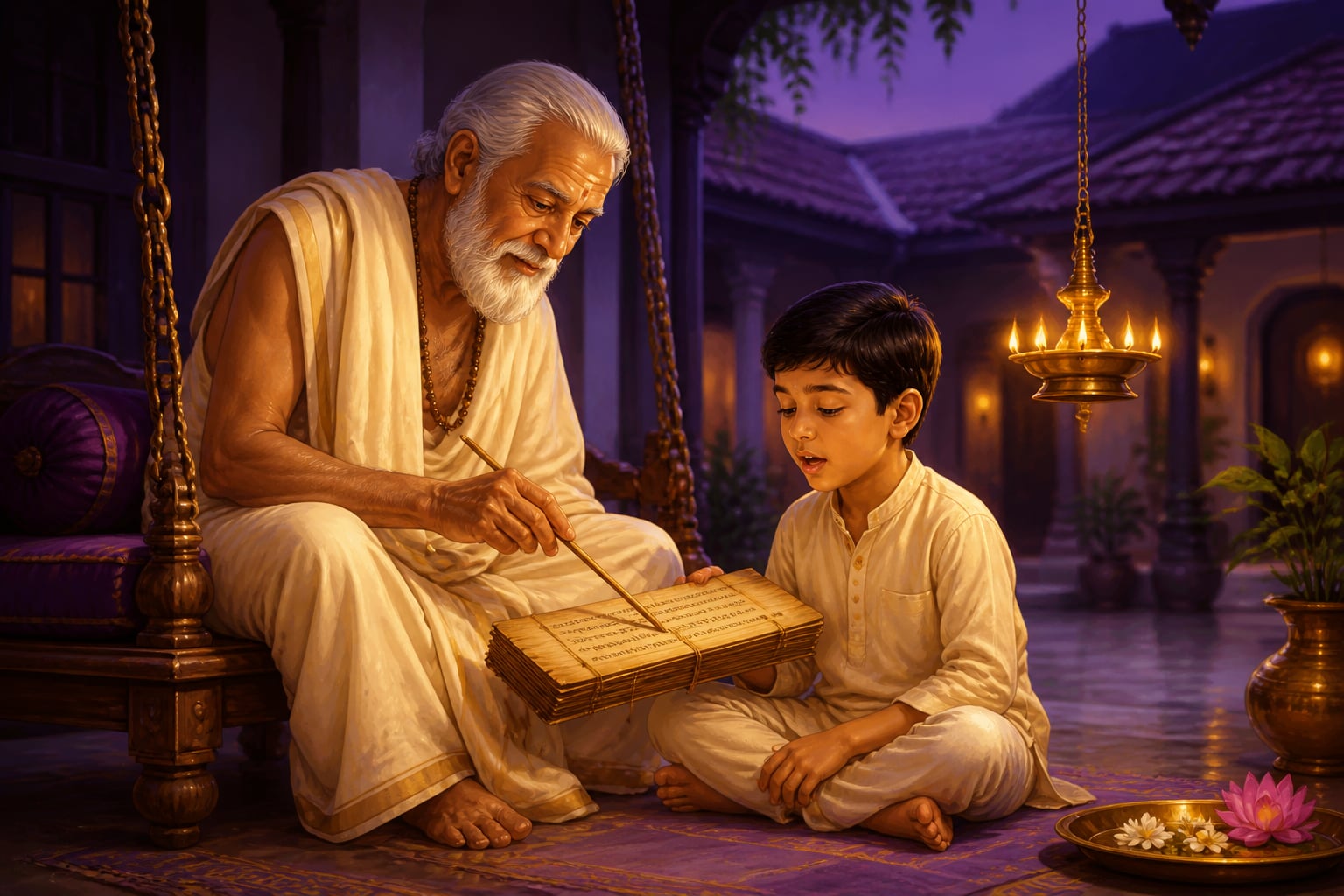
Elder teaching his grandson the Dwadasha Stotra

They memorized poetry.

The Dwadasha Jyotirlinga Stotra, a twelve-verse hymn naming each of the canonical Jyotirlingas, is perhaps the most successful geographical mnemonic in Indian history. For over a thousand years, Shiva devotees have chanted these verses, and in doing so, they have carried a map of sacred Bharat in their minds.

A sadhaka reciting the Dwadasha Stotra at a Ganga ghat at sunrise

The stotra is attributed to Adi Shankaracharya, the 8th-century philosopher who walked the length and breadth of India establishing mathas and standardizing practice. Whether he actually composed it is debated, but the attribution itself is significant. It gave the stotra the authority of the greatest teacher, ensuring universal adoption.

The Complete Stotra

Let us learn the stotra in full. Read it slowly. Try to visualize each location as you move through the verses.


Verse 1:

सौराष्ट्रे सोमनाथं च श्रीशैले मल्लिकार्जुनम् । उज्जयिन्यां महाकालमोंकारममलेश्वरम् ॥

saurāṣṭre somanāthaṃ ca śrīśaile mallikārjunam | ujjayinyāṃ mahākālam oṃkāram amaleśvaram ||

In Saurashtra (Gujarat), Somnath; on Sri Shaila mountain (Andhra Pradesh), Mallikarjuna; in Ujjain, Mahakal; and Omkareshwar, the pure Lord.


Verse 2:

परल्यां वैद्यनाथं च डाकिन्यां भीमशंकरम् । सेतुबन्धे तु रामेशं नागेशं दारुकावने ॥

paralyāṃ vaidyanāthaṃ ca ḍākinyāṃ bhīmaśaṅkaram | setubandhe tu rāmeśaṃ nāgeśaṃ dārukāvane ||

In Parali, Vaidyanath; in Dakini (Maharashtra), Bhimashankar; at Setubandha (Rameshwaram), Rameshwara; and Nageshwar in Darukavana.


Verse 3:

वाराणस्यां तु विश्वेशं त्र्यम्बकं गौतमीतटे । हिमालये तु केदारं घुश्मेशं च शिवालये ॥

vārāṇasyāṃ tu viśveśaṃ tryambakaṃ gautamītaṭe | himālaye tu kedāraṃ ghuśmeśaṃ ca śivālaye ||

In Varanasi, Vishweshwara (Kashi Vishwanath); on the banks of the Gautami (Godavari), Trimbakeshwar; in the Himalayas, Kedarnath; and Ghushmeshwar (Grishneshwar) in Shivalaya.


The Phala Shruti (Fruit of Recitation):

एतानि ज्योतिर्लिङ्गानि सायं प्रातः पठेन्नरः । सप्तजन्मकृतं पापं स्मरणेन विनश्यति ॥

etāni jyotirliṅgāni sāyaṃ prātaḥ paṭhennaraḥ | saptajanmakṛtaṃ pāpaṃ smaraṇena vinaśyati ||

One who recites these Jyotirlingas at dawn and dusk, the sins accumulated over seven lifetimes are destroyed by this remembrance.


Decoding the Geography

The stotra isn't just naming temples, it's providing location data. Look at the precision:

For a medieval pilgrim who knew basic geography, these references were enough to plan a journey. The stotra functions as a checklist: have you visited Saurashtra? Sri Shaila? The banks of Gautami?

The Order of the Stotra

Scholars have noted that the stotra doesn't follow a simple geographical sequence (north to south, clockwise circuit). Instead, it seems to begin with the most famous site (Somnath, repeatedly called the "first jyotirlinga") and then moves through the list in an order that may reflect:

  1. Pilgrimage priority, Sites considered most important come first
  2. Poetic meter, Sanskrit verse has strict metrical requirements; names had to fit
  3. Regional groupings, Verse 1 covers west/south, Verse 2 east/south, Verse 3 north/central

The order is not random, but neither is it a practical route map. Most pilgrims don't visit in this sequence.

Textual Variations

Not all manuscripts of the stotra are identical. Key variations include:

Vaidyanath Location:

Nageshwar Location:

Grishneshwar vs. Ghushmeshwar:

These variations aren't errors, they reflect genuine historical debates about which temples hold canonical status. The stotra didn't settle all disputes; it encoded them.

Why Attribution Matters

The stotra is attributed to Adi Shankaracharya, but scholars note:

Does this matter for devotees? Not really. What matters is that the attribution gave the stotra pan-Indian authority. Shankaracharya is revered across all regions; a hymn bearing his name would be accepted everywhere.

The attribution transformed a regional list into a national standard.

How the Stotra Is Used Today

The Dwadasha Jyotirlinga Stotra remains central to Shiva worship:

Daily Recitation: Many devotees recite it during morning and evening prayers, especially on Mondays (Shiva's day) and during Shravan month.

Temple Ritual: Priests recite it during special pujas. At Jyotirlinga temples, hearing the stotra while receiving darshan creates a powerful connection between the local site and the pan-Indian tradition.

A pilgrim arriving at Somnath temple at dawn

Pilgrimage Planning: Devotees who undertake the Dwadasha Jyotirlinga Yatra often begin by memorizing the stotra, using it as both prayer and itinerary.

Mental Pilgrimage: For those who cannot travel, reciting the stotra is considered equivalent to visiting all twelve sites. The phala shruti (fruit verse) promises that mere recitation destroys sins, pilgrimage of the mind is real pilgrimage.

The Stotra as Technology

Step back and consider what the stotra accomplishes:

  1. Standardization, It establishes a canonical list that all devotees can agree on
  2. Memorability, Verse form with meter and rhyme makes it easy to remember
  3. Accessibility, Any literate person (and many illiterate ones through oral transmission) can access the map
  4. Motivation, The phala shruti promises spiritual rewards for recitation
  5. Unity, It creates a shared identity among Shiva devotees across regions

This is technology in the deepest sense, a tool designed to accomplish a purpose. The stotra is a mnemonic device, a geographical database, a motivational text, and a community-builder all in twelve lines.

Learning the Stotra

For modern learners, here's a practical approach:

Week 1: Learn Verse 1. Say it aloud daily. Visualize Somnath by the sea, Mallikarjuna on the mountain, Mahakal in Ujjain, Omkareshwar on the island.

Week 2: Add Verse 2. Connect Vaidyanath to healing, Bhimashankar to the forested hills, Rameshwaram to the ocean, Nageshwar to the serpent-king's legend.

Week 3: Complete with Verse 3. Picture Kashi on the Ganga, Trimbakeshwar at the Godavari's source, Kedarnath in Himalayan snows, Grishneshwar near Ellora's caves.

Week 4: Add the Phala Shruti. Recite the complete stotra morning and evening.

By month's end, you will carry the sacred geography of Shiva in your mind, just as millions have for a thousand years.

The Living Map

The Dwadasha Jyotirlinga Stotra proves that maps need not be visual. The most enduring geographical knowledge is often carried in song, story, and verse, formats the human memory handles naturally.

When you recite "saurāṣṭre somanāthaṃ ca," you are not just praying. You are activating a map. You are joining a thousand-year conversation about where the sacred lives in Bharat. You are participating in a tradition that turned poetry into pilgrimage infrastructure.

The stotra is small, just three main verses. But it has guided millions of footsteps across the subcontinent, from the seas of Gujarat to the snows of Kedarnath.

Twelve lines. Twelve temples. One map that fits in your heart.

Key figures

Adi Shankaracharya

8th-century philosopher credited with composing the Dwadasha Jyotirlinga Stotra; reviver of Advaita Vedanta; founder of the four mathas

Somnath

The Jyotirlinga named first in the stotra; 'Lord of the Moon'; located in Saurashtra, Gujarat

The Pilgrim-Maker

The unknown composers, copiers, and transmitters who spread the stotra across India and ensured its survival

Historical context

Attributed to 8th century CE (Shankaracharya's traditional dates: 788-820 CE); earliest manuscripts from 10th-12th century CE

The stotra emerged during a period of standardization in Hindu practice. Shankaracharya's travels (whether historical or legendary) represented an effort to unify diverse regional traditions under common frameworks. The stotra served this unifying purpose, it gave devotees from Gujarat to Tamil Nadu a shared list of sacred sites.

Understanding the stotra as a historical artifact helps modern practitioners appreciate what they're participating in: a thousand-year-old technology of memory, identity, and sacred geography. The stotra isn't just ancient poetry, it's an engineering solution to the problem of standardizing worship across a diverse subcontinent.

Living traditions

The Dwadasha Jyotirlinga Stotra remains one of the most recited Sanskrit hymns in India. YouTube videos of the stotra have millions of views; Spotify and Apple Music host dozens of recordings by different artists. The stotra has been set to classical ragas, devotional styles, and modern compositions, each generation finding new ways to sing an ancient map into continued relevance.

Reflection

More in Jyoti Stambha: The Infinite Pillar of Light

All lessons in Jyoti Stambha: The Infinite Pillar of Light · The Twelve Jyotirlingas course