Saccasankha: The Conch of Truth
A truth-testing conch shell that reveals all
A divine conch shell possesses the power to sound only when held by someone who speaks the truth. When this magical shell arrives in a kingdom where lying has become commonplace, chaos ensues. Ministers, merchants, and even the king himself try to make it sound, only to be exposed as liars. Finally, a simple, honest person makes it ring. The tale reveals how rare and precious truthfulness has become, and how powerful it remains.
The Gift from the Gods
Long ago, in the kingdom of Videha, the god Sakka looked down from heaven and frowned.
"This kingdom has forgotten truth," he said. "Everyone lies - the king, the ministers, the merchants, even the children. Honesty has become so rare that people have forgotten what it looks like."
"What will you do?" asked his attendants.
Sakka smiled mysteriously. "I will give them a gift. A very unusual gift."
He took a conch shell from the divine treasury - a beautiful spiral of white and pink that gleamed like pearl. He whispered words of power over it, and the shell glowed briefly.
"This is the Saccasankha, the Conch of Truth. It will sound only when held by someone who speaks truly. Let us see if anyone in Videha can make it ring."
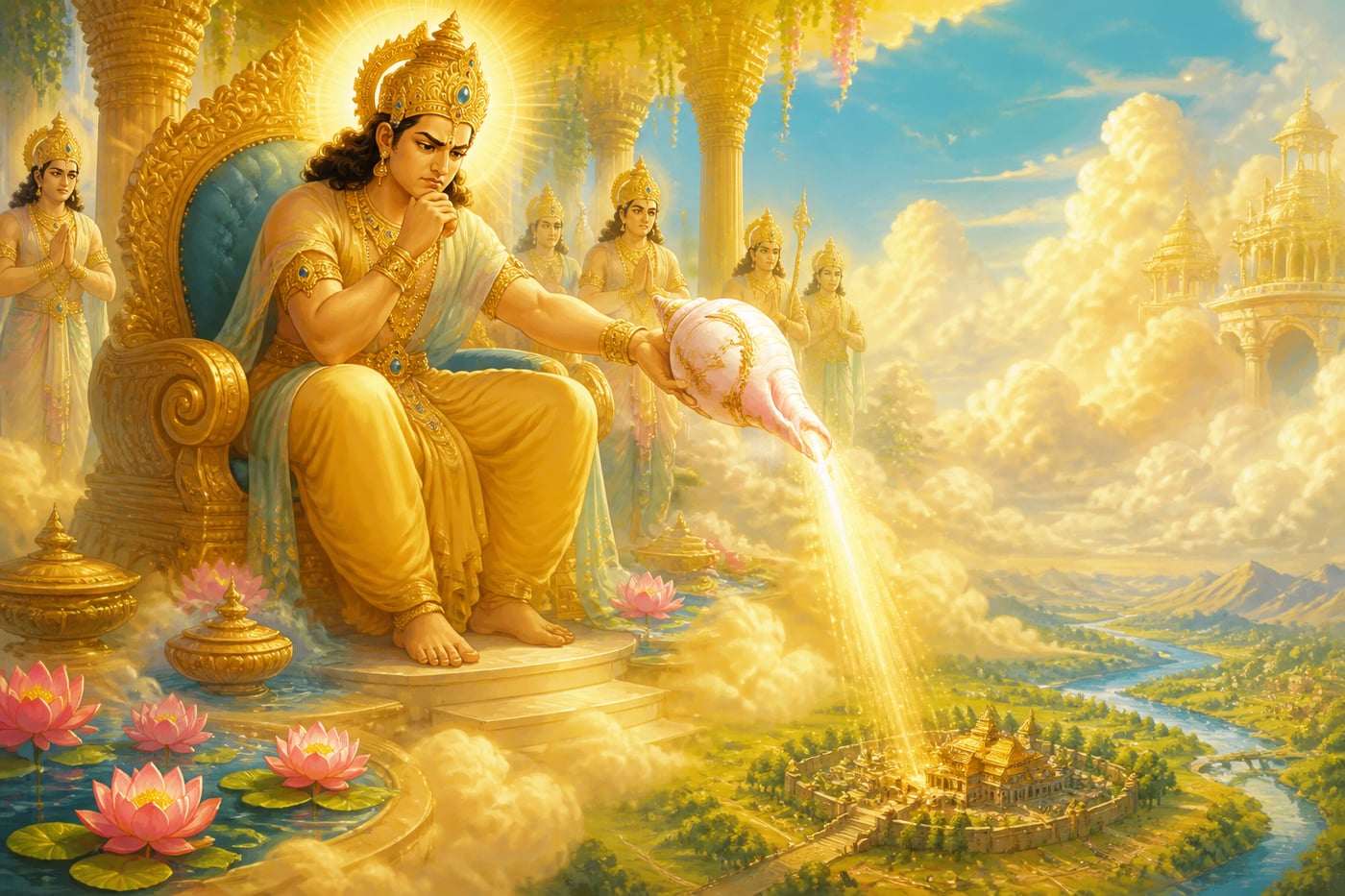
He placed the shell in a golden chest and sent it down to earth, where it appeared at the gates of King Janaka's palace.
The King's Announcement
When the guards found the mysterious chest, they brought it to King Janaka. Inside lay the beautiful conch shell and a scroll.
"This is the Saccasankha," the scroll read. "It will sound a pure, clear note when held by one who speaks the truth. May you find such a person in your kingdom."
King Janaka laughed. "Find such a person? I am the king - who is more truthful than I?"
He lifted the shell to his lips and blew with all his might.
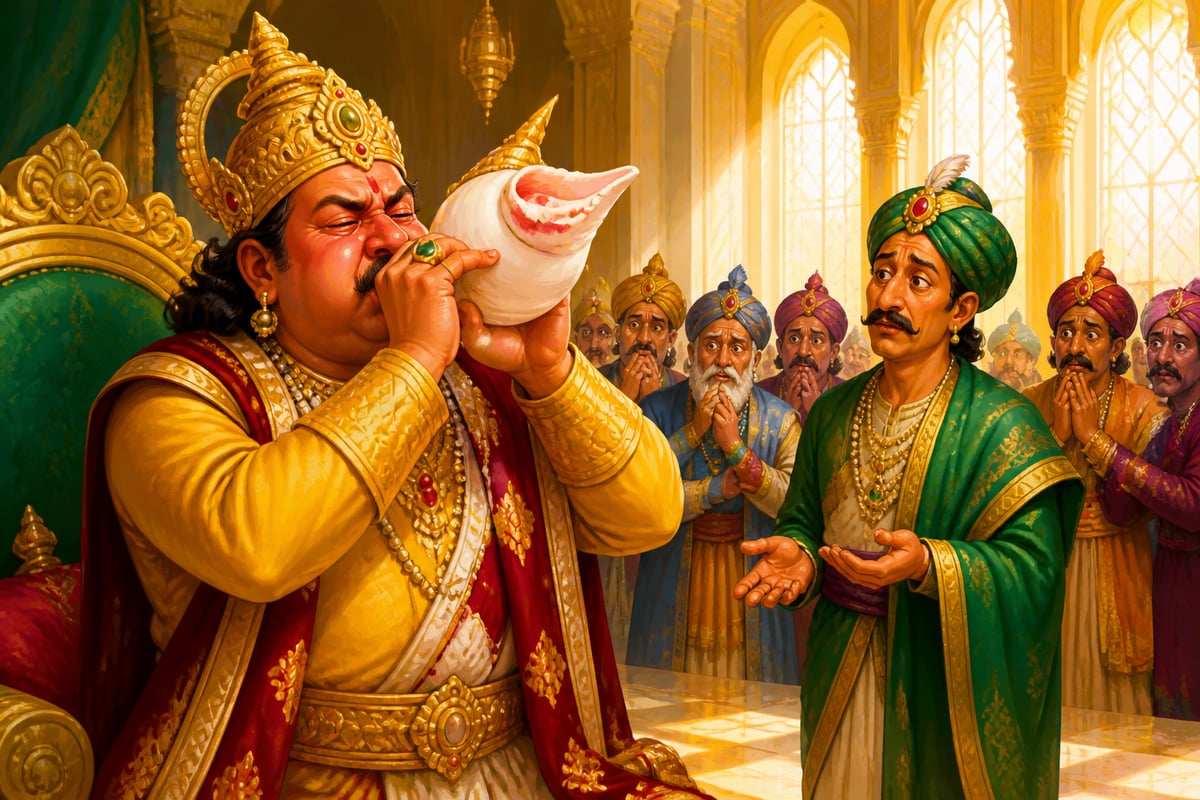
Nothing happened. Not a whisper of sound.
The king's face went red. He blew again. Silence.
"There must be some mistake," he muttered, handing the shell to his chief minister. "Here, Kautilya. You try."
The minister took the shell confidently. "Of course, Your Majesty. My honesty is well known."
He blew. Nothing.
"The shell is broken," Kautilya declared.
"Let others try," said the king.
The Parade of Liars
Word spread through the palace and then through the city: a magical conch would sound for anyone who spoke truth. Fame and fortune awaited whoever could make it ring.
People lined up by the hundreds.
The tax collector tried. He proclaimed, "I have never taken a single extra coin!" He blew. Silence.
"Next!"
The court astrologer stepped up. "I have never made a false prediction!" He blew. Silence.
"Next!"
A wealthy merchant approached. "I have never cheated a customer in my life!" He blew. Silence.
"NEXT!"
A landlord came forward. "I have always been fair to my tenants!" Silence.
A teacher: "I have never given undeserved grades!" Silence.
A judge: "I have never accepted a bribe!" Silence.
All day long, the people of Videha tried to make the conch sound. Important people. Ordinary people. Rich and poor. Young and old.
Not a single sound emerged from the shell.
By evening, the line had grown short, and the mood had changed. People who had been confident were now embarrassed. The truth was becoming clear: everyone in the kingdom had something to hide.
The Boy Named Sacca
At the very end of the line stood a young boy - perhaps twelve years old, with patched clothes and dusty feet. He was Sacca, an orphan who lived by doing odd jobs in the marketplace.
"What are you doing here?" laughed a guard. "This shell is for important people, not street urchins."
"The scroll said anyone could try," Sacca replied quietly.
"Let him try," said the king, exhausted. "We have failed all day. What harm can one more failure do?"
Sacca took the conch shell in his small hands. He didn't make any grand claims. He didn't proclaim his honesty.
Instead, he simply said: "My name is Sacca. I try to tell the truth. I don't always succeed, but I always try. And when I fail, I admit it."
He raised the conch to his lips and blew.
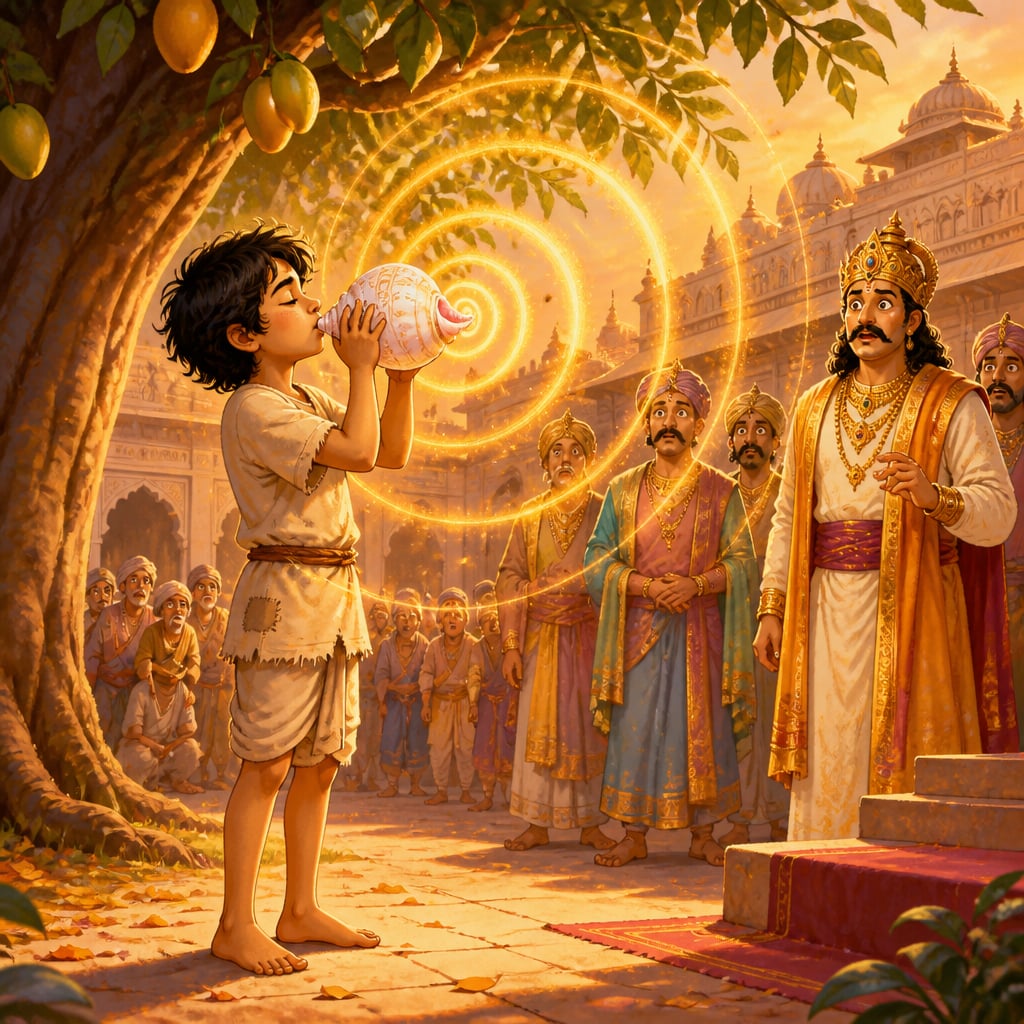
A sound rang out across the kingdom - pure and clear as a temple bell, sweet as sunrise, powerful as thunder. The note seemed to come from everywhere at once, filling the palace, the city, the fields beyond.
People stopped in the streets. They had never heard anything so beautiful.
"He did it," whispered the king. "The boy did it."
The Real Truth
When the note finally faded, King Janaka approached the boy.
"How did you do it? You didn't claim to be perfectly honest."
"That's why it worked," Sacca said simply. "Everyone else claimed to be perfect. They claimed they had never lied, never cheated, never done wrong. But that itself was a lie. Everyone has lied sometimes. Everyone has made mistakes."
He looked at the shell in his hands.
"I didn't claim to be perfect. I said I try to tell the truth and admit when I fail. That was honest. So the shell sounded."
The king was silent for a long moment. Then he kneeled before the boy - a king kneeling to an orphan.
"You have taught me something today," Janaka said. "True honesty is not claiming to be perfect. It is admitting we are not, and trying anyway."
He rose and addressed his people.
"From this day forward, Sacca will be my advisor in matters of truth. And I command that this day be remembered forever - the day a street orphan proved more honest than a king."
The Wisdom
The story of the Saccasankha teaches us something surprising about honesty. The liars weren't exposed because they had told lies - everyone has lied sometimes. They were exposed because they claimed to be perfect.
Sacca didn't claim perfection. He admitted he wasn't always honest. And that admission - that humble truth about his own imperfection - was honest enough to make the conch sound.
True truthfulness isn't about having a perfect record. It's about being honest about who you really are - including your failures and your ongoing struggle to be better.
In Your Life
Have you ever pretended to be better than you are? Claimed you never do things you actually do sometimes?
"I never eat extra cookies." "I always do my homework on time." "I never get angry."
These claims feel safer than admitting the truth. But they're their own kind of lie.
Imagine if you held the Saccasankha. Would it sound for you? Not if you claimed perfection - but maybe if you said something like Sacca: "I try to be honest. I don't always succeed. But I keep trying, and when I mess up, I admit it."
That's what real honesty looks like. Not perfection - just honest effort and honest admission when we fall short.
Reflection
- If you had to hold the Saccasankha right now, what would you say? Would claiming perfection work, or would you need to be honest about your imperfections?
- Why do you think almost everyone in the kingdom failed the test? Is it hard for people to be honest about their own imperfections? Why?
- The king kneeled before a poor orphan when he learned the truth. What does this say about real respect? Is it based on titles and wealth, or on something else?