Saccakiriya: The Act of Truth
Truth declarations that work miracles
In ancient times, when someone spoke an absolute truth - a saccakiriya or 'act of truth' - reality itself would bend to honor that truth. This tale collects several such miraculous moments: a queen whose pure love reverses poison, a mother whose truthful declaration saves her child from a snake, a courtesan whose honest admission of her profession stops a flood. Each story demonstrates that truth is not merely a virtue but a cosmic force with the power to reshape the world.
The Power of True Words
In ancient India, people believed in something remarkable: that truth itself was a force as real as fire or water. When someone spoke a statement that was completely, perfectly true - with no falsehood, no exaggeration, no hidden deception - that statement carried power.
They called this power saccakiriya: the Act of Truth.
A saccakiriya was not a prayer or a spell. It was simply a statement of absolute truth, spoken with complete sincerity. And when such a truth was spoken, reality itself responded.
Here are three stories of saccakiriyas that changed everything.
The Queen and the Poison
Queen Khema loved her husband, King Asoka, with a love that was absolutely pure. She had never looked at another man. She had never wished harm upon her husband. Her devotion was complete.
One day, enemies of the king slipped poison into his drink. Before anyone noticed, Asoka had swallowed it. He collapsed, his body burning with pain.
"The king is dying!" the healers cried. "There is no antidote for this poison!"
Queen Khema rushed to her husband's side. She took his burning hands in hers and spoke:
"By the truth of my love for this man - a love that has never wavered, never doubted, never been shared with another - may this poison leave his body. If my devotion is true, let it heal him."
The room held its breath.
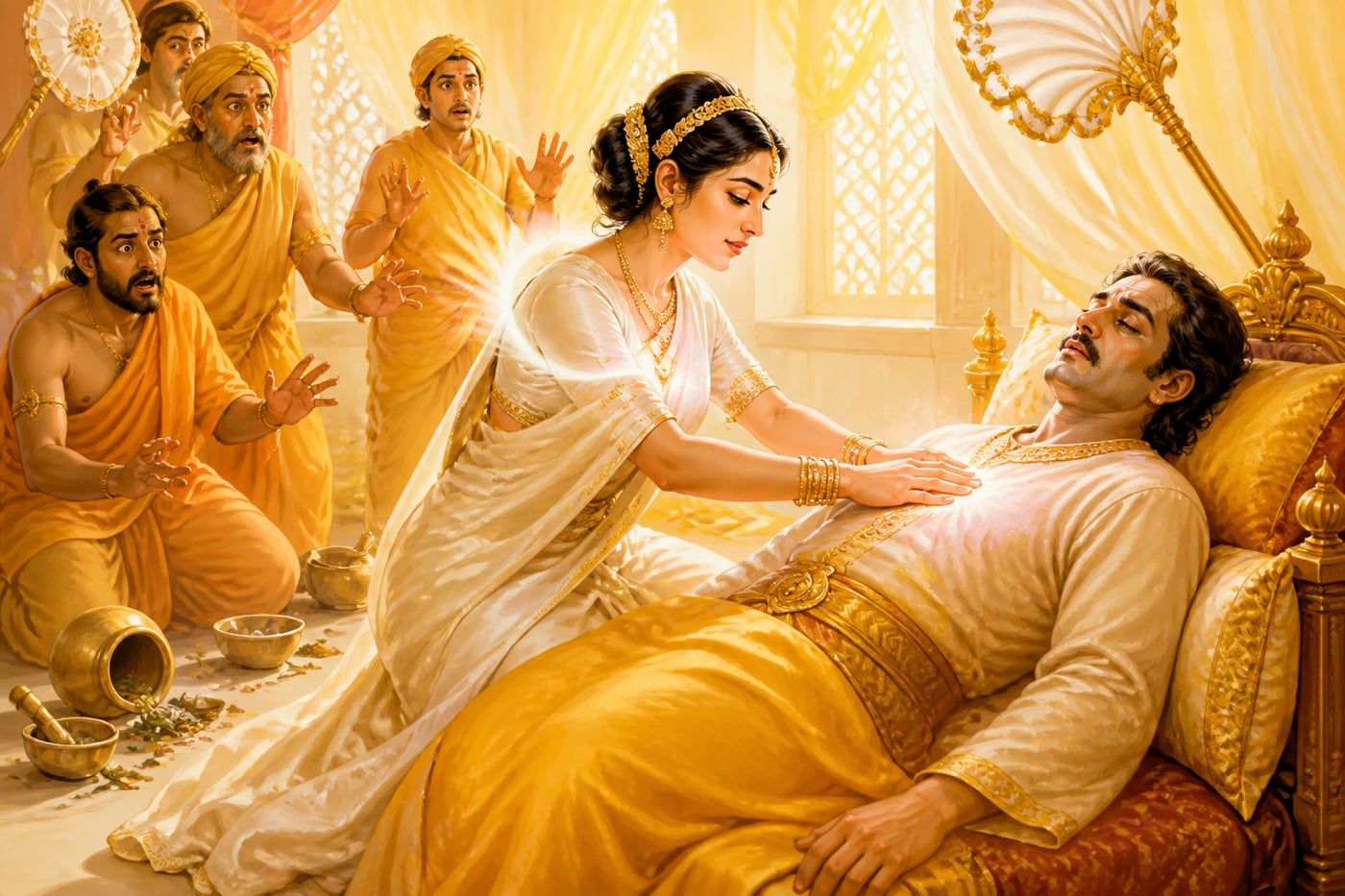
Slowly, the redness left the king's face. His breathing steadied. His eyes opened.
"Khema?" he whispered. "What happened?"
The poison had simply... stopped. The queen's saccakiriya - her declaration of absolutely true love - had reversed what no medicine could cure.
The Mother and the Snake
In a small village, a mother named Suppiya was gathering firewood when she heard a scream. She ran back to find her infant son lying on the ground, bitten by a cobra. The snake still coiled nearby, its hood spread.
The villagers wailed. "The child is dead! Cobra venom works instantly!"
But Suppiya knelt beside her son, whose tiny body was already turning cold. She looked at the cobra, and she spoke:
"Snake, hear my truth. I have loved this child from the moment I knew he was growing inside me. I have wished for nothing but his happiness. I have never, even for an instant, regretted his birth or wished him away. If this love is true - and it is - then your venom cannot harm him."
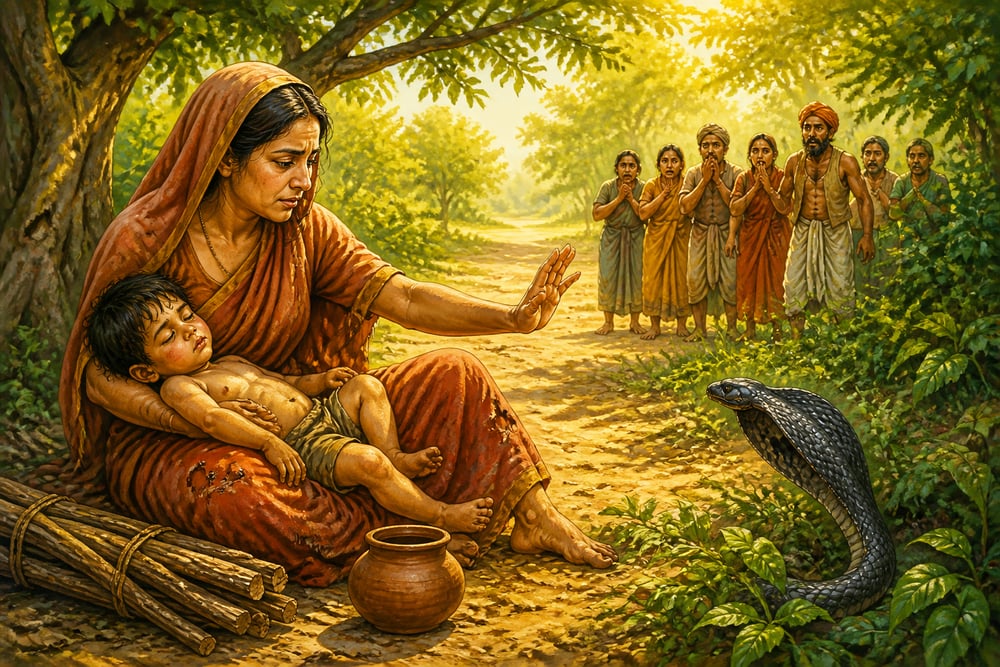
The cobra's hood slowly folded. It slithered away into the grass.
And in Suppiya's arms, her son's color returned. He began to cry - the healthy cry of a living child.
The neighbors stared in disbelief.
"How did you do that?" they asked.
Suppiya kissed her son's forehead. "I told the truth. And the truth had power."
The Courtesan and the Flood
In the city of Vesali, the river Vaggumuda rose higher every year during monsoon season. But one year, the floods were catastrophic. Water crashed through the city walls, sweeping away homes and lives.
"The river will destroy everything!" the people cried. "Nothing can stop it!"
Among the crowd watching the destruction was a courtesan named Bindumati. She was not a woman of high status - she made her living entertaining wealthy men. But she was honest about her profession and kind to everyone she met.
As the floodwaters rose toward the palace, Bindumati stepped forward.
"Let me try something," she said.
The nobles laughed. "What can you do, dancing girl?"
But Bindumati faced the raging waters and spoke:
"I am Bindumati. I am a courtesan. I sell my company to whoever pays, making no distinction between high caste or low, rich or poor. To me, a gold coin from a king and a copper coin from a beggar are the same - I serve all with equal care. This is the truth of how I have lived. By this truth, I command: Waters, flow backward."
The flood waters stopped.

For a moment, they stood still, like a wall of dark water frozen in time.
Then, slowly, impossibly, they began to recede. The Vaggumuda flowed backward toward its banks, leaving the city damp but unharmed.
The nobles stared at the courtesan in shock.
"How? You are not a holy woman. You are not a brahmin or a sage. How could YOUR truth have power?"
Bindumati smiled. "I did not claim to be holy. I claimed to be honest. I serve all my clients equally, without favor or discrimination. That is my truth - strange as it may seem. And truth is truth, no matter who speaks it."
The Common Thread
Three very different women. Three very different truths.
A queen spoke of her pure love.
A mother spoke of her unconditional devotion.
A courtesan spoke of her honest work.
What made each saccakiriya work?
Not that the truths were grand or spiritual. The courtesan's truth was about how she ran her business! What mattered was that each statement was completely, absolutely true. There was no exaggeration, no self-deception, no hidden falsehood.
When truth is that pure, it becomes power.
The Wisdom
The saccakiriya teaches us something profound: truth is not just a good habit or a moral rule. It is a force woven into the fabric of reality itself.
When we speak what is truly true - without spin, without self-serving edits, without trying to look better than we are - we align ourselves with something larger than our individual lives.
The queen, the mother, and the courtesan each lived truthfully in their own way. When crisis came, they could draw upon the power of that truthful living.
This is the final lesson of our chapter on Satya: Truth is not just something we should do. It is something we can become. And when we become it, we become capable of the miraculous.
In Your Life
You probably won't need to reverse poison, heal snakebites, or stop floods. But the principle of saccakiriya applies to everyday life too.
When you have lived truthfully - when your words match your actions, when you don't pretend to be what you're not - you carry a kind of power. People believe you. Your word carries weight. When you say something, it matters.
But if you've built your life on little lies and exaggerations, that power leaks away. When you really need to be believed, people will doubt you.
What truth could you speak that would be absolutely, completely honest? Not perfect - Bindumati wasn't perfect. But true to who you really are and how you really live?
That truth - whatever it is - is your saccakiriya waiting to be spoken.
And who knows? Maybe someday, speaking it will work a miracle of its own.
Reflection
- If you had to speak a saccakiriya right now - a statement so completely true that it could work miracles - what would it be? What is absolutely, undeniably true about you or how you live?
- Bindumati's truth was about her job - not about being holy or spiritual. Do you think any honest truth can have power, or only 'important' truths? What does this story suggest?
- As you look back on all six stories in this chapter about Satya (Truth), what do they have in common? What have you learned about the nature of truthfulness?