Vyaghridana: Gift to the Tigress
Compassion that crosses all boundaries
High in the snowy mountains, a prince discovers a starving tigress so weakened she is about to devour her own newborn cubs. His companions search desperately for food, but the prince knows there is no time. In an act of compassion that would echo through ages, he offers the only food available - himself - giving his body so that mother and cubs might live.
Three Princes in the Mountains
High in the snow-covered Himalayas, where the air was thin and the peaks touched the sky, three princes had come to study with a great teacher. They were brothers: Mahapranada, Mahadeva, and the youngest, Mahasattva.
The eldest was strong. The second was clever. But the youngest - Mahasattva - was different from his brothers in a way that was hard to name. He felt things more deeply. When he saw a bird with a broken wing, he would cry. When he saw a beggar in the street, he would give away his own food.
"You care too much," his brothers often told him. "The world is harsh. You cannot save everyone."
Mahasattva would just smile sadly. "But shouldn't we try?"
The Tigress in the Ravine
One spring day, the three brothers were walking through a mountain forest when they heard a sound that made them stop: a weak, desperate mewling.
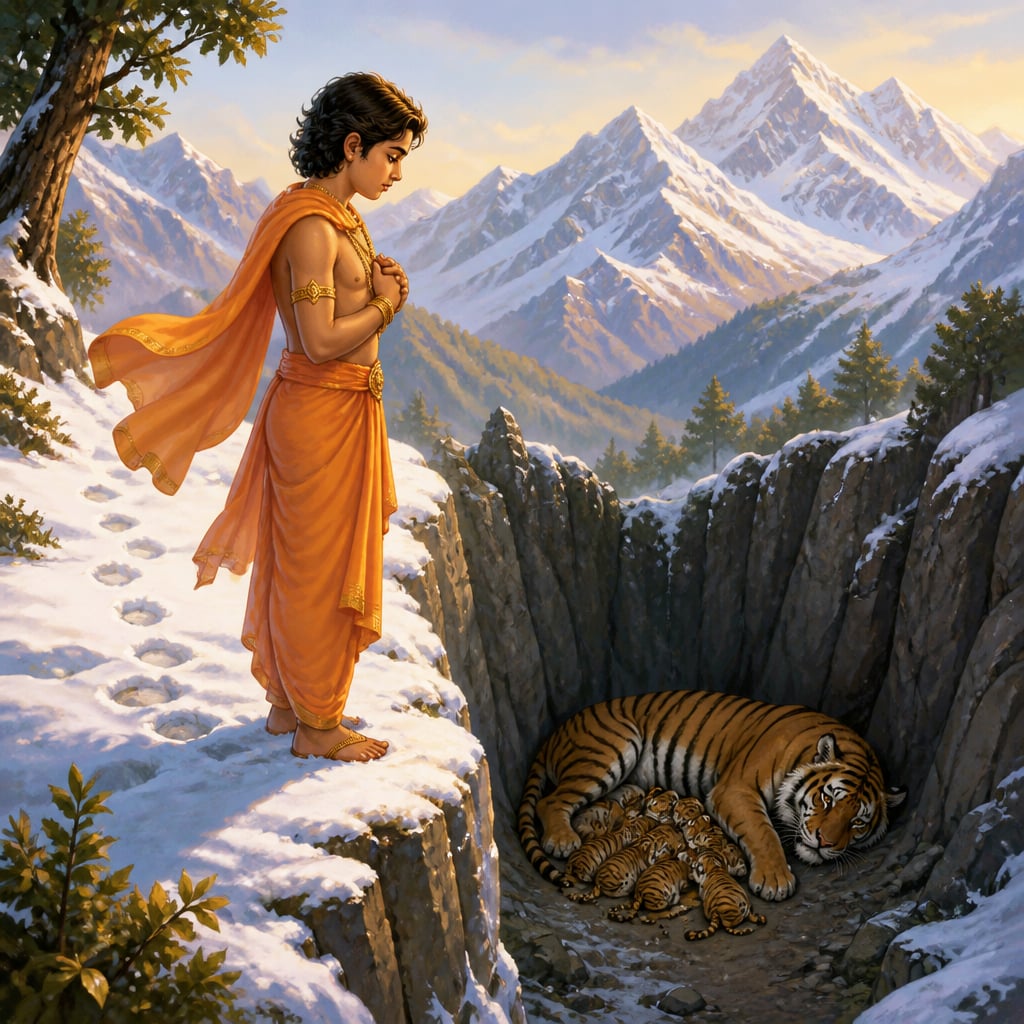
Peering over a cliff's edge, they saw something terrible.
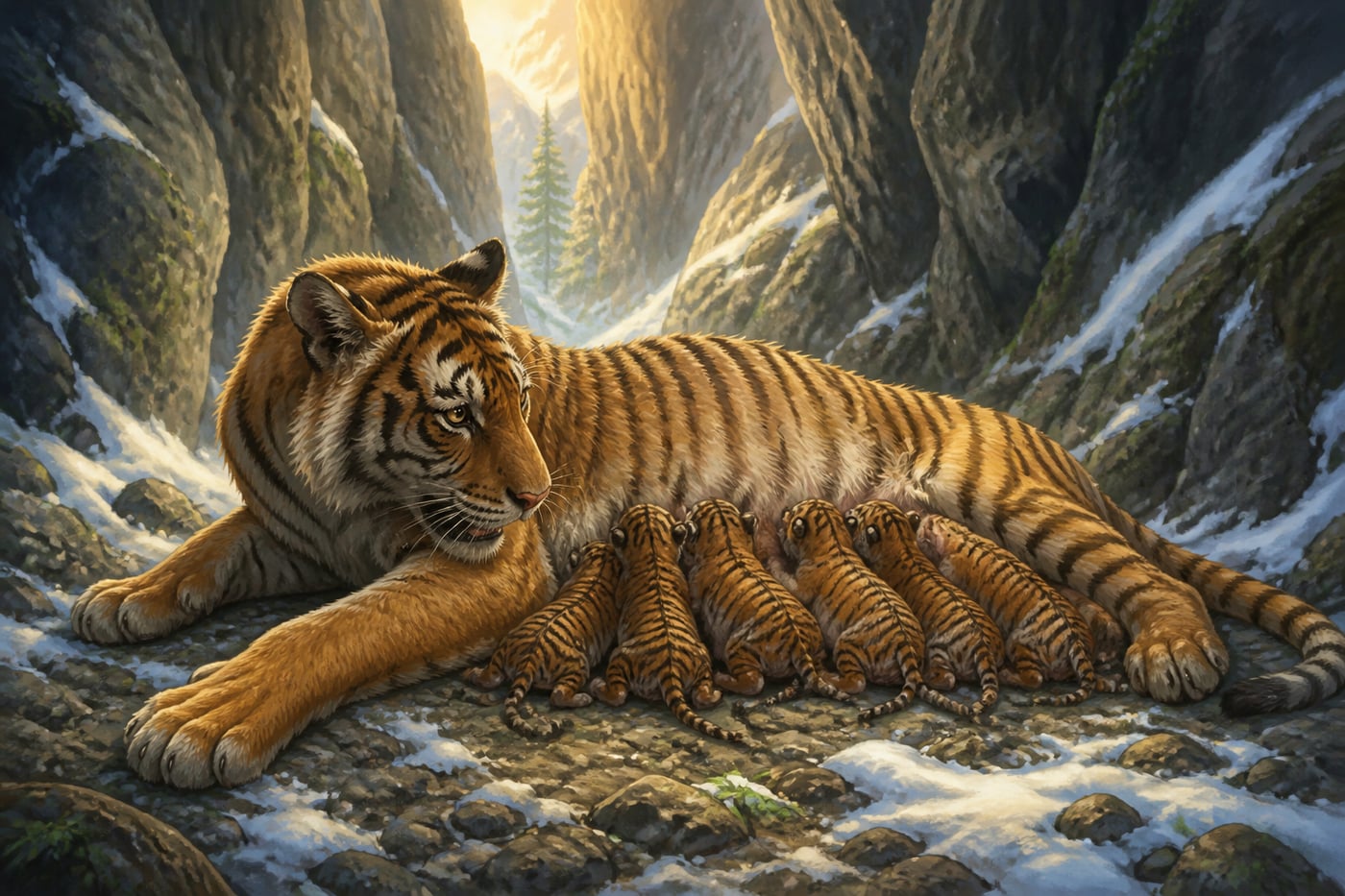
In a ravine below lay a tigress, so thin her ribs showed through her striped fur. Beside her huddled seven newborn cubs, blind and helpless. The tigress hadn't eaten in many days - too weak to hunt, she was slowly starving.
As the princes watched, the tigress turned her head toward her cubs. Her eyes were wild with hunger. She opened her mouth.
Mahapranada grabbed his brothers and pulled them back. "She's going to eat them," he whispered. "Her own children. That's how desperate she is."
"There's nothing we can do," said Mahadeva. "If we go down there, she might attack us. And we have no food to give her anyway."
The brothers turned to leave.
But Mahasattva did not move.
The Impossible Question
He stood at the edge, staring down at the tigress and her cubs. His brothers' voices faded as they walked ahead on the trail.
"There must be something," Mahasattva whispered to himself. "There must be something I can do."
He thought of running to find food. But what could he find in these mountains? And there was no time - the tigress was moments from eating her own babies.
He thought of calling for help. But who would come? And how long would it take?
And then, in the silence of the mountains, a thought came to him - clear as the snow, terrible as the drop below.
There was one thing. Only one.
"My body," he said softly. "My body is food."
His heart pounded. Fear gripped him. Every part of him wanted to run away, to follow his brothers, to pretend he had never seen the tigress.
But if he left, those cubs would die. And the tigress - she would go mad from eating her own children, or die herself from grief and starvation.
He thought of all the lives he could live, all the things he could do, all the people who would miss him.
And then he thought of the cubs.
Seven small lives that would end today, in the worst way imaginable.
Mahasattva closed his eyes. He felt a great peace settle over him.
"This body," he said, "has caused me to be reborn countless times. I have used it for selfish pleasures that led nowhere. But today - today I can use it for something that matters."
He took a deep breath.
And he jumped.
The Gift
The fall was long.
Mahasattva landed near the tigress, who lifted her head weakly. She was too exhausted even to attack. She just looked at him with eyes full of confusion and desperate hope.
"It's all right," Mahasattva whispered. "I'm here to help you."
But the tigress was so weak she couldn't even bite. Her jaws trembled and fell slack.
Mahasattva understood. He found a sharp bamboo and cut his own skin, letting blood flow. The smell reached the tigress. Something ancient woke in her.
She began to feed.
As his life slipped away, Mahasattva felt no pain - only joy. The tigress would live. The cubs would live. Seven small lives saved. One life well spent.
High above, the gods looked down. The earth trembled. Flowers fell from the sky like rain.
What the Brothers Found
Mahapranada and Mahadeva realized their youngest brother was no longer following them. They ran back to the cliff's edge.
What they saw below shattered their hearts.
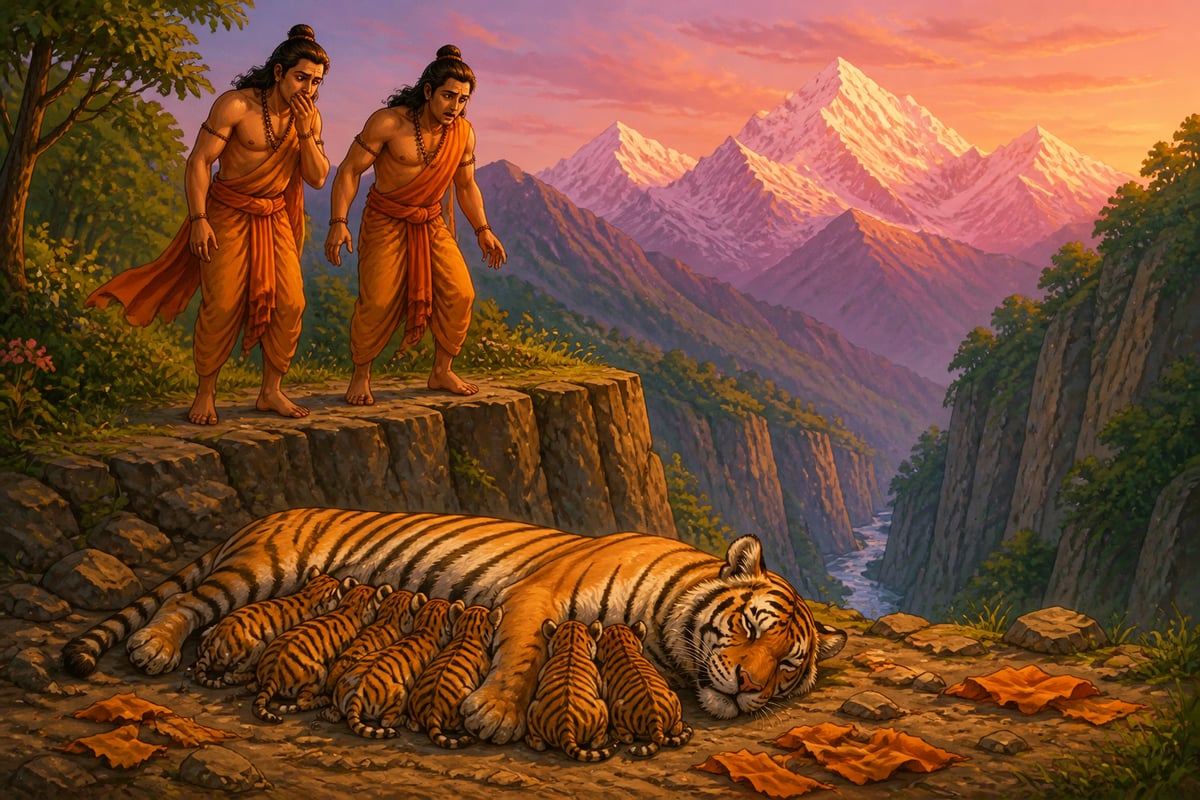
The tigress lay sleeping, her cubs nursing peacefully at her side. Her belly was full, her eyes calm. She had survived.
And near her... the remains of their brother.
The princes wept. They climbed down carefully and gathered what was left of Mahasattva. They built a stupa there in the mountains - a monument to mark the place where compassion had defeated death.
When they told their father, the king, he came to the mountain himself. He wept at the stupa and asked, "Why? Why did he do this?"
A wise monk who had heard the story answered: "Your son saw no difference between his own life and theirs. To him, saving seven lives was worth giving one. He understood that this body is temporary - but acts of compassion echo forever."
The Wisdom
Mahasattva's sacrifice is hard for us to understand. It seems extreme - maybe even unnecessary. Couldn't he have found another way?
But here's what the story asks us to consider: What would you be willing to sacrifice to save someone?
Most of us will never face such a choice. But in small ways, every day, we face versions of it. Do we ignore suffering because helping would cost us something? Do we walk past those in need because getting involved is inconvenient?
Mahasattva didn't calculate whether the tigress "deserved" help. He didn't ask if it was "fair" that he should sacrifice himself. He simply saw suffering and asked, "What can I do?"
The answer, for him, was everything.
In Your Life
You won't have to give your body to save a tigress. But you will face moments when helping someone costs you something real.
Maybe your friend needs help moving on the same day as a party you've been excited about. Maybe standing up for someone being bullied means risking becoming a target yourself. Maybe doing the right thing means losing something you want.
In those moments, think of Mahasattva. Not to feel guilty - his choice was extraordinary. But to ask yourself: "How much am I willing to give?"
You don't have to give everything. But can you give something?
The world changes not through one great sacrifice, but through millions of small ones - people choosing, again and again, to help when it would be easier to walk away.
Be one of those people. Not because you have to. But because you can.
Reflection
- Mahasattva's brothers decided nothing could be done and walked away. What makes the difference between accepting a situation as hopeless and continuing to look for solutions?
- Have you ever helped someone or something that most people would think didn't 'deserve' help? What happened? How did it feel?
- This story is famous because the sacrifice seems so extreme. But what smaller sacrifices do people make every day for others? Can small sacrifices add up to something as meaningful as one big sacrifice?