Vanaraja: The Monkey King's Bridge
A leader who became a bridge for his people
When the king of Benares discovers a magical mango tree guarded by monkeys, he sends his army to capture them. Trapped between soldiers and a great chasm, the Monkey King stretches his own body across the gap, becoming a living bridge. As his followers cross to safety over his breaking back, even the human king learns what true leadership means.
The Sweetest Mangoes in the World
High in the Himalayan foothills, where a great river tumbled over rocks and cliffs, there grew a mango tree like no other. Its branches spread wide over the water. Its fruit was the sweetest anyone had ever tasted - golden, dripping with nectar, perfect in every way.
Eighty thousand monkeys lived in that tree, and they were ruled by a king larger and stronger than any of them. His name was Mahakapi - the Great Monkey - and he loved his troop as a parent loves their children.
A King's Greed
"Remember," Mahakapi warned his monkeys every season, "never let a single mango fall into the river. If even one floats downstream, humans will find it - and then they will find us."
For years, the monkeys were careful. They ate every mango before it could drop.
But one day, a single fruit - hidden by leaves, overlooked by everyone - fell into the water. The river carried it downstream, tumbling over rapids, until it came to rest near the bathing place of the King of Benares.
A servant found it and brought it to the king.
One bite. That was all it took.
"This is the most incredible fruit I have ever tasted," the king declared. "Find me the tree that grows these mangoes. I must have more!"
His soldiers searched for days, following the river upstream, until they found the great tree - and the eighty thousand monkeys who lived in it.
"Your Majesty," a soldier reported, "the tree is full of monkeys. They're eating all the mangoes!"
The king's eyes narrowed. "Then kill them. Kill every last monkey, and the mangoes will be mine."
A hundred archers marched toward the tree.
Trapped
Mahakapi saw them coming. Torches flickered in the darkness. Arrows glinted in the moonlight. There was no escape - the river raged behind them, and death waited ahead.
The monkeys screamed in terror. Mothers clutched their babies. Young ones cried for help.
"Silence!" Mahakapi's voice cut through the chaos. "Listen to me. I will find a way."
He looked across the river. On the other side stood a bamboo grove - safety, if only they could reach it. But the gap was enormous. No monkey could jump that far.
No monkey except one.
Mahakapi climbed to the highest branch. He measured the distance with his eyes. Then, with all his strength, he leaped.
He soared through the air - farther than any monkey had ever jumped - and crashed into the bamboo on the far side. His hands caught a thick stalk. He had made it.
But making it himself wasn't enough.
The Living Bridge
Mahakapi tied the bamboo to his feet with vines. Then he leaped back toward the mango tree.
He almost made it.
The bamboo wasn't quite long enough. Mahakapi's hands caught a branch, but his body hung suspended over the churning river. The bamboo stretched from the far bank to his feet. His arms gripped the mango tree.
He had become a bridge.
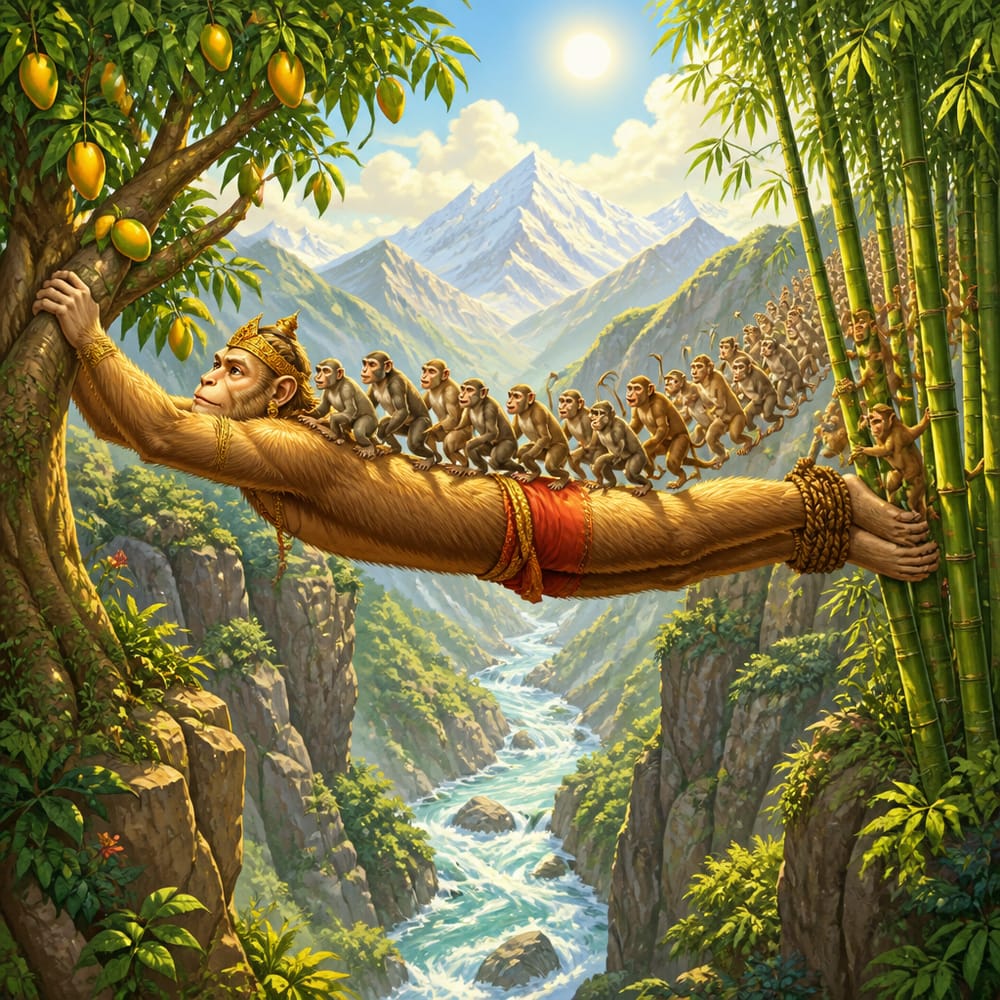
"Climb over me!" he shouted. "Quickly! Use my back as your path!"
One by one, eighty thousand monkeys scrambled across their king's body. Their feet dug into his back. Their weight pulled at his arms. The bamboo cut into his ankles. Every crossing was agony.
But Mahakapi held on.
Young monkeys crossed. Old monkeys crossed. Mothers carrying babies crossed. One after another, hour after hour, while the king's muscles screamed and his bones began to crack.
Devadatta's Cruelty
Among the monkeys was one named Devadatta, who had always been jealous of Mahakapi. He had wanted to be king himself.
As he crossed the living bridge, Devadatta saw his chance. He jumped high and came down hard on Mahakapi's back - deliberately, viciously.
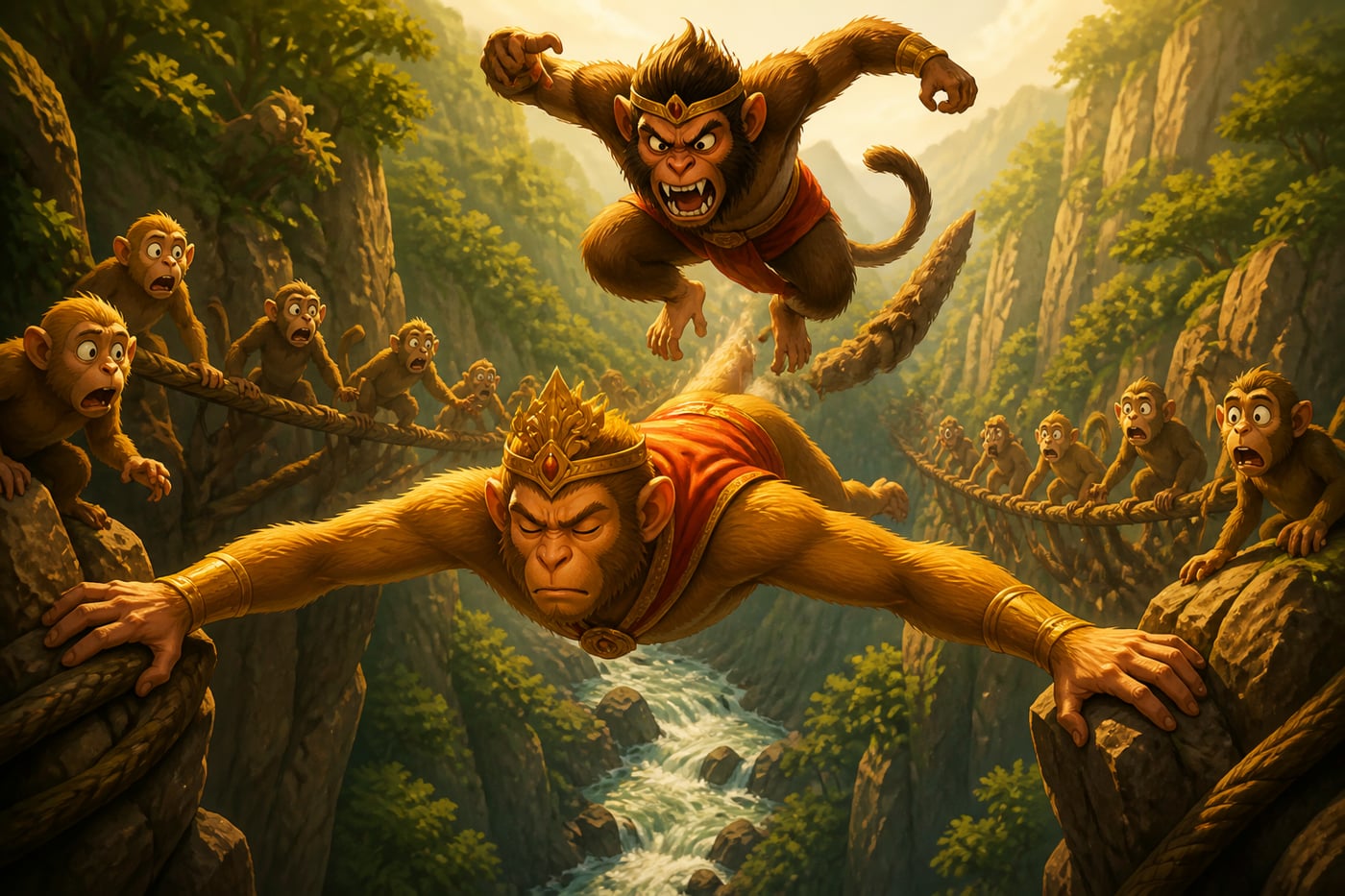
Something snapped.
Mahakapi's spine broke. But still, he did not let go. Still, he held the bridge in place until the very last monkey had crossed to safety.
Only then did his grip fail. He fell, not into the river, but onto a rock ledge just below - broken, dying, but at peace.
A King Teaches a King
The human king had watched everything. He had come to kill monkeys for mangoes. Instead, he had witnessed something that would change him forever.
"Bring him to me," he commanded. "Gently. With respect."
Soldiers carefully lifted Mahakapi and laid him before the king. The human monarch knelt beside the dying monkey.
"Why?" the king asked. "You could have saved yourself. You could have escaped and left the others behind. Why did you sacrifice everything?"
Mahakapi's voice was faint but steady.
"They are my people. I was not their king to be served - I was their king to serve them. What good is power if you don't use it to protect those who depend on you?"
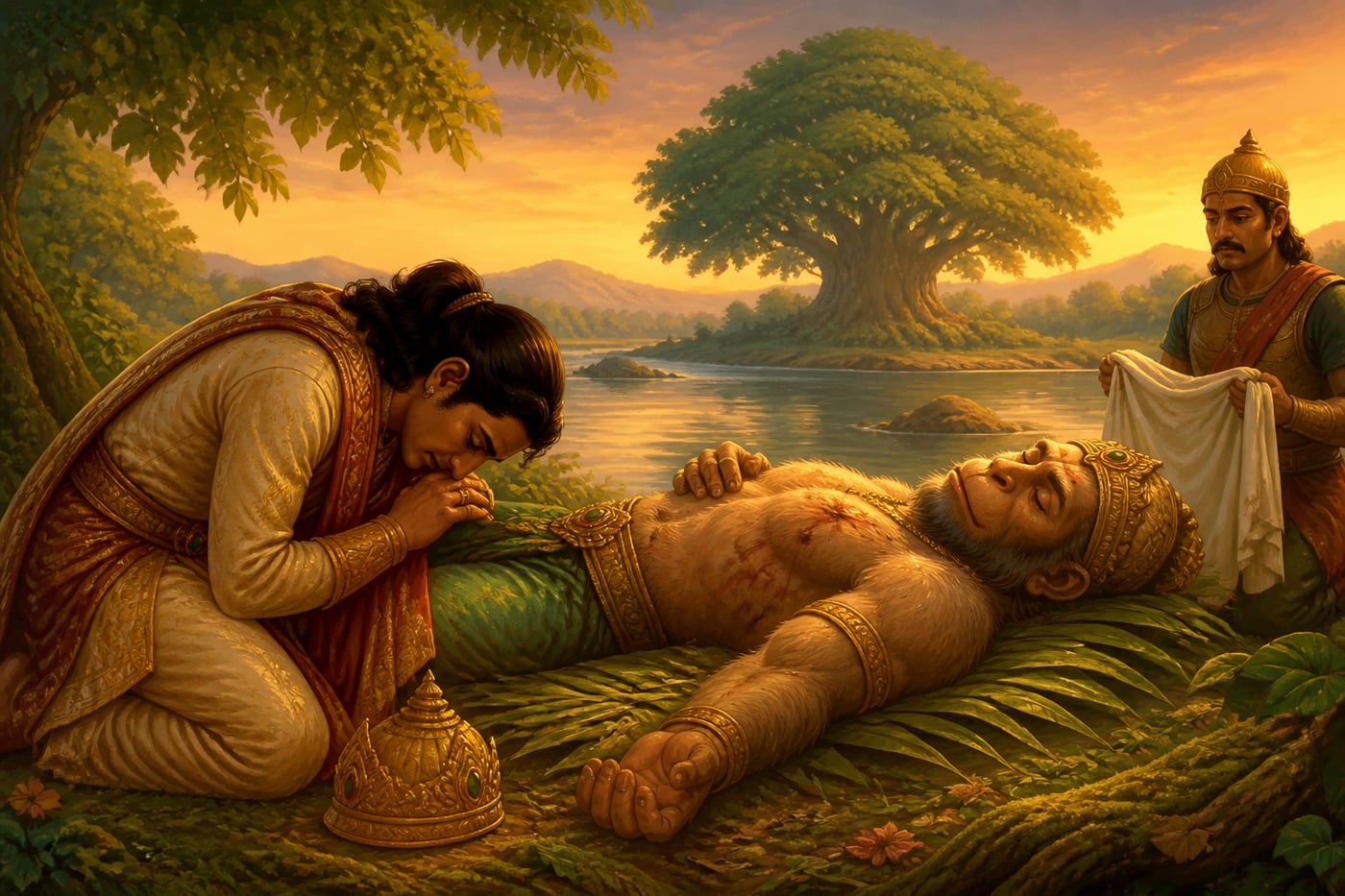
The king of Benares bowed his head.
"I came here thinking only of what I wanted - mangoes, pleasure, my own appetite. I was willing to kill eighty thousand living beings for fruit." His voice broke. "You have taught me what a king should truly be."
Mahakapi smiled. "Then my death has meaning. Protect your people, human king. That is all that matters."
He closed his eyes and was still.
The Wisdom
Mahakapi showed us the deepest meaning of leadership: it's not about having power over others, but having responsibility for them. He didn't ask "How can I save myself?" He asked "How can I save everyone?"
When he realized his own body could become a bridge, he didn't hesitate. Every monkey mattered to him - not because they could give him anything in return, but simply because they were his to protect.
Even when Devadatta deliberately hurt him, Mahakapi didn't let go. He stayed committed to his purpose until the very end.
In Your Life
You might not be a king, but you have moments when others depend on you. Maybe you're the oldest sibling, or a team captain, or just the one your friends look to when things get hard.
In those moments, you have a choice. You can think only of yourself - what's easiest, safest, best for you. Or you can ask: "What do the people counting on me need?"
Leadership isn't about being in charge. It's about being willing to put others first, even when it costs you something. You probably won't have to become a literal bridge. But you might have to stand up for someone being bullied. You might have to do extra work so your team succeeds. You might have to sacrifice your time, your comfort, or your pride.
That's what real leaders do. They don't ask to be carried. They become the bridge.
Reflection
- Have you ever been in a situation where someone was counting on you, and helping them was really hard or cost you something? What did you do?
- Devadatta hurt Mahakapi on purpose, but Mahakapi still saved him. Should we help people who have been cruel to us? Where do you draw the line?
- The human king's life changed completely after watching Mahakapi. Has witnessing someone else's courage or sacrifice ever changed how you see yourself or the world?