Shashaka: The Hare in the Moon
The ultimate gift when you have nothing to give
Four friends - a hare, an otter, a jackal, and a monkey - live together practicing virtue. On a sacred fast day, a hungry brahmin arrives seeking food. While the others find fish, meat, and mangoes, the hare has only grass to offer. Rather than give an unworthy gift, he leaps into the fire himself - and Indra, moved by this sacrifice, paints his image on the moon for all eternity.
Four Friends in the Forest
Long ago, at the edge of a forest near the holy city of Varanasi, four friends lived together: a hare, an otter, a jackal, and a monkey. Though they were different creatures with different ways, they had become the closest of companions.
The hare was their teacher. Though small and gentle, he was wise beyond his years. Every evening, as the moon rose, the four friends would gather to hear him speak about dharma - about right living, kindness, and the importance of giving.
"True charity," the hare would say, "is giving even when it costs you something. Anyone can give what they don't need. The real test is giving when you have little to spare."
The Sacred Fast Day
One evening, the hare looked up at the sky.
"Tomorrow is Uposatha - the sacred fast day. Let us each practice perfect generosity. If a traveler or holy person comes seeking food, we must give freely, holding nothing back."
The four friends agreed. They spent the night imagining the good deeds they would do.
The next morning, each went out to prepare their offering.
The otter swam in the river and found seven fish that a fisherman had left on the bank. "These were abandoned," the otter reasoned. "I will offer them to any hungry traveler."
The jackal discovered a pot of curd and a lizard in an untended field. "The farmer has forgotten these. I will give them to anyone in need."
The monkey climbed high into the trees and gathered a bunch of sweet mangoes. "These will make a fine gift for a hungry guest."
But the hare sat in the grass, troubled.
What did he have to give?
He ate only grass. And who would want grass? What kind of gift was that for a hungry traveler?
The Wandering Brahmin
As if in answer to an unspoken prayer, a brahmin appeared at the edge of the forest. He was thin and weary, his robes dusty from traveling.
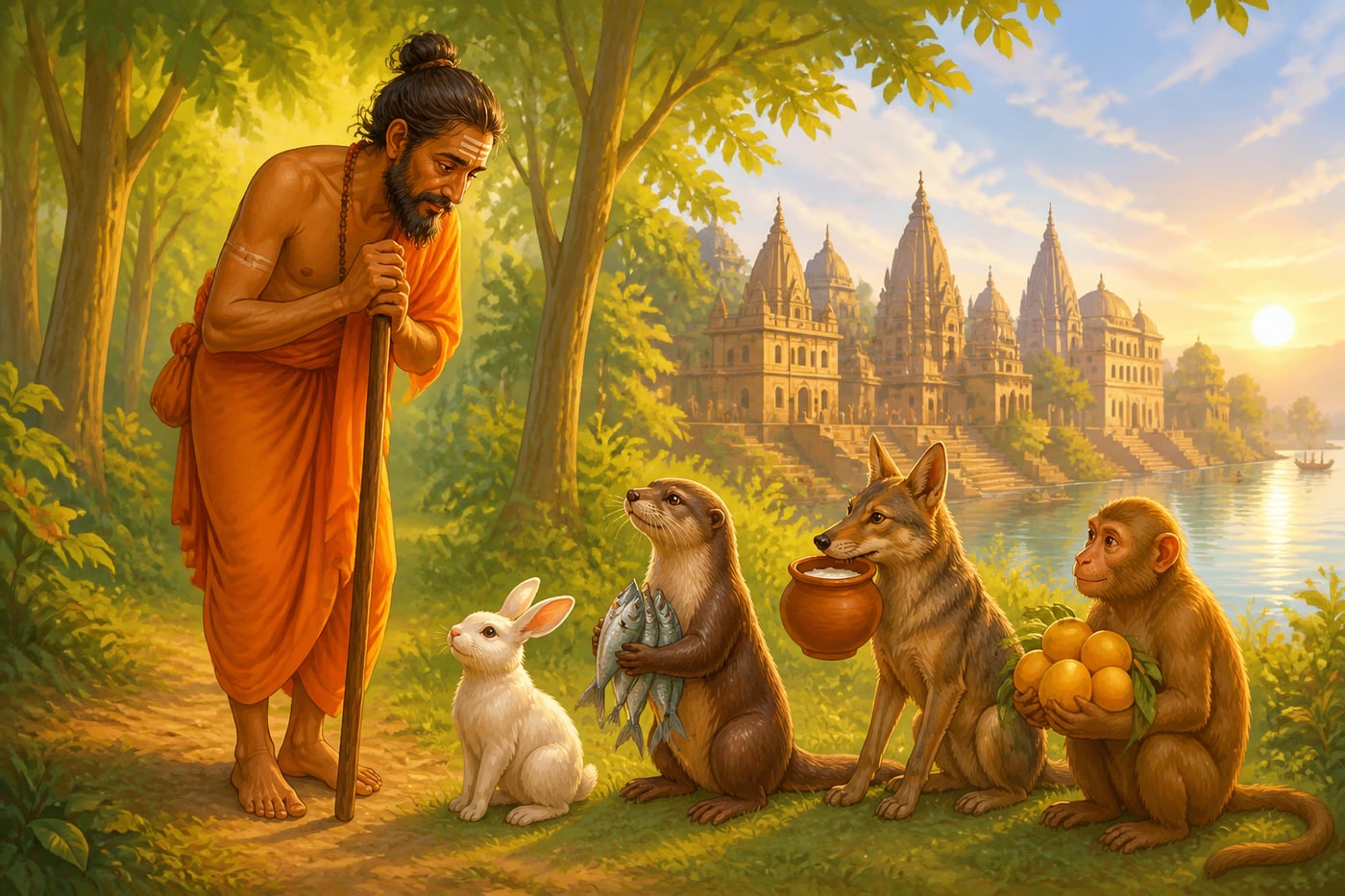
"Friends," he called out, "I have walked far and eaten nothing. Do you have any food to share?"
The otter rushed forward. "Holy one! I have seven fish. Please take them and be satisfied."
The brahmin smiled and blessed the otter but moved on.
The jackal appeared next. "Sir, I have curd and meat. Please eat and regain your strength."
Again the brahmin smiled and blessed the jackal but continued walking.
The monkey swung down with his mangoes. "These are the sweetest in the forest. Please accept them."
The brahmin blessed the monkey too, but still he walked toward the hare.
The hare's heart pounded. He had nothing. Nothing but grass. Nothing but himself.
And then - in a flash of clarity - the hare understood.
The Greatest Gift
"Holy one," the hare said, his voice steady, "I have no fish or fruit or meat to offer. I eat only grass, and that is not fit for you."
The brahmin looked at him with curious eyes.
"But," the hare continued, "there is one thing I can give."
He asked the brahmin to gather sticks and build a fire. The holy man did so, puzzled. When the flames crackled high, the hare spoke again.
"Please accept my body as your meal. I give it freely, with all my heart. There is no higher gift I can offer."
And without hesitation, the hare leaped into the fire.
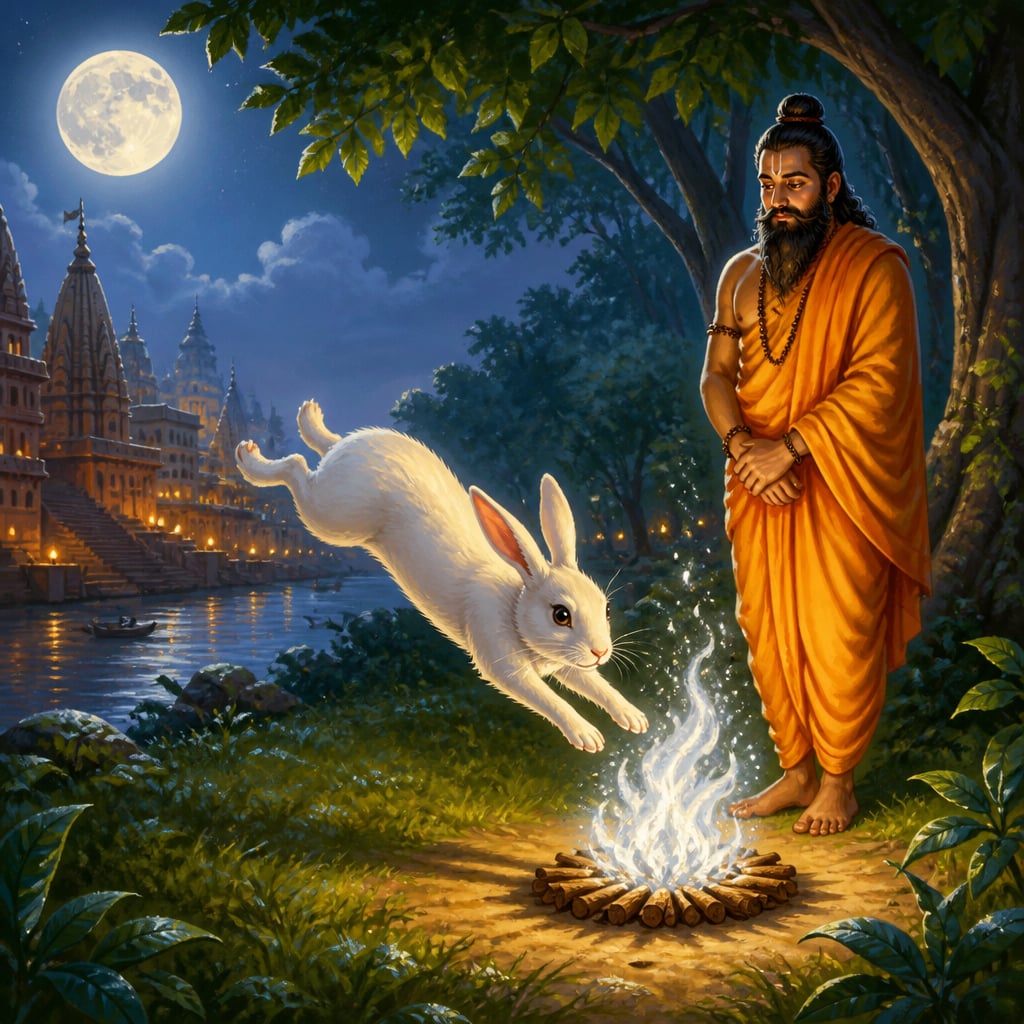
But something miraculous happened.
The flames did not burn him. They were cool as moonlight. The hare landed in the fire and felt no pain at all.
The brahmin began to glow. His dusty robes transformed into garments of light. He grew taller, more radiant, until he was no longer a wandering beggar at all.
"Little hare," said the god Indra - for that is who he truly was - "I came to test the virtue of you and your friends. The others gave what they had found. But you - you were willing to give everything. You offered your very life."
The hare blinked up at the king of the gods.
"Such compassion must never be forgotten," Indra declared. "I will paint your image on the face of the moon. For as long as the moon shines, all beings will look up and remember your sacrifice. They will remember that true giving holds nothing back."
The Moon Hare
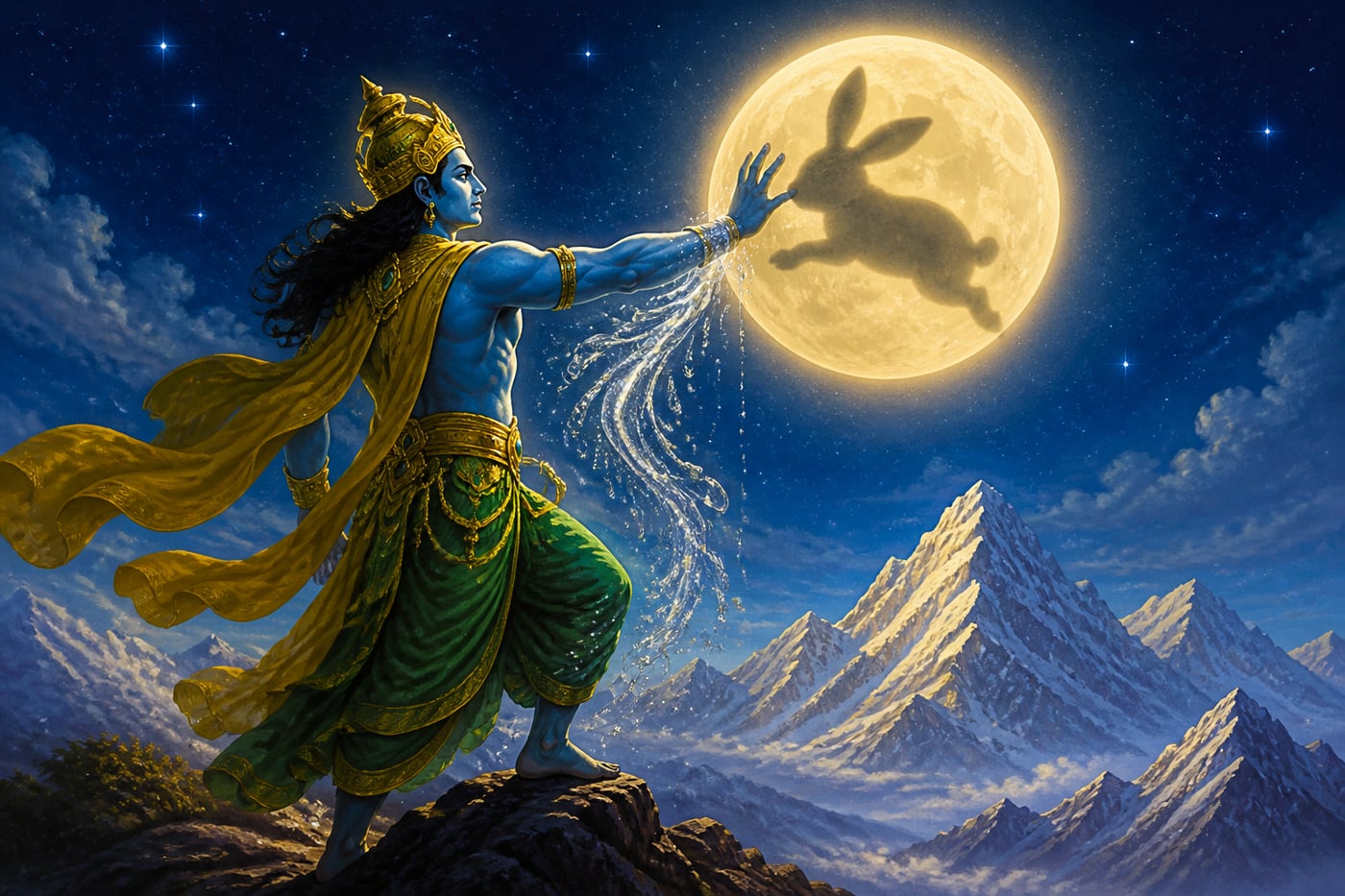
Indra reached down to the mountainside and squeezed a handful of rock until essence of mountain flowed like ink. With this, he painted the hare's image across the bright face of the moon.
Then the god vanished.
The hare lived on, teaching his friends for many more years. But every night, when the moon rose full and bright, all four of them would look up and see the hare's portrait shining down.
"That's you," the monkey would say, amazed.
"That's what you were willing to do," the hare would correct him gently. "And it's a reminder for all of us - that the greatest gift is the one that costs us something."
The Wisdom
The hare didn't have the otter's fish or the monkey's mangoes. He couldn't give what he didn't have. But he could give what he was - and that was enough.
True generosity isn't measured by the size of the gift. It's measured by what it costs the giver. A rich person giving a little means less than a poor person giving everything. The hare had almost nothing, but he was willing to give all of it.
His friends gave things they had found - valuable, but not truly theirs. The hare gave the only thing that was completely his: himself.
In Your Life
You might think: "I don't have much to give. I'm not rich. I don't have special talents. What can I possibly offer?"
The hare teaches us that everyone has something to give - even if it's just your time, your attention, or your kindness. Sitting with a lonely person. Listening when a friend needs to talk. Helping someone even when you're tired.
You don't have to leap into a fire. But you can give something that matters to you - your Saturday morning to help with a project, your favorite snack to cheer someone up, your courage to stand up for what's right.
The question isn't "Do I have enough to give?" It's "Am I willing to give what I have?"
Look up at the moon sometime. See if you can find the hare. He's been there for thousands of years, reminding us all that the smallest creature, with the biggest heart, can give the greatest gift.
Reflection
- Have you ever given something that really cost you - something you wanted to keep for yourself? How did it feel before, during, and after?
- The hare thought grass was a worthless gift. What's something you have that you think isn't valuable, but might actually be meaningful to give someone?
- Indra put the hare on the moon so everyone would remember his sacrifice. Why do you think it's important to remember and share stories of generosity?