Ujjayī: The Victorious Breath in Every Yoga Studio

Why it's called 'victorious' and what modern yoga class often misses

Ujjayī, the 'victorious breath', is ubiquitous in modern yoga studios. But victory over what? The answer reveals dimensions of the practice that 'ocean breathing' obscures.

The Sound of Every Yoga Class
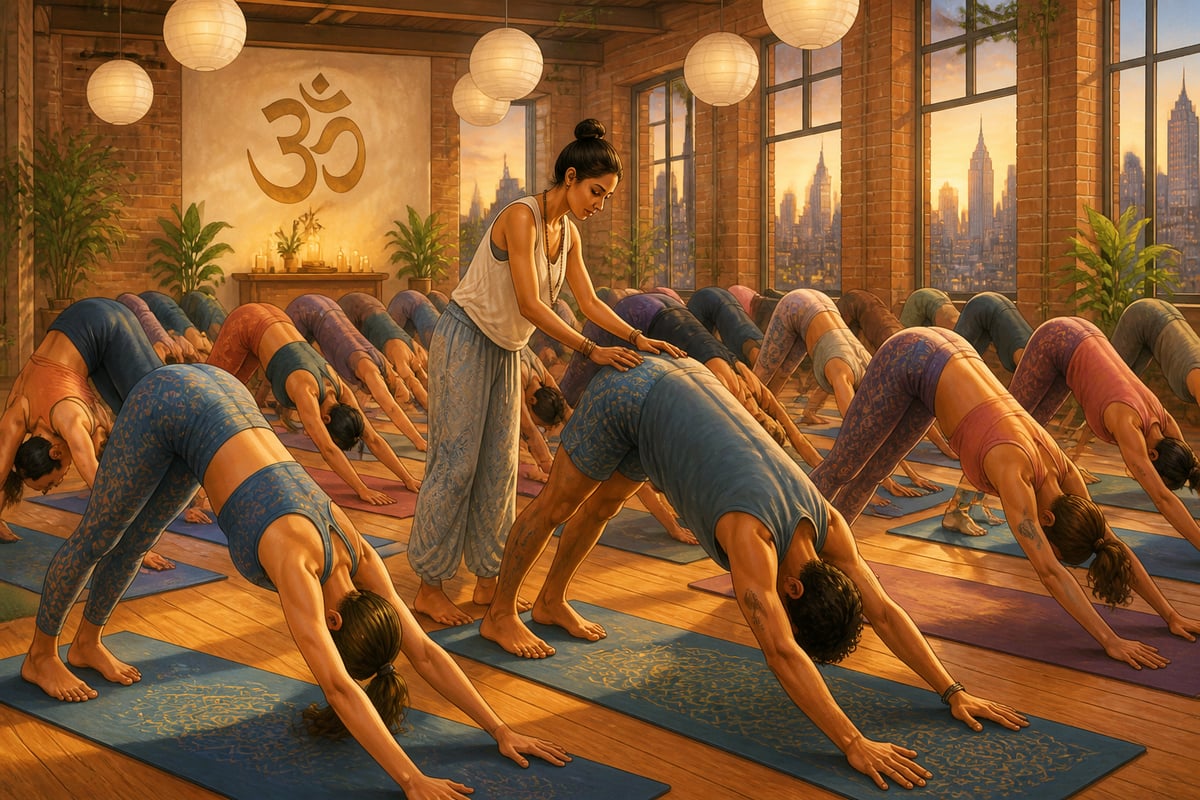
A packed Western yoga studio doing ujjayī breath through downward-dog flow

The studio is packed. Thirty practitioners in form-fitting clothes occupy every inch of floor space, mats touching. The room is warm, dimly lit, with a faint scent of essential oils. The instructor, microphone headset on, cues the class into downward-facing dog.

'Remember your ujjayi breath,' she says. 'That ocean sound. Constrict the back of your throat slightly. Let me hear you breathing.'

The room fills with a collective whooshing, dozens of practitioners producing the distinctive sound that has become the auditory signature of modern yoga. Some sound like Darth Vader. Some sound like distant waves. Some are barely audible. But everyone is doing some version of it.

This is ujjayī prāṇāyāma, the most commonly practiced breathing technique in Western yoga. It's taught in virtually every vinyasa, power, and flow class. It's described as 'ocean breath,' 'victorious breath,' or simply 'that yoga breathing.' Millions practice it weekly.

But here's what's rarely asked: Why is it called 'victorious'? Victory over what?

The answer transforms ujjayī from background noise into a powerful practice, and reveals what's lost when we reduce it to 'ocean sound.'

The Meaning of Victory

Ujjayī (उज्जायी) comes from the prefix 'ud' (उद्) meaning 'upward' or 'expanding' and the root 'ji' (जि) meaning 'to conquer' or 'to be victorious.' The suffix '-in' indicates one who possesses or practices. So ujjayī is 'one who is victorious' or 'the practice of the victorious one.'

But victorious over what?

The Haṭha Yoga Pradīpikā and other classical texts suggest several layers:

Victory over the senses (pratyāhāra): The audible breath draws attention inward. Instead of the mind scattering to external sounds, sensations, and thoughts, it anchors to the self-generated sound. This is the beginning of sense withdrawal, the fifth limb of yoga that prepares for concentration and meditation.

Victory over mental fluctuations (citta-vṛtti): The consistent, rhythmic sound creates what modern psychology might call a 'focus anchor.' The mind, given something to attend to, becomes less prone to wandering. This is preparation for dhāraṇā (concentration).

Victory over death (mṛtyu-jaya): Classical texts make extraordinary claims about ujjayī practiced with full understanding, that it leads to immortality or victory over death. This isn't literal promise of physical immortality but refers to transcending identification with the mortal body through yogic practice.

A seated yogi in Mysore practicing ujjayi breath with subtle throat constriction

Victory over prāṇa itself: The controlled breath, deliberately regulated through glottal constriction, represents mastery over the life-force. The practitioner is no longer breathed by automatic processes but consciously directs the breath.

When the yoga teacher says 'make the ocean sound,' she's touching the edge of a practice designed for self-mastery, but the full context rarely follows.

The Technique: What's Actually Happening

The ujjayī technique involves partial constriction of the glottis, the space between the vocal cords in the throat. This creates resistance to airflow, producing the characteristic sound and several physiological effects:

Slowed breath: The constriction naturally slows both inhale and exhale. What might be 3-second breaths become 6-8 seconds or longer. This automatically shifts toward parasympathetic activation.

Increased pressure: The resistance creates slight positive pressure in the airways, which may improve oxygen uptake in the lungs, similar to pursed-lip breathing used in respiratory therapy.

Heat generation: The friction of air against the constricted throat generates warmth. Classical texts describe ujjayī as a heating breath, used to stoke internal fire, contrasting with cooling breaths like śītalī.

Auditory feedback: The sound provides real-time feedback about breath quality. Irregular, gasping, or forced breathing immediately becomes audible, allowing self-correction.

Attention anchor: The continuous sound gives the mind an object of focus, supporting present-moment awareness throughout movement or stillness.

The physical mechanism is simple. The implications are profound, if understood and applied correctly.

How Modern Yoga Uses Ujjayī

In contemporary yoga classes, ujjayī serves primarily as:

Background breath: Something to do while moving through āsanas. The breath accompanies the postures rather than being a practice in itself.

Intensity regulator: When ujjayī becomes strained or impossible to maintain, it signals the practitioner is pushing too hard.

Class cohesion: The collective sound creates shared experience and rhythm, unifying individual practitioners into a group.

Ambient atmosphere: The whooshing sound has become part of yoga's 'feel', what yoga sounds like.

These are all valid uses. But they represent perhaps 20% of what ujjayī was designed to do.

What's Missing: Ujjayī as Complete Practice

In classical teaching, ujjayī wasn't background to āsana, it was a prāṇāyāma practice in itself, often done seated and often with kumbhaka (retention).

Ujjayī with kumbhaka: After inhaling with the ujjayī constriction, the practitioner holds the breath (antara kumbhaka), maintaining or intensifying the glottal engagement. This creates internal pressure that, according to classical teaching, forces prāṇa to penetrate deeper into the nāḍīs.

Ujjayī with bandhas: The three locks (mūla, uḍḍiyāna, jālandhara) were often engaged during ujjayī practice, containing and directing the energy generated.

Ujjayī with visualization: Advanced practice included visualizing prāṇa rising through the suṣumnā with each ujjayī inhale, drawn upward by the 'ud' (upward) quality the breath's name implies.

Ujjayī with mantra: Some lineages combined ujjayī with internal mantra repetition, the breath providing rhythmic structure for mental recitation.

The modern yoga class offers the technique stripped of these amplifications. It's like teaching someone to hold a violin bow without teaching them to play music, technically correct but functionally incomplete.

The Heating Question: When Not to Use Ujjayī

Classical texts classify prāṇāyāmas as heating or cooling. Ujjayī is heating, it generates internal warmth and is associated with pitta (fire) energy.

This raises a question rarely addressed in modern studios: Should everyone do ujjayī all the time?

Traditional teaching suggests no:

The modern standardization of ujjayī for all classes, all conditions, all practitioners ignores the traditional understanding of prāṇāyāma as medicine, appropriate in some contexts, contraindicated in others.

The Darth Vader Problem

Many practitioners, told to 'make the ocean sound,' produce something closer to Darth Vader, loud, forced, almost gasping. This reflects several misunderstandings:

Volume ≠ quality: The ujjayī sound should be audible primarily to the practitioner, perhaps faintly to neighbors. If it's loud enough for the whole room to hear, the constriction is likely too aggressive.

Effort ≠ effectiveness: Ujjayī should feel like gentle friction, not strangulation. The constriction is subtle, just enough to create resistance and sound.

Inhale vs. exhale balance: Many practitioners over-emphasize the exhale sound while neglecting the inhale. Classical ujjayī maintains the constriction and sound equally in both directions.

Relaxed throat: Despite the constriction at the glottis, the rest of the throat should remain relaxed. Tension in the jaw, tongue, or outer throat indicates misunderstanding.

The 'Darth Vader breath' often indicates someone forcing the technique, which undermines the very victory ujjayī is meant to produce.

Victory in Daily Life

Beyond the yoga studio, ujjayī offers practical applications that connect to its original purpose:

A professional using subtle ujjayī at her office desk before a stressful meeting

Ujjayī for focus: The sound provides an anchor for attention during any challenging task. Writing, studying, or problem-solving with gentle ujjayī breath can support sustained concentration, the original use before dhāraṇā.

Ujjayī for emotional regulation: When emotions intensify, the audible breath provides something stable to return to. The sound says 'I'm here, I'm breathing, I'm present', a tangible anchor amid internal storms.

Ujjayī for physical exertion: Traditional applications included physical labor and martial practice. The controlled breath regulates effort, prevents overexertion, and maintains mental calm during physical intensity.

In each case, the 'victory' becomes practical: victory over distraction, victory over reactive emotion, victory over physical chaos.

The Sound of the Self

At its deepest, ujjayī points toward something the yoga studio rarely discusses: the sound as reflection of inner state.

The quality of your ujjayī reveals your condition in real-time:

The sound becomes a mirror. By listening to your own breath, you hear your own state. This is pratyāhāra in action, the senses turning inward to observe the self rather than projecting outward to grasp the world.

The 'victory' of ujjayī includes victory over self-ignorance. You can't hide from yourself when you're listening to your own breath.

From Ocean Sound to Victorious Practice

The thirty practitioners in that crowded studio are doing something genuinely valuable. The collective breath creates coherence. The sound anchors attention. The technique regulates intensity.

But they're touching the surface of a practice designed for transformation.

To deepen ujjayī beyond 'ocean breath':

Practice it seated, as prāṇāyāma: Spend 5-10 minutes with ujjayī as the sole practice, not background to movement. Notice the effects when it receives full attention.

Add subtle retention: After inhaling with ujjayī, pause briefly (2-3 seconds) before exhaling. This begins to unlock the kumbhaka dimension.

Soften the intensity: Rather than maximizing the sound, minimize it while maintaining the constriction. The subtler the breath, the deeper the awareness required.

Remember the victory: Bring to mind that this is 'victorious breath', an ancient technology for self-mastery. Let the practice carry that intention, not just the technique.

Apply off the mat: Use gentle ujjayī during daily tasks that require focus, calm, or endurance. The practice is portable.

The Ubiquitous and the Deep

Ujjayī has become the most successful prāṇāyāma export in history. It's practiced by millions worldwide, in yoga studios, fitness centers, and living rooms. The technique has gone genuinely global.

But success has come with cost. What was designed as a practice of self-mastery has become background noise. What was meant to prepare for meditation has become exercise accompaniment. What was called 'victorious' has become... 'ocean sound.'

The technique works regardless of understanding, the physiological effects occur whether or not you know the Sanskrit. But knowing transforms the practice from breathing exercise to victory practice.

Next time you constrict your throat and hear that familiar sound, remember: you're not making the sound of the ocean. You're making the sound of victory, over the senses, over the scattered mind, over identification with the body that breathes.

That's what ujjayī was designed to accomplish. That's what victory means.

During demanding cognitive work, writing, coding, studying, problem-solving, practice very gentle ujjayī. The sound should be barely audible, just enough to give your mind something to return to when attention wanders. This is the original 'flow state' technology.

When emotions intensify, anxiety, anger, grief, the audible breath of ujjayī provides something concrete to hold. The sound says 'I am here, I am breathing, I am present.' It's harder to spiral into reactivity when you're anchored to audible breath.

During exercise, manual labor, or any sustained physical effort, ujjayī provides a governor. If you can't maintain the smooth sound, you're pushing beyond sustainable effort. The breath regulates the work.

Key figures

K. Pattabhi Jois

Founder of Ashtanga Vinyasa Yoga, the system that established ujjayī as the default breath for dynamic āsana practice. His teaching emphasized maintaining ujjayī throughout the entire practice sequence.

Through decades of teaching in Mysore and to Western students, Pattabhi Jois established the model of breath-synchronized movement that now defines 'flow' yoga. Ujjayī's global spread is largely due to his influence.

T. Krishnamacharya

The 'father of modern yoga,' whose students (Pattabhi Jois, B.K.S. Iyengar, T.K.V. Desikachar) shaped contemporary practice. He emphasized breath as the foundation of āsana practice.

By teaching that every movement should be synchronized with ujjayī breath, Krishnamacharya created the breath-movement integration that distinguishes yoga from mere exercise. His influence on ujjayī's modern role is foundational.

Case studies

How Ujjayī Conquered the World

In 1948, a young Indian teacher named K. Pattabhi Jois began teaching a system he called Ashtanga Vinyasa Yoga in Mysore, India. Drawing from his training with T. Krishnamacharya, he insisted that students maintain ujjayī breath throughout the entire practice - dozens of postures over two hours. This breath-movement synchronization became the defining feature of his system. When Western students began arriving in the 1970s, they carried the method home. Power yoga, vinyasa flow, and most contemporary dynamic styles derived directly or indirectly from this approach. By the 2000s, ujjayī had become the default breath in nearly every yoga studio in the Western world - taught in teacher trainings, cued in classes, expected of practitioners. What was once a specific prāṇāyāma technique had become 'how you breathe in yoga.'

The Yoga Sutras (2.49) place pranayama as the fourth limb, to be practiced only after asana is established. The Hatha Yoga Pradipika warns (2.16-17) that pranayama practiced incorrectly or prematurely can cause harm, emphasizing the need for qualified guidance, a context largely absent from modern studio instruction.

Understanding this history helps practitioners appreciate both what they're receiving (a powerful technique, globally accessible) and what's been filtered out (the deeper meaning, the complete practice, the larger context). The technique works regardless - but knowing the full story opens additional dimensions.

Ujjayī's global spread represents both success and simplification. The technique reached millions who would never have encountered it otherwise - genuine benefit. But the transformation from seated prāṇāyāma to movement accompaniment, and from 'victorious breath' to 'ocean sound,' represents significant loss of context.

Despite yoga's global spread, only 14% of classes include dedicated pranayama instruction. The technique that was once the entire point of practice has been reduced to a warm-up cue, creating an opportunity for teachers who can restore its depth.

The global yoga studio market was valued at $87.5 billion in 2023, yet a 2022 Yoga Alliance survey found that only 14% of yoga classes include dedicated pranayama instruction beyond basic breath coordination.

Historical context

Medieval Haṭha Yoga to Modern Global Practice (c. 1450 CE - Present)

Living traditions

Ujjayī is now practiced weekly by millions worldwide in yoga studios, home practice, and online classes. It has become synonymous with yoga breathing in the Western world. Traditional teaching continues in Indian institutions, while the global spread has made ujjayī perhaps the most commonly practiced prāṇāyāma in history, though often in simplified form.

Reflection

More in Prāṇa: From Sacred Breath to Breathwork

All lessons in Prāṇa: From Sacred Breath to Breathwork · Indian Wellness Traditions: Modern Connections course