Prāṇa Vidyā: The Forgotten Science of Life-Force
Understanding the sophisticated science that modern breathwork rediscovers
An introduction to prāṇa as understood in classical Yoga, not merely 'breath' but life-force itself, and how this sophisticated framework predates modern breathwork by millennia.
The $5,000 Breathing Lesson
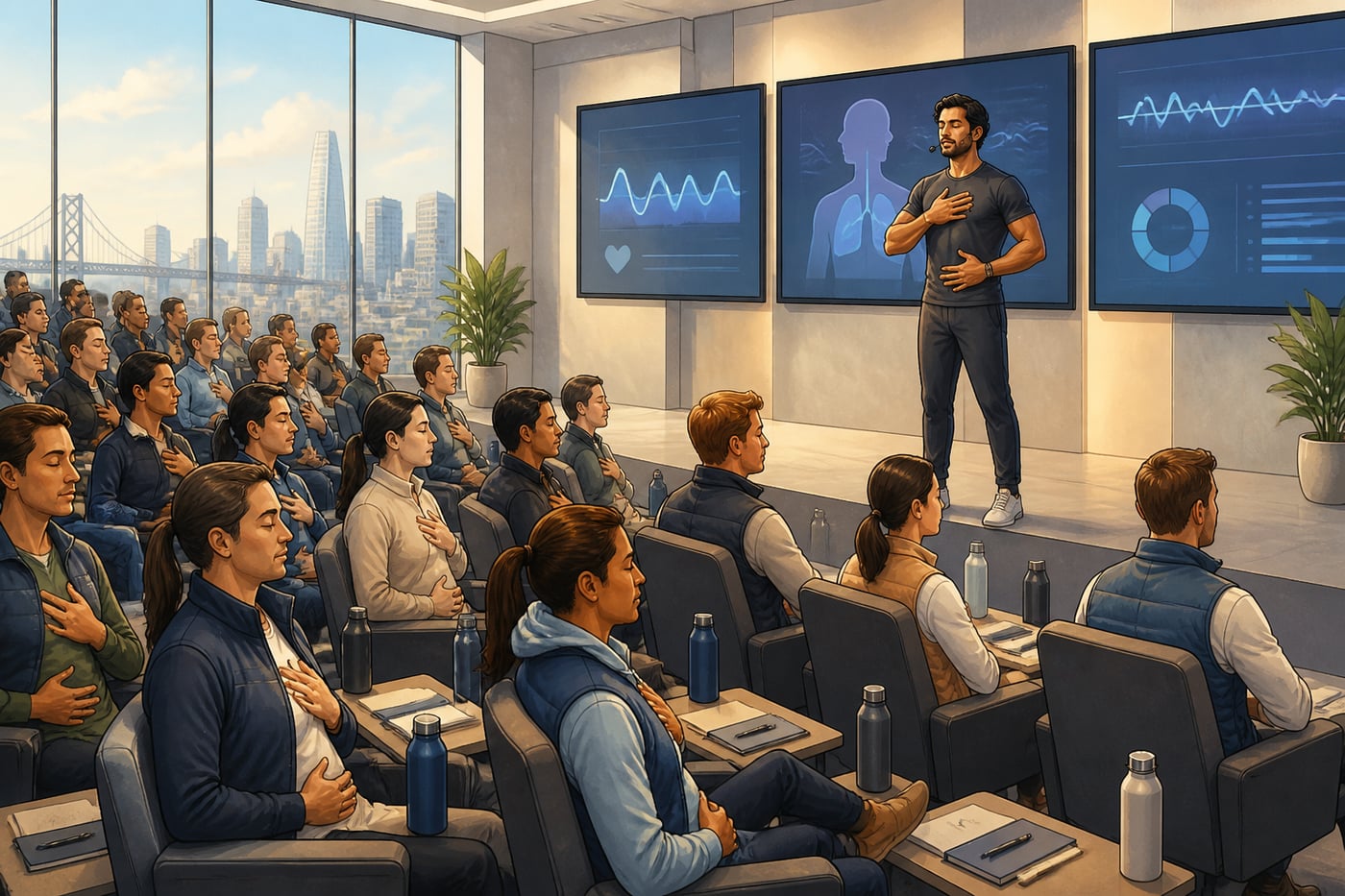
At a sold-out biohacking conference in San Francisco, executives in Patagonia vests and Allbirds sneakers settle into their seats. They've paid $5,000 each to learn the secrets of 'optimal breathing' from a renowned performance coach. Over the next three days, they'll master techniques with names like 'power breathing,' 'cyclic hyperventilation,' and 'controlled hypoxia.' They'll track their blood oxygen levels, measure their heart rate variability, and leave with protocols promising enhanced focus, reduced stress, and 'unlocked human potential.'
What none of them realize is that every technique they're learning was documented in Sanskrit texts written centuries ago. The 'power breathing' they'll practice tomorrow morning? It's bhastrikā, described in detail in the Haṭha Yoga Pradīpikā around 1450 CE. The 'breath holds' that will make them lightheaded? Kumbhaka, a practice ancient yogis considered so powerful they devoted entire chapters to its mastery. The cold plunge awaiting them on Day 3? Variations of this practice appear in yogic texts and have been central to Sikh Iśnān traditions for over 500 years.
This isn't a story of theft or appropriation, it's something more interesting. It's the story of how sophisticated knowledge, developed over millennia for spiritual awakening, has been rediscovered, renamed, and repurposed for the modern quest for optimization. And in that translation, something has been preserved, something has been lost, and vast territories remain unexplored.
Welcome to the forgotten science of prāṇa.
What Is Prāṇa? (Hint: It's Not Breath)
The most common mistake modern practitioners make is translating prāṇa as 'breath.' This is like translating 'electricity' as 'the stuff in batteries', technically related, but missing the larger phenomenon entirely.
Prāṇa (प्राण) is life-force itself, the animating energy that distinguishes a living body from a corpse. In the classical understanding, breath (śvāsa) is merely one vehicle through which prāṇa moves. It's the most accessible vehicle, which is why breath practices became the entry point for working with prāṇa. But prāṇa also moves through food, through sunlight, through the company we keep, through the thoughts we think.
The Praśna Upaniṣad, composed perhaps 2,500 years ago, opens with a student asking the sage Pippalāda: 'Master, from what is this prāṇa born?' The sage's answer spans the entire cosmology, prāṇa emerges from the Ātman (the universal Self), enters the body, and governs all bodily functions. When prāṇa departs, the body dies. This is not metaphor; it's the foundational framework of classical Indian physiology.

The Five Prāṇas: A Sophisticated System
Classical texts describe not one prāṇa but five (pañca-prāṇa), each governing different functions:
Prāṇa (प्राण) - The upward-moving energy centered in the chest, governing inhalation, the heart, and the intake of all nourishment, physical, mental, and spiritual.
Apāna (अपान) - The downward-moving energy centered below the navel, governing exhalation, elimination, reproduction, and the release of what is no longer needed.
Samāna (समान) - The equalizing energy centered at the navel, governing digestion and assimilation, transforming what enters into what we become.
Udāna (उदान) - The upward-rising energy centered in the throat, governing speech, expression, growth, and, at death, the departure of consciousness from the body.
Vyāna (व्यान) - The pervading energy that circulates throughout the body, governing movement, circulation, and the coordination of all other prāṇas.
This framework isn't mystical hand-waving, it's a precise map. When a modern breathwork instructor says 'exhale to activate the parasympathetic nervous system,' they're describing apāna's function. When they talk about 'stoking your inner fire,' they're touching on samāna. The ancient system anticipates modern discoveries while offering additional dimensions that remain unexplored.
The Journey West: From Swamis to Silicon Valley
How did this knowledge travel from Sanskrit manuscripts to San Francisco convention centers? The journey spans 130 years and several key figures.

Swami Vivekananda (1893) first introduced Americans to prāṇa at the Parliament of World Religions in Chicago. His Raja Yoga lectures described prāṇa as 'the infinite, omnipresent manifesting power of this universe' and explained prāṇāyāma as the method for controlling it. Educated Americans encountered these ideas as philosophy, not practice.
Paramahansa Yogananda (1920s-1950s) made prāṇa practice accessible through his Kriya Yoga teachings. His Autobiography of a Yogi, which would later influence Steve Jobs and millions of others, emphasized breath control as the key to spiritual awakening. Still, the audience remained spiritual seekers.
B.K.S. Iyengar (1960s-2000s) brought yogic breathing into the medical mainstream. His Light on Prāṇāyāma (1981) remains the definitive English-language guide, cited in scientific studies and taught to doctors. He insisted on precise technique and warned against superficial practice. Yet his very success in making prāṇāyāma respectable also began its separation from its spiritual context.
The Wellness Industry (2000s-present) completed the transformation. As yoga studios proliferated and 'breathwork' became a standalone category, techniques were extracted, renamed, and repackaged. Bhastrikā became 'power breathing.' Kumbhaka became 'breath holds.' The five prāṇas disappeared entirely, too complex, too foreign, too spiritual for a market wanting quick results.
What's Preserved and What's Lost
Let's be fair: modern breathwork has genuine value.
What's preserved:
- The core techniques work. Whether you call it nāḍī śodhana or 'alternate nostril breathing,' the physiological effects are real and measurable.
- Scientific validation. Modern research has confirmed what yogis knew experientially, specific breathing patterns affect heart rate variability, cortisol levels, and nervous system activation.
- Accessibility. Millions of people who would never enter a yoga studio or read a Sanskrit text are now practicing breath control.
What's lost:
- The larger energy framework. Prāṇa isn't just breath, it's the fundamental life-force, and breath is one doorway to it. Without this understanding, practitioners work with the symptom rather than the source.
- The five prāṇas. Modern breathwork focuses almost exclusively on the chest (prāṇa) and ignores the other four. This is like learning to play piano using only the middle octave.
- The ethical prerequisites. Classical texts are clear: prāṇāyāma should be practiced only after establishing yama (ethical restraints) and niyama (observances). Why? Because increasing life-force in an undisciplined mind is like putting rocket fuel in a car with bad steering.
- The spiritual purpose. The goal of prāṇāyāma was never stress relief or enhanced focus, these were side effects. The goal was preparing the mind for meditation and, ultimately, liberation (mokṣa). When we reduce prāṇāyāma to a productivity hack, we're using a rocket to commute to work.
Practicing with Awareness
Knowing this history doesn't mean you should stop using modern breathwork apps or attending workshops. It means you can practice with fuller awareness:
Recognize what you're doing. When you practice 'box breathing,' you're practicing a form of sama-vṛtti prāṇāyāma with kumbhaka. The technique is ancient; only the name is new.
Explore the deeper dimensions. Consider that the breath affects more than your nervous system, it's your most direct interface with life-force itself. What shifts when you approach practice with this understanding?
Learn from traditional sources. Modern teachers have valuable contributions, but they're building on a foundation laid over millennia. Reading even one classical text, even in translation, opens dimensions that no app can provide.
Consider the prerequisites. The ancient texts emphasized ethical living and mental discipline before intensive breath practice. This isn't outdated moralism, it's recognition that prāṇa amplifies whatever is present in the mind.
The Unexplored Territory
Here's what makes this exciting rather than discouraging: if modern breathwork, using perhaps 10% of the classical system, produces measurable benefits for focus, stress, and health, what might the full system offer?
The ancient texts describe prāṇāyāma leading to pratyāhāra (sense withdrawal), dhāraṇā (concentration), dhyāna (meditation), and ultimately samādhi (absorption). They describe the awakening of kuṇḍalinī energy, the purification of the nāḍīs (energy channels), and the direct experience of consciousness beyond body and mind.
These aren't mystical fantasies, they're the documented experiences of practitioners who devoted their lives to these techniques. Modern science is only beginning to map this territory with EEG studies of advanced meditators and neuroimaging of long-term practitioners.
The executives at that San Francisco conference will leave with genuinely useful techniques. But they'll leave without knowing that they've glimpsed the entrance to a vast temple, and mistaken the doorway for the entire structure.
In the lessons that follow, we'll explore specific techniques: nāḍī śodhana, bhastrikā, kapālabhāti, kumbhaka, ujjayī, and the cooling breaths. For each, we'll trace the journey from classical text to modern studio, noting what's preserved and what's waiting to be rediscovered.
The forgotten science of prāṇa isn't actually forgotten, it's just waiting for us to remember.
Before a stressful meeting, presentation, or difficult conversation, pause for 60 seconds. Don't try to 'fix' your breathing with a technique. Simply observe: Is your breath shallow or deep? Fast or slow? Held or flowing? The act of observation itself often begins to shift the pattern.
Elite athletes now use breathing protocols for recovery (slow, extended exhales to activate parasympathetic response) and performance (specific rhythms for different activities). The classical framework adds dimension: you're not just managing oxygen, you're directing life-force.
Key figures
Swami Vivekananda
First to introduce prāṇa and prāṇāyāma concepts to Western audiences at the 1893 Parliament of World Religions. His Raja Yoga lectures provided the intellectual framework for understanding breath control as a systematic science rather than exotic curiosity.
Raja Yoga (1896), which includes detailed chapters on prāṇa and prāṇāyāma, remains in print today. His framing of yoga as compatible with science opened doors that remain open.
Paramahansa Yogananda
Made prāṇāyāma practice accessible to Western students through Kriya Yoga teachings. His Autobiography of a Yogi (1946) brought yogic concepts including prāṇa to millions of readers.
Self-Realization Fellowship, founded 1920, continues teaching Kriya Yoga worldwide. His approach, practical technique with spiritual context, represents what modern breathwork often attempts but without the context.
B.K.S. Iyengar
Brought prāṇāyāma into the medical and scientific mainstream. His Light on Prāṇāyāma (1981) remains the most comprehensive English-language guide, cited in research papers and taught in teacher trainings worldwide.
Light on Prāṇāyāma details every major prāṇāyāma technique with precise instructions, cautions, and effects. It bridges traditional knowledge and modern needs while maintaining technical depth often missing in contemporary breathwork.
Case studies
130 Years of Transmission: From Swamis to Silicon Valley
In 1893, Swami Vivekananda stood before the Parliament of World Religions and declared that prāṇa was 'the infinite, omnipresent manifesting power of this universe.' His educated American audience received this as philosophy - interesting, perhaps true, but abstract. In 1920, Paramahansa Yogananda arrived in Boston and began teaching Kriya Yoga, making prāṇa practice accessible to students seeking more than philosophy. By 1966, B.K.S. Iyengar was teaching prāṇāyāma to medical doctors in London, and scientists began studying what yogis had mapped for millennia. Today, breathing techniques taught by Vivekananda's spiritual descendants are practiced in corporate wellness programs, athletic training facilities, and smartphone apps - often without any mention of prāṇa, yoga, or India.
The Yoga Sutras (1.34) prescribe pranayama as a method for calming the mind, while the Hatha Yoga Pradipika (2.1-2.3) outlines systematic breath control as foundational to all yogic advancement. Vivekananda's transmission preserved the philosophical framework from Patanjali, while successive teachers increasingly focused on the physiological techniques from Hatha texts.
Understanding this history helps practitioners locate themselves in a lineage rather than thinking breathwork was invented by a podcaster in 2015. It also reveals what's available for those who want to go deeper than apps and workshops.
Each generation made prāṇāyāma more accessible - and also more abstracted from its source. Vivekananda gave the philosophy, Yogananda the practice, Iyengar the precision. The wellness industry gave techniques without context. The full transmission requires all layers.
The $7.3 billion breathwork industry sells techniques documented in Sanskrit centuries ago, often without attribution. Practitioners who learn the original framework gain access to dimensions that rebranded versions leave out entirely.
A 2023 Grand View Research report valued the global breathwork market at $7.3 billion, with projections to reach $24.3 billion by 2030, reflecting the mass adoption of practices rooted in pranayama.
Historical context
Classical to Modern Transmission (c. 500 BCE - Present)
Living traditions
Prāṇāyāma is now practiced globally in yoga studios, corporate wellness programs, athletic training, and therapeutic contexts. The traditional teachers continue at institutions like Kaivalyadhama and Bihar School of Yoga, while the techniques, often under new names, reach millions through apps like Headspace, Calm, and specialized breathwork platforms.
- Kaivalyadhama Institute, Lonavala: Founded in 1924 by Swami Kuvalyananda, this is the world's oldest scientific yoga research institution. It maintains the connection between traditional prāṇāyāma instruction and modern scientific research, the bridge that modern breathwork often lacks.
- Bihar School of Yoga, Munger: Founded by Swami Satyananda Saraswati, this institution has produced some of the most comprehensive English-language texts on prāṇāyāma. Their Prāṇāyāma Prāṇa Vidyā remains a definitive resource.
Reflection
- Have you practiced any form of breathwork, from yoga classes, meditation apps, or wellness workshops? Knowing that these techniques have ancient origins, does anything shift in how you might approach them?
- The lesson suggests that prāṇa is life-force itself, not just breath. What might be the difference, in your own experience, between 'working with breath' and 'working with life-force'?
- The ancient texts insisted on ethical and mental discipline (yama and niyama) before intensive prāṇāyāma practice. Modern breathwork generally skips this. What might be gained or lost by this omission?