Prāṇa, Nāḍīs, Cakras: The Missing Context
The subtle body framework that gives prāṇāyāma its deeper meaning
What breathwork apps can't teach: the subtle body framework of prāṇa, nāḍīs, and cakras that gives prāṇāyāma its transformative power. Without this context, techniques become mere breathing exercises, effective for stress relief, but cut off from their deeper purpose.
Prāṇa, Nāḍīs, Cakras: The Missing Context
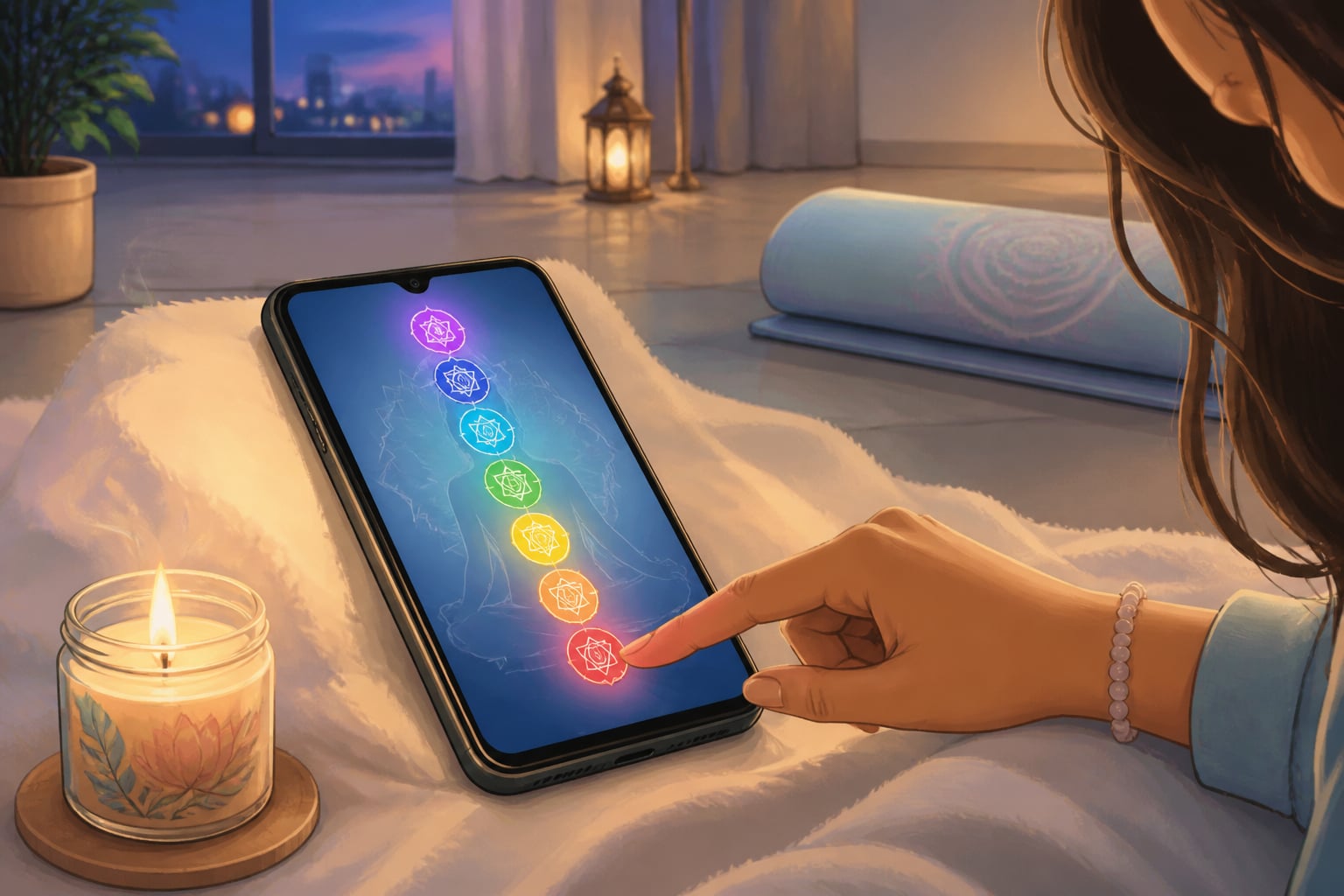
The app has a 4.8-star rating and three million downloads. "Unlock your chakras," the description promises. "Balance your energy centers. Achieve higher consciousness in just 10 minutes a day."
Scroll through the reviews: "I can feel my third eye opening!" "Finally balanced my root chakra." "The crown chakra meditation gave me tingles."
The app guides users through breathing exercises while a soothing voice names the chakras in sequence, root, sacral, solar plexus, heart, throat, third eye, crown. Each gets a color, a location, and a fifteen-second visualization. The entire "chakra system" is covered in under ten minutes.

Meanwhile, the Ṣaṭ-Cakra-Nirūpaṇa, a sixteenth-century text that is the actual source for most chakra information, describes practices that unfold over years or decades, requires qualified guidance, and embeds chakra work within a comprehensive system of mantra, yantra, deity visualization, and prāṇāyāma.
The gap between what a $4.99 app offers and what the tradition actually teaches is the subject of this lesson. Not because apps are worthless, many people genuinely benefit from them. But because something essential is lost when technique is severed from context, when a map of profound inner experience becomes a checklist of body locations and pretty colors.
This chapter has explored six prāṇāyāma practices: nāḍī śodhana, bhastrikā, kapālabhāti, kumbhaka, ujjayī, śītalī, and śītkarī. Each produces real physiological effects. Each has been validated, at least partially, by modern research. Each can be learned from an app, a YouTube video, or a weekend workshop.
But in the traditional framework, these techniques were never ends in themselves. They were methods for working with prāṇa through the nāḍī system toward cakra activation. Without understanding this framework, prāṇāyāma becomes what it has largely become in the modern world: effective breathing exercises, but breathing exercises nonetheless, cut off from the deeper purposes they were designed to serve.
What the Tradition Actually Describes
Let's be precise about what the traditional texts claim, since precision has been lost in decades of popularization:
Prāṇa is not breath. Breath (śvāsa) is the gross manifestation of prāṇa, the medium through which prāṇa can be accessed and directed. Prāṇa itself is the vital force or life-energy that animates all living things. It circulates through the body via subtle channels, concentrates at specific centers, and can be consciously directed through practice.
This isn't a metaphysical claim that modern science must either prove or disprove. It's a phenomenological description, a map of how practitioners across centuries reported experiencing their own vitality during concentrated practice. Whether prāṇa "really exists" as an objective energy is almost beside the point; what matters is whether the map is useful for navigating inner experience.
Nāḍīs are the channels through which prāṇa flows. The texts describe 72,000 nāḍīs, though three are paramount: iḍā (left, lunar, cooling), piṅgalā (right, solar, heating), and suṣumnā (central, neutral). Ordinary awareness oscillates between iḍā and piṅgalā, sometimes we're reflective and receptive, sometimes active and assertive. The goal of practice is to balance these opposing currents and awaken flow through suṣumnā, which remains dormant in most people.
Again, this isn't a claim about physical anatomy that can be confirmed or refuted by dissection. The nāḍīs correspond to functional polarities that practitioners recognize in their own experience: the different quality of right- versus left-nostril dominance, the shift between receptive and active states, the rare experience of complete balance and centeredness.
Cakras (literally "wheels") are described as centers where nāḍīs converge, junction points in the subtle body where prāṇa concentrates. The most common enumeration lists seven: mūlādhāra (base), svādhiṣṭhāna (sacral), maṇipūra (navel), anāhata (heart), viśuddha (throat), ājñā (brow), and sahasrāra (crown). Each is associated with specific qualities, challenges, and potentials.
The cakras are not physical locations you can point to on an anatomy chart. They're descriptions of different modes of consciousness, different centers of identity, different relationships to reality. "Opening" a cakra doesn't mean something happens at a body location, it means a shift in how consciousness operates, in what feels like "self," in how reality appears.
Why This Framework Matters for Practice
Without the subtle body framework, the prāṇāyāma practices we've explored in this chapter are like driving a car without knowing where roads lead. You can drive, the car works, but you're not really going anywhere intentional.
Consider nāḍī śodhana: the corporate wellness version teaches it as "stress relief through balanced breathing." This is true but incomplete. In the traditional understanding, alternating breath purifies the iḍā and piṅgalā channels, preparing them to surrender their dominance so suṣumnā can awaken. The stress relief is real, but it's a side effect of a deeper process, like noticing you've lost weight while training for a marathon.
Or consider bhastrikā and kapālabhāti: the biohacker version emphasizes oxygen saturation, alkaline blood pH, and nervous system activation. Valid, but the traditional purpose was to generate internal heat (tapas) that burns through blockages in the nāḍīs and awakens the dormant energy (kuṇḍalinī) coiled at the base of the spine.

Kumbhaka, breath retention, isn't just about building CO2 tolerance or vagal tone. Traditional texts describe retention as the period when prāṇa can be directed with precision, when the gross breath stops but the subtle energy becomes most malleable. The physiological effects are real; the energetic work is the actual purpose.
This doesn't mean the modern interpretations are wrong. Stress relief is valuable. Nervous system regulation matters. Improved CO2 tolerance has real benefits. But these are like using a smartphone only to make phone calls, technically correct, but missing most of what the device was designed for.
The Problem with Superficial Chakra Culture
The chakra system has suffered particular distortion. What the tradition describes as a sophisticated map of consciousness development has become, in popular culture, a simplified scheme of colored energy centers that can be "balanced" through crystals, essential oils, or ten-minute guided meditations.
Some specific problems:
Literalization: The cakras are described as if they're physical objects located at specific body points. But the tradition is clear that the subtle body is not the gross body, you can't find chakras through surgery any more than you can find the meaning of a word by dissecting the paper it's printed on.
Trivialization: Complex systems of practice, involving āsana, prāṇāyāma, mantra, visualization, and ethical development, have been reduced to affirmations and color visualizations. The depth has been removed while the vocabulary remains.
Commercialization: Every product from yoga mats to bedroom décor now comes in "chakra" themes. The seven-chakra rainbow has become a brand aesthetic rather than a map of inner transformation.
Decontextualization: The chakra system emerged from specific philosophical frameworks (particularly Tantra and Śākta traditions) with particular views about reality, consciousness, and liberation. Extracted from these frameworks, the system loses its coherence.
This doesn't mean all modern chakra work is fraudulent. Some teachers maintain genuine depth. Some practitioners have authentic experiences. But the gap between what's popularly available and what the tradition actually offers is vast, and most seekers don't realize what they're missing.
What Even Skeptics Can Learn
You don't have to believe in literal energy channels or spinning wheels of light to benefit from the subtle body framework. The system can be approached as:
A phenomenological map: The nāḍī and cakra descriptions correspond to recognizable patterns of experience. The difference between iḍā and piṅgalā dominance maps onto real shifts in mental state. The cakra qualities correlate with actual psychological and developmental challenges. You can use the map without claiming metaphysical certainty about what the map represents.
A practice organization principle: Different practices affect different aspects of experience. The subtle body framework helps organize practices into a coherent system rather than a random collection of techniques. Even if you're skeptical about energy channels, knowing that certain practices are traditionally "heating" versus "cooling" helps you choose appropriate methods for different purposes.
A language for inner experience: We lack good vocabulary for subtle internal states. The traditional terminology provides precise language for experiences that otherwise remain vague. "I felt a kind of warmth rising" becomes "prāṇa moving through suṣumnā." The label itself isn't the point, the precision it enables is.
A developmental model: The cakra system describes a progression of consciousness development, from survival concerns (mūlādhāra) through relational needs (svādhiṣṭhāna) to personal power (maṇipūra) to love (anāhata) to expression (viśuddha) to insight (ājñā) to transcendence (sahasrāra). This mirrors many psychological development models. You can use it as a framework for understanding growth without committing to its metaphysical claims.
The tradition itself was always somewhat agnostic about literal interpretation. What mattered was whether the practices produced the described results. If they did, debates about metaphysics were secondary.
Reclaiming Depth Without Superstition
The challenge is to engage with the subtle body tradition seriously without either:
Superstitious belief that takes symbolic descriptions literally, leading to magical thinking and disappointment when chakras don't behave like physical objects.
Dismissive skepticism that rejects the entire framework because it doesn't fit materialist assumptions, losing access to useful maps and methods.
A middle path recognizes that the tradition developed sophisticated technologies for working with consciousness, that these technologies were encoded in symbolic and metaphorical language, and that the language points to real experiences even if the experiences don't prove the metaphysical claims.
You can practice nāḍī śodhana while remaining agnostic about whether literal channels exist. You can use the cakra framework to organize your understanding of psychological development without believing in spinning energy wheels. You can direct "prāṇa" through focused attention without resolving whether prāṇa is a fundamental force or a useful fiction.
What you cannot do, not honestly, not effectively, is reduce these practices to mere breathing exercises while claiming to teach yoga. The practices emerged from a comprehensive worldview. Extracted from that worldview, they lose their organizing logic, their developmental sequence, and their ultimate purpose.
Completing the Chapter
This chapter began with a Silicon Valley biohacking conference where ancient prāṇāyāma circulated as "the newest wellness technology." We've traced how specific techniques, nāḍī śodhana, bhastrikā, kapālabhāti, kumbhaka, ujjayī, śītalī, śītkarī, moved from traditional contexts into modern wellness culture.
We've seen what was preserved: the techniques themselves work. They produce measurable physiological effects. Modern science has begun validating what practitioners knew experientially for centuries.
We've also seen what was lost: the philosophical frameworks, the sequential development, the subtle body understanding, the ultimate purposes beyond stress relief and performance enhancement.
The question isn't whether to reject modern adaptations, they serve real needs for real people. The question is whether something more is possible. Whether practitioners who want depth can find it. Whether the tradition can be engaged seriously, on its own terms, while remaining intellectually honest.
The practices in this chapter are entry points. The subtle body framework is the context that gives those entry points direction. What lies beyond, the actual transformation these systems were designed to produce, requires the integration of practice, understanding, and guidance that no app, no matter how highly rated, can provide.
But that's not an argument for despair. It's an invitation to depth. The tradition is still alive. Teachers who maintain it still exist. And the practices still work, not just for stress relief, but for the purposes they were originally designed to serve.
What's required is simply knowing that more is possible, and being willing to seek it.
In an era of unlimited information, the challenge is discernment. Authentic sources typically: cite classical texts accurately; acknowledge the tradition's complexity rather than oversimplifying; explain practices within their original frameworks; discuss contraindications and cautions; connect to living lineages rather than claiming independent discovery.
After establishing basic technique (which the earlier lessons in this chapter provide), the path to depth involves: longer practice durations, refined attention to subtle sensations, working with the same techniques over months or years rather than constantly seeking novelty, and ideally finding a qualified teacher for guidance.
You can engage the subtle body framework as a hypothesis, using it to organize practice while remaining agnostic about metaphysical claims. Practice nāḍī śodhana and notice whether the left-right descriptions match your experience. Use the cakra framework as a developmental model and see if it illuminates your psychology. The question isn't belief, it's utility.
Key figures
Pūrṇānanda
Sir John Woodroffe (Arthur Avalon)
Svātmārāma
Case studies
The Seven-Chakra Rainbow: From Sacred Map to Marketing Aesthetic
The seven-chakra system with rainbow colors - so ubiquitous that it appears on everything from yoga mats to corporate wellness posters - has a surprisingly recent history. The color associations, the precise number seven, and the emphasis on 'balance' all emerged from the intersection of tantric texts, Theosophical interpretation, and Western marketing. The original Ṣaṭ-Cakra-Nirūpaṇa describes six chakras (ṣaṭ means six), with sahasrāra treated differently as the goal rather than another chakra. Colors varied across traditions and weren't systematized into the ROYGBIV rainbow until Western interpreters - influenced by the seven-color spectrum Newton identified - mapped European color theory onto Indian subtle body maps. The notion that chakras should be 'balanced' or can be 'blocked' reflects more recent New Age interpretation than traditional teaching, which emphasized sequential awakening rather than equilibrium.
Traditional practitioners would find the modern chakra industry bewildering. Chakra work in classical Tantra involved years of preparation, mantra initiation, deity visualization, and systematic practice under guidance. The idea that a scented candle or a ten-minute meditation could 'open' a chakra would seem absurd - like claiming to earn a PhD by reading book summaries.
The commodification of the chakra system has had mixed effects. On one hand, millions have been introduced to concepts they might never otherwise encounter. On the other, the depth and context have been almost entirely lost. Many practitioners believe they understand the chakra system when they've only encountered its commercial surface. Some, seeking depth, eventually find authentic teaching - but many never realize there's more to find.
Popularity and authenticity often work against each other. The more accessible a teaching becomes, the more likely its depth will be sacrificed. This isn't an argument against accessibility - but it is an argument for being clear about what's been preserved and what's been lost, and for those who want depth to know that it exists and can be found.
The rainbow chakra system now appears on products from yoga mats to energy drinks, yet only 8% of practitioners can name the original text it derives from. This gap between commercial ubiquity and source literacy defines much of the modern wellness landscape.
The global chakra healing market, including crystals, essential oils, and courses, was estimated at $1.5 billion in 2023, while a survey of 200 practitioners found only 8% could name the original six-chakra text.
Wim Hof Method: Modern Validation Without Traditional Context
Wim Hof, the 'Iceman,' built a global wellness empire teaching breathing techniques that produce extraordinary physiological effects. Practitioners report enhanced immunity, reduced inflammation, improved cold tolerance, and altered states of consciousness. A 2014 PNAS study showed Hof's method could voluntarily activate the sympathetic nervous system and influence the immune response, results once thought impossible. The Wim Hof Method's core breathing technique is essentially bhastrikā followed by extended kumbhaka. Hof discovered the technique experientially through cold exposure experiments. He acknowledges Tibetan tummo influence but presents the method as his own innovation. Millions have trained in his system. Few realize they are practicing variants of techniques refined over a thousand years in Indian and Tibetan traditions, originally designed not for cold tolerance but for awakening kuṇḍalinī.
The Haṭha Yoga Pradīpikā describes bhastrikā with kumbhaka as a method to generate internal heat (tapas) that burns through nāḍī blockages and awakens dormant energy. The cold tolerance Hof popularized is a side effect of activating heat-generating processes in the subtle body. Traditional teachers also warned that powerful prāṇāyāma without ethical preparation, philosophical grounding, and a teacher's guidance can destabilize the practitioner. Hof's method works because the underlying technology works. What's missing is the framework that explains why it works and where it leads.
The Wim Hof Method has trained over 1 million people and inspired thousands of similar 'breathwork coaches.' Documented cases of psychological destabilization, including manic episodes and dissociation, have emerged among practitioners doing intensive practice without preparation. The technique works. The context that traditionally protected practitioners has been left behind.
When ancient technology gets stripped from its protective framework, the benefits remain but so do the risks the framework was designed to manage. Modern science can validate that a practice works. It cannot replace the wisdom that taught us how to use it safely.
The breathwork industry now exceeds $1 billion globally. Most certifications require less than 100 hours of training, compared to traditional prāṇāyāma which assumed years of preparatory study before powerful techniques were even introduced.
A 2014 PNAS study (Kox et al.) showed that Wim Hof Method practitioners could voluntarily suppress inflammatory response to endotoxin injection, with cytokine levels 200-300% lower than untrained controls.
Historical context
Integration Period: Tantra, Yoga, and Colonial Encounter (10th-20th century CE)
The subtle body framework developed through centuries of tantric elaboration, was systematized in haṭha yoga texts, and then encountered Western interpreters during the colonial period. Each stage added layers of meaning, interpretation, and sometimes distortion. Within India, transmission stayed within guru-śiṣya lineages even as the texts circulated more widely.
This historical arc, from experiential discovery through textual systematization to Western translation to commercial popularization, explains the current state of subtle body teaching. Each stage served purposes, but each also involved losses. Understanding this history helps practitioners navigate current resources with appropriate discernment, knowing which stage of the transmission they are encountering.
Living traditions
The subtle body framework underwrites the global breathwork industry, now valued over $1 billion, even as most consumers never encounter the source texts. International Yoga Day, observed annually since 2015, is the largest public expression of the tradition. Tibetan Buddhist teachers exiled in Dharamshala have preserved tsa-lung practices that work with the same channel-and-cakra map under different names. Within India, Bihar School of Yoga, KYM, and Kaivalyadhama continue teaching the framework with the depth the originating texts assume.
- Nāḍī Śodhana with Awareness of Iḍā and Piṅgalā: Traditional alternating nostril breathing done not as stress relief but with active attention to the qualitative difference between left-nostril (cooling, receptive) and right-nostril (heating, active) breathing. Practiced in 4-6-8 ratios (inhale-hold-exhale) for 10-20 minutes daily.
- Cakra Dhyāna in Living Tantric Lineages: Visualization of cakras with their bīja mantras (LAM, VAM, RAM, YAM, HAM, OM), associated deities, and yantra geometries. Traditionally given as initiation by a guru, not learned from books or apps. The practice unfolds over years, not minutes.
- Krishnamacharya Yoga Mandiram: Founded by T.K.V. Desikachar, son and student of the great Krishnamacharya. Maintains the integration of āsana, prāṇāyāma, and philosophy that characterized traditional teaching. Offers serious study programs that contextualize practices within the full subtle body framework, including individualized instruction in the Viniyoga tradition.
- Bihar School of Yoga: Founded by Swami Satyananda Saraswati in 1964. One of the most rigorous institutions teaching prāṇāyāma within its full tantric and yogic framework. Their Yoga Publications Trust prints the most respected manuals on subtle body practice in English. Residential programs range from a few days to a four-month sannyāsa training.
- Parmarth Niketan Ashram: One of the largest ashrams in Rishikesh, offering traditional yoga education that includes the philosophical context often missing from Western training. The daily Ganga Aarti at sunset is among the most attended in India. Programs range from weeks to months, allowing deep immersion in practice and study with various visiting teachers.
Reflection
- Which prāṇāyāma technique have you been treating purely as a stress-relief tool, and what would change in your practice if you approached it instead as work with prāṇa moving through the nāḍīs?
- Why might the tradition have encoded its deepest insights about consciousness in symbolic language like chakras as spinning wheels and kuṇḍalinī as a coiled serpent, rather than in plain technical description?
- If a practice produces real, measurable effects but its underlying explanation cannot be verified by modern instruments, what authority should the traditional explanation hold for a thoughtful modern practitioner?