The Statesman of Mewar

Building the Foundations of Governance

Military victory alone does not build lasting kingdoms. After securing Chittor and repelling the Arab threat, Bappa Rawal faced the challenge of transforming a war coalition into a functioning state. How he organized his administration, integrated conquered populations, managed tribal allies, and created durable institutions would determine whether Mewar became a fleeting episode or an enduring dynasty. The cowherd-turned-warrior now had to become a statesman.

From Conquest to Governance

The fall of Chittor around 740 CE presented both opportunity and challenge. The great fortress was his - but controlling a fortress is not the same as governing a kingdom. The Mori administration, with its trained officials, established procedures, and detailed knowledge of land grants, tax obligations, and local customs, had to be integrated rather than destroyed. Diverse populations - hill tribes who had fought alongside Bappa, plains farmers who simply wanted to till their fields in peace, merchants whose caravans needed safe roads, and displaced warriors seeking a lord worthy of their swords - all had to be united under a single rule.

Bappa had learned warfare in the mountains and diplomacy in the coalition against the Arabs. Now he had to learn the less glamorous but equally essential arts of administration: collecting taxes without impoverishing farmers, dispensing justice that satisfied local customs while maintaining royal authority, building and maintaining roads that carried trade, and keeping the peace among communities with ancient rivalries. The cowherd had become a warrior; the warrior had become a conqueror; now the conqueror had to become a statesman.
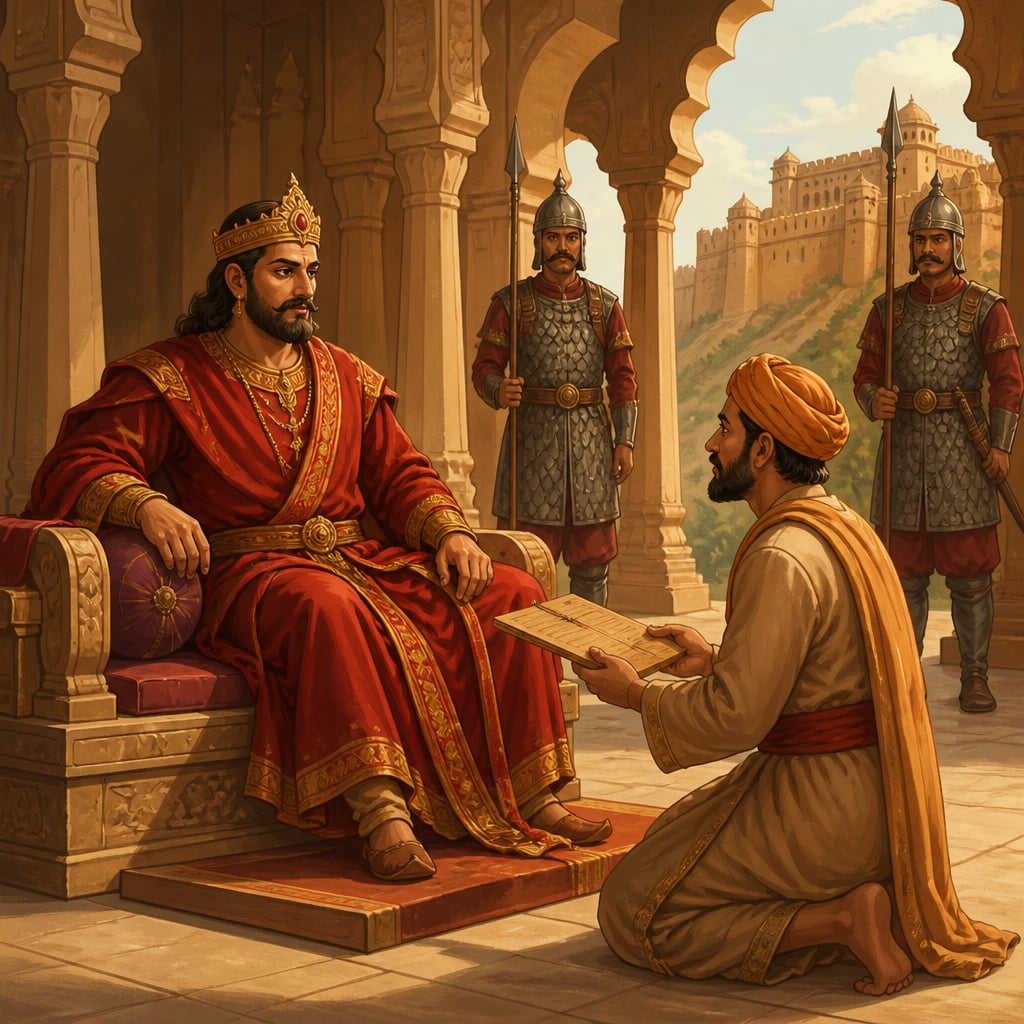
Bappa Rawal holding court at Chittor as king

Medieval Indian kingdoms combined centralized authority with decentralized administration, and Bappa created a layered system that balanced royal power with practical necessity. At the apex sat the Royal Court at Chittor, where the king ruled surrounded by his mantriparishad (council of ministers), military commanders (senapatis), and religious advisors who ensured all major decisions accorded with dharma. Below this, the kingdom was divided into provinces, each governed by trusted nobles who collected taxes and raised troops but owed allegiance to Chittor. At the base, villages retained their traditional councils (panchayats) for day-to-day matters - disputes over field boundaries, inheritance quarrels, minor crimes - with the central government intervening only in major disputes and tax collection. And threading through this formal structure, the tribal territories of the Bhils maintained considerable autonomy, owing military service and nominal tribute but governing themselves by their own customs.

Integrating Rivals and Formalizing Alliances

One of Bappa's most important decisions was how to treat the displaced Mori dynasty. A lesser ruler might have eliminated them entirely - executing the nobles, dispersing their families, erasing their memory. Bappa chose differently. Instead of destruction, he offered integration. Mori nobles who accepted Guhila sovereignty retained their lands and positions. Their expertise in administration, their knowledge of local conditions, their relationships with subordinate chiefs - all were too valuable to discard in a fit of victorious vengeance. This policy reduced resistance from Mori loyalists, preserved institutional knowledge that would have taken years to rebuild, and demonstrated to all observers that submission to Guhila rule brought safety rather than destruction. When the next petty chief considered whether to resist or submit, he would remember how the Moris had been treated.

Bappa Rawal and a Bhil chieftain formalize their alliance with an arrow and tilak

The Bhil tribes had been crucial to Bappa's rise - without their warriors and their knowledge of mountain paths, he could never have built the coalition that seized Chittor. Now their relationship had to be institutionalized, transformed from a personal alliance with Bappa into a formal arrangement that would survive beyond any individual's lifetime. Bhil warriors would serve as scouts, guerrilla fighters, and guardians of mountain passes - roles that matched their extraordinary skills. Bhil regions would govern themselves, paying nominal tribute rather than the regular taxes extracted from plains villages. And in the most powerful symbol of all, Bhil chiefs would apply the ceremonial tilak mark on each new king's forehead at coronation - an honor acknowledging that the Guhila kingdom rested on tribal alliance as much as Rajput arms. This arrangement would last over a thousand years, surviving countless political changes while the original understanding endured.

Revenue, Justice, and the Work of Kingship

No kingdom can function without revenue, and Bappa's administration developed systematic ways to extract resources without killing the prosperity that generated them. The land tax (bhaga) claimed the king's share of agricultural production - typically one-sixth according to the dharmashastra texts, though actual rates varied by region, crop quality, and local custom. Chittor's strategic position controlling routes between Gujarat's wealthy ports and north India made trade duties a significant income source; merchants paid for the security that allowed their caravans to pass unmolested. Provincial governors and allied chiefs paid annual tribute acknowledging Guhila sovereignty. And the Aravallis themselves provided mineral wealth - copper, lead, zinc - along with valuable timber from the forested slopes.

But the king's most important function, the duty that distinguished legitimate rule from mere tyranny, was administering justice (nyāya). Bappa established courts at multiple levels, each handling appropriate cases. The Royal Court at Chittor heard major disputes - conflicts between nobles, crimes affecting the whole kingdom, appeals from lower courts. Here the king himself sat in judgment, his word final. Regional courts allowed provincial governors to apply both royal edicts and local custom to the cases that came before them. And at the village level, traditional councils of elders settled the everyday disputes - who owned which field, whose cattle had trampled whose crops, how an inheritance should be divided - according to customary law refined over generations. This system balanced royal authority with local autonomy, ensuring that justice was accessible while maintaining the king's ultimate sovereignty.

Political marriages cemented alliances that swords alone could not secure. According to Rajput traditions, Bappa took as many as 35 wives from different kingdoms and regions - each marriage representing a diplomatic alliance, a treaty with her family's kingdom. These included Rajput houses whose kinship networks could be activated in times of crisis; Mori princesses whose presence in his household legitimized Guhila rule over former Mori subjects; and families from Gujarat and Malwa whose connections created diplomatic ties across regional boundaries. This vast network of marriage alliances created relationships spanning Rajputana, Gujarat, and beyond - each wife a living treaty, binding families together across generations.

Religious Tolerance and Military Vigilance

Bappa's religious policy balanced personal devotion with political pragmatism. Shaivism was promoted - the Eklingji temple established Mewar as a Shaivite kingdom, and the ideology of rulers as divine servants gave the Guhilas unique legitimacy. But other Hindu sects were tolerated: Vaishnavites who worshipped Vishnu, Shaktas devoted to the Goddess, and various local traditions all continued their practices unmolested. Jain communities received particular protection, not merely from tolerance but from calculation - their merchant networks were economically vital, and their temples attracted pilgrims who spent money in local markets. Even tribal religions were respected; the Bhils continued their traditional worship without pressure to adopt Brahmanical practices. This tolerance was both principled and practical, following dharmic ideals while building the broadest possible base of support.

Bappa Rawal inspects the Mewar army at sunset on the Chittor parade ground

Military infrastructure received careful attention. Chittor itself was expanded and strengthened, its walls improved, its cisterns enlarged to sustain longer sieges. A network of subsidiary forts protected mountain passes and trade routes, each garrison connected by signal fires that could summon reinforcements within hours. Border posts monitored Arab movements from Sindh, ensuring early warning of any renewed invasion. And military colonies of settled warriors (samantas) held lands in exchange for military service, creating a distributed defense system that could mobilize quickly while costing the treasury little in peacetime.

The Statesman's Achievement

Bappa's reign was not without difficulties. Some Mori nobles resented their displacement despite inclusive policies, and plots had to be watched for and occasionally suppressed. Maintaining Bhil loyalty required constant attention - gifts, recognition, careful respect for their autonomy. The question of succession loomed; multiple wives meant multiple sons with competing claims, a problem Bappa could only partially address by clearly designating heirs. External pressures continued as border raids tested defenses and diplomatic maneuvering demanded attention.

Yet by the end of his reign, Bappa had accomplished a remarkable transformation. A scattered coalition of exiles, tribesmen, and displaced warriors had become a territorial state with defined boundaries and functioning administration. A conquered fortress had become the capital of systematic governance, its halls filled with officials who knew their duties. Diverse populations had been integrated into a functioning polity where each group had its place and purpose. Institutions had been created - the samanta system, the Bhil alliance, the administrative hierarchy, the religious foundation at Eklingji - that would outlast any individual ruler.

Consider Bappa's arc: an orphaned prince raised as a cowherd; blessed by a sage; a warrior who helped defeat the Arabs; a conqueror who seized Chittor; and now a statesman who built enduring institutions. Each transformation required different skills. The cowherd learned the land and its people; the disciple learned wisdom and self-mastery; the warrior learned to fight and to lead men in battle; the statesman learned to govern through patience, compromise, and systematic organization. Bappa's greatness lay not in any single achievement but in his capacity for continuous growth.

The practical work of administration lacks battle's drama - no songs are sung about tax collection, no legends told about road maintenance. But it is in this unglamorous work that kingdoms either solidify or crumble. Bappa's willingness to do this work, to transform himself yet again when circumstances demanded, showed maturity matching his valor. The foundations were laid. Now came time to build upon them with the enduring monuments of cultural patronage.

Historical context

Mid-8th Century CE

The mid-8th century saw the consolidation of the three great Indian powers: Gurjara-Pratiharas in the north (who would dominate Kannauj), Palas in Bengal (who would establish a Buddhist-oriented empire), and Rashtrakutas in the Deccan (who would challenge both). Mewar under the Guhilas emerged as a significant regional power in this tripartite landscape. Trade routes between Gujarat and the north remained vital, and Chittor's control of key passages made it strategically valuable.

Living traditions

The administrative traditions Bappa established left lasting marks on Mewar. The samanta system of feudal subordination continued throughout medieval and early modern times. The Bhil alliance persisted until Indian independence, with tribal representatives participating in royal ceremonies. The balance between central authority and regional autonomy that Bappa established would characterize Mewar's governance for over a millennium. Modern administrative divisions in Rajasthan still reflect medieval boundaries.

Reflection

More in Bappa Rawal

All lessons in Bappa Rawal · Lesser Known Guardians of Dharma course