The Orphan of Nagda
From Royal Exile to Mountain Refuge
In the tumultuous 8th century, when Arab armies threatened to sweep across India as they had Persia and Central Asia, a young prince of the Guhila clan grew up in exile among the rugged Aravalli hills. Bappa Rawal - the 'child king' - would emerge from obscurity to forge a kingdom that would stand as a bulwark of Hindu resistance for over a thousand years. This is the story of how a shepherd boy became the founder of Mewar.
The Aravallis: Refuge of Kings
The Aravalli Range stretches across Rajasthan like a spine of weathered stone, its peaks worn smooth by five hundred million years of wind and rain. In the 8th century CE, these ancient hills offered something precious: refuge. While Arab armies probed ever deeper into the subcontinent, conquering kingdoms that had stood for centuries, the Aravallis sheltered those who refused to submit.
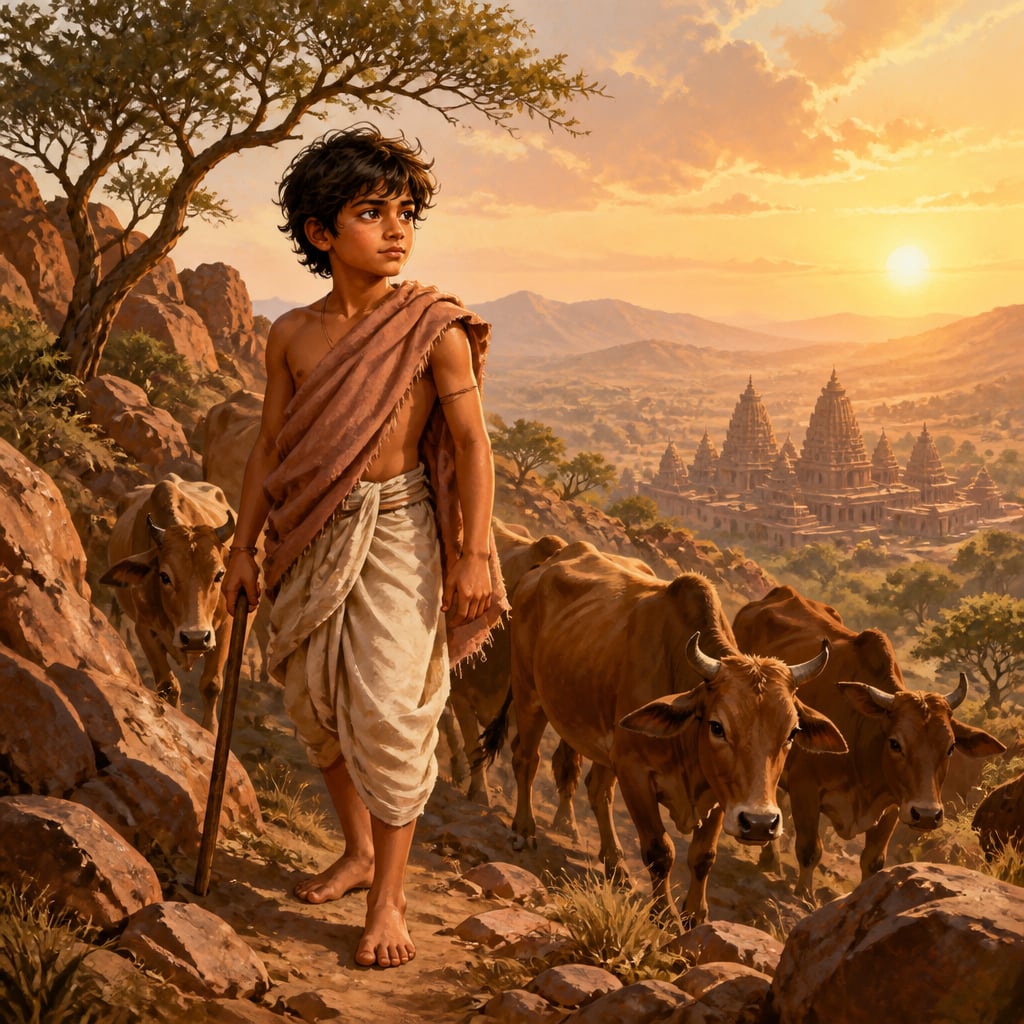
Nestled in a valley of these hills lay Nagda, a town of temples and traders where the clatter of commerce mixed with the chanting of priests. It was here that a boy named Kalbhoj came to be raised - a prince who knew nothing of his royal blood, tending cattle among the rocky slopes where his ancestors had once ruled as kings.
The Guhilas (also called Guhilots) were an ancient Rajput clan claiming descent from epic heroes, their lineage supposedly reaching back to the solar dynasty of Lord Rama himself. By the early 8th century, they ruled a modest territory around Idar in present-day Gujarat, overshadowed by more powerful neighbors. The Mori Rajputs dominated the region around Chittor - the great fortress that would later become synonymous with Rajput valor and sacrifice.
When Kalbhoj was born - likely around 713 CE - his family ruled a small domain, their glory faded from earlier centuries. But within a few years, catastrophe struck. Some accounts speak of an Arab raid that killed his father Mahendra II in a desperate battle; others tell of internal conflict that tore the clan apart. What remains consistent across all versions is the aftermath: the young prince was spirited away to safety in the dead of night, hidden among the common folk of Nagda where no enemy would think to search for royal blood.
"In the mountains, the hunted become hunters. In exile, princes learn what kings forget."
The Shepherd Prince and His Guru
Kalbhoj grew up not in a palace with silk cushions and silver plates, but among herders who rose before dawn and worked until their hands were calloused. He tended cattle in the meadows around Nagda, learning the ways of the mountains - which paths led where, which caves offered shelter from monsoon storms, where water could be found in the driest season. He learned to read the sky for weather, to track animals through dense forest, and to move silently when predators were near.
This education would prove invaluable. A prince raised in comfort might know statecraft from books; a prince raised as a herder knew the land itself and its people. He understood the rhythms of pastoral life and the fierce independence of mountain folk who bowed to no distant king. The Brahmins of the region recognized something special in the boy - a certain bearing, a quickness of mind, a natural authority that cattle-herding could not explain. According to tradition, he studied under sages in forest hermitages, learning not just the Vedas but the arts of war and governance that would one day serve him on the throne.
The pivotal figure in Bappa's transformation was Haritarashi, a Shaivite sage who lived in a cave near Nagda, his body thin from years of tapas (spiritual austerity), his eyes bright with inner fire. The stories of their meeting vary in detail, but the essence remains constant across centuries of retelling: the sage recognized the prince's destiny and became his guru.

According to the most famous account, young Kalbhoj noticed one particular cow would wander away each day and return in the evening with her udder mysteriously empty. Curious, he followed her through winding mountain paths until he discovered her secret: she went to a cave where she offered her milk to a Shivalinga tended by the sage Haritarashi. Day after day, the cow performed this act of devotion while the sage sat in meditation nearby.
Impressed by the boy's patience and devotion - he had followed quietly for days before revealing himself - and recognizing his royal bearing despite humble clothes, Haritarashi took Kalbhoj as his disciple. In the cool darkness of that cave, he revealed the boy's true identity and began preparing him to reclaim his heritage. The training was rigorous: not just mantras and rituals, but philosophy, strategy, and the hard discipline of self-mastery.
The Gift of Eklingji
Haritarashi's greatest gift was not military training but spiritual authority. The sage initiated Bappa into the worship of Eklingji - a form of Lord Shiva meaning "Lord of the Single Linga." At the cave where the cow had offered milk, a temple would one day rise to become the spiritual heart of a kingdom.
In ancient India, a king's legitimacy rested not merely on military power but on divine sanction. By establishing this sacred connection, Haritarashi gave Bappa something no army could provide: the spiritual foundation for dynasty-building. The Guhila rulers would style themselves as dewans (ministers) of Eklingji - the god was the true ruler, they merely his servants. This theological innovation had profound consequences. It created an unbreakable bond between dynasty and land that would endure for over a millennium. Even the greatest Mewar kings would walk barefoot to Eklingji temple to report their deeds to their divine lord.
It was around this time that Kalbhoj acquired the name by which history knows him: Bappa Rawal. The title combines Bappa (a term meaning "father" or "child" in the local dialect) with Rawal (derived from Rājaputra, son of a king). Thus "Bappa Rawal" could mean "Child King" or "Prince Bappa" - fitting for a figure at the boundary of history and legend.
As Bappa grew to manhood, he began attracting followers. The Aravallis were home to displaced nobles whose lands had been seized, dispossessed soldiers seeking a worthy commander, and tribal groups who chafed under plains kings who taxed but never protected. To these people, a prince with a legitimate claim, blessed by a powerful sage, offered something precious: hope.

The Bhil tribes were particularly important allies. These indigenous forest people were formidable guerrilla warriors who knew every hidden path in the mountains, every cave where an army could shelter, every stream crossing where enemies could be ambushed. Bappa earned their loyalty through respect and shared hardship - later Mewar traditions would require a Bhil chief to apply the ceremonial tilak on each new king's forehead at coronation, a honor acknowledging that the kingdom stood on tribal alliance as much as Rajput arms.
The Gathering Storm
The Umayyad Caliphate had conquered Sindh in 712 CE - the same year Bappa was born, as if fate had arranged the timing. From Sindh, Arab commanders launched raids deeper into India, testing defenses, probing for weakness. In 725 CE, an Arab force under Junaid swept through Gujarat into Rajasthan, burning towns and carrying away plunder. The Gurjara-Pratihara confederation and various Rajput clans resisted these incursions, but the pressure was relentless. The situation demanded leaders who could fight - and Bappa's hour was approaching.
The Mori Rajputs who controlled Chittor were hard-pressed by these attacks. Their king, Man Mori, needed allies desperately. And in the hills, a young prince with loyal followers was ready to prove himself worthy of the destiny Haritarashi had foretold.
Destiny Calls
By the late 720s, several threads were converging toward a moment that would reshape Indian history. Bappa had established himself as a leader in the Aravalli region, his band of followers growing with each passing season. The Arab threat demanded united resistance from kingdoms that had long competed. Opportunities were emerging for those bold enough to seize them - and Bappa Rawal was nothing if not bold.
As we leave Bappa in this moment of transition - no longer a hidden prince but not yet a ruling king - we can appreciate the remarkable journey he had already completed. Orphaned in infancy, raised in exile among herders and sages, educated in both worldly and spiritual wisdom, blessed by his guru with divine sanction, and now gathering followers for the defining struggle of his age. The Aravallis had sheltered him. The Bhils had allied with him. Haritarashi had prepared him. All that remained was to descend from the mountains and claim his destiny - first as a defender against Arab invasions, then as conqueror of Chittor, and finally as founder of Mewar.
The shepherd boy was ready to become Bappa Rawal.
Historical context
Early 8th Century CE
India in the early 8th century was a patchwork of competing kingdoms. The Gurjara-Pratiharas were rising in the north, the Rashtrakutas were emerging in the Deccan, and the Palas would soon dominate Bengal. In Rajasthan, various Rajput clans competed for dominance while facing the new threat of Arab raids from Sindh. The Chalukyas and their vassals formed a southern bulwark. This was an age of flux - old powers declining, new ones rising, and an entirely new civilization pressing from the west.
Living traditions
Bappa Rawal remains a foundational figure for Rajput identity, particularly in Mewar. The Mewar royal family (House of Udaipur) traces unbroken descent from him and maintains the Eklingji traditions he established. His story of the hidden prince who rose to found a dynasty resonates as a narrative of resilience and divine destiny. In modern Rajasthan, Bappa is celebrated as both a defender against invasion and a symbol of the enduring Hindu Rajput heritage of the region.
- Eklingji Temple Complex: The sacred temple of Lord Eklingji, divine patron of Mewar, stands at the site where tradition says Bappa first worshipped Shiva under Haritarashi's guidance. The present structure dates mostly from the 15th century but incorporates earlier elements. The temple houses a four-faced Shiva linga and remains the spiritual center of Mewar royalty.
- Nagda Archaeological Site: Ruins of ancient Nagda, where Bappa spent his youth. The site includes the beautiful Saas-Bahu temples (10th-11th century) and remains of other structures from the Guhila period. The area around Nagda preserves the landscape of Bappa's early years - hills, lakes, and temple ruins.
- Chittorgarh Fort: The great fortress that Bappa would later conquer and make the capital of Mewar. Standing on a 180-meter high hill covering 700 acres, Chittor is India's largest fort and the cradle of Rajput resistance. While most visible structures are later, the fort's association with Bappa marks the beginning of its legendary history.
Reflection
- Bappa's identity was hidden from him during childhood - he lived as a cowherd without knowing he was a prince. How might this experience have shaped his character differently than a typical royal upbringing would have?
- Bappa chose to rule as 'Diwan (minister) of Eklingji' rather than claiming absolute kingship. What does this theological choice reveal about the relationship between spiritual humility and political power?
- Bappa's guru Haritarashi recognized potential in a poor cowherd that no one else saw. Have you ever had someone believe in you before you believed in yourself? How did that recognition change your path?