The Patron of Mewar
Temples, Scholarship, and the Arts
Kingdoms are remembered not only for battles won but for what they built and supported. Bappa Rawal, having established military security and administrative foundations, turned to cultural patronage - commissioning temples, supporting scholars, and encouraging artistic traditions. The Eklingji temple he founded would become Mewar's spiritual heart, outlasting all his political achievements and keeping his memory alive for over a thousand years.
The Patron King
In ancient Indian political thought, a king's duties extended far beyond warfare and administration. The ideal ruler - the dharmaraja - was expected to be a patron of religion, learning, and the arts. These activities were not mere luxuries or indulgences of a wealthy court but essential functions of kingship itself. Temples legitimized the dynasty by connecting it to cosmic forces beyond human politics; scholars preserved the knowledge that made civilization possible and created new wisdom for future generations; and the arts expressed a civilization's highest achievements, demonstrating that the kingdom had risen beyond mere survival to flourishing.
Bappa Rawal, having secured his kingdom through conquest and organized it through administration, now faced this third dimension of kingship. The cowherd had become warrior, the warrior had become statesman, and now the statesman would become patron. His cultural achievements would prove as enduring as his military ones - perhaps more so, for the temples he built would stand when his battles were forgotten.
Eklingji: The Divine King's Temple
Bappa's most significant act of patronage was the establishment - or major expansion - of the Eklingji Temple at Kailashpuri, near the site where tradition says he first encountered his guru Haritarashi and began worshipping Lord Shiva in a simple mountain cave. What had been a hermit's shrine would become the spiritual heart of a kingdom.
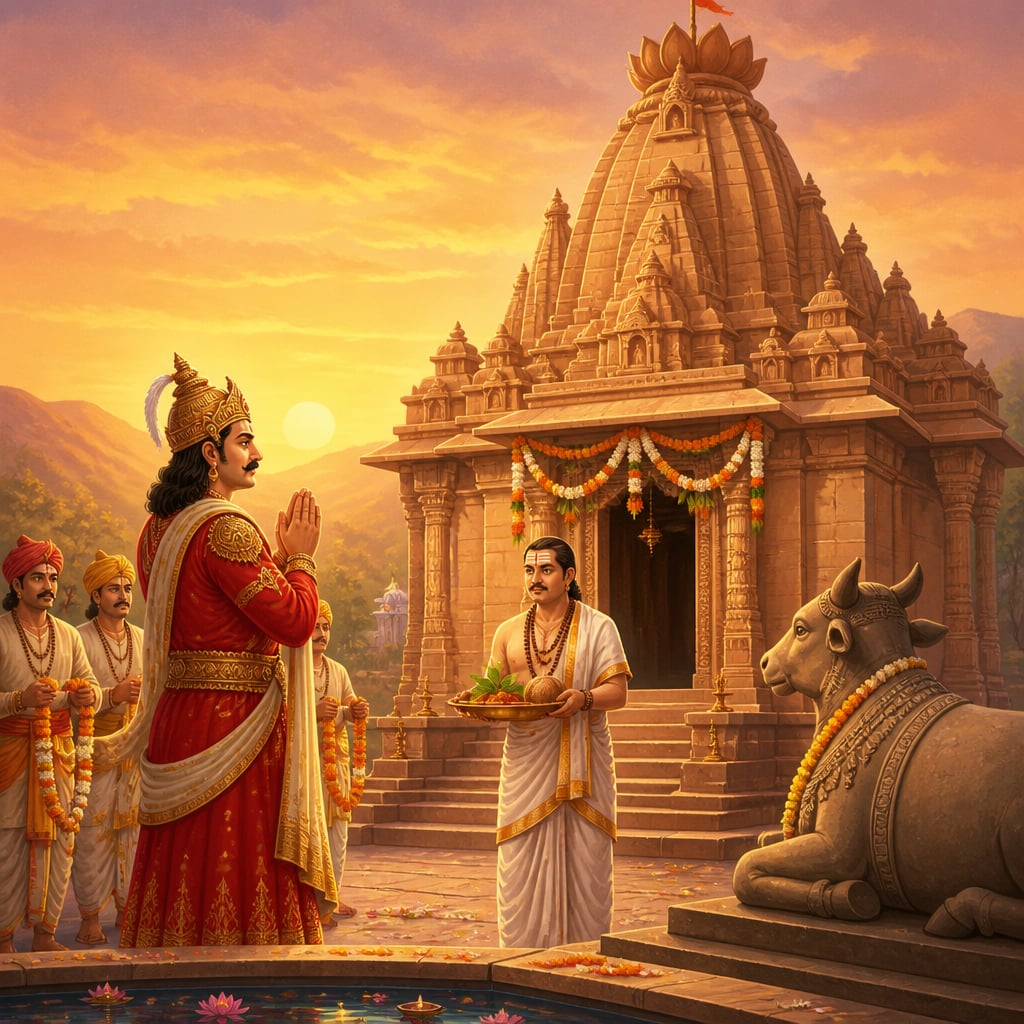
The temple was not merely a place of worship but the spiritual center of the entire realm. As "Diwan of Eklingji," every Guhila king was technically a servant of the god, ruling on divine authority rather than by mere human power. The temple thus legitimized the dynasty in ways no military victory could - for who could challenge the authority of God's own chosen minister? The original 8th-century temple has been rebuilt and expanded many times over the centuries, but the site retains its sacred character. The temple complex eventually grew to include over 100 shrines surrounding the main sanctuary, though most visible structures date from later periods. At its heart lies the four-faced black marble Shivalinga, representing Shiva's cosmic aspects: creator, preserver, destroyer, and the transcendent fourth state beyond all categories. This chaturmukha (four-faced) form was unusual and became iconic of Mewar's distinctive Shaivism.
The ruling family maintained intimate ties with the temple across all the centuries that followed. The Maharana visited regularly - traditionally every Monday, Shiva's sacred day - not to command but to report to his divine lord. Walking barefoot to the temple, the most powerful man in the kingdom humbled himself before the deity he served. This practice continued until Indian independence and beyond, a living tradition connecting the modern world to Bappa's founding vision.
While Eklingji was preeminent, Bappa's patronage extended to other temples as well. Traditions associate him with temples to Surya (the sun god) at Chittor - appropriate for a dynasty claiming descent from the solar (suryavamsha) lineage of Lord Rama. A gold coin issued by Bappa Rawal, discovered in Ajmer, bears testimony to this dual devotion: one side features a Shivalinga while the reverse shows a Sun covered by a royal Chatra (umbrella), symbolizing both his Shaiva faith and solar lineage. Lesser temples throughout Mewar received royal land grants and protection, tying rural populations to the Guhila religious framework. And though personally devoted to Shiva, Bappa protected Jain communities and their temples; their merchant networks were economically vital, and religious tolerance built broader support than narrow sectarianism could achieve.
Supporting Brahmins and Sanskrit Learning
Land grants to Brahmins were a standard form of royal patronage throughout Indian history, and Bappa established patterns that his successors would continue for a millennium. These grants served multiple purposes that intertwined religious duty with political calculation. Brahmins performed the rituals that maintained cosmic order and legitimized royal authority - the coronation ceremonies, the victory sacrifices, the daily observances that connected earthly kingship to heavenly approval. Supporting them was supporting dharma itself.

But Brahmin villages (agraharas) served educational purposes as well. They became centers of learning where Sanskrit, philosophy, law, astronomy, medicine, and other subjects were taught to new generations. Royal patronage maintained India's intellectual traditions during an era when knowledge depended on living transmission from teacher to student. And literate Brahmins staffed the royal bureaucracy - the scribes who drafted copper-plate grants, the record-keepers who tracked land holdings and tax obligations, the diplomats who negotiated with neighboring kingdoms. By supporting Brahmin education, kings ensured a supply of capable administrators who owed their positions to royal favor. Land grants were more reliable than cash payments in an era of uncertain currency and unreliable treasuries. Granting villages to Brahmins created stable, hereditary supporters of the regime whose prosperity depended on the dynasty's continuation.
The 8th century was a vibrant period for Sanskrit literature and philosophy. While Bappa's court was modest compared to great literary centers like Kashmir or Kannauj, it maintained respectable intellectual standards. Court poets composed praise-poems (prasastis) celebrating royal achievements, and these compositions, inscribed on copper plates and stone pillars, are our primary sources for this period. Shaivite theologians elaborated the doctrines surrounding Eklingji worship, developing the sophisticated philosophical framework of the king as god's servant. Beyond religious scholarship, the court needed experts in law (dharmashastra), astrology (jyotisha), and medicine (ayurveda) - practical learning that royal patronage sustained.
The Arts and Material Support
Mewar would later become famous for its distinctive school of miniature painting, those jewel-like images that capture Rajput courtly life with exquisite detail. But the artistic traditions that produced that later achievement had their roots in Bappa's early period. The temples he patronized required sculptors who could carve images of gods and goddesses from stone, whose skills would develop over centuries into a sophisticated regional style. Western India had ancient traditions of metalworking, and royal patronage supported craftsmen who created ritual implements for temples, weapons for warriors, and jewelry for the court. Mewar's location on trade routes between Gujarat's ports and north India gave it access to fine textiles, and court patronage of weavers and dyers maintained these industries. Though evidence is scarce for this early period, temple traditions certainly included ritual music and dance that would develop over centuries into the refined arts of later courts.

Royal patronage of religion took concrete material forms beyond mere verbal blessing. Villages were assigned to temples, with their tax revenue supporting priests, maintaining ritual observances, and funding repairs. These grants were inscribed on copper plates to ensure their permanence - documents that archaeologists still discover today, bearing witness to Bappa's generosity across twelve centuries. Gold, silver, and other valuables were donated to temple treasuries, their interest funding ongoing operations. Building and repairing temples required substantial resources - stone quarried from the Aravallis, labor organized from surrounding villages, skilled craftsmen brought from wherever their expertise could be found. Annual or seasonal donations of grain, cloth, and other necessities supplemented permanent endowments.
Creating Mewar's Identity
Bappa's cultural patronage was part of a broader phenomenon: the synthesis of tribal, Rajput, and Sanskritic elements into a distinctive Mewar identity that would endure for over a millennium. This involved Sanskritization - the process by which local traditions were integrated into pan-Indian Sanskrit culture. Bappa's court, though provincial compared to great centers of learning, participated in this process by patronizing Sanskrit scholarship and adopting Brahmanical forms. But at the same time, Mewar developed its own character that no other kingdom could claim: the unique relationship to Eklingji that made its kings divine servants, the Bhil alliance that connected Rajput rule to tribal support, the specific forms of local worship that gave the region its distinctive flavor.
The theological framework of the king as Eklingji's servant was a sophisticated intellectual achievement that solved a real political problem. How does a dynasty that rose through conquest - that seized Chittor from its previous rulers - claim legitimate authority? By grounding that authority in divine appointment rather than mere force. Bappa ruled not because he was strongest but because Eklingji chose him. This theology created unassailable legitimacy for kings who maintained their devotion while binding them to righteous conduct.
The Enduring Legacy
Bappa's cultural patronage had effects that long outlasted his political achievements. The temple he founded remains active today - pilgrims still come, rituals still continue, the divine presence still receives worship. The political structures Bappa created have long since been superseded by democracy, but the spiritual center persists. Later Guhila rulers continued and expanded the patterns of patronage Bappa established, each generation adding to the temples, supporting new generations of scholars, and maintaining traditions their ancestor had begun. The cumulative effect was a cultural heritage of extraordinary richness.
We should acknowledge what we don't know about Bappa's cultural patronage. The 8th-century structures at Eklingji have been rebuilt many times; little original architecture survives. No literary works composed at his court have been preserved. We know the patterns of patronage from later evidence and assume continuity back to the founding period. This uncertainty is common for early medieval Indian history. We can be confident that Bappa established Eklingji worship and patronized Brahmins, but specific details remain conjectural.
Ultimately, Bappa's cultural patronage was not separate from his statecraft but an extension of it. Temples created grateful priestly communities who would pray for the dynasty's success. Land grants created loyal Brahmin administrators whose prosperity depended on Guhila rule. Sanskrit learning produced the documents that recorded and legitimized royal authority. The arts expressed and enhanced royal prestige. Religious festivals brought communities together under royal sponsorship, creating shared identity that transcended local differences. The 'soft power' of cultural patronage complemented the hard power of military force and administrative control. Together, they created a polity durable enough to endure for over a millennium.
Bappa's achievements as patron raise deeper questions about the relationship between power and meaning. Why did he devote resources to temples rather than armies? What did Eklingji worship mean to him personally? How did his early spiritual training under Haritarashi shape his later kingship? The next lesson will explore these questions through the lens of Bappa's philosophy and dharma - the spiritual dimension of a king who called himself servant to a god.
Historical context
Mid-8th Century CE
The mid-8th century was a golden age of Indian temple architecture. The Rashtrakutas were creating the magnificent Kailasa temple at Ellora; the Palas were building Buddhist monasteries in Bengal; the Pratiharas were patronizing temples in their domains. Bappa's cultural patronage, though more modest in scale, participated in this broader flowering of religious architecture and learning across the subcontinent.
Living traditions
Bappa's cultural patronage created Mewar's most enduring legacy. The Eklingji temple remains an active pilgrimage site and the spiritual center for millions of devotees. The tradition of the ruler as 'Diwan of Eklingji' continued until Indian independence, and the current titular Maharana still maintains the ceremonial relationship. The temple's survival through centuries of political upheaval - including Sultanate and Mughal periods - testifies to the durability of cultural institutions over political ones.
- Eklingji Temple Complex: The spiritual heart of Mewar, founded by Bappa Rawal. The complex now contains 108 temples built over successive centuries, though the core shrine houses the four-faced Shivalinga that has been worshipped since the 8th century. The present architecture is mostly 15th century, but the sacred site and religious traditions date from Bappa's time.
- Nagda Temples (Saas-Bahu): The ruins of ancient Nagda, Bappa's childhood home, include the beautiful Saas-Bahu temples from the 10th-11th century. Though post-Bappa, these temples represent the mature development of the architectural traditions he initiated. The intricate carvings show the sophistication of Mewar's temple art.
- Ahar Cenotaphs and Museum: The traditional cremation ground of Mewar's rulers, with cenotaphs dating from medieval times. The museum houses archaeological finds from the region, including artifacts from the early Guhila period. The site represents the continuity of Mewar's royal traditions from Bappa's time onward.
Reflection
- Bappa founded a temple that remains active over 1,200 years later, while his political achievements are largely forgotten by non-specialists. What does this say about what truly endures?
- Bappa called himself 'Diwan of Eklingji' - servant of God rather than absolute sovereign. Was this genuine humility or strategic positioning? Can the two be distinguished, and does it matter?
- Bappa invested resources in cultural and spiritual infrastructure that would outlast his political achievements. In your own life, what investments are you making that might outlast your immediate work? What legacy are you building?