Philosophy and Kingship

Dharma & Devotion

Krishnadevaraya was a devout Vaishnava who prostrated before the deity at Tirupati as 'servant of servants.' Yet he patronized Shaiva temples with equal generosity and kept pragmatic ethics above sectarian loyalty. Explore how the emperor understood his role as a dharmic ruler, balancing personal devotion with pluralistic patronage, and combining the warrior's aggression with the philosopher's restraint.

The Servant of Servants

At the height of his power, Krishnadevaraya walked barefoot up the sacred hills of Tirumala. Before the deity Sri Venkateswara, the undefeated emperor prostrated himself completely, not as king, but as "dasadasanudasa" (servant of servants of servants).

Krishnadevaraya walking barefoot up the sacred hills of Tirumala at dawn

This image captures something essential about Krishnadevaraya's understanding of kingship. Power was a trust, not a possession. The king who could command armies was himself commanded by dharma and devotion.

Personal Faith: Sri Vaishnavism

Krishnadevaraya was a committed Sri Vaishnava, a follower of the Vishishtadvaita philosophy established by Ramanujacharya. This tradition emphasized:

His personal devotion was genuine and deep. The Amuktamalyada's subject, the Vaishnava saint Andal, reflected his own spiritual orientation. When he visited Tirupati (which he did repeatedly), inscriptions record elaborate donations:

The golden crown he donated to Tirupati, still used in special ceremonies, remains one of the temple's most treasured possessions.

Tirumala: The Sacred Center

Among Krishnadevaraya's many acts of patronage, his devotion to Tirumala Tirupati stands supreme. The temple received gifts exceeding those to any other shrine:
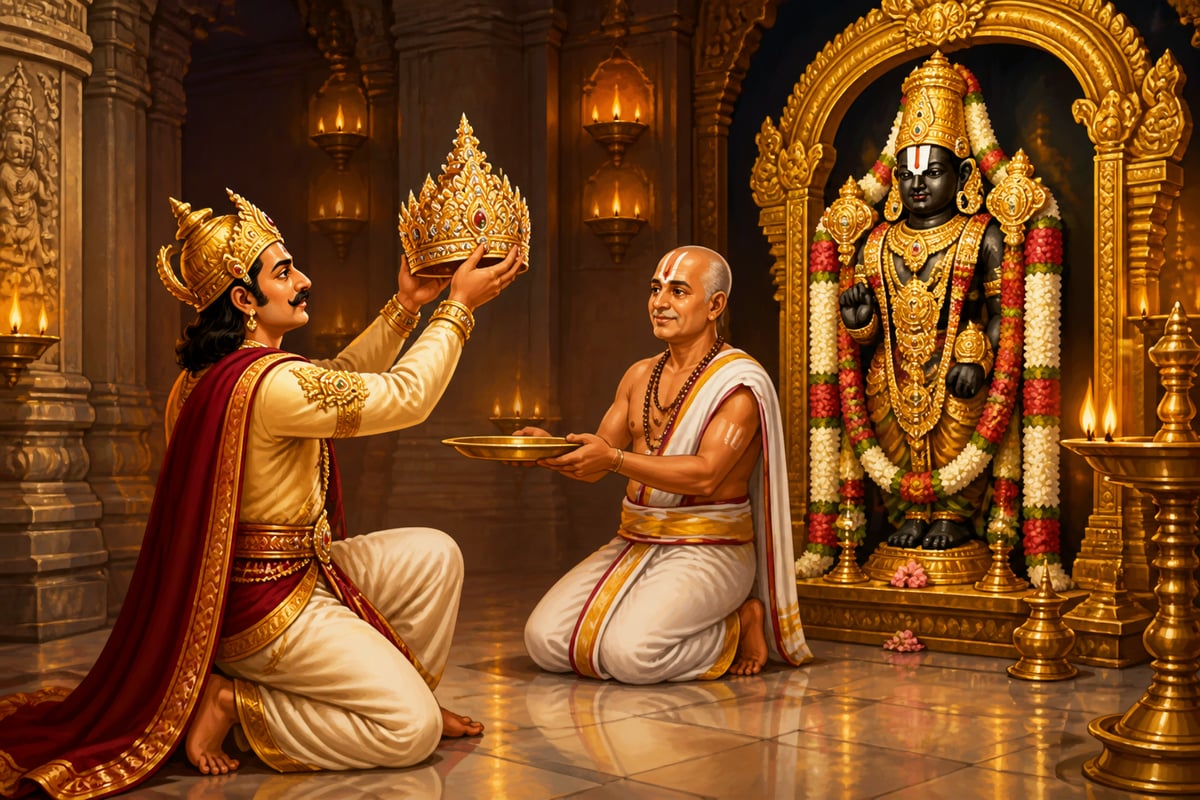
Krishnadevaraya offering a diamond-studded golden crown at Tirumala Tirupati

Donation Purpose
Gold-plated vimana Main shrine tower
Diamond-studded crowns Deity ornaments
Mandapam construction Pilgrim facilities
Village grants Permanent endowment
Golden sword and shield Ritual objects

Inscriptions record that Krishnadevaraya visited Tirumala multiple times during his reign, unusual for any ruler, given the demands of governance and war. After major victories, he would journey to Tirumala to offer thanksgiving.

The emperor also renovated the Govindaraja Temple at Tirupati and the Varadaraja Temple at Kanchipuram, major Vaishnava pilgrimage sites.

Pluralistic Patronage

Despite his personal Vaishnavism, Krishnadevaraya's patronage extended across all Hindu traditions. This was not mere political calculation, it reflected a genuine understanding that protecting dharma meant protecting all dharmic paths.

Shaiva Patronage

The Virupaksha Temple at Hampi, dedicated to Shiva, received continuous royal attention. The empire's very identity was connected to Virupaksha; the kings took the deity's name as part of their royal titles.

Krishnadevaraya patronized:

Jain and Other Traditions

Vijayanagara continued the earlier South Indian pattern of Jain tolerance. Jain temples existed within the empire, and Jain merchants played important commercial roles. While not patronizing Jain institutions as extensively as Hindu ones, Krishnadevaraya did not persecute or discriminate against them.

Muslim Integration

Remarkably, Krishnadevaraya employed Muslims in his army and administration. Muslim cavalry commanders served in his military. Muslim merchants operated freely in Vijayanagara's markets. The emperor's pragmatism extended to religious matters, he protected dharma without persecuting those outside it.

Raja-Dharma: The King's Duty

Krishnadevaraya's understanding of kingship drew on traditional Indian political philosophy, particularly as articulated in:

Protection as Primary Duty

The king's fundamental duty was protection, of subjects, of dharma, of the realm:

"The king who protects his people from invasion, from oppression, and from want, he alone deserves the throne."

This protection had multiple dimensions:

Danda-Niti: The Science of Punishment

Krishnadevaraya understood that protection required force. His raja-niti sections in Amuktamalyada discuss danda (punishment/force) as essential to governance:

"Without danda, the strong devour the weak as fish in water. The rod of punishment, wielded justly, is the foundation of order."

This was not cruelty but realism. A king who could not punish wrongdoing could not protect his people. Military strength was the prerequisite for all other achievements.

Kosha: Treasury as Foundation

Krishnadevaraya emphasized the importance of treasury (kosha):

"From the treasury comes the army; from the army comes the territory; from territory comes revenue; and from revenue comes the treasury. This wheel must never stop."

Good governance required economic prosperity. Overtaxation destroyed the base; undertaxation left the state weak. The art lay in balance.

The Philosopher-King Ideal

Indian political tradition imagined the ideal king as combining multiple excellences:

Aspect Krishnadevaraya's Fulfillment
Warrior (Kshatriya) Never defeated in battle
Scholar (Brahma-vidya) Composed Amuktamalyada
Patron (Dharma-data) Extensive temple donations
Administrator (Artha-vid) Efficient governance
Devotee (Bhakta) Personal worship at Tirumala

Krishnadevaraya came closer to this ideal than perhaps any other South Indian ruler. He was not merely a warrior who happened to patronize temples, or a scholar who happened to rule. He integrated these aspects into a coherent understanding of kingship.

Timmarasa: The Minister's Role

Krishnadevaraya in private counsel with prime minister Saluva Timmarasa

Krishnadevaraya's philosophy of governance included recognizing the importance of wise counsel. His prime minister Saluva Timmarasa (Timmarusu in Telugu) served throughout his reign, providing:

The relationship exemplified the Arthashastra ideal of king and minister as complementary, the king providing vision and decision, the minister providing information and implementation.

Tragically, this relationship ended badly. In his later years, Krishnadevaraya turned against Timmarasa (possibly due to court intrigue), having him blinded. This act haunted the emperor's final days and stands as a reminder that even great rulers could fail their own principles.

Religious Architecture as Philosophy

Krishnadevaraya's temple constructions expressed philosophical principles in stone:

The Gopuram: Gateway to the Divine

The massive gopurams (gateway towers) he added to temples served multiple purposes:

The Mandapam: Community Space

Kalyana mandapams (marriage halls) and other pillared halls provided spaces for:

The Tank: Purification and Provision

Temple tanks (pushkarinis) combined sacred and practical functions:

War and Dharma

How did Krishnadevaraya reconcile his military aggression with dharmic principles? The tradition provided frameworks:

Dharma-Yuddha: Righteous War

War fought for protection of dharma, with proper treatment of enemies and non-combatants, was considered righteous. Krishnadevaraya's wars against the Sultanates were framed as dharma-protection, defending Hindu civilization against those who would destroy it.

Restraint in Victory

The dharmic warrior shows restraint even in victory. Krishnadevaraya's treatment of the Gajapatis, defeating them but then making peace and alliance, followed this principle. Complete destruction was not the goal; restoration of order was.

The Warrior's Devotion

The Bhagavad Gita's teaching, perform your duty without attachment to results, informed Kshatriya ethics. The warrior fights because it is his dharma, offering the results to the divine. Krishnadevaraya's pilgrimages after victories expressed this understanding, victory belonged to the divine, not the king.

The Final Years

Krishnadevaraya's last years were shadowed by personal tragedy:

He died in 1529 CE, leaving an empire at its peak but with succession unclear. The philosophical composure he showed in victory was tested by personal loss in his final years.

Yet even here, his understanding of dharma provided framework. Power was temporary; the king was merely a trustee. What mattered was how one fulfilled one's duty during the time given.

True kingship lies not in accumulating power but in using power for purposes beyond oneself, protecting the weak, preserving tradition, and serving the divine through service to creation.

Historical context

Krishnadevaraya's Religious Life (1509-1529 CE)

The 16th century saw diverse approaches to ruler-religion relationships across India. The Mughals would develop their own model (reaching its peak with Akbar's syncretism). In the South, Vijayanagara maintained the traditional Hindu pattern of dharmic kingship with pluralistic patronage.

Living traditions

Krishnadevaraya's donations to Tirumala continue to shape the temple's ritual life. The golden crown he gave is used during special festivals. The administrative systems for temple management that were refined during his era influenced later practices. His model of combining personal devotion with pluralistic patronage remains influential in discussions of Indian secularism and tolerance.

Reflection

More in Krishnadevaraya

All lessons in Krishnadevaraya · Great Emperors: Revival & Resistance course