Ashtadiggajas - The Eight Elephants
The Patron
At Krishnadevaraya's court, eight poets stood like elephants guarding the eight directions of literature. These 'Ashtadiggajas', including the legendary Allasani Peddana and the witty Tenali Ramakrishna, created the golden age of Telugu poetry. But the greatest literary achievement may have been the king himself: Krishnadevaraya's Amuktamalyada remains a masterpiece of Telugu literature. Discover how a warrior-king became 'Andhra Bhoja', the Bhoja of Telugu lands.
The Poet-King
Krishnadevaraya was not merely a patron of poets, he was himself a poet of the highest order. His Amuktamalyada ("She of the Unfading Garland") is considered one of the five great Telugu kavyas (mahakavyas), ranking alongside the works of poets he patronized.
This combination of warrior and wordsmith was not accidental. In the Indian tradition, the ideal king was expected to master both sword and scripture, to be sarvajna (all-knowing) as well as sarvavijeta (all-conquering). Krishnadevaraya fulfilled this ideal so completely that he earned the title Andhra Bhoja, comparing him to the legendary King Bhoja of Malwa, renowned for his learning.
The Ashtadiggajas: Eight Elephants of Telugu Literature
Just as eight elephants (ashtadik-gajas) were said to support the eight directions of the universe in Hindu cosmology, eight great poets supported the literary universe of Krishnadevaraya's court. These Ashtadiggajas were:

1. Allasani Peddana (అల్లసాని పెద్దన)
The greatest of the eight, Peddana earned the title Andhra Kavita Pitamaha, "Grandfather of Telugu Poetry." His masterpiece Manucharitra (The Story of Manu) set new standards for Telugu kavya.
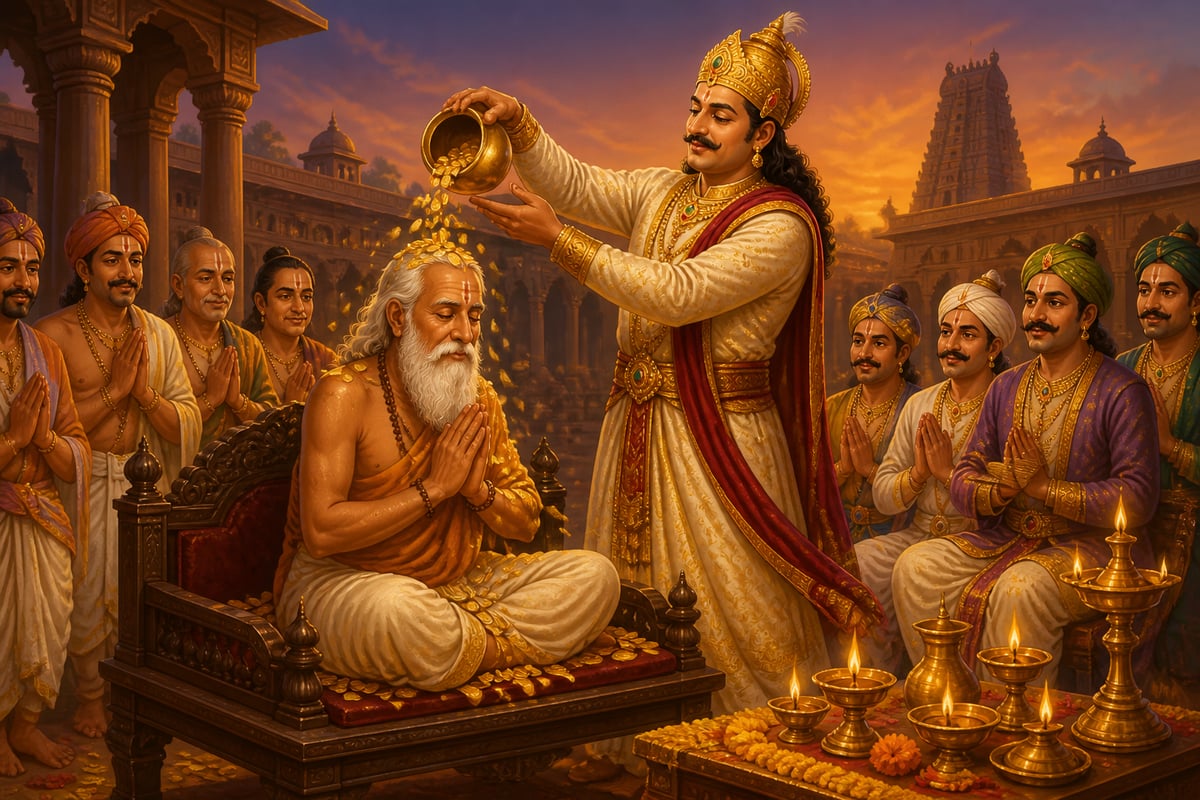
Krishnadevaraya honored Peddana above all others:
- He was given the title "Kavibrahma" (Brahma among poets)
- The king personally welcomed him with gifts of jewels and elephants
- His opinions on poetry were considered final at court
Peddana's style combined Sanskrit learning with Telugu expressiveness, creating a synthesis that defined classical Telugu literature.
2. Nandi Thimmana (నంది తిమ్మన)
Known for his Parijatapaharana (The Stealing of the Parijata), Thimmana brought wit and dramatic flair to Telugu poetry. His work recounts Krishna stealing the divine Parijata flower from Indra's heaven for his wife Satyabhama.
His title "Mukku Timmana" ("Timmana of the Nose") allegedly came from his prominent nose, evidence of the informal, teasing atmosphere at Krishnadevaraya's court.
3. Madayyagari Mallana (మదయ్యగారి మల్లన)
Mallana's Rajasekhara Charita demonstrated mastery of the prabandha (narrative poem) form. He was known for his skill in both Sanskrit and Telugu, bridging the two literary traditions.
4. Dhurjati (ధూర్జటి)
A devotee of Shiva, Dhurjati composed Kalahasti Mahatmyam celebrating the sacred temple of Kalahasti (modern Srikalahasti). His poetry combined bhakti (devotion) with classical learning.
Dhurjati's relationship with Krishnadevaraya showed the king's religious tolerance, though a Vaishnava himself, Krishnadevaraya generously patronized this Shaivite poet.
5. Ayyalaraju Ramabhadra (అయ్యలరాజు రామభద్రుడు)
Ramabhadra contributed to the court's literary output with works on various Puranic themes. His compositions showed the depth of Sanskrit learning characteristic of all the Ashtadiggajas.
6. Pingali Surana (పింగళి సూరన)
Surana's works including Raghavapandaviyam demonstrated remarkable technical skill, this work could be read as either the story of Rama or the story of the Pandavas, depending on interpretation.
7. Ramaraja Bhushana (రామరాజ భూషణుడు)
Also known as Bhattu Murthi, he composed Vasucharitra, another major prabandha. His title "Bhushana" (ornament) indicated his decorative, elaborate style.
8. Tenali Ramakrishna (తెనాలి రామకృష్ణ)

The most famous of the eight in popular memory, Tenali Ramakrishna became legendary not for epic poetry but for wit. Countless folk tales celebrate his clever solutions to impossible problems and his ability to outwit even the king.
His actual literary work, Panduranga Mahatmyam, was serious religious poetry, but history remembers him as the "Vikatakavi" (jester-poet) whose stories are still told across South India.
Amuktamalyada: The King's Masterpiece
Krishnadevaraya's own literary contribution, Amuktamalyada, tells the story of Andal (also called Goda Devi), the only female among the twelve Alvar saints of Tamil Vaishnavism.
The Story
Andal was the adopted daughter of Periyalvar, a priest at the Srivilliputtur temple. From childhood, she was devoted to Lord Vishnu. She would secretly wear the flower garlands meant for the temple deity before they were offered to the god.
When her father discovered this apparent sacrilege, the deity himself intervened, declaring that he preferred the garlands worn first by Andal, hence her name "Amuktamalyada" ("She who offered the worn garland").
Andal composed passionate devotional poetry expressing her love for Vishnu as a bride longing for her bridegroom. According to tradition, she finally merged with the deity at the Srirangam temple, becoming his bride in the ultimate sense.
Why Krishnadevaraya Chose This Story
The choice was significant:
Tamil-Telugu Unity: By celebrating a Tamil saint in Telugu verse, Krishnadevaraya emphasized the cultural unity of South India under his rule.
Bhakti and Kingship: The work connects devotional love (bhakti) with political philosophy. Embedded in the narrative are discussions of raja-dharma (kingly duty) and governance.
Women's Devotion: Andal's story celebrated female spirituality and agency, unusual emphasis for the period.
Literary Achievement
The Amuktamalyada is considered one of the Pancha Maha Kavyas (Five Great Kavyas) of Telugu literature:
| Kavya | Author |
|---|---|
| Amuktamalyada | Krishnadevaraya |
| Manucharitra | Allasani Peddana |
| Panduranga Mahatmyam | Tenali Ramakrishna |
| Vasucharitra | Ramaraja Bhushana |
| Parijatapaharana | Nandi Thimmana |
Remarkably, four of these five masterpieces were produced at Krishnadevaraya's court, a concentration of literary genius rarely matched in world history.
Raja-Niti in Amuktamalyada
The Amuktamalyada is not merely a devotional poem, it contains extensive discussions of statecraft. In one famous section, Krishnadevaraya outlines principles of good governance:
On choosing ministers:
A king should appoint ministers who are learned, virtuous, and experienced, never those who merely flatter.
On taxation:
Tax the people as a gardener tends flowers, nurture growth, don't destroy the plant for a quick harvest.
On military preparation:
A king should always be prepared for war, even in times of peace. The army is the foundation of the state.
These passages show that Krishnadevaraya's literary and political minds were integrated, his poetry contained his philosophy of rule.
The Telugu Renaissance
Krishnadevaraya's patronage sparked what scholars call the Telugu Renaissance, a flowering of Telugu literature, music, dance, and scholarship that transformed the language into a vehicle for the highest cultural expression.
Before Krishnadevaraya
Telugu literature existed before Vijayanagara, but:
- Sanskrit remained the prestige language for serious scholarship
- Telugu was considered appropriate mainly for popular or devotional works
- No Telugu court had systematically patronized literature at this level
The Transformation
Krishnadevaraya changed this status quo:
- He personally wrote in Telugu, demonstrating that the language was worthy of kings
- He patronized scholars who developed Telugu's literary capabilities
- He sponsored translations from Sanskrit, enriching Telugu vocabulary
- He made Telugu a court language alongside Sanskrit and Kannada
The Legacy
The literary forms and standards established under Krishnadevaraya remained authoritative for centuries. Even today, classical Telugu style is defined by the works of the Ashtadiggajas. The prabandha form they perfected remains the gold standard of Telugu kavya.
Beyond Poetry: Music and Dance
Krishnadevaraya's cultural patronage extended beyond literature:
Music
The Vijayanagara court developed the foundations of what would become Carnatic music. Temple musicians, court performers, and traveling artists all benefited from royal patronage. The Vittala Temple's musical pillars demonstrate the period's acoustic sophistication.
Dance
Bharatanatyam and other classical dance forms received royal support. Temple dancers (devadasis) performed elaborate compositions, and the sculptural record at Hampi preserves dance poses and musical instruments in stone.
Scholarship
Sanskrit scholarship continued alongside Telugu development. Commentaries, grammatical works, and philosophical texts were produced under royal patronage. The empire's libraries preserved and copied manuscripts that might otherwise have been lost.
The Poet-Patron Relationship
Krishnadevaraya's relationship with his poets was remarkable for its mutual respect:
Generosity
The king rewarded poets lavishly, grants of villages, gifts of gold and jewels, ceremonial honors. Peddana reportedly received lands, elephants, and the right to ride in procession alongside the king.
Accessibility
Despite his power, Krishnadevaraya engaged with poets as an intellectual equal. He debated literary questions, accepted criticism of his own work, and valued honest assessment over flattery.
Institutional Support
Beyond individual gifts, Krishnadevaraya created institutions, mathas (monasteries) that supported scholars, temples that maintained libraries, and court positions that gave poets financial security.
This combination of personal appreciation and institutional support created an environment where literature could flourish at the highest level.
The Vikatakavi: Tenali Ramakrishna's Legacy
While the other Ashtadiggajas are remembered primarily by scholars, Tenali Ramakrishna lives in popular memory. Hundreds of folk tales feature his wit:
- Outsmarting greedy merchants
- Solving impossible riddles
- Even besting the emperor himself through cleverness
These stories, though largely fictional, preserve a truth: Krishnadevaraya's court valued wit and intellectual play alongside serious scholarship. The king who could appreciate a cleverly-turned jest was the same king who composed mahakavyas.
The greatest patrons create ecosystems where genius can flourish, not by controlling artists, but by providing the resources and freedom that allow creativity to find its own path.
Historical context
Telugu Literary Renaissance (1509-1529 CE)
The 16th century saw the flourishing of vernacular literatures across India. In the north, bhakti poets composed in Hindi, Bengali, and Marathi. The South had already developed rich Tamil and Kannada traditions. Krishnadevaraya's patronage elevated Telugu to comparable status, creating a golden age that would influence the language for centuries.
Living traditions
The Ashtadiggajas remain canonical in Telugu literature education. Amuktamalyada is studied in universities and quoted in cultural discourse. Tenali Ramakrishna stories have been adapted into films, TV series, and children's books, his wit remains popular across South India. Telugu literary awards often invoke Krishnadevaraya's name, and his declaration 'Telugadela yanna deshambu telugenu' appears in discussions of Telugu linguistic identity.
- Srivilliputtur Temple: The temple where Andal grew up and composed her devotional poetry. The tallest gopuram in Tamil Nadu (11 stories) marks this sacred site.
- Lepakshi Temple: A Vijayanagara-era temple with magnificent murals and sculptures. The hanging pillar and giant Nandi demonstrate the period's artistic achievement.
Reflection
- Krishnadevaraya was both patron and practitioner, he funded poets while composing poetry himself. How does participating in an activity (not just supporting it) change one's understanding and appreciation of it?
- Of the Ashtadiggajas, Tenali Ramakrishna is remembered in folk tales while others are known mainly to scholars. Why does popular memory preserve wit and cleverness more than literary achievement?
- Krishnadevaraya embedded political philosophy (raja-niti) within a devotional poem. Why might he have combined governance lessons with religious narrative rather than writing a separate political treatise?