Hampi - City of Wonders
The Capital
In its golden age, Vijayanagara (Hampi) was one of the largest and most magnificent cities on Earth, larger than London or Paris, as splendid as Rome or Beijing. Portuguese travelers marveled at its temples, palaces, and bazaars. Walk through the streets of this wonder city: the Virupaksha Temple where Krishnadevaraya worshipped, the Vittala Temple with its musical pillars, and the royal enclosure where the emperor held court.
A City Beyond Compare
When Portuguese merchants first entered Vijayanagara in the early 16th century, they struggled to describe what they saw. Domingo Paes wrote that the city was "as large as Rome, and very beautiful to the sight." Fernao Nuniz called it "the best provided city in the world." Abdul Razzaq, the Persian ambassador who visited earlier, declared it "such that the eye has not seen nor ear heard of any place resembling it upon the whole earth."
These were not naive travelers easily impressed. They had seen the great cities of Europe, the Middle East, and Africa. Yet Vijayanagara left them speechless.
The Scale of the City
Vijayanagara spread across approximately 25-30 square kilometers, an enormous area for any medieval city. The population during Krishnadevaraya's reign likely exceeded 500,000 people, making it one of the largest cities in the world at that time.
To understand this scale, consider contemporary cities:
| City | Population (c. 1500 CE) |
|---|---|
| Vijayanagara | 500,000+ |
| Beijing | 600,000-700,000 |
| Cairo | 400,000-500,000 |
| Constantinople | 400,000 |
| Paris | 200,000 |
| London | 50,000-75,000 |
Vijayanagara was not merely large, it was among the very largest cities on Earth, comparable only to the great capitals of China and the Islamic world.
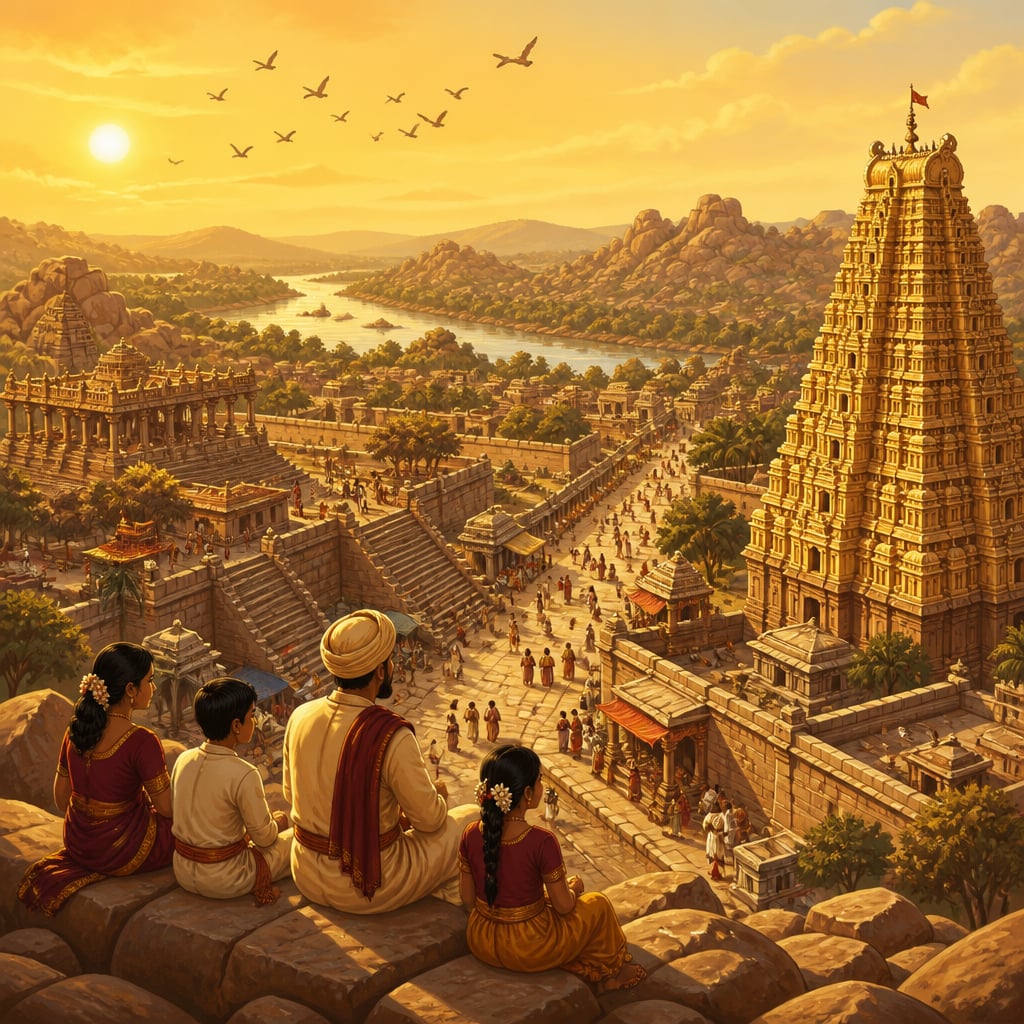
The Three Zones
The city was organized into three distinct zones, each serving different functions:
The Sacred Center
The oldest part of the city clustered around the Virupaksha Temple, dedicated to Lord Shiva. This was where Harihara and Bukka had first established their capital in 1336, choosing a site associated with Kishkindha from the Ramayana.
The sacred center included:
- Virupaksha Temple, the main royal temple, still active today
- Hemakuta Hill, dotted with older temples predating Vijayanagara
- Matanga Hill, offering panoramic views of the entire city
- Achyutaraya Temple, built during Krishnadevaraya's reign
This zone was the spiritual heart of the empire. Every king came here to worship, and major festivals centered on Virupaksha.
The Royal Center
South of the sacred zone lay the Royal Center, the administrative and ceremonial heart of the empire. This walled enclosure contained:
The Royal Enclosure:
- The king's private chambers and audience halls
- The Mahanavami Dibba, a massive stepped platform for the Dasara festival
- Underground chambers and secret passages
- The royal mint and treasury
The Zenana Enclosure:
- The queens' quarters with elegant pavilions
- The Lotus Mahal, a beautiful two-story palace blending Hindu and Islamic architecture
- Watchtowers and elaborate gates
- Gardens and water features
The Elephant Stables:
- Housing for the royal elephants, eleven domed chambers in a row
- One of the best-preserved structures, showing Islamic architectural influence
Krishnadevaraya expanded the Royal Center significantly, adding new structures that displayed the empire's wealth and power.
The Urban Core
Surrounding the sacred and royal centers was the Urban Core, where ordinary life happened. This vast area contained:
- Bazaars stretching for kilometers, selling everything from diamonds to vegetables
- Workshops producing textiles, metalwork, and jewelry
- Residential quarters for merchants, artisans, and workers
- Tanks and wells providing water to the populace
- Temples serving neighborhood communities
The main bazaar ran from the Virupaksha Temple toward the Royal Center, a distance of over a kilometer. Paes described shops "very well built, with arcades, and very long."
Architectural Marvels
Vijayanagara architecture reached its peak under Krishnadevaraya. The style blended Hindu temple traditions with influences absorbed from the Sultanates, creating something uniquely "Vijayanagara."
The Vittala Temple Complex
The Vittala Temple is considered the finest achievement of Vijayanagara architecture. Though construction began earlier, Krishnadevaraya significantly expanded it.
Its wonders include:
The Stone Chariot: A massive stone chariot standing in the temple courtyard, so finely carved that the wheels once actually turned. It was designed as a shrine for Garuda, the vehicle of Vishnu. This chariot has become the symbol of Karnataka, appearing on currency notes.

The Musical Pillars: The temple's pillars produce musical notes when struck. Each pillar is carved from a single stone but contains multiple columns that vibrate at different frequencies. These sa-re-ga-ma pillars demonstrate engineering knowledge we still don't fully understand.
The Ranga Mantapa: A vast hall with 56 pillars, each carved with figures of celestial musicians and dancers. The detail is extraordinary, you can identify specific musical instruments and dance poses.
The Hazara Rama Temple
The Hazara Rama Temple (Temple of a Thousand Ramas) served as the private chapel of the royal family. Its walls are covered with bas-reliefs depicting the entire Ramayana, thousands of figures narrating Rama's story in stone.
Krishnadevaraya added to this temple, and inscriptions record his donations. The carvings include Portuguese traders among the visitors, showing how international Vijayanagara had become.
The Lotus Mahal
The Lotus Mahal in the zenana enclosure exemplifies the architectural fusion of Krishnadevaraya's era. The structure combines:
- Hindu-style pyramidal towers on the roof
- Islamic-style pointed arches and geometric patterns
- A lotus-bud finial (hence the name)
- Cross-ventilation creating natural air-conditioning
This building demonstrates that Vijayanagara architects absorbed useful techniques from everywhere, creating spaces both beautiful and functional.
Water Engineering
In a region with unreliable rainfall, water management was crucial. Vijayanagara's engineers created an elaborate system that sustained half a million people.
The Tungabhadra Channel
An ancient dam across the Tungabhadra River (possibly pre-Vijayanagara but maintained and expanded by the empire) diverted water into channels that irrigated fields and filled city tanks.
Tanks and Reservoirs
Over 30 tanks within and around the city stored water:
- The Manmatha Tank served the sacred center
- The Stepped Tank in the royal enclosure showcased architectural elegance
- Smaller tanks dotted residential areas
Aqueducts and Channels
Stone and brick channels carried water throughout the city. Some ran underground to preserve water from evaporation. The engineering rivaled Roman aqueducts.
Life in the City
Portuguese accounts give us glimpses of daily life in Vijayanagara.
Markets and Commerce

Paes described the markets with wonder:
"You will find everything... from precious stones to silk and velvet, from horses to grain... The merchants here are so rich that they can undertake to pay for all the horses brought to the port."
The bazaars sold:
- Diamonds from the famous Golconda mines (before they fell to Vijayanagara's enemies)
- Textiles, cotton, silk, and finer fabrics
- Spices brought from the Malabar coast
- Horses imported via Portuguese traders
- Everyday goods, vegetables, grains, pottery, metalware
Festivals
The Mahanavami (Dasara) festival was the grandest celebration. For nine days, the city became a stage for:
- Military processions with thousands of cavalry and elephants
- Wrestling matches and martial demonstrations
- Dance performances by hundreds of women
- Distribution of gifts and honors
- Animal sacrifices (buffaloes, goats) by the thousands
Krishnadevaraya participated personally, reviewing troops from the Mahanavami Dibba and distributing rewards to deserving soldiers and scholars.
Cosmopolitan Population
Vijayanagara was remarkably diverse:
- Hindu communities from across South India
- Muslim merchants and craftsmen living in their own quarters
- Portuguese traders with their factors and agents
- Persian and Arab merchants in the diamond and horse trades
- African slaves brought by the Portuguese (unfortunately)
This diversity created a cosmopolitan culture that absorbed influences while remaining distinctively Vijayanagara.
The King's City
Krishnadevaraya transformed Vijayanagara from a great city to a wonder of the world. His constructions included:
- Expansion of the Vittala Temple
- New gopurams (gateway towers) at major temples
- The Krishna Temple (named for the deity, though associated with the king)
- Improvements to the royal enclosure
- New bazaars and market facilities
He also patronized the city's intellectual life, poets, scholars, and artists gathered at his court, making Vijayanagara a center of Telugu and Sanskrit literature.
A City Frozen in Time
After Krishnadevaraya's death and the catastrophic defeat at Talikota (1565), Vijayanagara was sacked and abandoned. The population fled, and the city was never rebuilt.
This tragedy became archaeology's gain. Because no later construction covered the Vijayanagara ruins, the city survives in remarkable completeness. Walking through Hampi today is walking through the 16th century, the same streets where Portuguese traders haggled, the same temples where Krishnadevaraya worshipped, the same platforms where elephants paraded.
The ruins spread across 25 square kilometers, a ghost city that tells the story of an empire's glory and fall. UNESCO recognized its significance by designating Hampi a World Heritage Site in 1986.
Great cities are more than stone and mortar, they are the physical expressions of civilizational achievement. In Vijayanagara, Krishnadevaraya created a city that announced to the world: here was a civilization at its peak.
Historical context
Vijayanagara at its Peak (1509-1529 CE)
While Vijayanagara flourished in the south, North India was in turmoil. The Delhi Sultanate declined, and in 1526, Babur's Mughal invasion began a new era. The Deccan Sultanates remained Vijayanagara's primary rivals, while Portuguese presence on the coast introduced European trade and influence.
Living traditions
Hampi draws over 500,000 visitors annually from around the world. UNESCO designated it a World Heritage Site in 1986, recognizing its outstanding universal value. The stone chariot of Vittala Temple appears on Indian currency and is Karnataka's official symbol. The ruins inspire architects, artists, and historians, while local guides keep the city's stories alive. Research continues to reveal new aspects of Vijayanagara's urban planning, water management, and daily life.
- Vittala Temple Complex: The architectural masterpiece of Vijayanagara, featuring the famous stone chariot, musical pillars, and elaborate carvings. The stone chariot has become Karnataka's symbol.
- Virupaksha Temple: The main functioning temple at Hampi, continuously active since the 7th century. The gopuram dominates the skyline as it did in Krishnadevaraya's time.
- Royal Enclosure & Mahanavami Dibba: The ceremonial heart of the empire. The stepped platform was where Krishnadevaraya reviewed his armies. Nearby are the royal bath (stepped tank) and basement structures.
- Lotus Mahal & Elephant Stables: The zenana enclosure's elegant Lotus Mahal demonstrates architectural fusion. The elephant stables, eleven domed chambers, are among the best-preserved structures.
Reflection
- Portuguese travelers compared Vijayanagara to Rome, the highest praise they could offer. What place has left you speechless with its scale, beauty, or achievement? What made it so impressive?
- Vijayanagara's diversity, Hindus, Muslims, Portuguese, Persians, Africans, coexisted in a city built to protect Hindu civilization. How did this apparent contradiction work in practice?
- The lesson states that 'great cities are the physical expressions of civilizational achievement.' What does a city reveal about the civilization that built it? What would future archaeologists learn about our civilization from our cities?