The Southern Expedition

The Statesman

After conquering North India through 'violent uprooting,' Samudragupta marched south with a completely different strategy. Instead of eliminating the twelve Dakshinapatha kings, he defeated them in battle, then released them to rule as his tributaries. This 'grahanamoksha' (capture and release) policy revealed strategic genius beyond mere military might, understanding that distant territories require different governance, and that showing magnanimity after demonstrating power can be more effective than permanent conquest.

The March to Dakshinapatha

With North India secured under Gupta rule, Samudragupta turned his gaze southward. Beyond the Vindhya mountains lay the Dakshinapatha, the great southern route through the Deccan plateau to the tip of the peninsula. Here ruled powerful kingdoms that had never acknowledged northern sovereignty.

But Samudragupta's approach to the South would be fundamentally different from his northern campaigns. The warrior who had "violently uprooted" nine dynasties would now demonstrate that strategic flexibility was as important as military force.
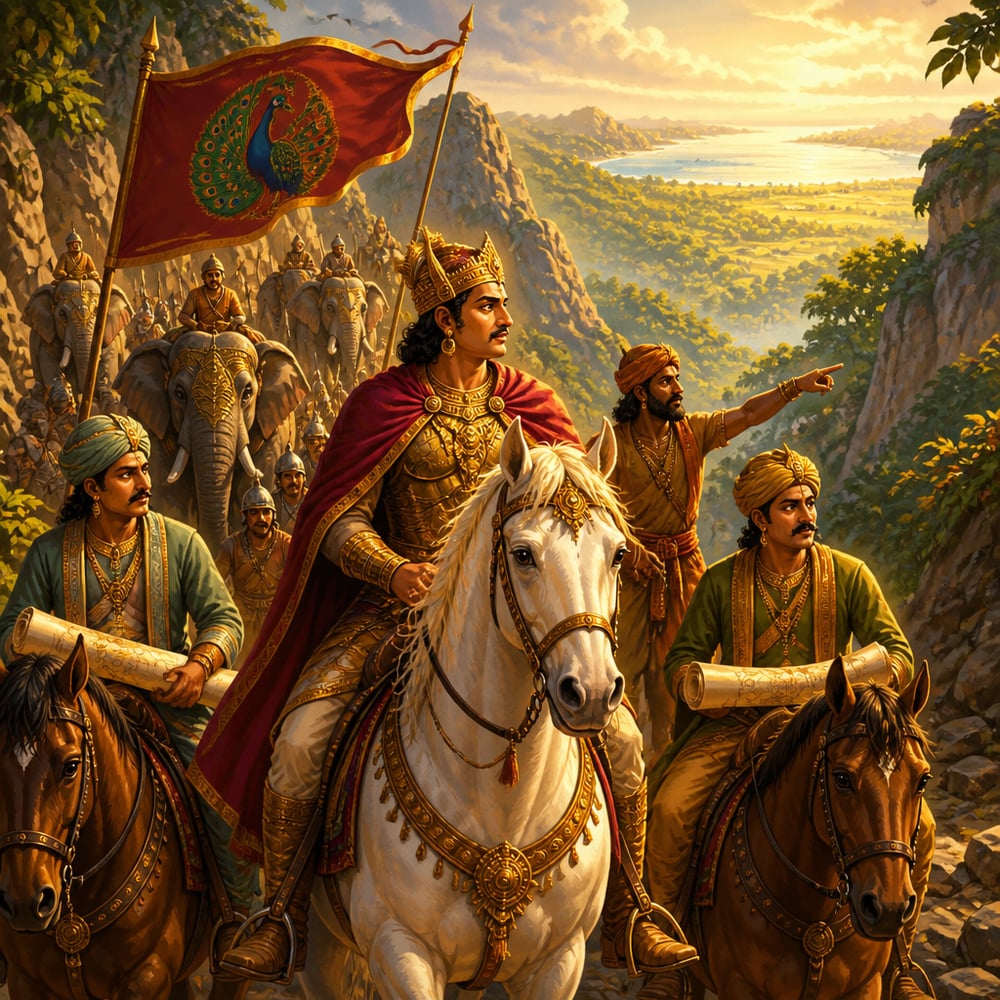
Samudragupta leading his army across a Deccan pass into Dakshinapatha

The Strategic Challenge

The Deccan presented unique challenges that made the northern strategy of total conquest impractical:

Geographical Distance: The southern kingdoms lay hundreds of miles from the Gupta heartland in Magadha. Maintaining direct administration over such distant territories would strain any ancient logistics system.

Unfamiliar Terrain: The Deccan plateau, with its different climate, terrain, and fortification styles, disadvantaged northern armies accustomed to the Gangetic plains.

Local Power Structures: Southern kingdoms had deep roots, loyal populations, and administrators experienced in local governance. Replacing them entirely would be enormously difficult.

Cost-Benefit Calculation: The resources required to permanently conquer and administer the South might exceed any benefits gained.

Samudragupta recognized these realities. His genius lay not just in winning battles but in understanding what to do after winning them.

The Twelve Kings of Dakshinapatha

The Prayag Prashasti names twelve southern kings whom Samudragupta defeated:

King Kingdom Approximate Region
Mahendra Kosala Chhattisgarh region
Vyaghraraja Mahakantara Jungle regions of Odisha
Mantaraja Kurala Possibly Kerala coast
Mahendragiri Pishtapura Coastal Odisha
Swamidatta Kottura Ganjam district
Damana Erandapalla Unknown, possibly AP
Vishnugopa Kanchi Tamil Nadu (Pallava)
Nilaraja Avamukta Possibly southern Odisha
Hastivarman Vengi Coastal Andhra
Ugrasena Palakka Possibly central Deccan
Kubera Devarashtra Unknown location
Dhananjaya Kusthalapura Unknown location

These were not minor chieftains but established rulers with histories, armies, and administrations. Vishnugopa of Kanchi, for instance, ruled the Pallava kingdom, one of the most significant southern dynasties.

The Grahanamoksha Policy

Defeated Dakshinapatha kings re-installed on their thrones

Samudragupta's treatment of these twelve kings introduces a new Sanskrit term to Indian political vocabulary: grahanamoksha, "capture and release."

The inscription describes the policy:

"Capturing and then liberating all the kings of Dakshinapatha..."

The sequence was deliberate:

  1. Defeat in battle, Demonstrating Gupta military superiority beyond question
  2. Capture of the king, Proving that the ruler's life was in Samudragupta's hands
  3. Release and restoration, Returning the king to his throne as a clear act of grace
  4. Acknowledgment of suzerainty, The restored king ruled as a tributary, acknowledging Gupta overlordship

This was psychological warfare as much as military strategy. A king who had been captured and released understood his life depended on Gupta goodwill. He had been humiliated, yes, but also spared, creating both gratitude and fear.

The Logic of Dharma-Vijaya

Indian political theory distinguished between different types of conquest:

Dharmya-vijaya (Righteous Conquest): The conqueror defeats enemies but restores them as tributaries, taking only acknowledgment of supremacy and perhaps tribute. This was considered the highest form of conquest, practiced by ideal chakravartins.

Lobha-vijaya (Greedy Conquest): The conqueror takes territory and wealth, leaving defeated kingdoms impoverished but intact.

Asura-vijaya (Demonic Conquest): The conqueror destroys everything, killing kings, annexing territories, eliminating populations. While effective, this was considered adharmic.

Samudragupta consciously practiced different policies for different situations:

This was not moral inconsistency but strategic flexibility.

The Southern Campaign Route

The Prayag Prashasti provides enough detail to reconstruct Samudragupta's likely route:

Phase 1: Through the Eastern Corridor From Magadha, Samudragupta marched south through Kosala (Chhattisgarh) and into the jungle regions of Odisha. This eastern route avoided the fortified Deccan plateau kingdoms initially.

Phase 2: Down the Eastern Coast After subduing Mahakantara and Pishtapura, the army moved down the coastal plain, defeating the kingdoms of Vengi, Kottura, and Erandapalla.

Phase 3: Into the Tamil Lands The campaign's furthest reach was Kanchi (Kanchipuram), where Samudragupta defeated Vishnugopa of the Pallava dynasty. This brought Gupta power to the very heart of Tamil country.

Phase 4: Return Journey The army returned northward, likely through a different route, securing acknowledgments from any kingdoms missed on the way down.

The Battle of Kanchi

Pallava king Vishnugopa kneeling and being released at Kanchi

The defeat of Vishnugopa of Kanchi was the campaign's climactic achievement. The Pallavas were no minor power, they would later become one of the greatest dynasties of medieval India, builders of the famous Mahabalipuram temples.

For Samudragupta to march deep into Pallava territory and defeat their king demonstrated a military reach unprecedented since the Mauryas. The distance from Pataliputra to Kanchipuram is over 1,500 kilometers, an extraordinary campaign.

Yet even here, Samudragupta applied grahanamoksha. He defeated Vishnugopa, demonstrated Gupta supremacy, then allowed the Pallava dynasty to continue. Centuries later, the Pallavas remembered this, evidence that the policy created lasting impressions.

Creating a Buffer Zone

The grahanamoksha policy created a brilliant strategic situation:

Gupta Core (Direct Rule): The Gangetic heartland, from Bengal to the Punjab borders, under Gupta governors and administrators

Tributary Buffer (Indirect Rule): The twelve southern kingdoms, nominally independent but acknowledging Gupta overlordship, providing tribute, and bound by gratitude and fear

Beyond (Independent but Impressed): Kingdoms too distant for even tributary status, but aware of Gupta power and unlikely to cause trouble

This structure minimized administrative burden while maximizing prestige and security. Samudragupta did not need to govern the South directly, he only needed the South to acknowledge his supremacy.

Tribute and Obligations

What did the restored southern kings owe?

Formal Acknowledgment: Recognition of Gupta paramountcy in official documents and proclamations

Tribute Payment: Regular contributions of wealth, though amounts are not specified

Military Support: Obligation to provide troops if called upon by the Gupta emperor

Diplomatic Subordination: No independent foreign relations or alliances against Gupta interests

In exchange, the kings retained:

Internal Autonomy: Freedom to govern their kingdoms according to local customs

Dynastic Continuity: The throne would pass to their heirs, not Gupta appointees

Local Prestige: Continued respect from their populations as legitimate rulers

Lessons in Imperial Management

Samudragupta's differentiated approach to North and South reveals sophisticated imperial thinking:

Know Your Limits: Even the greatest conqueror cannot control everything. Choosing where to rule directly and where to rule indirectly is a mark of wisdom.

Match Strategy to Context: The northern kingdoms were close, familiar, and integrable. The southern kingdoms were distant, different, and better managed at arm's length. Different situations demanded different approaches.

Power Plus Magnanimity: Defeating enemies proves strength; releasing them after defeat proves confidence. The combination creates authority that mere force cannot match.

Long-Term Stability: By leaving local rulers in place, Samudragupta avoided the rebellions that plague foreign occupiers. The restored kings had every incentive to maintain order.

Comparison with Other Empires

Samudragupta's dual policy finds parallels in other successful empires:

Rome: Direct rule in core provinces, client kingdoms on the frontiers

China (Han): Direct administration in the heartland, tributary relationships with borderlands

Persia (Achaemenid): Satrap system with varying degrees of autonomy based on distance and local conditions

The pattern emerges: successful empires rarely attempt to govern everything identically. Flexibility in administration is essential for sustainable expansion.

The Return to Pataliputra

Samudragupta returned from his southern campaign having achieved:

He had proved himself not just a warrior but a statesman. The "violent uprooter" of the North had become the magnanimous overlord of the South.

The Empire's Extent

By the campaign's end, Samudragupta could claim influence over nearly the entire Indian subcontinent:

This was the most extensive Indian empire since the Mauryas, achieved not through uniform conquest but through strategic flexibility.

The Statesman Emerges

The southern expedition reveals dimensions of Samudragupta's character beyond the warrior:

Strategic Patience: Rather than rushing to annexation, he calculated the best long-term approach

Psychological Insight: Understanding that captured and released kings would be more reliably submissive than either corpses or undefeated rivals

Administrative Wisdom: Recognizing the limits of direct control and designing systems that worked within those limits

Dharmic Consciousness: Choosing the righteous form of conquest when circumstances allowed

The "Napoleon of India" was also, in his way, a philosopher of empire.

Historical context

Samudragupta's Southern Campaign (c. 350-360 CE)

South India in the mid-4th century CE was divided among numerous kingdoms of varying size and power. The Pallavas were emerging as a major force in Tamil country. Coastal kingdoms controlled lucrative trade with Rome and Southeast Asia. The Deccan plateau remained fragmented among multiple dynasties. No northern power had seriously projected into these regions since the Satavahanas centuries earlier.

Living traditions

The grahanamoksha policy influenced later Indian approaches to conquered territories. The Mughal mansabdari system and British use of princely states both echo this approach of ruling indirectly through local authorities. The concept of 'suzerainty' rather than sovereignty, paramount power acknowledging subordinate kings, remained central to Indian political thought until 1947.

Reflection

More in Samudragupta

All lessons in Samudragupta · Great Emperors: The Golden Age course