The Digvijaya Campaign

The Conqueror

Upon assuming power, Samudragupta launched the most extensive military campaign in Indian history, the Digvijaya, or conquest of all directions. The Allahabad Pillar Inscription meticulously records his 'violent uprooting' of nine North Indian kings, ending their dynasties entirely. Unlike conquerors who merely demanded tribute, Samudragupta exterminated royal lines that resisted him. This lesson explores the strategic brilliance, military innovations, and ruthless efficiency that transformed the Gupta kingdom into a pan-Indian empire within a single reign.

The Conqueror Ascends

When Chandragupta I died around 335 CE, his chosen heir inherited a kingdom, but Samudragupta dreamed of an empire. The young ruler wasted no time. Almost immediately upon securing his throne, he began planning what would become the most extensive military campaign in Indian history.

The Prayag Prashasti records Samudragupta's campaigns in meticulous detail, listing conquered kings by name and describing the fate that befell each. Reading this inscription, we encounter not a benevolent philosopher-king but a ruthless conqueror whose ambition reshaped the subcontinent.

The Strategic Situation

In 335 CE, North India was a patchwork of competing kingdoms:

Kingdom Ruler Location
Nagas Multiple dynasties Central India, Mathura region
Achyutas Achyuta Eastern Gangetic region
Kotas Unknown Near Magadha
Maukharis Unknown Central Gangetic plain
Madras Unknown Western regions
Various others Multiple Scattered across Aryavarta

These kingdoms had grown accustomed to independence during the centuries of fragmentation following the Mauryas. They formed alliances, fought small wars, and maintained a rough balance of power. None anticipated what was coming.

The Policy of Violent Uprooting

Samudragupta's approach to conquest was distinctive and terrifying. The inscription uses the phrase "prasabhoddharan", violent uprooting. This was not mere metaphor.

When Samudragupta defeated a king, he did not simply demand tribute and withdraw. He ended dynasties. The inscription specifically notes that nine North Indian kings were "violently uprooted," their kingdoms absorbed directly into the Gupta Empire with no possibility of restoration.
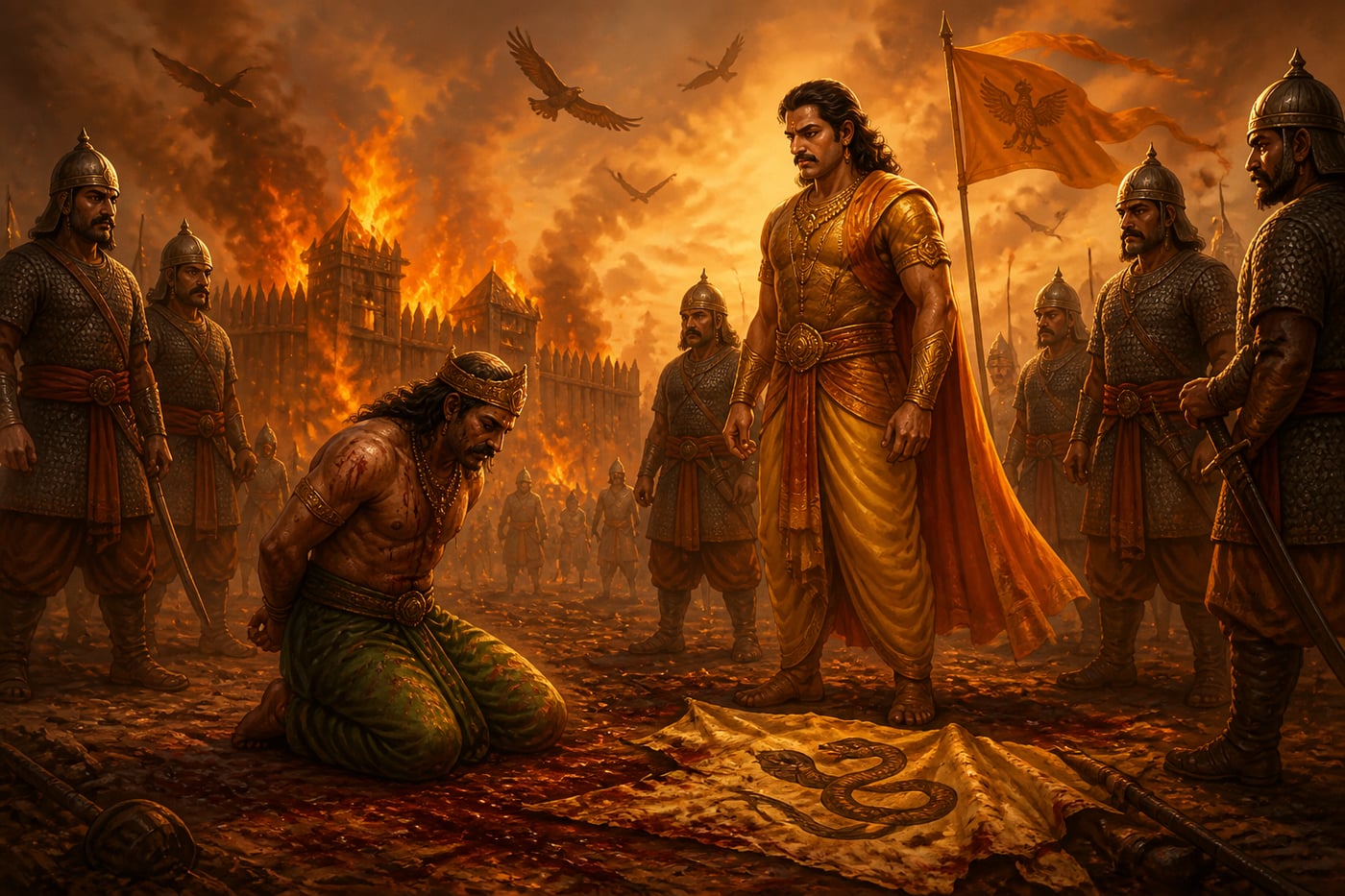
Samudragupta uprooting the Naga king Ganapati-naga in defeat

"By whose arm was produced the uninterrupted flow of wealth from the violent uprooting of Achyuta, Nagasena, and Ganapati-naga..." , Prayag Prashasti

This policy served multiple purposes:

Eliminated future threats: A living defeated king could rebuild, form alliances, and rebel. A dead dynasty posed no such risk.

Demonstrated power: The complete destruction of royal houses sent a message to others contemplating resistance.

Consolidated territory: Without surviving claimants, conquered territories could be fully integrated into Gupta administration.

The Nine Uprooted Kings

The Prayag Prashasti names the North Indian rulers whom Samudragupta destroyed:

  1. Rudradeva, Likely a Naga ruler
  2. Matila, Kingdom in the Gangetic region
  3. Nagadatta, Another Naga dynasty member
  4. Chandravarman, Possibly from Bengal region
  5. Ganapatinaga, Major Naga king, controlled central territories
  6. Nagasena, Powerful Naga ruler
  7. Achyuta, King of a significant eastern kingdom
  8. Nandin, Controlled territories near Magadha
  9. Balavarman, Eastern king, possibly Assam region

Each name represents not just a military victory but the extinction of a royal line. These were not peripheral chieftains but established rulers with armies, treasuries, and centuries of history. Samudragupta erased them all.

Military Strategy and Tactics

How did Samudragupta achieve such comprehensive conquest? Several factors combined:

Personal Leadership: The inscription describes Samudragupta's body as bearing "the marks of hundreds of battle wounds." He led from the front, inspiring his troops and personally engaging in combat.

Samudragupta leading the Gupta cavalry into battle

Speed and Surprise: Rather than building up slowly, Samudragupta struck rapidly, defeating enemies before they could form coalitions. The campaign was a blitzkrieg centuries before the term existed.

Superior Organization: The Gupta army was not merely larger but better organized than its opponents. Supply lines, communication systems, and coordinated operations gave them decisive advantages.

Ruthless Exploitation of Victory: Each victory provided resources, soldiers, elephants, gold, supplies, for the next campaign. Momentum built upon momentum.

The Gupta Military Machine

Under Samudragupta, the Gupta army became the most formidable force in India:

Infantry (Padati): The backbone of the army, organized in disciplined formations

Cavalry (Ashva): Mobile strike forces used for rapid advances and flanking

War Elephants (Gaja): The shock troops of ancient Indian warfare, used to break enemy lines

Chariots (Ratha): Though declining in importance, still used for command and elite warriors

The inscription's description of Samudragupta as "apratiratha" (without an equal chariot-warrior) suggests mastery of all these arms. He was not a distant commander but an active participant in every phase of battle.

The Campaigns Across Aryavarta

Samudragupta's northern campaigns followed a systematic pattern:

Phase 1: Securing the Base First, he consolidated Magadha and the territories inherited from his father. Any internal opposition was eliminated. The Lichchhavi territories were fully integrated.

Phase 2: The Naga Wars The Naga kingdoms controlled crucial territories in central and western North India. Samudragupta targeted them systematically, defeating Ganapatinaga, Nagasena, and Nagadatta in a series of campaigns that broke Naga power forever.

Phase 3: Eastern Expansion With the center secured, Samudragupta moved east, defeating Achyuta, Chandravarman, and Balavarman. This extended Gupta control toward Bengal and Assam.

Phase 4: Western Consolidation The remaining kings, Rudradeva, Matila, Nandin, fell in campaigns that rounded out Gupta control of the entire Gangetic plain and beyond.

The Transformation of Aryavarta

By the campaign's end, the political map of North India had been redrawn:

Before: Dozens of independent kingdoms, constantly shifting alliances, no paramount power

After: A unified Gupta Empire controlling territory from Bengal to Punjab, from the Himalayas to the Vindhyas

This transformation happened within roughly a decade, an astonishing achievement that justified the comparison to Napoleon.

The Human Cost

The abandoned audience hall of a kingdom uprooted by Gupta conquest

We should not romanticize these conquests. The Prayag Prashasti, composed to glorify Samudragupta, reveals tremendous violence:

The inscription praises these actions as demonstrations of power. To those who experienced them, they were catastrophes. Nine dynasties ended; countless soldiers, nobles, and civilians perished.

This honest acknowledgment does not diminish Samudragupta's historical significance, but it reminds us that empire-building exacts a terrible price.

Administrative Integration

Conquest was only the beginning. Samudragupta had to integrate his vast new territories:

Direct Rule: Core territories around Magadha and the Gangetic heartland were placed under direct Gupta administration with appointed officials.

New Provinces: Conquered kingdoms were reorganized into provinces (bhuktis) governed by royal officers.

Military Presence: Garrisons were established throughout the empire to maintain order and deter rebellion.

Revenue Systems: Standardized taxation replaced the varied systems of conquered kingdoms.

The efficiency of this integration was crucial. Many conquerors have won wars only to lose the peace. Samudragupta both conquered and consolidated.

The Psychological Impact

Samudragupta's victories transformed expectations across India:

For potential enemies: Resistance meant not mere defeat but annihilation. This encouraged preemptive submission.

For the Gupta administration: Victory bred confidence, attracting talented individuals to serve a rising power.

For Indian consciousness: After centuries of fragmentation, unified rule was again possible. The Mauryan ideal could be revived.

Foundations for Further Conquest

The northern campaigns were not the end but the beginning. With Aryavarta secured, Samudragupta could turn his attention southward.

The Dakshinapatha, the great southern route through the Deccan, beckoned. There lay twelve more kingdoms, and Samudragupta would march against them all. But his approach to the South would differ from his policy in the North, revealing strategic flexibility alongside military genius.

The Warrior's Character

The Digvijaya campaigns reveal Samudragupta's essential character:

Ambition without limits: He was not content to rule a kingdom; he demanded an empire.

Ruthlessness in pursuit of goals: The "violent uprooting" policy shows willingness to use extreme measures.

Personal courage: Leading from the front, bearing battle wounds, earning his reputation through combat.

Strategic vision: Not random aggression but systematic conquest following a coherent plan.

These qualities made him India's Napoleon, a comparison that captures both his military genius and his willingness to pay any price for victory.

Historical context

Samudragupta's Northern Campaigns (c. 335-350 CE)

North India in 335 CE was divided among numerous kingdoms with no paramount power. The Nagas controlled major portions of central India; various other dynasties ruled the eastern and western regions. No single ruler had united the Gangetic plain since the Kushanas, and they had never controlled it as completely as the Mauryas. The political fragmentation meant that coordination against a determined aggressor was nearly impossible.

Living traditions

Samudragupta's campaigns set the model for imperial conquest in India. Later dynasties, from the Pratiharas to the Mughals, sought to replicate his unification of North India. The term 'digvijaya' entered common usage for any comprehensive campaign of conquest. Modern military historians study his campaigns as examples of rapid conquest and political consolidation. His comparison to Napoleon, made by British historian V.A. Smith, remains the most famous characterization of any ancient Indian ruler.

Reflection

More in Samudragupta

All lessons in Samudragupta · Great Emperors: The Golden Age course