Legacy of the Napoleon of India
Legacy & Lessons
Samudragupta died around 375 CE, leaving an empire that stretched across the subcontinent. But his legacy transcended mere territory, he had created the conditions for India's Golden Age. His military conquests established political unity; his cultural patronage attracted artists and scholars; his religious policies modeled pluralistic governance; his merit-based succession ensured capable heirs. This lesson examines how his reign shaped Indian civilization for centuries and why the comparison to Napoleon, made over 1,500 years after his death, continues to define his historical reputation.
The End of an Era
Samudragupta died around 375 CE, after roughly forty years of reign. In that time, he had transformed a regional kingdom into the largest Indian empire since the Mauryas, performed the ancient Ashvamedha, earned the titles "King of Poets" and "Napoleon of India," and set the stage for one of history's great cultural flowerings.
But what exactly did he leave behind? And why does his legacy matter nearly two millennia later?
The Empire at His Death
When Samudragupta died, the Gupta Empire encompassed:
Direct Rule:
- The entire Gangetic plain from Bengal to eastern Punjab
- Territory extending south to the Vindhyas
- Estimated 15-20 modern Indian states in whole or part
Tributary States:
- Twelve southern kingdoms acknowledging Gupta overlordship
- Frontier kingdoms and tribes paying tribute
- States that submitted without war
Diplomatic Influence:
- Sri Lanka sending embassies
- Southeast Asian states acknowledging Gupta prestige
- Even distant powers aware of the Gupta name
This was the most extensive Indian empire since Ashoka's death in 232 BCE, over 600 years of fragmentation ended by one ruler's ambition and ability.
The Succession
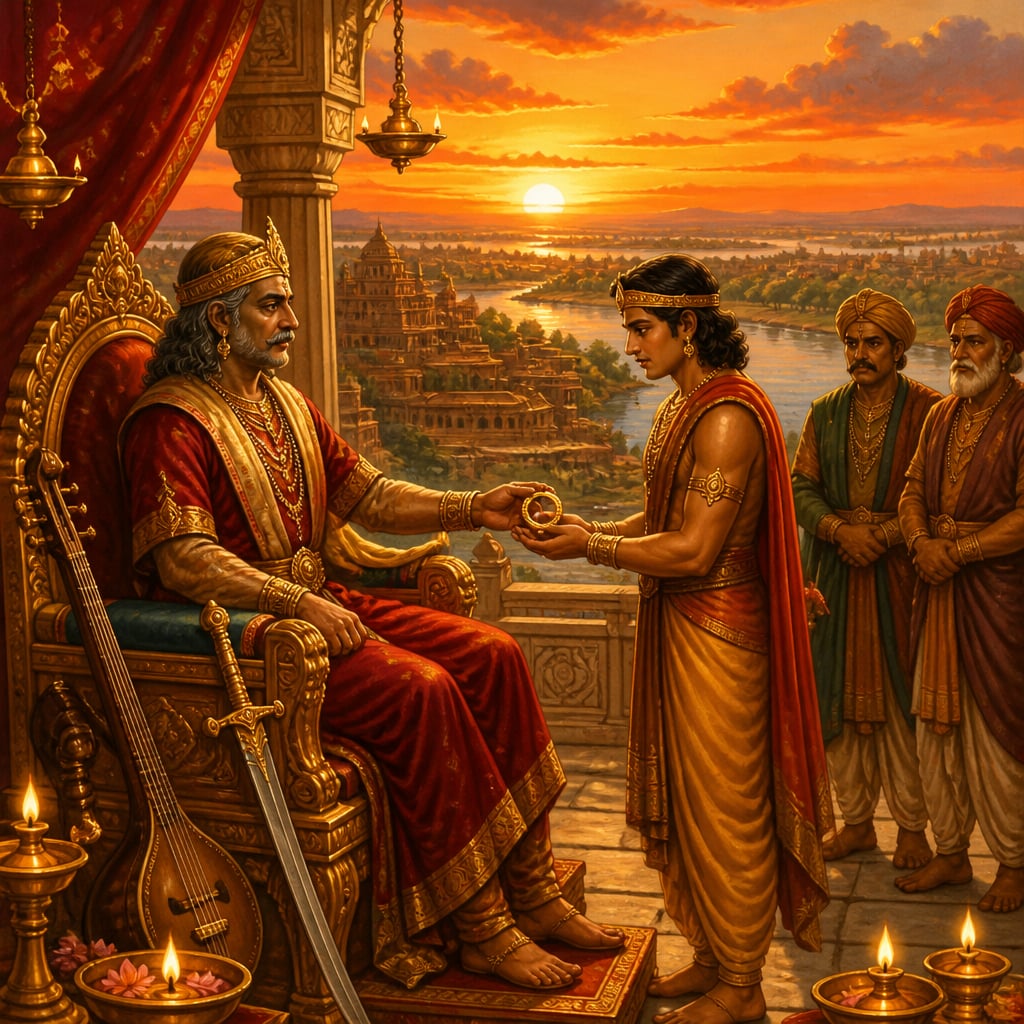
Samudragupta was succeeded by Chandragupta II, who would take the title Vikramaditya and become legendary in his own right. The succession was smooth, Samudragupta's policy of selecting heirs by ability continued.
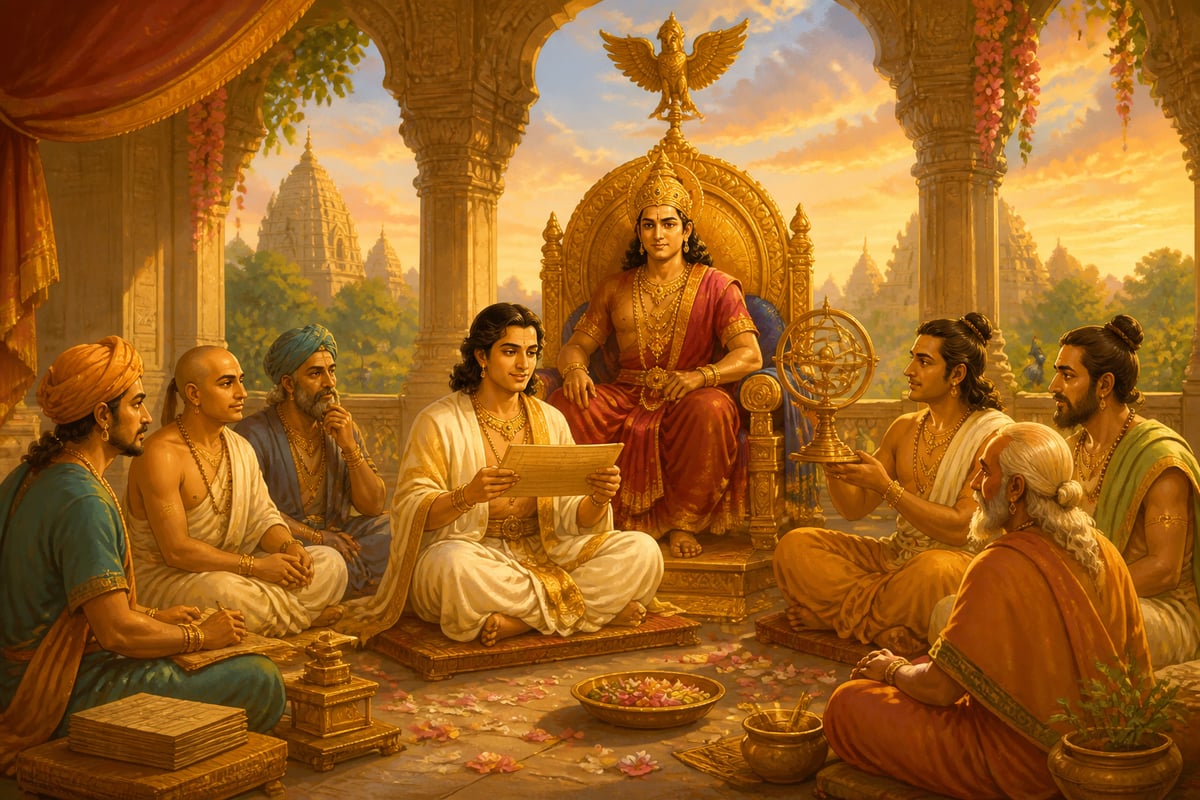
Chandragupta II (Vikramaditya) would:
- Complete the conquest of western India by defeating the Shakas
- Host the legendary "Nine Gems" (Navaratnas) including the poet Kalidasa
- Preside over the peak of the Golden Age
- Continue his father's religious patronage and cultural development
This smooth succession was itself part of Samudragupta's legacy, he had established systems that outlasted him.
Military Legacy
Samudragupta's military achievements set patterns that lasted centuries:
The Model of Conquest
His campaigns demonstrated that North India could be unified under a single power. Later dynasties, the Pratiharas, the Palas, the Delhi Sultanate, and the Mughals, all sought to replicate this achievement.
The Limits of Empire
His differentiated approach to North and South established a realistic understanding of Indian geography. Direct rule in the Gangetic heartland, indirect control beyond, this pattern recurred in subsequent empires.
The Importance of Speed
His rapid campaigns showed that speed and decisive action could prevent coalition formation. This lesson informed Indian military thinking for generations.
Cultural Legacy
Perhaps more lasting than his conquests was Samudragupta's cultural impact:
The Gupta Golden Age
The cultural flowering that reached its peak under Chandragupta II and Kumaragupta I began under Samudragupta. He established:
- Royal patronage of arts and scholarship
- The court as a center of learning
- The ideal of the cultured warrior-king
- Infrastructure for artistic production
Sanskrit's Classical Age
The Gupta period saw Sanskrit reach its classical form. Works produced under Gupta patronage, including Kalidasa's plays, the final recensions of the epics, and foundational scientific texts, became standards for centuries.
The Gupta Aesthetic
In sculpture, architecture, and decorative arts, the Gupta period established the classical Indian style:

- The Buddha images of Sarnath
- The Vishnu images of Mathura
- Temple architecture forms that influenced later development
- A balance of naturalism and idealization that defined Indian art
Samudragupta may not have personally created these works, but his patronage created the conditions for their emergence.
Religious Legacy
Samudragupta's approach to religion was remarkably balanced:
Vedic Revival
The Ashvamedha and support for Brahminical learning revived Vedic traditions that had declined.
Buddhist Patronage
Simultaneously, he welcomed Buddhist institutions, the Sri Lankan monastery at Bodh Gaya being the most famous example.
The Model of Pluralism
This combination, personal devotion (to Vishnu), traditional practice (Ashvamedha), and patronage of other traditions (Buddhism), became the model for Indian kingship. Later rulers followed this pattern of supporting multiple religious traditions.
Administrative Legacy
The Gupta administrative system, refined during Samudragupta's reign, influenced subsequent Indian governance:
Provincial Structure
The empire was organized into provinces (bhuktis) and districts (vishayas), a pattern that later empires adapted.
Revenue Systems
Gupta taxation and land grant systems (documented in later inscriptions) became templates for medieval Indian administration.
Coinage
Gupta gold coins set standards for Indian numismatics. Their weight, purity, and artistic quality were benchmarks against which later coinages were measured.
The "Napoleon of India" Title
In 1901, British historian Vincent A. Smith published a history in which he called Samudragupta the "Napoleon of India." The comparison was meant as high praise, Napoleon was then considered the greatest military genius of the modern era.
Why the Comparison Works
| Napoleon | Samudragupta |
|---|---|
| Rose from obscure origins | Guptas were minor chiefs |
| Conquered rapidly across Europe | Conquered rapidly across India |
| Military genius | Undefeated in battle |
| Patron of arts and sciences | Kaviraja, patron of learning |
| Created new political order | Unified fragmented subcontinent |
| Legal and administrative reforms | Established lasting governance |
Why the Comparison Falls Short
| Napoleon | Samudragupta |
|---|---|
| Empire collapsed after death | Empire lasted 150+ years |
| Died in exile | Died in triumph |
| Successors undistinguished | Chandragupta II exceeded him culturally |
| Ultimately defeated | Never lost a major battle |
In some ways, Samudragupta exceeded his European counterpart.
The Complete Sovereign
Looking back across Samudragupta's reign, we see a remarkably complete achievement:
Military: Undefeated conqueror who unified the subcontinent
Political: Created a durable empire with effective administration
Cultural: Patron of arts who established the court as learning center
Religious: Balanced traditional practice with pluralistic patronage
Personal: Warrior, poet, musician, the Renaissance ideal centuries before Renaissance
Few rulers in any civilization have combined so many excellences.
Lessons for Leadership
What can we learn from Samudragupta's life and reign?
On Merit
His selection as heir over older brothers established that ability matters more than birth order. His success vindicated his father's choice and established a model for meritocratic succession.
On Strategy
His differentiated approach to North and South shows that great strategists adapt to circumstances rather than applying one formula everywhere.
On Culture
His investment in arts and learning shows that true greatness encompasses more than power, the Golden Age was his lasting monument.
On Legacy
His careful preparation of succession and systems shows that great leaders build institutions that outlast them.
The Unfinished Legacy
What did Samudragupta not accomplish?
The Far Northwest: The Punjab and beyond remained outside Gupta control. Chandragupta II would partially address this.
Permanent Southern Control: The tributary system, while elegant, was inherently unstable. Southern kingdoms eventually reasserted independence.
Institutional Depth: The empire remained dependent on capable individuals. When later Gupta rulers proved weaker, the system struggled.
These limitations remind us that even the greatest rulers are bounded by their circumstances.
Samudragupta in Historical Memory
How has Samudragupta been remembered?
In His Time
The Prayag Prashasti was designed to preserve his memory. Its location on an Ashoka pillar connected him to Mauryan greatness.
In Medieval India
The Gupta era became a benchmark, later rulers sought to emulate or exceed their achievements.
In Colonial Scholarship
British historians rediscovered the Guptas through coins and inscriptions. Smith's "Napoleon" comparison made Samudragupta accessible to Western readers.
In Modern India
Samudragupta appears in textbooks as a national hero, the unifier of India, patron of culture, embodiment of Indian achievement.
The Golden Age Foundation
Ultimately, Samudragupta's greatest legacy was creating the conditions for India's Golden Age:
Political Unity: Stable rule enabled long-term cultural investment
Patronage Networks: Royal support attracted talent to the Gupta court
Religious Harmony: Pluralistic patronage allowed diverse traditions to flourish
Administrative Stability: Effective governance freed resources for culture
Succession Planning: Capable heirs continued and expanded his achievements
The poetry of Kalidasa, the astronomy of Aryabhata, the sculpture of Sarnath, the temple traditions of later centuries, all trace their conditions of possibility to what Samudragupta built.
Conclusion: The Meaning of Greatness
What makes a ruler "great"? Samudragupta offers one answer:
Conquest that unifies rather than merely destroys
Power exercised with strategic wisdom
Patronage that creates lasting cultural monuments
Succession that ensures achievements survive the founder
Character that combines strength with refinement
The man who bore battle scars from hundreds of wounds also played the veena with mastery. The conqueror who "violently uprooted" his enemies also released others with grace. The emperor who claimed universal sovereignty also encouraged diverse religious traditions.
This combination, of opposites reconciled, of excellences combined, is what made Samudragupta great. Not merely the Napoleon of India, but a model of what human achievement might be when ambition serves civilization rather than mere ego.
The Golden Age he inaugurated has passed. But its achievements, in art, literature, science, and religion, remain part of India's living heritage. And the memory of the king who made it possible endures, inscribed on an ancient pillar, depicted on golden coins, and taught to each new generation that seeks to understand India's past.
Final Reflection
As we conclude our study of Samudragupta, consider:
- What would you want inscribed on your metaphorical pillar?
- How might you combine seemingly opposite excellences in your own life?
- What "golden age" might you help create for those who come after?
Samudragupta's story is not just history, it is an invitation to consider what greatness means and how it might be pursued.
Historical context
End of Samudragupta's Reign and Legacy (c. 375 CE onward)
At Samudragupta's death around 375 CE, India was more unified and prosperous than at any time since Ashoka. The Gupta court had become a magnet for scholars, artists, and poets. The administrative systems were functioning effectively. The succession to Chandragupta II was smooth. The conditions for the Golden Age's full flowering were in place.
Living traditions
Samudragupta's legacy extends far beyond his conquests. The Gupta numeral system evolved into the numbers used worldwide, the '0' and the decimal system that enables modern mathematics. Gupta art established the classical Indian aesthetic. Gupta literature, especially works patronized by his successors, remains foundational. The model of the cultured warrior-king influenced Indian political ideals for centuries. And the comparison to Napoleon ensures that Samudragupta remains one of the few ancient Indian rulers known to global audiences.
- Sarnath Archaeological Site: Contains some of the finest examples of Gupta sculpture, including the famous Sarnath Buddha. The site demonstrates the artistic achievements that Samudragupta's patronage made possible.
- Udayagiri Caves: Contains rock-cut caves from the Gupta period, including a famous Varaha (boar incarnation of Vishnu) relief. The caves date to Chandragupta II's reign but reflect artistic traditions established under Samudragupta.
- National Museum Gupta Gallery: Houses the most comprehensive collection of Gupta artifacts in India, coins, sculptures, terracottas, and inscriptions. Essential for understanding the material culture of Samudragupta's empire.
Reflection
- Samudragupta's legacy extended far beyond his lifetime because he built systems and institutions, not just personal achievements. What are you building that will outlast you? What systems have you created that will continue without your presence?
- The Prayag Prashasti was carved on an ancient pillar to preserve Samudragupta's memory. What would you want inscribed to preserve your memory? What achievements, qualities, or contributions would you want remembered?
- Samudragupta combined seemingly opposite qualities, the brutality of 'violent uprooting' with the sensitivity of a poet-musician. How do we evaluate such complex figures? Must great achievement involve such contradictions?