The Shunga Renaissance in Art

Bharhut, Sanchi & Artistic Glory

The dynasty that supposedly persecuted Buddhists produced some of Buddhism's finest art. The stupas of Sanchi and Bharhut, expanded under Shunga patronage, showcase masterpieces of Indian sculpture that influenced art across Asia. From graceful yakshis to narrative reliefs telling Buddhist stories, Shunga artists created works that still inspire awe. How did an age of religious tension become an age of artistic glory? The answer reveals that Indian civilization was always more complex than simple narratives suggest.

The Paradox of Shunga Art

Here is one of history's great ironies: the dynasty that Buddhist texts condemn as persecutors created some of the greatest Buddhist art ever made.

The stupas of Sanchi and Bharhut, expanded and adorned during Shunga rule, contain sculptures of extraordinary beauty and sophistication. The railings and gateways carved during this period tell Buddhist stories with a mastery that would influence Asian art for centuries.

How do we explain this paradox?

The Evidence of Stone

Before examining the art itself, let us be clear about what the archaeological evidence shows:

Site Shunga-Period Activity
Sanchi Stupa I enlarged; gateways (toranas) added or begun
Bharhut Stupa expanded; magnificent railing created
Bodhgaya Temple complex developed
Amaravati Early phases of stupa construction

These are not the actions of a dynasty bent on destroying Buddhism. Whatever Pushyamitra's personal views, his dynasty presided over a flourishing of Buddhist art unprecedented in Indian history.

Sanchi: The Great Stupa

The Great Stupa of Sanchi (Stupa I) was originally built by Emperor Ashoka in the 3rd century BCE. Under the Shungas, it was:

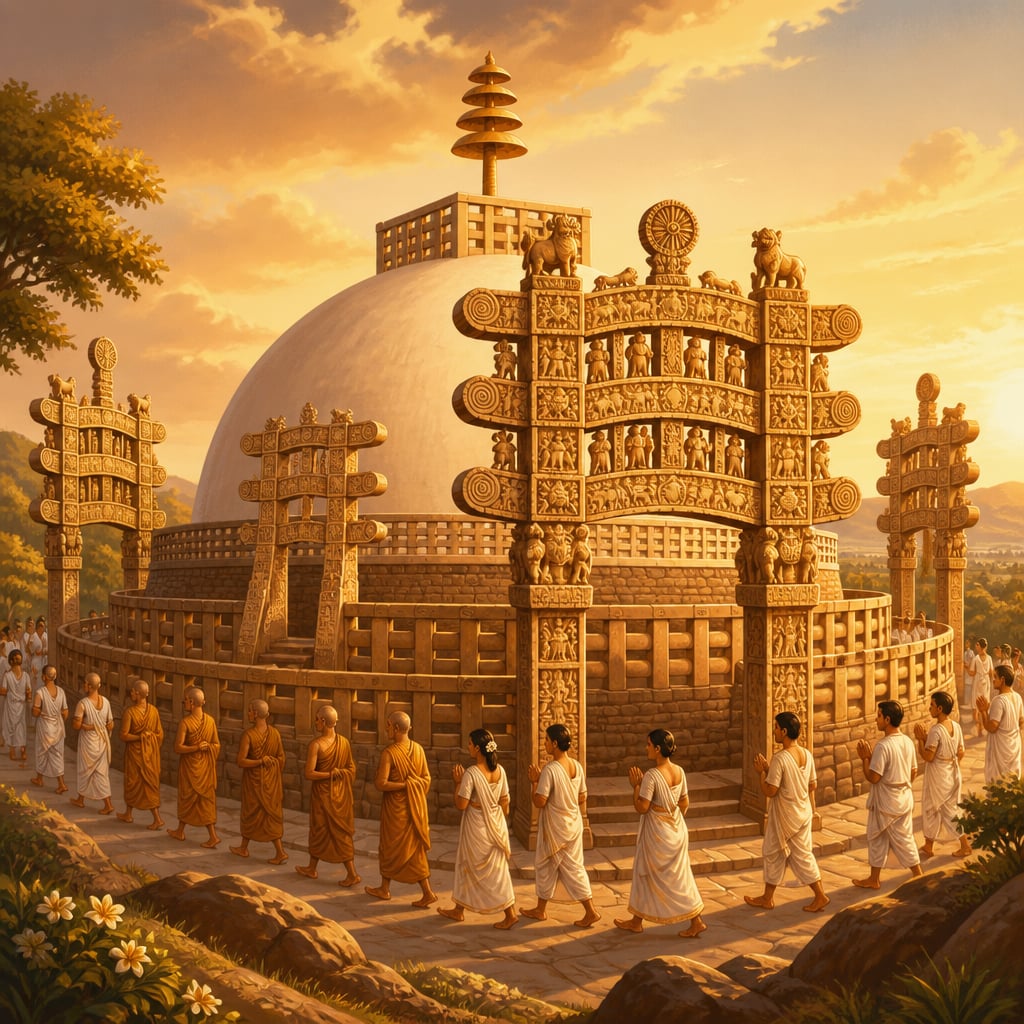
The Great Stupa of Sanchi expanded under the Shungas with carved toranas

The four gateways (toranas) of Sanchi are among the supreme achievements of Indian art. Each stands about 34 feet high, carved with intricate scenes from Buddhist texts:

The Aniconic Buddha

Aniconic Buddha as an empty throne at Bharhut

A striking feature of Shunga-period Buddhist art is the absence of Buddha images. The Buddha is represented symbolically:

This was not due to any prohibition but reflected the early Buddhist aesthetic that the Buddha had transcended physical form. The human Buddha image would not emerge until the Kushan period, centuries later.

This aniconic approach produced remarkably evocative art. The empty throne surrounded by worshippers creates a powerful sense of presence through absence, the Buddha is more powerfully present for not being depicted.

Bharhut: The Masterpiece of Relief Sculpture

The Bharhut Stupa in Madhya Pradesh contained what may be the finest relief sculptures of ancient India. Though the stupa itself is now largely destroyed, the surviving railings and carvings, preserved in the Indian Museum in Kolkata, represent artistic achievement of the highest order.

Bharhut characteristics:

The Bharhut railings depict:

The Yakshi Tradition

A Bharhut yakshi in tribhanga pose

Among the most celebrated figures in Shunga art are the yakshis, female nature spirits associated with trees, fertility, and abundance. These figures combine:

The yakshis of Bharhut and Sanchi stand in tribhanga (triple-bend) poses, one hand reaching up to grasp a tree branch, bodies curved in graceful S-shapes. This iconography would influence Indian art for millennia.

How do we reconcile the sensuous yakshis of Shunga art with the ascetic ideals of Buddhism?

The answer is that popular Buddhism always incorporated folk traditions. The yakshis were guardian spirits of the stupa, welcoming worshippers and blessing them with prosperity. Buddhist art was never purely about renunciation, it celebrated life even while teaching detachment.

Greek Influence and Indian Synthesis

Shunga art shows unmistakable traces of Greek influence, absorbed from contact with the Indo-Greek kingdoms:

But this was not mere imitation. Shunga artists synthesized Greek techniques with Indian traditions:

Greek Contribution Indian Transformation
Naturalistic drapery Applied to Indian dress and body types
Narrative sequences Used to tell Jataka tales
Architectural ornament Combined with Indian symbolic motifs
Perspective techniques Adapted to Indian compositional logic

The result was a new artistic language, neither purely Greek nor traditionally Indian, but something richer than either.

Terracotta Excellence

Beyond monumental stone sculpture, the Shunga period produced exquisite terracotta art:

Terracotta was the art of common people, affordable, accessible, and reflecting popular taste. Shunga terracottas show a society vibrant with religious devotion, aesthetic appreciation, and technical skill.

Sites like Chandraketugarh in Bengal and Kaushambi in Uttar Pradesh have yielded thousands of Shunga-period terracottas, revealing the artistic culture that flourished beneath the political surface.

The Question of Patronage

Who paid for this Buddhist art under a supposedly anti-Buddhist dynasty?

The inscriptions at Sanchi and Bharhut provide answers. They record donations from:

Notably, some donors have Brahmanical names, suggesting that patronage crossed religious boundaries. The inscriptions rarely mention royal donors, this was popular patronage, not state-directed art.

The implication is significant: even if Pushyamitra's state favored Brahmanical traditions, the Buddhist community remained prosperous and generous enough to fund monumental art projects. This contradicts narratives of thoroughgoing persecution.

Technical Innovation

Shunga sculptors achieved remarkable technical advances:

Stone Carving

Compositional Skill

Standardization

Art and Society

Shunga art reveals a society more complex than simple religious categories suggest:

Religious Pluralism: Buddhist, Brahmanical, and folk religious elements coexist in the same monuments. Yakshis guard Buddhist stupas; Vedic symbols appear alongside Buddhist scenes.

Economic Prosperity: The sheer scale of artistic production indicates wealth. Merchants, craftsmen, and ordinary devotees had resources for generous donations.

Technical Education: The quality of workmanship shows sophisticated training systems. Sculptors inherited and developed traditions spanning generations.

Cultural Confidence: The art displays assurance about its place in the world. These were not the works of a culture under threat but of one flourishing.

Legacy of Shunga Art

The artistic innovations of the Shunga period influenced subsequent Indian art for centuries:

The yakshi figure, the narrative relief, the aniconic Buddha representation, the synthesis of foreign and indigenous elements, all these emerged or crystallized during the Shunga period.

The Message of the Monuments

What do these monuments tell us about Pushyamitra and his dynasty?

First, that religious policy was more complex than "persecution" suggests. A dynasty that truly sought to destroy Buddhism would not have permitted, let alone patronized, such magnificent Buddhist monuments.

Second, that Indian civilization operated on multiple levels. Royal preference for Vedic traditions did not prevent Buddhist communities from thriving, creating art, and attracting donors.

Third, that art transcends politics. Whatever tensions existed between Brahmanical and Buddhist communities, artists and patrons collaborated to create beauty that served shared human needs for meaning and transcendence.

The stones of Sanchi and Bharhut speak more truthfully than polemical texts. They tell of a civilization capacious enough to contain contradictions, sophisticated enough to synthesize influences, and confident enough to create beauty that endures for millennia.

Conclusion: Beyond Religious Boundaries

Perhaps the greatest lesson of Shunga art is that civilization is not a zero-sum game. The Brahmanical revival could coexist with Buddhist artistic flourishing. Greek techniques could enrich Indian traditions. Royal preferences could differ from popular practice.

The sculptures of Sanchi and Bharhut invite us to see the Shunga period not as an era of religious conflict but as an age of creative synthesis, messy, contradictory, and gloriously productive.

Historical context

Shunga Period (c. 185-73 BCE)

The Shunga period saw a paradoxical flourishing of Buddhist art despite the dynasty's Brahmanical preferences. Major Buddhist sites like Sanchi and Bharhut were expanded and adorned with unprecedented sculptural programs. This was funded primarily by popular donations rather than state patronage, showing the Buddhist community's continued prosperity.

Living traditions

Shunga art established patterns that influenced Buddhist art across Asia. The iconography developed at Sanchi and Bharhut spread to Sri Lanka, Southeast Asia, and through Gandharan art to East Asia. The yakshi figures inspired goddesses in Hindu, Buddhist, and Jain traditions. Today, Sanchi remains one of India's most important archaeological sites, while Bharhut sculptures in Kolkata continue to inspire artists and scholars.

Reflection

More in Pushyamitra Shunga

All lessons in Pushyamitra Shunga ยท Great Emperors: The Golden Age course