The Last Mauryans

Decline & Crisis

After Ashoka's death, the mightiest empire India had ever seen began to crumble. Seven emperors in fifty years, each weaker than the last. As treasury emptied and armies decayed, Greek kings from Bactria sensed opportunity. Discover how the Mauryan decline created the crisis that would bring a Brahmin general named Pushyamitra to power, and force him to make an impossible choice between loyalty and duty.

The Empire That Forgot How to Defend Itself

In 232 BCE, Emperor Ashoka, the greatest ruler India had ever known, died after transforming the Mauryan Empire into a beacon of dharmic governance. His edicts carved in stone proclaimed non-violence, religious tolerance, and welfare for all beings. His missionaries carried Buddhism across Asia.

But Ashoka left behind a paradox: an empire built by war that had renounced warfare.

The Fatal Inheritance

Ashoka's successors inherited the largest empire in Indian history, stretching from Afghanistan to Bengal, from Kashmir to Karnataka. They also inherited his policies of Buddhist patronage and reduced military spending.

The result was predictable. Over the next fifty years, seven emperors sat on the throne of Pataliputra. The Puranas record their names, Kunala, Dasharatha, Samprati, Shalishuka, Somavarman, Shatadhanvan, and finally Brihadratha, but their reigns blur together into a story of decline:

Problem Evidence
Succession crises Seven rulers in ~50 years indicates instability
Treasury depletion Heavy spending on monasteries, reduced from trade taxation
Military decay Army neglected; frontier garrisons weakened
Provincial autonomy Governors increasingly independent; central control weakened

The empire that Chandragupta had built through brilliant strategy and Ashoka had expanded through conquest was being hollowed out from within.

The Storm from the Northwest

While the Mauryas declined, a new power was rising in Bactria, the Greek kingdom carved from Alexander's empire in what is now Afghanistan and Central Asia. The Bactrian Greeks had not forgotten Alexander's dream of conquering India.
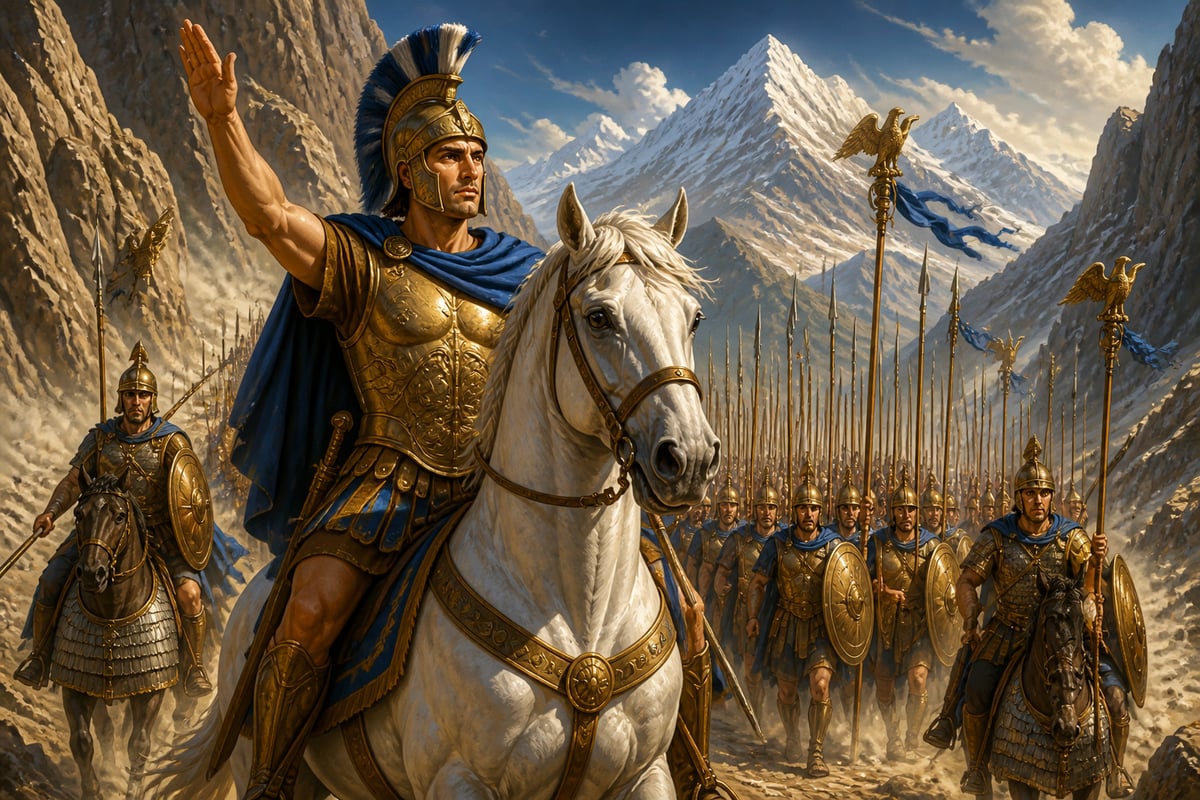
Demetrius leading the Greek invasion through the Hindu Kush

Around 185 BCE, Demetrius I of Bactria launched a massive invasion. Unlike Alexander's raid a century and a half earlier, Demetrius came to stay. His forces:

The Yavanas (as Indians called the Greeks) were formidable. They brought:

Contemporary Testimony

We know the invasion was real and devastating because of an unlikely witness: the grammarian Patanjali. In his Mahabhasya (Great Commentary on Panini's grammar), written around this time, Patanjali uses current events as grammatical examples:

"The Yavana besieged Saketa; the Yavana besieged Madhyamika."

Patanjali uses the present tense, not "the Yavana had besieged" but "besieges." He was writing while these events were happening. Sacred cities like Saketa (Ayodhya) were under foreign siege.

This was not a border raid. This was an existential threat to Indian civilization.

The Last Maurya

Brihadratha, the tenth and final Mauryan emperor, faced this crisis with apparent paralysis. The sources paint a picture of a ruler who:

Whether Brihadratha was personally incapable or simply overwhelmed by inherited problems, the result was the same: the Mauryan state could not perform its most fundamental function, protecting its people.

Brihadratha the last Mauryan emperor on his throne with anxious ministers

Enter Pushyamitra

Pushyamitra Shunga was a Brahmin who had risen to the position of senānī, commander-in-chief of the Mauryan army. His family, the Shungas, came from the region of Ujjain. Despite his Brahmin birth, he had proven himself a capable military leader.

Pushyamitra faced an impossible situation:

The Arthashastra, which Pushyamitra surely knew, addresses precisely this situation. Kautilya wrote that a king who cannot protect his people loses the mandate to rule. The king exists for the kingdom, not the kingdom for the king.

The Coup

The Puranas record what happened with brutal brevity:

Pushyamitra striking down Brihadratha on the parade ground

"Then the general Pushyamitra, born of the Shunga lineage, became king."

Later sources, including the Buddhist Divyavadana, provide details. During a military parade, an inspection of troops, Pushyamitra killed Brihadratha. Some accounts suggest he struck down the emperor in front of the assembled army; others say soldiers loyal to Pushyamitra did the deed.

The army did not resist. The soldiers acclaimed Pushyamitra as their new leader. The Mauryan officials, seeing which way the wind blew, quickly transferred their allegiance.

In a single day, the Mauryan dynasty, founded by Chandragupta 136 years earlier, ended.

Multiple Perspectives

How should we judge Pushyamitra's act? Sources differ sharply:

The Buddhist View (Divyavadana, later texts):

The Brahmanical View (Puranas, later Hindu tradition):

The Historical Assessment: The truth likely lies between these partisan accounts. Pushyamitra:

The Ethics of Regime Change

Pushyamitra's coup raises questions that remain relevant today:

When does loyalty to an institution override loyalty to its leader?

Pushyamitra was sworn to serve the Mauryan throne. But when the man on that throne proved incapable of performing his fundamental duty, protecting the realm, did Pushyamitra's higher loyalty lie with the office or the officeholder?

Can violence ever serve dharma?

Regicide, rājavadha, was among the gravest acts in Hindu political thought. The king embodied cosmic order. Yet the Dharmasutras and Arthashastra recognized that a king who oppresses his people or fails in his duties loses his sacred status.

What is āpaddharma, emergency ethics?

The Dharmic tradition recognized that normal rules may be suspended during existential crisis. With Yavanas at the gates, was Pushyamitra's violent seizure of power justified as āpaddharma, the dharma appropriate to disaster?

The Immediate Aftermath

Pushyamitra moved quickly to consolidate power:

  1. Secured Pataliputra, The capital accepted his rule without significant resistance
  2. Retained experienced administrators, The Mauryan bureaucracy continued functioning
  3. Mobilized the army, The military, which had acclaimed him, was reorganized for war
  4. Prepared defenses, Resources were redirected from monasteries to fortifications

The Shunga dynasty had begun. But its first task was survival, the Greeks were still advancing.

The Stakes

What was at stake in 185 BCE?

If the Yavanas conquered the Gangetic heartland, India's future would have been radically different:

Pushyamitra's seizure of power, brutal and controversial as it was, preserved the possibility of Indian civilization continuing on its own terms.

The fate of that civilization would be decided in battle.

Historical context

Late Mauryan Period (c. 200-185 BCE)

The once-mighty Mauryan Empire had fragmented after Ashoka's death in 232 BCE. Seven emperors ruled in approximately 50 years, each weaker than the last. Provincial governors acted independently, the treasury emptied supporting monasteries rather than armies, and frontier defenses collapsed. Indo-Greek kingdoms in Bactria sensed opportunity.

Living traditions

The Mauryan decline serves as a cautionary tale in Indian historical consciousness about the dangers of neglecting defense and succession. Pushyamitra's coup is debated in discussions about legitimate vs. illegitimate regime change. The period marks the first documented Greek invasion of the Gangetic heartland, setting a pattern of northwestern vulnerability that would recur throughout Indian history.

Reflection

More in Pushyamitra Shunga

All lessons in Pushyamitra Shunga · Great Emperors: The Golden Age course