Defeating the Greeks
War Against the Yavanas
With the Mauryan dynasty overthrown and Greeks advancing on Pataliputra, Pushyamitra faced his first test as ruler. The Indo-Greek kings commanded battle-hardened armies with superior cavalry and siege technology. Could a Brahmin general succeed where Mauryan emperors had failed? The battles that followed would determine whether India remained Indian, or became a Hellenistic province.
The Test of Fire
Pushyamitra Shunga had seized power claiming that the Mauryas could not defend the realm. Now he had to prove he could do what they could not. The Yavanas (Greeks) were advancing toward the Gangetic heartland, and they had no intention of stopping at the old frontiers.
The Enemy
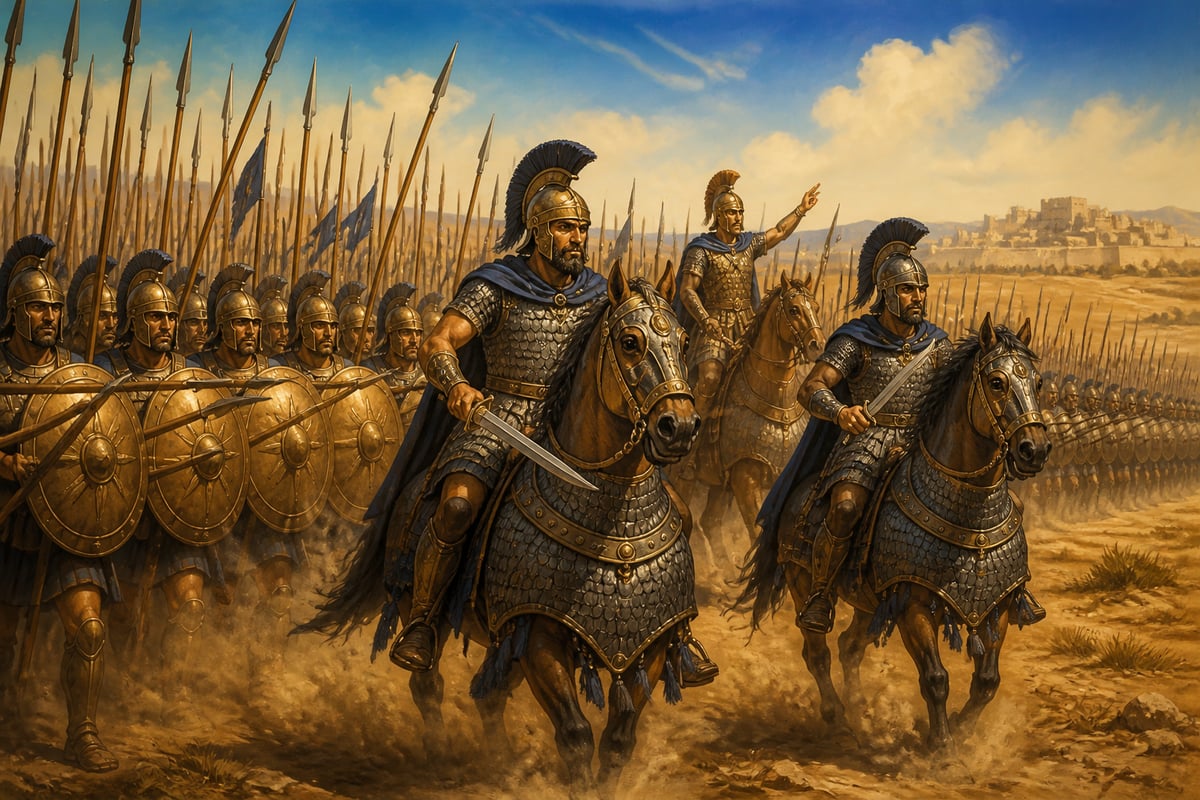
The Indo-Greek forces represented the finest military tradition of the ancient world, the heritage of Alexander's Macedonians, refined through a century of Central Asian warfare. Their army combined:
Greek Infantry:
- Disciplined phalanx formations
- Sarissa (long pike) tactics
- Shield wall coordination developed over centuries
Bactrian Cavalry:
- Heavy cataphracts (armored horsemen)
- Central Asian horse-archer traditions
- Mobility and shock tactics
Siege Capability:
- Greek engineering expertise
- Siege towers and battering rams
- Experience reducing fortified cities
The commander, Demetrius I of Bactria, styled himself "Aniketos", the Invincible. He had already conquered Gandhara and the Punjab. His generals, including Apollodotus and Menander (who would later become famous in Indian tradition as Milinda), were experienced campaigners.
Pushyamitra's Army
Pushyamitra's forces were the remnants of the once-mighty Mauryan military machine. The army had declined under generations of neglect, but it retained important advantages:
War Elephants:
- India's traditional armored fighting platforms
- Terrifying to horses unfamiliar with them
- Effective against infantry formations
Numerical Strength:
- The Gangetic heartland could raise large armies
- Motivated by defense of homeland and dharma
- Fighting on familiar terrain
Home Advantage:
- Knowledge of local geography
- Secure supply lines
- Fortified cities as strong points
Most importantly, Pushyamitra brought something the later Mauryas had lacked: determined leadership. A commander willing to fight and die with his men.
The Campaign
The Greek invasion followed the traditional route through the northwestern passes, then down through the Punjab toward the Gangetic plain. The sources are fragmentary, but we can reconstruct the general course of events:
Phase 1: Initial Greek Advance
The Greeks initially met little resistance. They had already conquered:
- Gandhara (the Peshawar-Taxila region)
- Much of the Punjab
- Parts of Sindh and western Rajasthan
Demetrius's forces advanced toward the sacred cities of the Gangetic plain. As Patanjali recorded in present tense, they besieged Saketa (Ayodhya) and Madhyamika, deep within the traditional Aryan heartland.
Phase 2: Shunga Mobilization
Pushyamitra's first task after the coup was military reorganization:
- Recalled experienced officers from retirement and provincial postings
- Redirected treasury resources from monasteries to military spending
- Mobilized provincial forces under centralized command
- Secured the eastern flank to prevent any rebellion while fighting in the west
The army that assembled at Pataliputra was larger and better-organized than anything the late Mauryas had fielded.
Phase 3: The Decisive Battles
The Divyavadana records that Pushyamitra "personally led his army against the Yavanas." The Malavikagnimitram, a play by Kalidasa written centuries later but based on Shunga traditions, provides additional details.
The decisive engagement appears to have occurred somewhere in the doab (the land between the Ganges and Yamuna rivers). Pushyamitra's grandson Vasumitra played a key role, later sources credit him with a major victory over the Greeks near the Sindhu (Indus) river.
| Phase | Greek Position | Shunga Response |
|---|---|---|
| Initial | Advance through Punjab | Consolidation at Pataliputra |
| Siege | Attacking Saketa, Madhyamika | Army mobilization |
| Counter-offensive | Extended supply lines | Pushyamitra advances west |
| Decision | Battles in doab region | Greeks pushed back |
| Settlement | Retreat to Punjab | Frontier stabilized |
The Turning Point
Why did Pushyamitra succeed where the Mauryas had failed?
1. Leadership Presence
Unlike Brihadratha, who apparently remained in the capital during the crisis, Pushyamitra led from the front. Ancient Indian texts emphasize that a king who personally leads his army inspires confidence and courage. The soldiers knew their commander would share their fate.

2. Religious Motivation
Pushyamitra framed the conflict as a defense of dharma against foreign invaders. The Vedic yajnas (sacrifices) he later performed were partly to claim divine sanction for his rule, but they also served to unite the population behind the war effort.
3. Strategic Focus
The late Mauryas had tried to maintain a vast empire while neglecting the military. Pushyamitra concentrated resources on the existential threat. Everything else, including the Buddhist establishments the later Mauryas had favored, became secondary to survival.
4. Tactical Adaptation
Indian armies learned to counter Greek tactics:
- War elephants disrupted cavalry charges
- Archery harassed phalanx formations
- Fortified positions neutralized siege advantages
- Scorched-earth tactics stretched Greek supply lines
The Greek Withdrawal
The Greeks did not suffer a catastrophic defeat, they withdrew in relatively good order. But they abandoned their deepest gains:
- Saketa (Ayodhya) was relieved
- Madhyamika was secured
- The Greeks retreated to the Punjab and eventually to their Bactrian heartland
The Indo-Greek kingdoms would persist for another century, but they never again threatened the Gangetic heartland. The frontier stabilized roughly along the Sutlej river, a boundary that would recur throughout Indian history.
Vasumitra's Victory
Kalidasa's Malavikagnimitram celebrates the victory of Pushyamitra's grandson Vasumitra over the Yavanas. The play, though written centuries later, preserves Shunga court traditions:

"On the banks of the Sindhu, Prince Vasumitra defeated the Yavana army."
This victory, probably occurring later in Pushyamitra's reign or during his successor Agnimitra's rule, seems to have definitively ended the Greek threat. Vasumitra is portrayed as a warrior-prince who combined martial prowess with courtly refinement, the ideal Kshatriya.
The Ashvamedha
After securing the realm, Pushyamitra performed the Ashvamedha (horse sacrifice), the ancient Vedic ritual by which a king claims universal sovereignty. According to some sources, he performed it twice.
The Ashvamedha was profoundly significant:
Politically:
- It proclaimed Pushyamitra as a chakravartin (universal sovereign)
- It challenged any rival to oppose his horse's wanderings
- It demonstrated that Vedic traditions, neglected under the Buddhist Mauryas, had been revived
Religiously:
- It required elaborate Vedic rituals with Brahmin priests
- It represented a deliberate turn away from the Buddhist emphasis of Ashoka's successors
- It restored the traditional relationship between Kshatriya king and Brahmin priesthood
Militarily:
- The horse's year-long wandering was protected by the army
- Any territory it entered unchallenged was claimed as tributary
- The final sacrifice celebrated military victory
The Ayodhya inscription records one of Pushyamitra's Ashvamedha sacrifices, confirming the literary accounts.
Legacy of the War
The defeat of the Greek invasion had consequences far beyond the immediate military situation:
Preserved Indian Civilization: If the Greeks had conquered the Gangetic heartland permanently, Indian culture might have developed very differently. Sanskrit might have yielded to Greek. Vedic traditions might have been marginalized. The trajectory of Buddhism, Jainism, and Hinduism alike would have been altered.
Established Shunga Legitimacy: Pushyamitra's usurpation was controversial, regicide always is. But his successful defense of the realm provided the justification he needed. He had done what the Mauryas could not.
Created a New Balance: The Indo-Greek kingdoms remained in the northwest, eventually producing cultural synthesis (Gandharan art, for example). But they remained peripheral to Indian civilization rather than dominating it.
Restored Brahmanical Influence: The war established a new political settlement, Brahmin priests regained the influence they had lost under Buddhist Mauryas, and the warrior-priest alliance that characterized classical Hindu polity was restored.
The Price of Victory
Victory came at a cost. The war required:
- Heavy taxation to fund the military
- Reduction of Buddhist institutional support
- Centralization of power under military authority
- Continued mobilization even after the immediate threat passed
Buddhist sources, understandably hostile to Pushyamitra, portray him as a persecutor. While the extent of anti-Buddhist activity is disputed, the shift in patronage from monasteries to Vedic institutions was real and significant.
A Brahmin Who Became a Warrior
Pushyamitra's career raised fundamental questions about varna (social class):
He was born a Brahmin, the priest class traditionally devoted to learning and ritual. Yet he became a general, killed a king, and waged war as a kshatriya (warrior). Was this a violation of varna-dharma (the duties of one's class)?
Later tradition seems to have resolved this in two ways:
- Necessity knows no law, āpaddharma justifies exceptional action during crisis
- Action over birth, a man who performs kshatriya duties effectively becomes a kshatriya
The Manusmriti, compiled during or after the Shunga era, discusses these questions extensively. Pushyamitra's example may have influenced the discussion.
Conclusion: The Defender's Achievement
Pushyamitra Shunga came to power through violence, there is no escaping that fact. But his subsequent actions demonstrate why the army acclaimed him and why later generations honored his memory:
- He faced an existential threat and did not flinch
- He reorganized a decayed military and led it personally
- He defeated an enemy that had terrified the previous dynasty
- He restored India's capacity to determine its own future
The test of fire was passed. Now Pushyamitra could turn to his longer-term vision: the revival of Vedic civilization.
Historical context
Early Shunga Period (c. 185-150 BCE)
The Mauryan Empire had fallen; the Shunga dynasty faced immediate challenge from Indo-Greek invaders who had penetrated deep into the Gangetic heartland. The outcome of the conflict would determine whether India remained culturally independent or became part of the Hellenistic world spreading from the Mediterranean.
Living traditions
The Greek-Shunga conflict established the pattern of northwestern vulnerability and defense that would recur throughout Indian history. Modern strategic thinking about India's western frontier echoes these ancient concerns. The cultural synthesis that emerged, particularly Gandharan Buddhist art combining Greek technique with Indian spirituality, represents one of history's great artistic achievements.
- Ayodhya: The sacred city that was besieged by Greeks during the late Mauryan period. Pushyamitra's relief of Ayodhya was one of his first military achievements. The city's liberation from foreign siege may have contributed to its enduring sacred status.
- Surkh Kotal (Indo-Greek Site): A fire temple complex from the Indo-Greek/Kushan period showing the cultural synthesis between Greek and Indian traditions that emerged after the wars. Greek artistic techniques merged with Indian religious concepts.
Reflection
- When facing a serious challenge, have you ever had to ruthlessly prioritize one thing over other legitimate concerns? How did you decide what to sacrifice?
- Why do you think the army acclaimed Pushyamitra and followed him into battle against the Greeks? What had he demonstrated that the Mauryan emperors had not?
- The Greeks brought superior military technology and training, yet lost. What does this suggest about the relationship between technical capability and strategic success?