The Northern Campaigns
The Conqueror
For six relentless years, Harsha campaigned across North India, bringing kingdom after kingdom under his rule. From the ashes of tragedy emerged a military genius who combined strategic patience with overwhelming force. Discover how a grieving teenager became the paramount ruler of Aryavarta, controlling an empire stretching from Gujarat to Bengal, the largest unified domain in India since the great Guptas.
Six Years of Conquest
When Harsha took the throne in 606 CE, he controlled two important but still regional powers: his ancestral kingdom of Thanesar and the Maukhari domains around Kanauj, which had fallen to him after Grahavarman's death. Powerful enemies surrounded him on all sides, and his primary rival, the treacherous Shashanka of Gauda, remained at large.
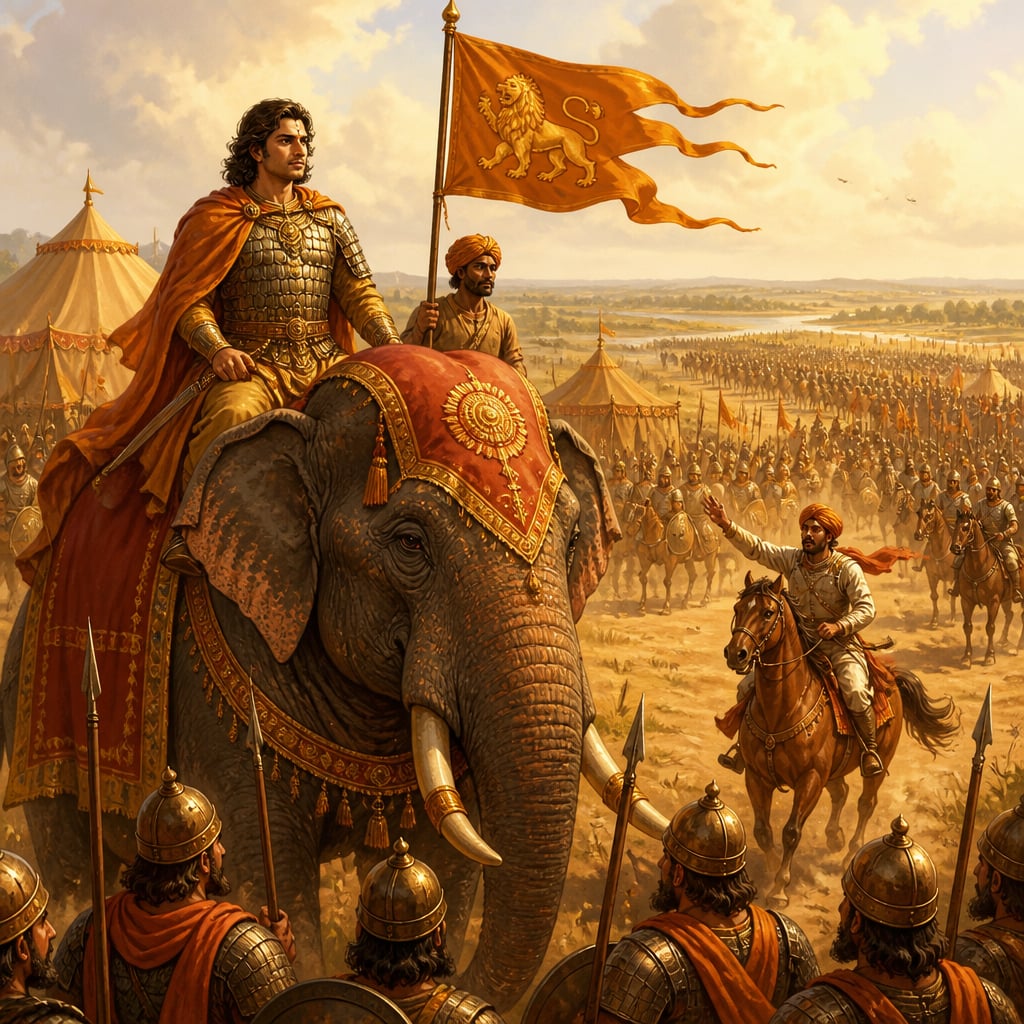
What followed was one of the most remarkable military campaigns in Indian history. Over the next six years, Harsha brought nearly all of North India under his dominion, not through a single dramatic battle, but through patient, systematic conquest.
The Strategic Situation
Before examining Harsha's campaigns, we must understand the political landscape he faced. North India in the early seventh century was a patchwork of competing kingdoms:
| Kingdom | Location | Status |
|---|---|---|
| Gauda | Bengal | Hostile (Shashanka) |
| Valabhi | Gujarat/Saurashtra | Initially hostile, later allied |
| Malwa | Central India | Hostile (allied with Shashanka) |
| Magadha | Bihar | Contested territory |
| Kashmir | Northwest | Independent |
| Nepal | Himalayas | Tributary |
| Sindh | Lower Indus | Independent |
Harsha's challenge was threefold:
- Avenge his brother by defeating Shashanka
- Secure his base by neutralizing hostile neighbors
- Unite North India under a single, stable rule
The Eastern Front: War with Shashanka
Harsha's first priority was Shashanka. The king of Gauda had murdered Rajyavardhana through treachery and remained a powerful threat. But Shashanka was no fool, he understood that a direct confrontation with Harsha's growing forces would be suicidal.
The early campaigns against Gauda were frustrating. Shashanka avoided pitched battle, retreating when Harsha advanced and raiding when he withdrew. The terrain of Bengal, its rivers, forests, and monsoon flooding, favored defense.
Banabhatta describes Harsha's determination:
"The king pursued his enemy as the sun pursues darkness, yet the wicked Shashanka fled like a shadow, always retreating beyond reach."
Harsha could not immediately destroy Gauda, but he could contain it. He established a strong military presence in Magadha (Bihar), cutting Shashanka off from central India and forcing him to remain on the defensive.
The Western Campaigns
While the eastern front remained stalemated, Harsha turned west. The kingdoms of Gujarat and Saurashtra, ruled by the Maitraka dynasty from their capital at Valabhi, posed a potential threat or a possible alliance.
Harsha's approach was sophisticated. Rather than immediate conquest, he first demonstrated his military power through a show of force, then offered terms. The Maitrakas were practical rulers. They saw which way the wind was blowing.

By approximately 610 CE, Harsha had established friendly relations with Valabhi, later cemented through a marriage alliance. His sister Rajyashri, rescued from her forest ordeal, may have married the Valabhi king, though sources differ on the details.
This western alliance gave Harsha:
- Secure western flank, no threat from Gujarat
- Access to maritime trade, Valabhi's ports connected to Arabian commerce
- Strategic depth, enemies could not exploit divisions in the west
The Conquest of Central India
With his flanks secured, Harsha turned to central India. The Malwa kingdom had allied with Shashanka in the original attacks on the Maukharis. This made them enemies.
The campaign against Malwa was more straightforward than the frustrating eastern war. Unlike Shashanka, the Malwa forces chose to stand and fight. Harsha's army, disciplined, well-supplied, and highly motivated, crushed them.
By 612 CE, Harsha had absorbed Malwa into his empire, extending his control across the heart of India. This had strategic implications:
- Severed Shashanka's western allies, Gauda was now isolated
- Controlled the trade routes, Malwa sat astride major commercial paths
- Demonstrated invincibility, other kingdoms took notice
The Mechanics of Conquest
Xuanzang, who later interviewed Harsha extensively, provides insight into how these campaigns were conducted:
"The king does not remain in one place. He is constantly traveling, inspecting his army, judging disputes, and personally leading campaigns. He sleeps little and works constantly."
Harsha's success rested on several factors:
1. Personal Leadership Unlike rulers who commanded from palaces, Harsha led from the front. He shared the hardships of campaign life with his soldiers, building fierce loyalty. His personal bravery in battle became legendary.
2. Organized Logistics Ancient Indian warfare often failed due to supply problems. Harsha's administration ensured his armies were fed, equipped, and paid. This allowed sustained campaigns rather than quick raids.
3. Flexible Diplomacy Not every kingdom was conquered by force. When possible, Harsha preferred alliance, marriage, or vassalage to costly warfare. Kingdoms that submitted peacefully retained their rulers under Harsha's suzerainty.
4. Righteous Reputation Harsha's cause, avenging a treacherous murder, was viewed sympathetically. Rulers who might have opposed a naked aggressor found it harder to resist someone pursuing legitimate grievance.
The Assembly of Kings
As Harsha's conquests expanded, a new political reality emerged. The traditional system of completely independent kingdoms gave way to a hierarchical structure with Harsha at the apex.

Harsha adopted the title Maharajadhiraja, "Great King of Kings", indicating his position above other rulers. Subordinate kings owed him:
- Military service when called
- Tribute in treasure and resources
- Loyalty in foreign affairs
In exchange, they retained local autonomy. This was not the centralized Mauryan model where the emperor directly administered everything. Harsha's system was more feudal, a pyramid of obligations with the emperor at the top.
Xuanzang recorded that by the time of his visit, Harsha could command:
"Five thousand elephants, twenty thousand cavalry, and fifty thousand infantry, not from his own territories alone, but from the contributions of his tributaries."
The Frontier Kingdoms
Not all of North India came under Harsha's direct rule. Some kingdoms, while acknowledging his supremacy, maintained substantial independence:
Kashmir in the northwest remained effectively autonomous. Its mountain terrain made conquest impractical, and its rulers posed no threat. Harsha was content to receive nominal submission without attempting occupation.
Nepal sent tribute and acknowledged Harsha's overlordship while maintaining its own governance. The Himalayan kingdoms were too remote and too difficult to control directly.
Sindh in the lower Indus valley also remained independent, though its rulers likely maintained diplomatic relations with Harsha's court.
These arrangements showed Harsha's strategic wisdom. He recognized the limits of practical power and did not waste resources attempting the impossible.
The Long War with Gauda
Throughout these campaigns, the war with Shashanka continued. It was a war of attrition rather than decisive battles. Harsha gradually pushed Gauda's influence westward, capturing territory piece by piece.
The Magadha region, including the ancient imperial capital of Pataliputra, became firmly Harsha's. Control of Magadha gave him:
- Symbolic legitimacy, the heartland of previous empires
- Agricultural wealth, the fertile Gangetic plains
- Strategic position, from which to pressure Gauda
By approximately 637 CE, when Shashanka finally died of natural causes, Gauda had been reduced from a major power to a regional kingdom. Harsha quickly absorbed its territories, finally bringing Bengal under his rule.
The Empire Complete
By 612 CE, just six years after his hasty coronation, Harsha had united most of North India. By 637 CE, with Shashanka's death and Gauda's absorption, his empire reached its maximum extent:
- West: Gujarat and Saurashtra (through alliance with Valabhi)
- East: Bengal (after Shashanka's death)
- North: Kashmir and Nepal (as tributaries)
- South: The Vindhya mountains and the Narmada River
This was the largest unified domain in India since the Gupta Empire. Harsha had achieved what no ruler had managed since Skandagupta, bringing political unity to the northern subcontinent.
Military Innovations
Harsha's armies represented the military sophistication of early medieval India. Xuanzang and other sources describe:
Elephant Corps: War elephants remained central to Indian warfare. Harsha's thousands of elephants served as mobile fortresses, shock weapons, and status symbols.
Cavalry: Horse-mounted warriors provided mobility for rapid campaigns. Harsha personally often fought from horseback.
Infantry: The core of any army, foot soldiers handled siege warfare, garrison duty, and defensive operations.
Navy: Though less discussed, Harsha maintained river fleets for operations in Bengal's waterways and possibly coastal forces through his Valabhi allies.
The Price of Empire
Conquest came at a cost. Years of warfare drained treasuries and took lives. Banabhatta, despite his loyalty to Harsha, hints at the human toll:
"The king had brought peace to the land, but peace bought with the blood of many battles and the tears of many widows."
Harsha seems to have been aware of this cost. His later reign emphasized religious charity, support for scholars, and public welfare, perhaps an attempt to balance the karma of conquest.
The Foundation for Greatness
By 612 CE, Harsha was no longer a grieving teenager thrust into unwanted leadership. He was Maharajadhiraja, the paramount ruler of North India, commander of vast armies, and overlord of dozens of tributary kings.
The six years of northern campaigns had achieved multiple objectives:
- Avenged (partially) his brother, Shashanka was contained and weakened
- Rescued and honored his sister, through strategic marriage alliances
- United North India, under a stable imperial structure
- Established personal reputation, as both warrior and statesman
The military phase of Harsha's career was largely complete. Now would come the cultural flowering that would make his reign legendary, the patronage of scholars, the building of monasteries, the composition of plays.
But one major military challenge remained. Harsha had conquered everything north of the Narmada River. What would happen when he tried to cross it?
Historical context
Early Medieval Period (606-612 CE)
North India was divided among numerous competing kingdoms following the Gupta collapse. Harsha's campaigns occurred against a backdrop of political fragmentation, where no single power had achieved hegemony for over a century. Trade routes remained important, but the era of great Gupta prosperity had faded.
Living traditions
Harsha's campaigns represent the last successful unification of North India by an indigenous Hindu ruler. Military strategists study his combination of force and diplomacy. His systematic approach, securing each front before opening another, remains relevant in strategic planning.
- Kumrahar Archaeological Site: Ruins of ancient Pataliputra, the former Mauryan and Gupta capital. Harsha controlled this region, which represented the symbolic heartland of Indian empire. The site includes remains of an 80-pillar hall from the Mauryan period.
- Valabhi Ruins: Archaeological site of the Maitraka capital, Harsha's important western ally. Valabhi was a major center of Buddhist learning and trade. The ruins, though limited, evoke the prosperous kingdom that formed half of Harsha's western alliance.
Reflection
- In your own life, when have you chosen alliance over confrontation? What made that approach successful or unsuccessful?
- Why do you think Harsha chose to lead his armies personally rather than commanding from a distance like many rulers?
- The Nitisara says enemies should be conquered by treaties rather than force. When is force appropriate, and when should diplomacy take precedence?