Philosophy and Compassion
Philosophy & Dharma
Though born into a Hindu family devoted to Shiva, Harsha became increasingly drawn to Buddhist teachings as his reign matured. His religious journey culminated in the extraordinary quinquennial assemblies at Prayaga, where every five years he gave away the entire royal treasury to monks, Brahmins, and the poor. Xuanzang witnessed this spectacle firsthand and left detailed accounts of an emperor who believed that kingship meant not accumulating wealth but distributing it. This lesson explores Harsha's unique approach to dharma, religious harmony, and the radical philosophy of dana (giving) as the highest duty of kings.
The Emperor Who Gave Everything Away
Every five years, at the sacred confluence of the Ganga and Yamuna at Prayaga (modern Allahabad), the most extraordinary spectacle in seventh-century India unfolded. Emperor Harshavardhana, ruler of all North India, would gather his treasury, the accumulated wealth of five years of taxation, tribute, and trade, and systematically give it all away.
Not some of it. All of it.
Buddhist monks received robes and alms. Brahmins received gold and cattle. The poor received food, clothing, and money. Orphans, widows, the sick, and the destitute came from across the empire to receive the emperor's charity. The distribution continued for seventy-five days until the treasury was completely empty.
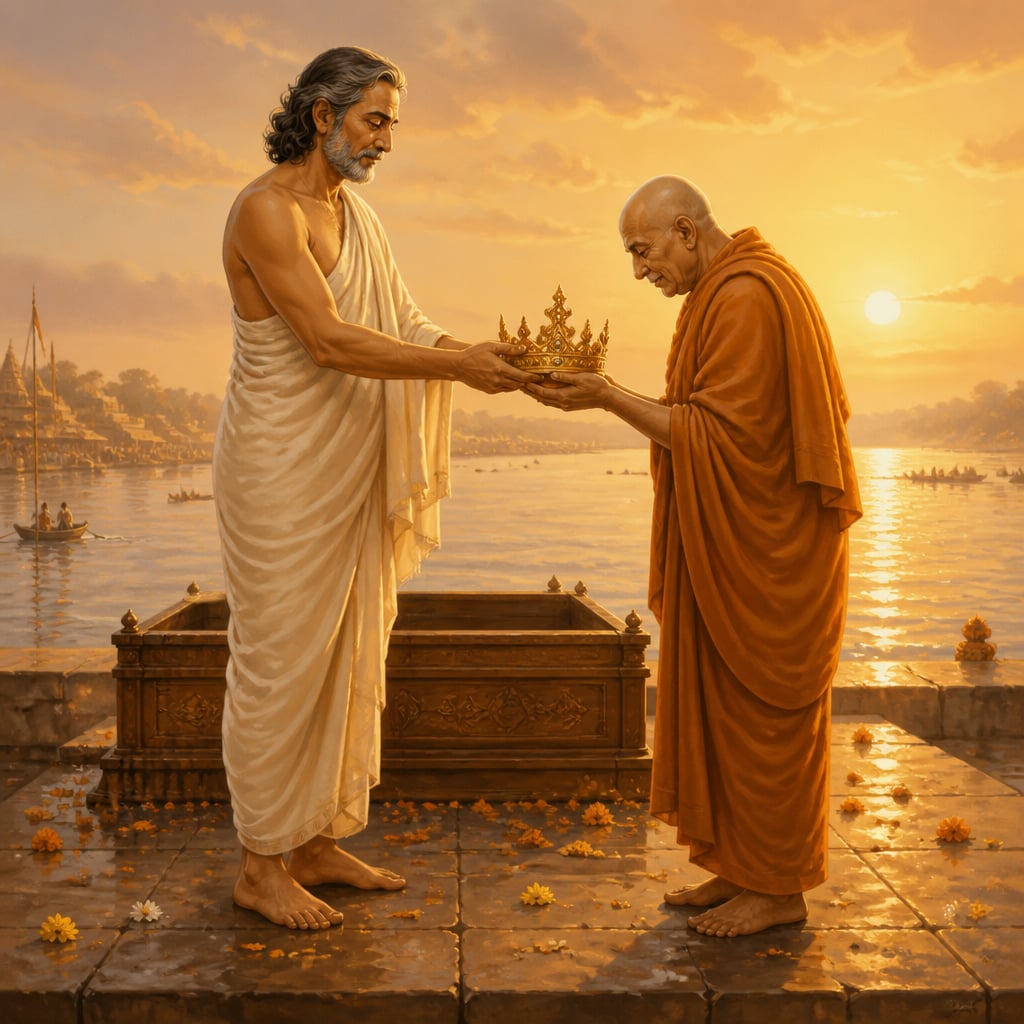
On the final day, Harsha would remove his own royal ornaments, crown, necklaces, bracelets, even his royal robes, and give them away too. He would then borrow a simple garment from his sister Rajyashri and return to his capital to begin accumulating wealth again for the next assembly.
Xuanzang, the Chinese pilgrim who witnessed the assembly of 643 CE, recorded his astonishment:
"The king gives away everything. He exhausts the treasury completely. Then he borrows clothes from his sister and rides away rejoicing, saying that he has deposited his treasures in an excellent storehouse, the field of merit."
This was Dana, the philosophy of giving, practiced on a scale that defies modern imagination.
The Spiritual Journey of a King
Harsha was born into a family devoted to Shiva. His father Prabhakaravardhana was a devout Shaivite, and the family's ancestral temple at Thanesar was dedicated to Shiva as Sthanesvara (Lord of the Place). Young Harsha participated in these traditions, and throughout his reign he maintained respect for Hindu practices.
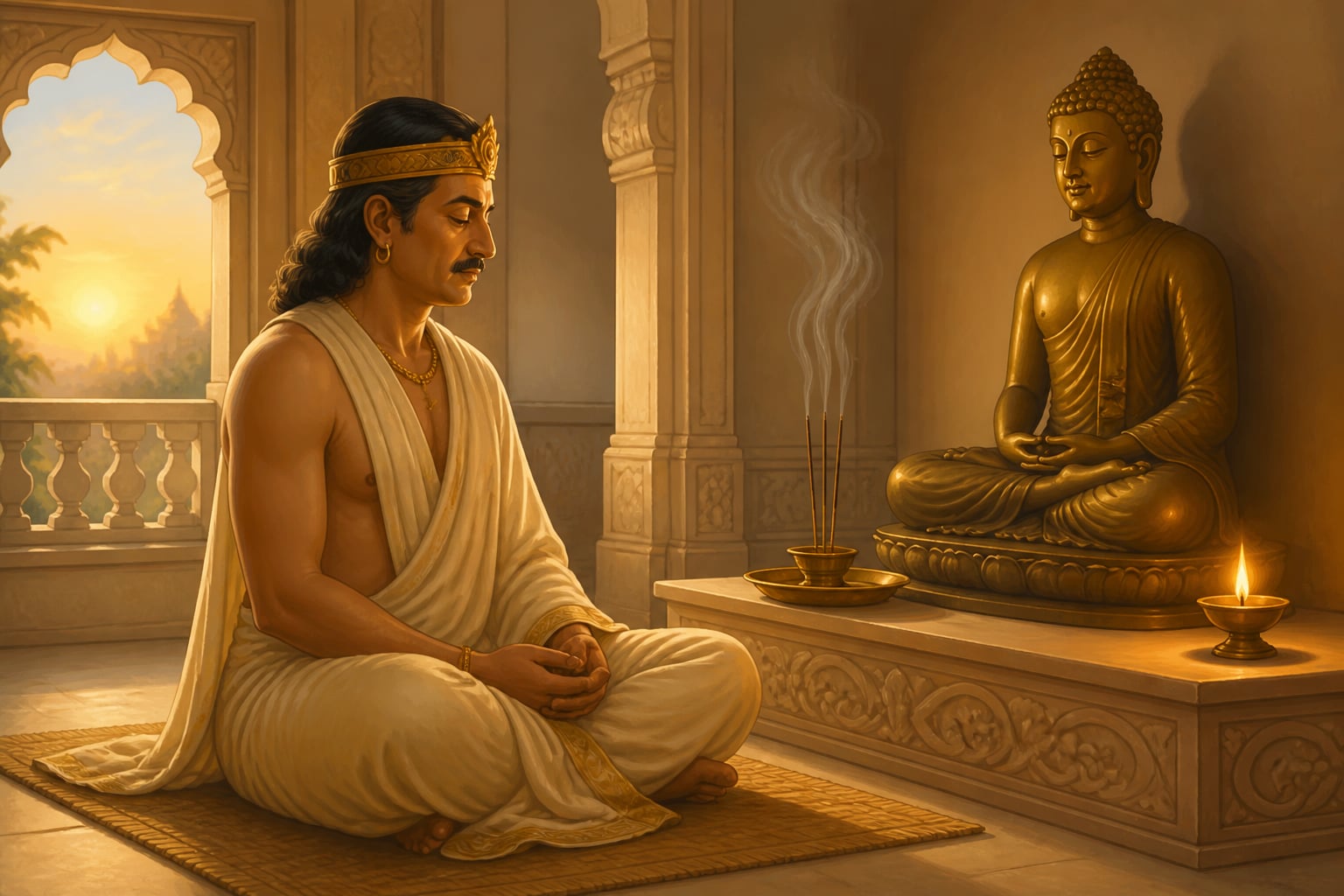
Yet as the decades passed, Harsha was increasingly drawn to Buddhism.
Xuanzang attributes this to Harsha's growing philosophical sophistication:
"In his youth, the king followed the practices of his ancestors. But as he studied the scriptures of all schools and conversed with learned teachers, he came to appreciate the Buddha's teachings on compassion and impermanence."
Several factors likely contributed to this spiritual evolution:
1. Personal Tragedy Harsha had lost his father, brother, and brother-in-law within months. Buddhism's teachings on impermanence (anicca) and suffering (dukkha) may have provided philosophical frameworks for processing grief.
2. Contact with Buddhist Masters Nalanda University, which Harsha patronized extensively, was the greatest Buddhist institution in the world. Constant interaction with brilliant Buddhist scholars naturally exposed him to sophisticated philosophical arguments.
3. Xuanzang's Influence The Chinese pilgrim spent years at Harsha's court between 636-644 CE. Their conversations clearly influenced the emperor, who arranged the great assembly at Prayaga partly to honor Xuanzang.
4. The Ethics of Power Buddhism's emphasis on compassion (karuna) and non-attachment may have appealed to a ruler who had seen the destructive consequences of ambition and conflict. The path of giving aligned with his evolved understanding of what kingship should mean.
The Quinquennial Assemblies: Prayaga Mahotsava
The Prayaga Mahotsava (Great Festival at Prayaga) was Harsha's most distinctive institution. Held every five years at the sacred confluence (Sangam) of the Ganga, Yamuna, and the mythical Sarasvati, these assemblies combined religious celebration, charitable distribution, and political theater.
Xuanzang describes the elaborate preparations:
| Component | Details |
|---|---|
| Location | Prayaga Sangam (confluence of three rivers) |
| Duration | 75 days |
| Attendees | 500,000+ monks, Brahmins, and laypeople |
| Frequency | Every five years |
| Purpose | Complete distribution of royal treasury |
The assembly began with Buddhist ceremonies, recitations of sutras, philosophical debates, and offerings to the sangha. Then came honors for Brahmins, with similar debates and donations. Finally, the vast distribution to common people commenced.
The Order of Giving
Harsha's distribution followed a carefully structured sequence:
Day 1: A magnificent image of the Buddha was installed, and donations were made to Buddhist monks and monasteries. Xuanzang notes that Harsha "offered precious jewels, golden flowers, and fine robes."
Day 2: Similar ceremonies honored Surya (the Sun God), reflecting the emperor's title "Shiladitya" (Sun of Virtue) and his family's continued Hindu connections.
Day 3: Shiva was honored, acknowledging the ancestral deity of Harsha's family. This ecumenical approach demonstrated religious harmony.
Days 4-75: The systematic distribution of wealth to all comers. Buddhist monks received robes and necessities. Brahmins received gold, silver, and cattle. The general population received food, clothing, and coins.
The Scale of Giving
Xuanzang's figures seem incredible but were recorded by an eyewitness:
- Ten thousand Buddhist monks fed daily during the assembly
- Two thousand Brahmins honored with substantial gifts
- Five hundred thousand people received some form of charity
- Five years of accumulated treasury wealth distributed
Even accounting for exaggeration, the scale was extraordinary. Harsha gave away what most kings hoarded, and did so repeatedly throughout his reign.
Dana: The Philosophy of Giving
Dana (दान), the Sanskrit term for giving, generosity, or charity, was not merely a practice for Harsha but a philosophy of kingship. The concept appears across Indian traditions:
In Hindu Dharma: Dana is one of the primary duties (svadharma) of householders, especially kings. The Dharmasutras rank dana alongside tapas (austerity) and satya (truth) as fundamental virtues. For a king, dana demonstrates that he holds wealth in trust for his people, not for himself.
In Buddhist Teaching: Dana is the first of the six paramitas (perfections) that lead to enlightenment. The Buddha taught that generosity purifies the mind of attachment and generates merit that benefits both giver and receiver.
In Jain Tradition: Dana supports the ascetic community and enables laypeople to participate in spiritual progress through material support of monks.
Harsha's radical interpretation went further than traditional concepts. Most kings practiced dana on auspicious occasions, coronations, victories, solar eclipses. Harsha institutionalized total giving, making complete divestiture a recurring royal duty.
Banabhatta recorded Harsha's philosophy:
"The king said: 'What use is a treasury that lies hoarded? Gold locked in vaults produces nothing. But gold given to the worthy produces merit that follows us beyond death. I prefer an empty treasury and a full account of good deeds.'"
Religious Harmony in Practice
Despite his increasing Buddhist sympathies, Harsha never became an exclusive or sectarian ruler. His assemblies honored Buddhist, Hindu, and Jain traditions. His patronage extended to temples, monasteries, and scholars of all schools.
Xuanzang, a Buddhist monk, admiringly notes:
"Though the king greatly honored the Buddhist faith, he did not neglect other teachings. He built rest houses for travelers regardless of religion. He maintained Brahmin schools as well as Buddhist monasteries. He said that truth appears in many forms."
This ecumenical approach was both philosophical and practical:
Philosophically, Harsha seemed to believe that different teachings represented different paths to the same truth. His debates at Kanauj brought together Buddhist, Hindu, and Jain scholars not to establish one winner but to explore ideas.
Practically, ruling a religiously diverse empire required accommodation. Harsh sectarianism would have alienated significant portions of his subjects. By honoring all traditions, Harsha maintained legitimacy across religious boundaries.
The Great Debate at Kanauj
In 643 CE, Harsha organized a massive religious assembly at Kanauj specifically to honor Xuanzang and showcase Buddhist philosophy. The assembly included:
- Twenty tributary kings attending the emperor
- Three thousand Buddhist monks from across India
- Three thousand Brahmins and Hindu scholars
- One thousand Jain monks and scholars
Xuanzang presented the Mahayana Buddhist position, challenging all comers to debate. The assembly lasted eighteen days. According to Xuanzang's account (which may be self-serving), no one successfully refuted his arguments.
More interesting than the debate's outcome was its occurrence. Here was an emperor who believed that religious truth should be tested through intellectual combat, that the best ideas should be examined publicly, and that the ruler's duty included facilitating this discourse.
Welfare as Statecraft
Harsha's charity was not merely spiritual, it was political wisdom. His welfare programs created bonds of loyalty that military force alone could not achieve.
Infrastructure for the Poor

Xuanzang describes systematic welfare provisions:
- Rest houses built along major roads where travelers could stay free
- Medical facilities where physicians treated the sick without charge
- Feeding stations where the hungry could receive meals
- Emergency reserves maintained for famine and disaster relief
These were not royal whims but institutionalized systems maintained throughout the empire.
The Political Calculus of Generosity
Harsha's generosity served multiple political purposes:
1. Legitimacy A king who gave away his treasury demonstrated that he ruled for his people, not for himself. This strengthened his claim to righteous kingship (dharma-raja).
2. Loyalty Those who received the emperor's charity became personally grateful. The quinquennial assemblies created recurring occasions for reinforcing these bonds.
3. Intelligence The assemblies brought people from across the empire to one place. This provided opportunities to assess public sentiment, identify local problems, and gather information.
4. Soft Power Harsha's reputation for generosity spread far beyond his borders. Rulers from Tibet to Southeast Asia sent envoys to witness the assemblies. This enhanced India's prestige and facilitated diplomacy.
The Economics of Giving Everything
How could an empire function if its king gave away the entire treasury every five years?
The answer reveals sophisticated economic understanding:
Wealth Regeneration India in the seventh century was extraordinarily productive. Agriculture, trade, and crafts generated substantial surplus. Five years was sufficient time to refill the treasury through regular taxation.
Redistribution Effects The distributed wealth did not disappear, it circulated through the economy. Recipients spent their gifts on goods and services, stimulating economic activity. In modern terms, Harsha was practicing stimulus spending.
Reduced Hoarding Hoarded gold contributes nothing to economic activity. By distributing treasury reserves, Harsha kept wealth circulating rather than locked away.
Merit Economy In the worldview of seventh-century India, merit (punya) was as real as material wealth. Harsha believed he was making deposits in a "storehouse" that would yield returns across lifetimes.
The Kumbh Mela Connection
Harsha's quinquennial assemblies at Prayaga are considered precursors to the Kumbh Mela, the great pilgrimage festival that continues today as the world's largest human gathering.
The connections are clear:
- Same location: The sacred Sangam at Prayaga (Allahabad/Prayagraj)
- Similar timing: Cyclical assemblies linked to auspicious periods
- Religious purpose: Spiritual merit through gathering, ritual, and charity
- Mass attendance: Hundreds of thousands of pilgrims assembling
While the Kumbh Mela's origins predate Harsha, his institutionalization of grand assemblies at Prayaga contributed to the tradition's development. Every twelve years, when millions gather at Prayagraj for the Kumbh, they participate in a tradition that Harsha's generosity helped shape.
The Witness: Xuanzang's Testimony
We know so much about Harsha's religious life because Xuanzang documented it extensively. The Chinese pilgrim's perspective provides valuable outside verification:
On Harsha's Personal Practice:
"The king rises early and performs Buddhist meditation before beginning state business. He takes only one meal a day and is frugal in his personal habits, though magnificently generous to others."
On Religious Balance:
"He does not eat meat, following Buddhist precepts, but he does not forbid others from doing so. He honors all teachings while personally following the Buddha's path."
On the Joy of Giving:
"After giving away everything, the king appeared not depleted but energized. He said that hoarding wealth is like storing water in a vessel with holes, it gives no satisfaction. But giving is like planting seeds, it grows and multiplies."
The Meaning of Compassion in Power
Harsha's philosophy challenges common assumptions about power and wealth:
Modern assumption: Success means accumulating resources and protecting them.
Harsha's philosophy: True success means acquiring the ability to give generously.
Modern assumption: A ruler's treasury represents his power.
Harsha's philosophy: An empty treasury after giving represents the highest achievement.
Modern assumption: Keep reserves for security.
Harsha's philosophy: Give everything away, trusting that righteousness will provide.
This was not naive idealism. Harsha built and maintained a powerful empire. He defended his borders, administered justice, and conducted diplomacy skillfully. But he believed that the purpose of acquiring power was to use it for others' benefit, and he lived that belief dramatically.
The Legacy of the Giving King
Harsha's quinquennial assemblies ended with his death in 647 CE. His empire fragmented, and no successor maintained his institutions. Yet the impact endured:
On Indian Charity: The tradition of royal dana continued in later Indian kingdoms, though rarely on Harsha's scale. The principle that kings hold wealth in trust for distribution became embedded in Indian political thought.
On Buddhist Memory: Harsha became one of Buddhism's great royal patrons, remembered alongside Ashoka. His support helped Buddhism flourish in its final great centuries in India.
On Religious Harmony: Harsha's ecumenical approach provided a model for ruling diverse populations. Later Indian rulers would cite his example when managing religious pluralism.
On the Kumbh Tradition: The massive assemblies at Prayaga that Harsha institutionalized contributed to the development of what would become the world's largest pilgrimage gathering.
The emperor who gave everything away left something that could not be given away, an example of what compassion in power might look like.
Historical context
Post-Gupta Period (c. 630-645 CE)
This period saw the peak of Harsha's cultural and religious patronage. Having consolidated his empire and accepted the Narmada as his southern boundary, Harsha turned his energy to scholarship, religious dialogue, and charitable institutions. Buddhism flourished under his patronage even as it declined elsewhere.
Living traditions
Harsha's philosophy of dana continues to influence Indian concepts of charity and philanthropy. The Indian tradition of wealthy individuals distributing largesse, from feeding programs to educational sponsorships, echoes his belief that wealth exists to be shared. The Kumbh Mela, now the world's largest gathering, continues at the same Prayaga where Harsha gave away his treasures.
- Triveni Sangam: The sacred confluence where the Ganga, Yamuna, and mythical Sarasvati rivers meet, the exact location where Harsha held his quinquennial assemblies. Pilgrims still bathe here and boat rides take visitors to the confluence point.
- Nalanda University Ruins: The ruins of the great Buddhist university that Harsha patronized extensively. Xuanzang studied here and described it as the world's greatest center of learning. The archaeological site includes monasteries, temples, and lecture halls.
- Xuanzang Memorial Hall: A modern memorial honoring the Chinese pilgrim who documented Harsha's reign and spent years at Nalanda. Built with Chinese cooperation, it contains displays about Xuanzang's journey and Indo-Chinese Buddhist connections.
Reflection
- Have you ever experienced giving something away only to find that it brought you more than keeping it would have? What does this suggest about the relationship between generosity and abundance?
- How do you reconcile Harsha's Buddhist leanings with his continued support for Hindu traditions? What does his approach teach about holding personal convictions while respecting others' paths?
- The Mahabharata says wealth has only three destinations: giving, enjoying, or being lost. Is Harsha's choice of giving over accumulation wise or foolish for a king responsible for defending his realm?