The Last Classical Emperor
Legacy & Lessons
In 647 CE, Harshavardhana died without an heir, and with him died the last hope for a unified classical India. Within years, his carefully constructed empire fragmented into warring kingdoms. The political chaos that followed would not end until Prithviraj Chauhan attempted reunification five centuries later. This final lesson examines Harsha's death, the succession crisis that destroyed his legacy, and his enduring significance as the last great Hindu emperor of a unified North India.
The End of an Era
In the early months of 647 CE, the great emperor Harshavardhana fell gravely ill in his capital at Kanauj. He was fifty-seven years old, having reigned for forty-one years, longer than most kingdoms of his era survived. For four decades, he had held the fractious north together through force of will, military power, and personal magnetism.
Now, as he lay dying, the question that haunted every medieval monarchy arose with terrible urgency: Who would succeed him?
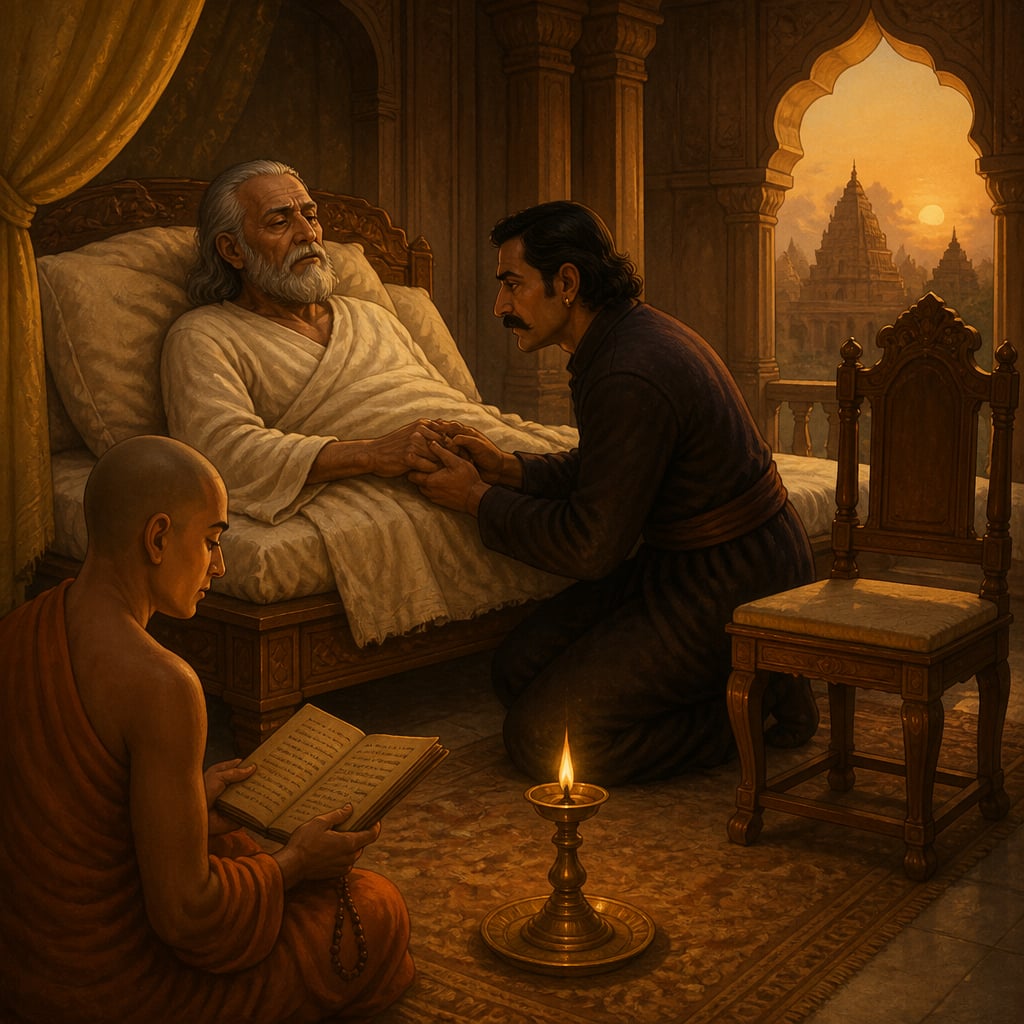
The answer was devastating in its simplicity: No one.
A Life Without Heirs
Harsha had never produced a surviving heir. The sources are unclear on the exact circumstances, whether his children died young, whether he never had sons, or whether some tragedy eliminated potential successors. What we know is that when death approached, there was no designated prince, no clear line of succession, no trained heir ready to assume power.
This was not merely unfortunate. It was catastrophic.
Xuanzang, who had left India only two years before Harsha's death, recorded what he knew of the emperor's family situation:
"The king had no son to carry on his line. Though he had ruled with wisdom for many years, the matter of succession remained unsettled."
For an emperor who planned everything else meticulously, his campaigns, his religious assemblies, his patronage of learning, this failure to secure the succession seems inexplicable. Perhaps he believed he had more time. Perhaps personal tragedy had eliminated his heirs. Perhaps the very completeness of his personal control made delegation seem unnecessary.
Whatever the cause, the result was disaster.
The Death of the Emperor
Harsha died in 647 CE, likely in Kanauj, surrounded by his court but without a successor. The Chinese sources, particularly the Tang Shu (History of the Tang Dynasty), provide the clearest account of what happened next:
"Shiladitya died, and his minister Arjuna seized the throne by force. He executed all of the royal family to eliminate rivals."

The man identified as Arjuna (sometimes called Arunashva) was apparently a minister or general who moved swiftly to fill the power vacuum. His first act was to eliminate anyone with a claim to legitimacy, a bloody purge that destroyed what remained of the Pushyabhuti-Vardhana line.
| Event | Year | Consequence |
|---|---|---|
| Harsha dies without heir | 647 CE | Power vacuum created |
| Arjuna seizes throne | 647 CE | Purge of royal family |
| Chinese embassy arrives | 648 CE | Diplomatic incident follows |
| Embassy attacked | 648 CE | Arjuna antagonizes Tang China |
| Wang Xuance's revenge | 648-649 CE | Arjuna defeated with Tibetan help |
The Chinese Diplomatic Incident
The chaos following Harsha's death caught the Tang Chinese court by surprise. Emperor Taizong had maintained warm relations with Harsha, and a Chinese embassy was already en route when news of the succession crisis arrived.
The embassy, led by Wang Xuance, arrived in India in 648 CE to find not the friendly emperor who had hosted Xuanzang, but a usurper named Arjuna who viewed the Chinese delegation with suspicion. What happened next became a famous incident in Chinese historical records.
Arjuna attacked the Chinese embassy, killing most of the delegation. Wang Xuance escaped with a handful of survivors and fled north to Tibet. There, he convinced the Tibetan king Songtsen Gampo to provide troops for a punitive expedition.

With a combined force of Tibetan and Nepali soldiers, Wang Xuance returned to India, defeated Arjuna's forces, and took the usurper prisoner back to China. This extraordinary episode, a Chinese diplomat raising an army in Tibet to avenge an insult in India, demonstrates the international significance of Harsha's court and the chaos that followed his death.
But Wang Xuance's victory did not restore order. It merely removed one usurper, leaving the underlying problem unsolved.
The Great Fragmentation
With Harsha dead and Arjuna defeated, there was no center holding the empire together. The feudatory kings who had submitted to Harsha's overlordship immediately asserted independence. The careful balance of power that Harsha had maintained through personal authority and military strength collapsed within years.
The map of North India transformed from a unified empire to a patchwork of competing kingdoms:
Bengal and Bihar broke away under regional dynasties. The Later Guptas (unrelated to the imperial Guptas) established themselves in parts of eastern India. Gauda, Harsha's old enemy to the east, re-emerged as an independent power.
Central India fragmented into numerous small kingdoms. The Maitrakas of Valabhi, who had been Harsha's allies, briefly expanded but soon faced their own problems.
Kashmir under the Karkota dynasty became completely independent, beginning its own distinct historical trajectory.
Kanauj itself, Harsha's magnificent capital, became a prize fought over by successive dynasties, the Pratiharas, Palas, and Rashtrakutas would spend two centuries in a triangular struggle for this symbol of imperial legitimacy.
The Chinese pilgrim Yijing, who visited India about thirty years after Harsha's death, found a completely different political landscape:
"The land that was once united under Shiladitya is now divided among many kings, each claiming sovereignty, none possessing true power."
The Succession Failure: Analysis
How could such a capable ruler have failed so completely at succession planning? Several factors deserve consideration:
1. Personal Tragedy Harsha had lost his father and brother within months at age sixteen. His sister Rajyashri, widowed and nearly killed, survived but apparently had no role in succession. Personal loss may have made the subject of succession psychologically difficult.
2. The Feudal System Harsha's empire was not a centralized bureaucratic state but a network of subordinate kings held together by his personal authority. Such systems often struggle with succession because the paramount ruler's power cannot easily be transferred.
3. Overconfidence After forty-one years of successful rule, Harsha may have simply assumed he had more time. Many rulers postpone succession planning, believing the problem will resolve itself.
4. Lack of Collateral Relatives The violent events of 606 CE, the murders and purges that brought Harsha to power, may have eliminated collateral branches of the family who could otherwise have provided heirs.
5. Religious Priorities Harsha's increasing focus on Buddhism and religious patronage in his later years may have distracted from mundane matters like succession. His massive quinquennial assemblies at Prayaga consumed enormous resources and attention.
The Historical Significance
Harsha's death without a successor was not merely a personal or dynastic failure. It marked a turning point in Indian history:
The End of Classical India Historians consider Harsha the last emperor of "classical" India, the last ruler in the tradition of the Mauryas and Guptas who unified the north under a single paramount authority. After him, the concept of a unified northern empire survived only as an aspiration, not a reality.
Five Centuries of Fragmentation From 647 CE until the emergence of Prithviraj Chauhan in the late twelfth century, no ruler succeeded in uniting North India. The Tripartite Struggle between the Pratiharas, Palas, and Rashtrakutas exhausted all three powers without producing a clear winner.
Vulnerability to Invasion The fragmentation following Harsha's death left North India divided and weak precisely when new threats were emerging. The Arab conquest of Sindh in 712 CE, just sixty-five years after Harsha's death, succeeded in part because there was no unified power to resist it.
The Last Hindu Emperor Harsha is often called the "last great Hindu emperor" of unified North India. While this terminology oversimplifies (Harsha himself was more Buddhist than Hindu in his later years), it captures an important truth: no Hindu ruler would control as much of the north until the brief career of Prithviraj Chauhan, and he too would fall, to Turkic invaders.
What Might Have Been
History does not deal in counterfactuals, but we cannot help wondering: What if Harsha had secured the succession?
A unified North India, continuing Harsha's policies of religious tolerance, scholarly patronage, and diplomatic engagement with China and Southeast Asia, might have developed very differently. The technologies, institutions, and cultural achievements of the classical period might have continued to evolve rather than fragmenting.
The Arab invasions might have faced a unified resistance rather than a patchwork of squabbling kingdoms. The eventual Turkish conquests might have been delayed or deflected. India's medieval history might have taken a completely different course.
But this is speculation. What actually happened was fragmentation, weakness, and eventually conquest. Harsha's failure to plan succession cost India dearly.
The Enduring Legacy
Despite the disaster of his death, Harsha left a profound legacy:
The Ideal of Unity Kanauj became a symbol of legitimate imperial authority. For centuries, rulers who captured it claimed the mantle of Harsha's succession. The memory of northern unity under Harsha kept the aspiration alive even when reality fell short.
Cultural Golden Age The patronage Harsha provided to literature, philosophy, and religion produced lasting achievements. Nalanda University continued to flourish for centuries after his death. The Chinese pilgrims he hosted brought Buddhism to East Asia in forms shaped by their Indian experiences.
Administrative Models Harsha's system of governance, the network of tribute relationships, the religious tolerance, the regular assemblies and tours, influenced later Indian rulers. Even those who could not match his achievements studied his methods.
Historical Memory Banabhatta's Harshacharita preserved Harsha's story in vivid detail, ensuring that later generations would know of his achievements. Xuanzang's accounts made him famous across Asia. Harsha became a model against which later rulers were measured.
Leadership Lessons from the End
Harsha's death and its aftermath offer sobering lessons:
Personal excellence is not enough. Harsha was brilliant, energetic, and capable, but these qualities died with him. Without institutional structures or designated successors, even the greatest individual achievements cannot survive their creator.
Succession must be planned. The failure to designate and prepare an heir is the most serious mistake a leader can make. It renders all other achievements temporary. Every leader must ask: "What happens when I am gone?"
Systems outlast individuals. Harsha's empire depended too heavily on his personal authority. A more institutionalized state might have survived his death. The lesson: build systems, not just personal power.
Conclusion: The Last Classical Emperor
When Harshavardhana died in 647 CE, an era died with him. He was the last ruler to sit on a throne that commanded the obedience of the entire north, the last emperor in the classical tradition that began with Chandragupta Maurya a millennium earlier.
His forty-one-year reign represented the final flowering of ancient Indian civilization before its transformation in the medieval period. The religious tolerance, scholarly achievement, international connections, and administrative sophistication of his court would not be matched for centuries.
Yet Harsha's story ends in tragedy. The empire he spent his life building collapsed within years of his death. The dynasty he represented, stretching back through his father and brother, ended with him. The succession he failed to secure became the most consequential failure of his reign.
Personal tragedy forged Harsha into a great leader, the deaths of his father and brother thrust him onto the throne and gave him the burning purpose that drove his early conquests. But personal tragedy also ended his legacy, the absence of an heir ensured that everything he built would crumble.
Even great emperors have limits, Harsha learned this at the Narmada, where Pulakeshin II stopped his southern expansion. But he did not learn the deeper lesson: that his own mortality was the ultimate limit. All the power in the world could not extend his reign beyond his lifespan.
Succession planning is essential, This is perhaps the most important lesson of Harsha's story. All his achievements, the conquests, the cultural patronage, the religious assemblies, the international diplomacy, were rendered temporary by his failure to designate an heir.
Harsha began his reign as a sixteen-year-old boy, grieving and thrust into unwanted responsibility. He ended it as the most powerful ruler in Asia, lord of an empire stretching from Kashmir to Bengal. But between these points lies not just a story of triumph, but a cautionary tale about the fragility of human achievement.
The last classical emperor of India was great. But greatness that cannot be continued is, in the end, greatness that is lost.
As the Sanskrit poets remind us: Kālah sarvam harati, Time takes everything. Even the legacy of emperors.
Historical context
End of Classical India (647 CE and aftermath)
Harsha's death came at a pivotal moment in Asian history. The Arab conquest of Persia was just five years old; the Islamic expansion that would eventually reach India was beginning. A unified North India might have been better positioned to resist these future threats. Instead, the subcontinent entered a period of fragmentation just as new challenges were emerging on the horizon.
Living traditions
Harsha's historical significance is recognized in Indian education, where he is taught as the last great pre-Islamic emperor of North India. The contrast between his achievements and their impermanence serves as a meditation on the fragility of political accomplishments. Academic institutions, particularly in the study of Sanskrit literature and ancient Indian history, continue to engage with texts from his era.
- Kanauj Archaeological Sites: The ancient city that served as Harsha's imperial capital and remained the symbol of legitimate rulership for centuries after his death. Archaeological excavations have revealed layers of habitation, though much of Harsha's city lies beneath later constructions. The perfume industry still flourishes here, a tradition said to date from Harsha's time.
- Nalanda Mahavihara Archaeological Site: The great Buddhist university that Harsha patronized lavishly. It continued to flourish for centuries after his death, outlasting his empire by far. Now a UNESCO World Heritage Site, it represents the cultural legacy that survived when his political legacy did not. The ruins visible today date primarily from the post-Harsha period.
- Triveni Sangam (Prayagraj): The confluence of the Ganges, Yamuna, and mythical Saraswati rivers where Harsha held his famous quinquennial assemblies, distributing wealth accumulated over five years. The tradition of religious gatherings at this site continues to this day, including the Kumbh Mela.
Reflection
- Have you thought about what would happen to your responsibilities, projects, or relationships if you were suddenly unable to continue? What would survive, and what would collapse?
- Why do you think Harsha, despite all his wisdom and planning in other areas, failed so completely at succession planning?
- The Sanskrit saying 'Kalah sarvam harati', Time takes everything, suggests that impermanence is inevitable. If everything is ultimately temporary, does succession planning even matter?